




Summarize with AI

March 6, 2026
5
Min reading
The energy transition will undoubtedly be the biggest challenge of the century. On the SirEnergies blog, we usually present to you the various technological innovations that will play a major role in this company.
Today we are going to talk about what is called Power-to-gas. It is one of the three ways to produce renewable green gas. One of the main obstacles to the use of renewables such as wind turbines is Intermittent production.
Power-to-Gas makes it possible to use Surpluses in electricity production when the network does not necessarily need it for produce gas. It is a way of using the overproduction of renewable production assets.
In this article, we will present to you the principles, maturity and uses of this technology.
To function, the electrical network requires a perfect balance between electricity production and consumption. Wind turbines and solar panels produce when there is wind or sun, so sometimes that time is not necessarily right.
The idea behind Power-to-Gas is to make this operational problem an asset for the energy transition.
It is therefore a question of using carbon-free electricity in order to produce Hydrogen by electrolysis of water. This hydrogen can then be used to produce electricity, or can be stored for later use. Hydrogen can also be mixed with other gases in order to produce “green” gas (because it comes from an energy that does not emit CO2).
The main advantages of Power-to-Gas are:
As we said earlier, Hydrogen is the cornerstone of this system. This energy appears to be the vector, the means of transporting clean energy. The electricity produced can be used in a water electrolysis process to produce hydrogen.
The hydrogen in question can be stored and then used later in its gaseous form or used to produce electricity thanks to A hydrogen fuel cell.
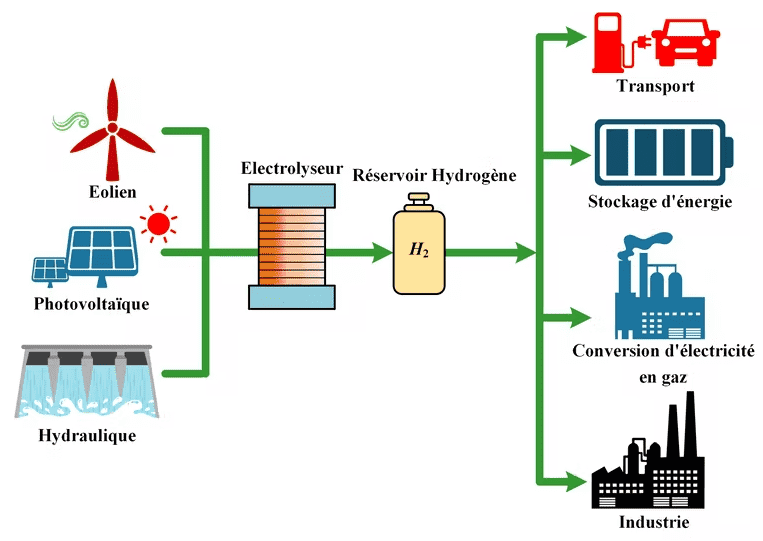
Source: TheConversation.com
It is for these reasons that hydrogen is perceived as a solution for the future. However, it is necessary to see the emergence of a genuine hydrogen industrial fabric in France. There are several initiatives that we will look at later.
One of the limitations of hydrogen electrolysis is installation cost. It is an industrial investment that involves a number of risks and costs inherent in this type of project.
The difficulty of storage is also one of the limits of this energy. Its transport and distribution can also raise safety questions, as hydrogen remains a flammable substance.
This process also raises some criticisms regarding its electricity consumption, which is not entirely renewable. Sometimes it is necessary to compensate for this lack of electricity through the network and therefore, sometimes, through thermal power plants.
The GRHYD project is an acronym for Network Management through Hydrogen Injection to Decarbonize Energies. It's about first major project in the development of hydrogen in France. It was launched in 2014 and is currently managed by ENGIE.
It also has the support of ADEME. The location of this project is located in the urban community of Dunkerque.
This is a project to inject Hythane fuel for mobility purposes as well as hydrogen to heat homes near Dunkerque.
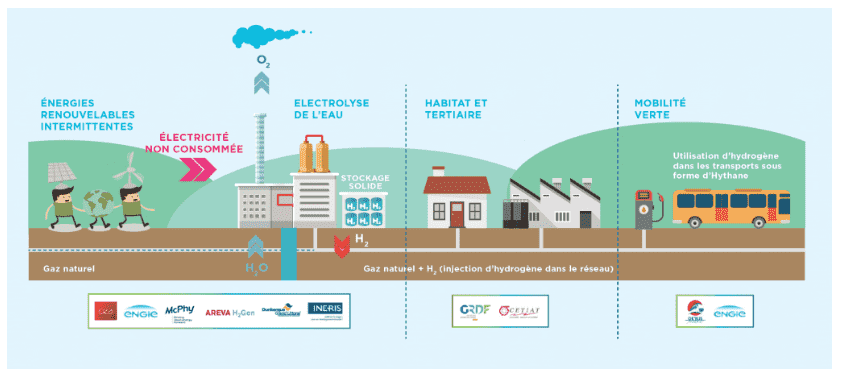
Source: GRDF
The Jupiter 1000 project is also one of the most successful in France. Located in Fos-sur-Mer, this project uses excess electricity to convert it into hydrogen by two electrolysers, but also into synthetic methane using a methanation reactor.
It also has a structure of CO2 capture from neighboring industrial fumes, which reinforces its sustainable aspect. It is located near an important point in the network of RTE And of Teréga/GRTgaz.
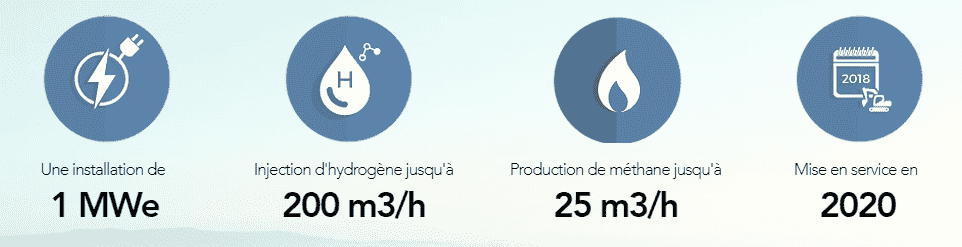
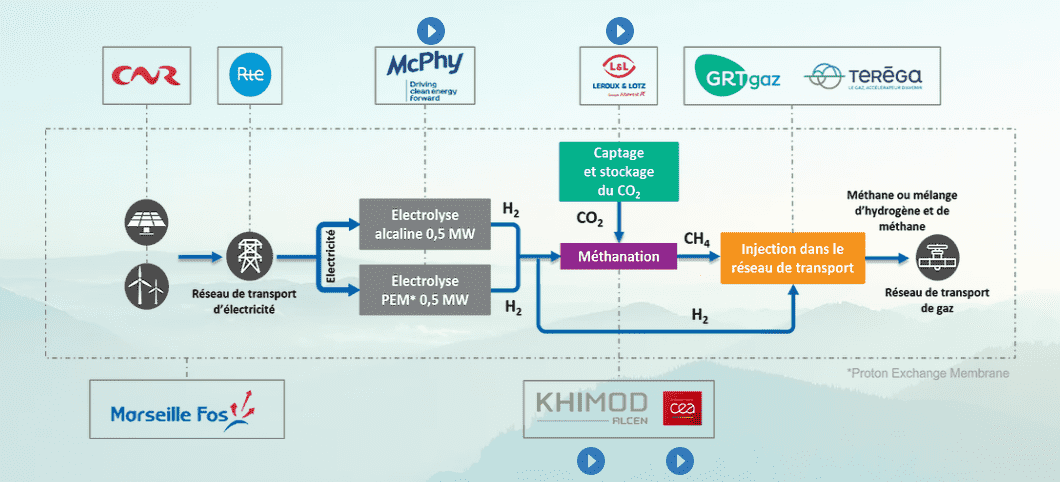
Source: Jupiter1000.eu
Today, there are more than 70 projects identified in Europe, including several industrial demonstrators. For example, there are demonstrators in Hungary, Holland or even Poland.
Power-to-Gas has not yet reached the stage of industrial maturity in any country in Europe or in the world.
But the most advanced country among our European neighbors in the field remains Germany, with numerous large-scale projects. In this respect, we can mention the project. Energiepark Mainz, with a capacity of more than 6 MW, or the project WindGas Falkenhagen which operates 2 MW and has been active since 2013.
This technology is set to be developed thanks to the strong electrification of uses. It is certain that the energy transition and the objective of carbon neutrality require scaling up on this type of technology, the vast majority of which are controlled.
It is also essential to see the public authorities support this type of initiative, such as the transformation of a former coal-fired power plant that was shut down by the group. GazelEnergie in France.
Public subsidies are essential in order to stimulate private investment in these types of cases. The reindustrialization of the site that GazelEnergie is undertaking is an example of a long-term investment.
In a few clicks, organize an exchange with one of our experts.


weekly newsletter subscribers

4.9
