






Summarize with AI

02 August 2026
8
Min reading
Between renewable energy, negative prices, and grid costs, the electricity market is becoming increasingly volatile. Traditional purchasing strategies are no longer enough. The value of electricity now also depends on when it is consumed.
In this context, energy flexibility is becoming a strategic lever. By temporarily adapting their consumption to market and grid signals, businesses can reduce costs, generate revenue, and contribute to the stability of the electrical system.
This adaptability is now accessible to a growing number of companies. Production, refrigeration, electric vehicle charging, storage, or self-consumption: flexibility potential is already present at many sites.
Why has flexibility become essential? What benefits can it generate for a business? And how can it be implemented in practice? Here are our answers.
Key takeaways
Energy flexibility refers to a company's ability to adapt its electricity consumption according to its needs, as well as market and grid signals.
Energy flexibility takes several forms:
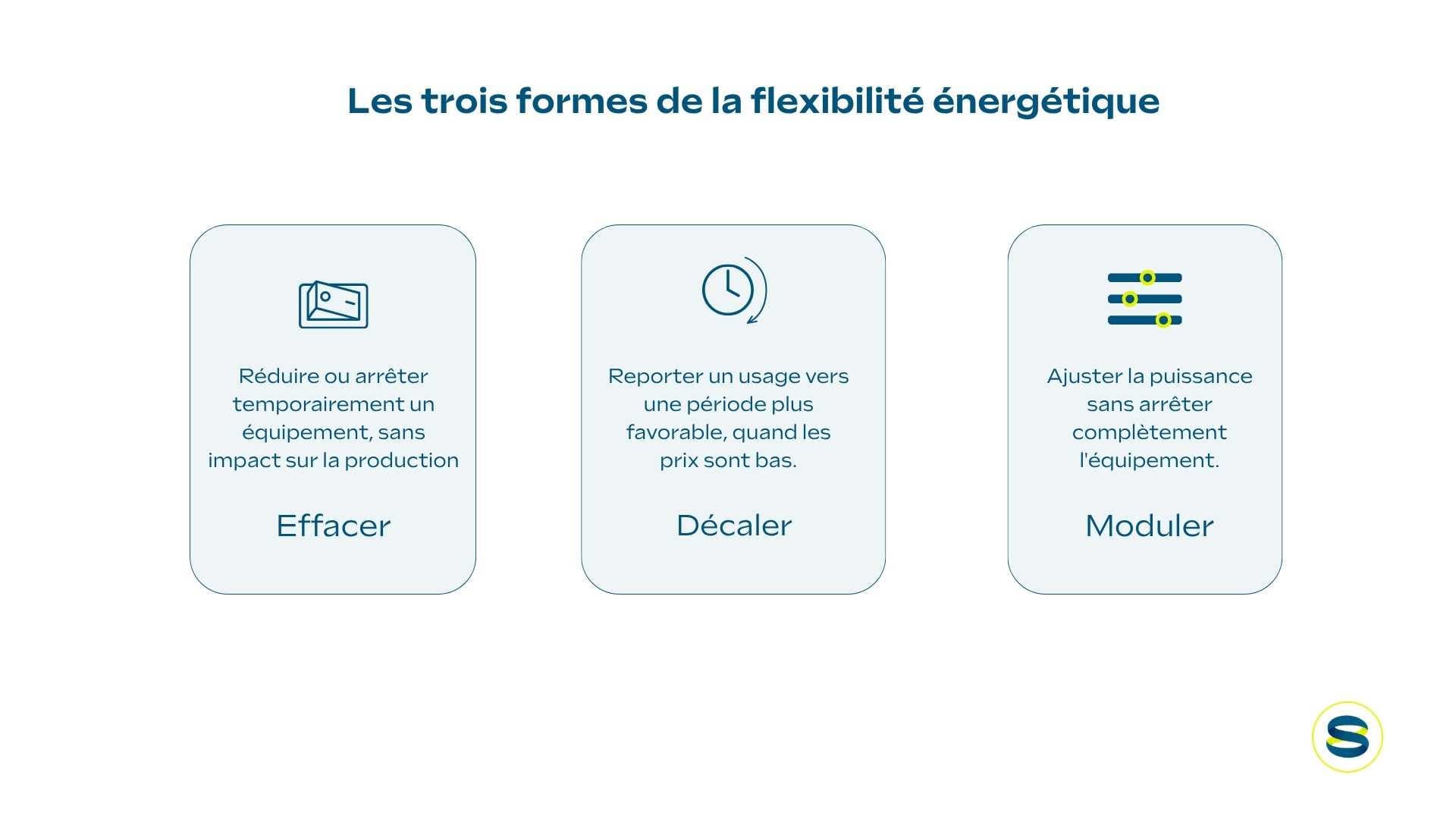
These adjustments can last from a few minutes to several hours, depending on the company's constraints and the needs of the electrical system.
Energy flexibility serves three complementary objectives:
Energy flexibility does not necessarily require heavy investment or complex technologies.
In many companies, equipment is already adjustable. It is therefore not a matter of investing in new flexible capacities, but of identifying and structuring existing sources of flexibilitysuch as:
Looking to identify flexibility potential at your sites and assess your room for maneuver? Our experts are here to help.
{{ask-conseil="/ctas"}}
The electrical system is undergoing a profound transformation. Electricity is becoming an increasingly variable flow, influenced in real time by production, weather, and consumption. Structural imbalances are occurring more frequently, reinforcing the need for energy flexibility to stabilize both the grid and the market.
The rapid rise of renewable energy is changing how the electrical system operates. Electricity production is becoming intermittent, dependent on weather conditions. While very high during sunny or windy periods, it can also drop rapidly. Phases of overproduction and supply tension follow one another, often out of sync with demand.
France is particularly affected. Since 2025, the full availability of the nuclear fleet, combined with the growth of renewable energy, has generated production surpluses. Faced with sluggish domestic demand, these surpluses are exported to neighboring countries. (Learn more about France's electricity export records)
Production variations have a direct impact on electricity prices. When renewable production is abundant and demand is low, prices drop, sometimes even turning negative. Conversely, when production decreases, prices rise again.
These fluctuations are amplified by the merit order. This European mechanism mobilizes production resources based on their marginal cost. Low-cost renewable energies are prioritized. When they are abundant, they drive prices down. During periods of tension, the use of thermal power plants drives prices up.
The result: prices are becoming more volatile and unpredictable.
Energy flexibility addresses these imbalances. By aligning supply and demand in real time, it helps to reduce strain, balance the grid, and stabilize prices.
The challenge now is to consume electricity at the right time—when it is most available, least carbon-intensive, and least expensive.
For France, the stakes are strategic: it is about strengthening its energy sovereignty and decarbonizing by making the most of its local, low-carbon, and competitive electricity, rather than exporting it.
According to the French Energy Regulatory Commission (CRE), demand-side flexibility is one of the essential levers for supporting the increasing integration of renewable energy into the French power system.
Faced with this need for energy flexibility, businesses are becoming a key lever for adjusting the power system. But flexibility is also an opportunity to reduce energy bills and generate additional revenue.
In an increasingly variable power system, the price of electricity now also depends on when it is consumed. Time-based signals are becoming central to energy procurement.
Energy flexibility allows companies to take advantage of this. By shifting certain usage patterns, businesses can lower their supply costs.
The short-term spot markets reward this adjustment capacity:
The Day-Ahead market allows electricity to be purchased the day before for the following day. A company capable of quickly adjusting its needs based on prices reduces its electricity bill.
The Intraday market allows for even finer control, with purchases possible up to 5 minutes before delivery. A company can adapt its consumption and manage its bill in near real-time, depending on production, demand, and prices.
Energy flexibility can serve the grid while also becoming a source of revenue.
By signing up for a demand response program with a specialized operator, a company commits to temporarily reducing its consumption when the grid needs it. In return, it receives compensation.
The value generated depends on many criteria, such as the power that can be mobilized, the company's availability, and its ability to meet its commitments.
The capacity mechanism is the primary mechanism for remunerating flexibility in France. Its 2026 reform increases the economic appeal of flexibility. It improves the targeting of critical periods, with peak period signals concentrated during rush hours (7 a.m.–10 a.m. and 5 p.m.–8 p.m.).
In this context, the value of flexibility increasingly depends on the ability to act at the right time. Companies capable of quickly adjusting their consumption or mobilizing storage are best positioned to take advantage of it.
The Ministry of Ecological Transition establishes demand flexibility as a priority for the Multiannual Energy Program (PPE), in line with decarbonization and energy sovereignty goals.
Manage your energy strategy with real-time market signals. Discover Pilott, our energy management platform.
{{ask-pilott="/ctas"}}
Energy flexibility is not just for large industrial sites. Many companies already have room to maneuver. The challenge is to identify controllable usage and activate it at the right time.
Comparison table of the 4 energy flexibility levers
The first way to gain flexibility is also the simplest and least expensive: shifting energy-intensive usage to periods when electricity is most abundant and least expensive.
The off-peak hour reform is part of this logic. By introducing afternoon off-peak hours, it encourages consumption during peak solar production times.
These adjustments help reduce electricity bills without significant investment, through changes in practices or control tools.
When production constraints allow, a company can monetize its flexibility by signing a demand response contract with a specialized operator (aggregator).
Analyzing the load profile helps identify usage that can be reduced or interrupted temporarily without impacting operations. These capacities are then monetized by an operator through a customized contract.
Battery storage allows you to use electricity when it is most useful, rather than just when it is produced or purchased.
In practical terms, energy is stored when prices are low and production is abundant, then consumed when prices or needs increase.
This strategy reduces exposure to market prices while providing more flexibility to the electrical system.
However, it requires an initial investment whose profitability must be evaluated. The return on investment must take into account the savings made on electricity purchases, the revenue generated by demand response, and the reduction in peak power demand.
Photovoltaic installations are also a lever for flexibility. The focus should not be solely on electricity production; its usage must also be optimized based on market conditions.
The logic remains the same: prioritize self-consumption when market prices are high, and store electricity when prices are low.
Thanks to our energy management platform Pilott, analyze your consumption and track market prices daily to capitalize on your energy flexibility.
{{ask-pilott="/ctas"}}
The rise of renewable energy is profoundly changing the rules of the electrical system and energy procurement. With increasingly variable production, the value of electricity no longer depends solely on the volumes consumed, but also on when it is consumed.
For businesses, this demand for energy flexibility is also an economic opportunity. Adapting consumption allows you to both reduce costs and create value.
Electricity is no longer just an expense item; it is a controllable and valuable resource. Companies capable of consuming at the right time will have a lasting competitive advantage.
With the experts at Sirenergies, identify your potential for flexibility, optimize your bill, and manage your consumption and purchasing over the long term.
{{ask-conseil="/ctas"}}
In a few clicks, organize an exchange with one of our experts.


weekly newsletter subscribers

4.9
