




Summarize with AI

March 6, 2026
7
Min reading

After several years of turmoil on the energy markets, the year 2026 is beginning with a paradoxical situation.
While wholesale electricity prices are generally on the decline, energy bills However, they continue to weigh on business budgets.
This discrepancy reflects a profound transformation of the French energy system. The end of ARENH changes the rules of the game, with prices now exposed to the market.
The evolution of your energy bill in 2026 will mainly depend on your contract and your consumption profile.
Good news: you can take action today.
Anticipating, negotiating and optimizing your energy budget is possible thanks to concrete and accessible levers.
Sirenergies gives you the keys to take back control of your energy bill in 2026.
December 31, 2025 marked the end ofARENH (Regulated Access to Historic Nuclear Electricity).
This mechanism contributed to stabilizing bills, by allowing alternative suppliers to buy part of EDF's nuclear electricity at a regulated price (€42/MWh).
Since the 1Er January, ARENH is replaced by two new devices :
With the end of ARENH, We go from a controlled price in advance to a market price adjusted afterwards.
UNV aims to protect consumers from excessive increases.
Concretely:
According to the public authorities, “in view of the low prices of French carbon-free energy on wholesale markets”, UNV is not expected to be activated in 2026.
No impact is expected for consumers with regulated sales rates or who have subscribed to offers indexed to the TRV.
While these announcements are intended to be reassuring for 2026, the backing of TRV to the market requires vigilance.
For market offers, uncertainty prevails.
Emmanuelle Wargon, president of the Commission for Energy Regulation (CRE) believes that he is:
“almost impossible to calculate an average evolution”.
The impact will depend on the date the contract was taken out and the consumption profile.
There is only one solution to protect yourself: Follow the markets, compare offers, (re) negotiate contracts and adjust its purchasing strategy.
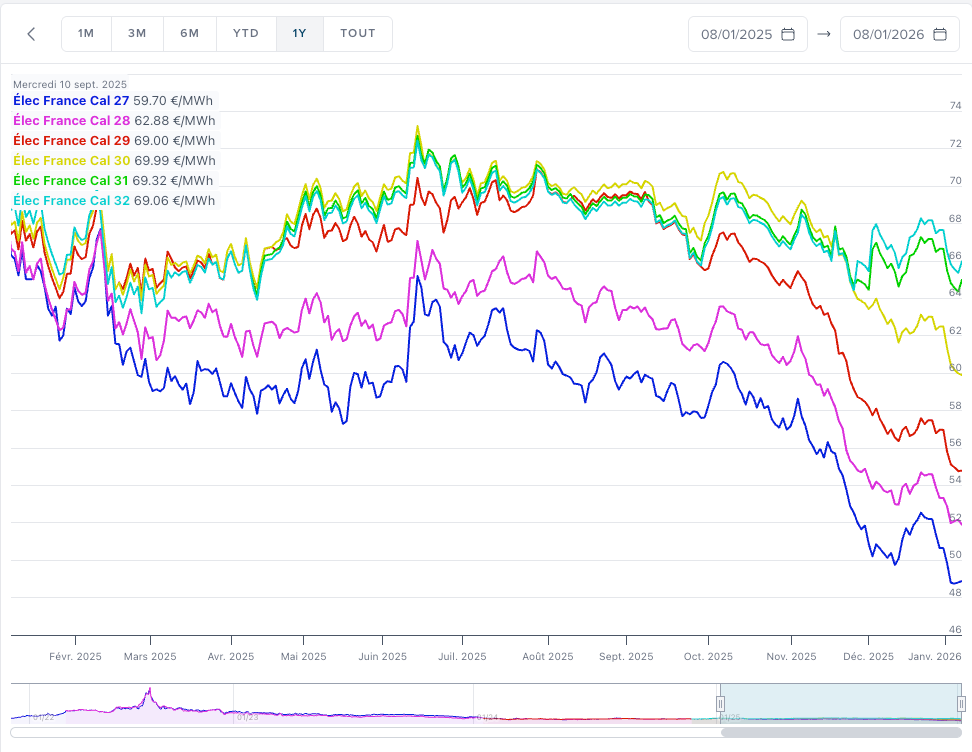
Currently, the forecasts of Baseload electricity prices for 2026 stabilize between 58 and 70 €/MWh. This wholesale rate is dictated by the end of the mechanism ARENH, the performance level of the Nuclear park French, as well as the evolution of the prices of gasses and quotas of CO2.
The rise of renewable energies also plays a key role in this price balance.
Entered into force on 1Er August 2025 for four years, the TURPE 7 (tariff for the use of public electricity networks) Is the main driver of structural increases in bills, regardless of the price per kWh.
The strong increase observed in 2025 (+ 7.7%) should make it possible to:
The next evolution is expected on 1Er August 2026.
The increase is expected to follow inflation, unless the regulatory course changes.
At 1Er February 2026, the excise duty on electricity — including the former TICFE — should Increase mechanically with indexing.
Excluding the 2026 Finance Act, the rates should change as follows, including the ZNI increase to finance tariff equalisation in non-interconnected areas:
Source: Bofip government taxes
The 2026 finance bill proposes the gradual reduction of normal electricity rates by €0.9/MWh over two years (including €0.5/MWh from 2026).
A Senate amendment proposes to reduce individual excise duties by €3/MWh and corporate excise duties by €0.42/MWh.
On January 3, 2027, Roland Lescure, Minister of the Economy, made a surprise announcement: the 25% decrease in the Delivery Rate Contribution (CTA) on electricity bills. Applied to the subscription, this tax finances the pension plan for the electricity and gas industries.
This decrease will be progressive, at a rate of 5% per year Starting on 1Er February 2026.
However, the reduction in the energy bill remains modest. Estimated at around ten euros per year for a household, it could go up to 200 euros per year for a baker.
The electrification of uses is a priority for France. This orientation is directly reflected in the gas bill.
Despite the fall in wholesale prices on the market, the bill continued to increase in 2026, due to regulated taxes and costs:
An electricity bill is divided into three blocks:
.png)
You can act on these three components. It's not just the price that's negotiable.
To reduce your energy bill, you can:
Electricity contracts also hide hidden costs, all negotiable :
Looking to reduce your 2026 electricity bill?
With Sirenergies, analyze your contracts and invoices, identify the most efficient optimization levers and secure your post-ARENH energy budget.
{{ask-invoice=” /ctas "}}
Beyond contracts, reducing your electricity consumption remains the most effective lever. Cumulative solutions exist for all budgets:
Regulatory reminder: the Tertiary decree requires companies and communities with more than 1,000 m² of tertiary buildings to reduce their consumption by 40% in 2030, 50% in 2040 and 60% in 2050.
In 2026, electricity switched to greater dependence on markets. This transformation reduces budget visibility, with more unpredictable energy bills.
Faced with this new situation, anticipating your contracts, controlling your consumption and managing your energy are no longer options: they are strategic imperatives.
With Sirenergies, negotiate, optimize and secure your 2026 budget. Stop having to pay your electricity bill. Let's reduce it together.
{{ask-rdv=” /ctas "}}
In a few clicks, organize an exchange with one of our experts.


weekly newsletter subscribers

4.9

.png)

The subscribed power must be calculated according to the consumption profile and uses (heating, industrial processes, tertiary equipment). One fine analysis makes it possible to ensure the adequacy between real need and contract.
This makes it possible to choose the right time to contract, secure your budgets and anticipate increases.
Changing suppliers can allow you to benefit from more competitive prices, adapted services or better contractual conditions. Thanks to sourcing, change is happening without interruption of supply.
L'ARENH est remplacé par le VNU (Versement Nucléaire Universel), un mécanisme de redistribution des revenus excédentaires d'EDF en cas de prix très élevés, et par les CAPN, des contrats long terme pour les gros industriels.
Sourcing consists in identifying and analysing the offers of several electricity and gas suppliers. This approach makes it possible to obtain contracts adapted to the consumption profile and budgetary constraints of the company.
En 2026, les principaux leviers sont : la renégociation de votre contrat de fourniture au bon moment, l'optimisation de votre tarif d'acheminement (TURPE), la vérification de votre éligibilité aux taux réduits de taxes (Accise), et la réduction de votre consommation (efficacité énergétique, autoconsommation).
Industrial companies consume large volumes of energy for their production processes. They have to deal with the volatility of prizes, multi-site management and specific taxes. Controlling costs is essential to remain competitive.
Among the taxes include TICFE, TICGN, CTA, CJA and TURPE. They represent a significant part of the bill and vary according to consumption profiles. Understanding them well is essential to optimize costs.
The €/MWh is a price unit used in wholesale markets, while kWh is the unit visible on your bills.
Communities are subject to taxes such as TICFE or TICGN. Sirenergies analyzes invoices, identifies exemption possibilities and fixes possible errors to reduce the tax burden.
Some businesses may obtain a partial or total exemption from the TICFE or the TICGN, depending on their activity and energy intensity. The support of an expert makes it possible to identify the eligibility criteria and to put together the file.
Tertiary companies must manage their energy costs while guaranteeing the comfort of users (offices, shops, services). Consumption is often linked to heating, air conditioning and lighting, which requires precise monitoring to avoid budgetary excesses.
Farms must deal with high seasonal needs (greenhouse heating, irrigation, storage) and high volatility of prizes. Controlling these costs is essential to maintain profitability and secure the business.
En analysant votre courbe de charge pour identifier la puissance réelle appelée, puis en demandant un ajustement à votre fournisseur ou via un expert en énergie.
All businesses, from SMEs to large organizations, can benefit from this service. Les local authorities also find it a lever to better control their budgets.
C'est le levier le plus rapide pour obtenir des résultats visibles. L'éclairage représente environ 40 % de la consommation d'électricité d'une commune.
Passer au LED avec pilotage intelligent permet de réduire la facture de 50 à 80 %, avec un retour sur investissement (ROI) rapide, souvent estimé à 2 ou 3 ans.
Le dispositif ARENH a laissé place au VNU (Versement Nucléaire Universel).
Ce changement structurel expose davantage les entreprises aux prix de gros, rendant la gestion des risques plus complexe qu'auparavant.
Il devient alors indispensable de définir une stratégie d'achat d'électricité avec Sirenergies pour lisser l'impact de la volatilité des marchés sur votre budget.
One invoice consists of several elements: consumption, supplier share, taxes and contributions. The analysis of each line makes it possible to identify possible errors and to check the consistency with the signed contract.
Sourcing offers better visibility on the market and promotes the selection of competitive contracts. It helps to reduce the risks associated with price volatility and to optimize the energy budget.
Idéalement entre 6 et 12 mois avant l'échéance, de préférence au printemps ou au début de l'été lorsque la demande est plus faible.
Farms are subject to taxes such as TICFE or TICGN. Sirenergies verifies their application, identifies cases of exemption and accompanies the procedures to reduce the tax burden.
Les coopératives de taille ETI ou grande entreprise peuvent être soumises à l'audit énergétique réglementaire (norme NF EN 16247). Sirenergies n'a ni la compétence ni l'accréditation pour réaliser cet audit : nous vous orientons vers un bureau d'études partenaire accrédité, et vous accompagnons en amont sur vos achats et en aval sur le pilotage.
Plusieurs leviers existent pour préserver la fiscalité locale :
La réussite d'un projet collectif énergie repose sur trois piliers fondamentaux :
Exceeding capacity leads to financial penalties and can impact the size of the contract. Adjust the correctly subscribed power makes it possible to avoid these additional costs.
The industry is concerned by TICFE, TICGN and other contributions that may represent an important part of invoices. Sirenergies identifies cases of exemption and accompanies the procedures to benefit from them.
Même le bâtiment le plus moderne et le mieux isolé perd son efficacité si ses usages sont inadaptés. La technologie et les normes ne suffisent pas : la transition énergétique est avant tout une transformation humaine.
Derrière chaque kilowattheure consommé se cache une habitude.
Un collaborateur sensibilisé comprend qu'ouvrir une fenêtre alors que le chauffage est allumé ou laisser un ordinateur en veille consomme de l'énergie inutilement. En replaçant l'humain au centre de la stratégie de gestion de l'énergie, l'entreprise s'assure que ses équipements performants sont utilisés de manière optimale, garantissant ainsi une rentabilité durable et un impact environnemental réduit.
Les profits include a direct reduction in bills, strengthened budgetary forecasting and better control of consumption. Businesses gain visibility and efficiency thanks to adapted tools.
Tertiary companies are concerned by taxes such as TICFE or TICGN. Sirenergies checks the accuracy of invoices, identifies possible exemptions, and helps correct errors to sustainably reduce costs.
Un appel d’offres permet de mettre en concurrence plusieurs fournisseurs d’électricité et de gaz afin d’obtenir des conditions contractuelles optimisées. C’est une démarche transparente qui permet de choisir l’offre la plus adaptée aux besoins budgétaires et techniques de l’organisation.
Le calendrier 2026 impose deux échéances majeures :
Pour simplifier ces démarches, vous pouvez centraliser vos données de consommation avec la plateforme Pilott de Sirenergies, garantissant ainsi la conformité de vos rapports réglementaires.
Pas nécessairement sur votre facture finale. Si les prix de gros (le prix de l'énergie brute) ont baissé, les coûts d'acheminement (TURPE) et certaines taxes augmentent, compensant souvent la baisse de la part énergie.

En 2026, les principaux leviers sont : la renégociation de votre contrat de fourniture au bon moment, l'optimisation de votre tarif d'acheminement (TURPE), la vérification de votre éligibilité aux taux réduits de taxes (Accise), et la réduction de votre consommation (efficacité énergétique, autoconsommation).
Pas nécessairement sur votre facture finale. Si les prix de gros (le prix de l'énergie brute) ont baissé, les coûts d'acheminement (TURPE) et certaines taxes augmentent, compensant souvent la baisse de la part énergie.
L'ARENH est remplacé par le VNU (Versement Nucléaire Universel), un mécanisme de redistribution des revenus excédentaires d'EDF en cas de prix très élevés, et par les CAPN, des contrats long terme pour les gros industriels.