






Summarize with AI

October 29, 2026
7
Min reading

Since February 2026, the blockade of the Strait of Hormuz has triggered a new shockwave in energy markets. Gas prices have soared, driving electricity prices up in their wake.
This latest episode highlights a structural reality: as long as the price of electricity remains linked to the price of gas, no economy is safe from geopolitical crises.
One response is essential: accelerating the transition to renewable energy. Following the 2022 crisis, the conflict in the Middle East confirms that renewable energy can play a key role in cushioning energy shocks—not only for nations, but for your business as well.
Renewable energy is the primary lever for protecting businesses against the energy price volatility caused by geopolitical crises. By reducing reliance on gas in the electricity mix, solar, wind, and PPAs help smooth out costs and secure budgets over the long term.
Fuel, gas, electricity... No country is immune to the price spikes caused by the conflict in the Middle East. Despite its low dependence on gas from Iran and the Arabian Peninsula, Europe is also affected.
The Strait of Hormuz is the primary trigger for the energy crisis at the start of 2026.
Brought to prominence by the war in the Middle East, this maritime corridor is a strategic chokepoint for global hydrocarbon trade. Every day, it handles:
In the absence of alternatives capable of absorbing such volumes, its closure immediately unbalanced global supply. In just a few weeks, fossil fuel prices jumped by more than 40%.
Even though Europe only imports about 7% of its LNG through the strait, it is not spared. In a globalized market, price increases are passed on to the bills of all consumers.
The rise does not only affect fuel and gas: the price of electricity follows the same trend. This is explained by the functioning of the European market, which is based on the merit order principle.
To meet demand, production methods are mobilized from cheapest to most expensive. The price of electricity is determined by the marginal cost of the last power plant called upon, which is generally a gas-fired plant.
The result: the price of electricity does not reflect the production cost of the national energy mix. Even low-cost electricity is sold at the price of gas as soon as it is needed to balance the system. When gas prices rise, electricity prices follow suit...
Are you struggling to understand the impact of the crisis on your energy contracts? Our experts can analyze your situation and provide you with a clear assessment.
{{ask-conseil="/ctas"}}
The conflict in the Middle East demonstrates it clearly: renewable energies are a key lever for reducing electricity's dependence on gas and limiting exposure to geopolitical shocks.
Renewable energies play a dual and essential role in energy resilience:
The consequence is mechanical: the less gas is used, the less it influences the price of electricity. In other words, the higher the share of renewables, the more the economy is protected from the volatility of fossil fuel markets.
This dynamic has been at work in Europe since the 2022 energy crisis. As early as May, the European Union launched the RePowerEUplan, structured around three pillars:
The initial effects are now visible. For the first time, according to the report from the energy think tank Ember, wind and solar power generated more electricity in Europe in 2025 than fossil fuels. Renewables now account for nearly half of the European energy mix (47.7%, or 1,331 TWh).
In terms of consumption, the results are also clear. Gas demand in Europe has fallen by 20% over the past three years.
Europe's energy independence is growing... but the war in the Middle East serves as a reminder that it remains vulnerable and must redouble its efforts.

The war in the Middle East concretely demonstrates two trends: economies dependent on fossil fuels are the most vulnerable; conversely, countries that have invested in renewable energy are better able to cushion the shock.
The crisis in the Middle East highlights a fact that is already measurable: renewable energy not only reduces dependence on gas and geopolitical constraints, but also lowers the global energy bill.
Published in March 2026, the Ember report reveals that, since February 28, 2026,
"existing wind and solar capacity worldwide has made it possible toavoid generating 330 TWh of electricity from gas, representing a potential saving of more than 40 billion dollars."
Globally, Ember estimates that one-seventh of the world's gas production could be replaced by existing solar and wind capacity.
In Europe, Spain illustrates this dynamic. The country is navigating the energy crisis with a more controlled electricity bill than its neighbors. The reason: massive investments in renewable energy.
In 2025, the Iberian Peninsula generated 55.5% of its electricity from wind, solar, and hydroelectric power.
Today, gas is used less frequently to balance the system, and therefore influence prices.
"We only need gas on the market about 15% of the time, compared to 90% in Italy or 40% in Germany,"
explains José Maria González Moya, director of the Spanish Association of Renewable Energy Companies,
According to Ember, this structural decoupling between gas and electricity prices has reduced the influence of fossil fuels on electricity prices by 75% since 2019.
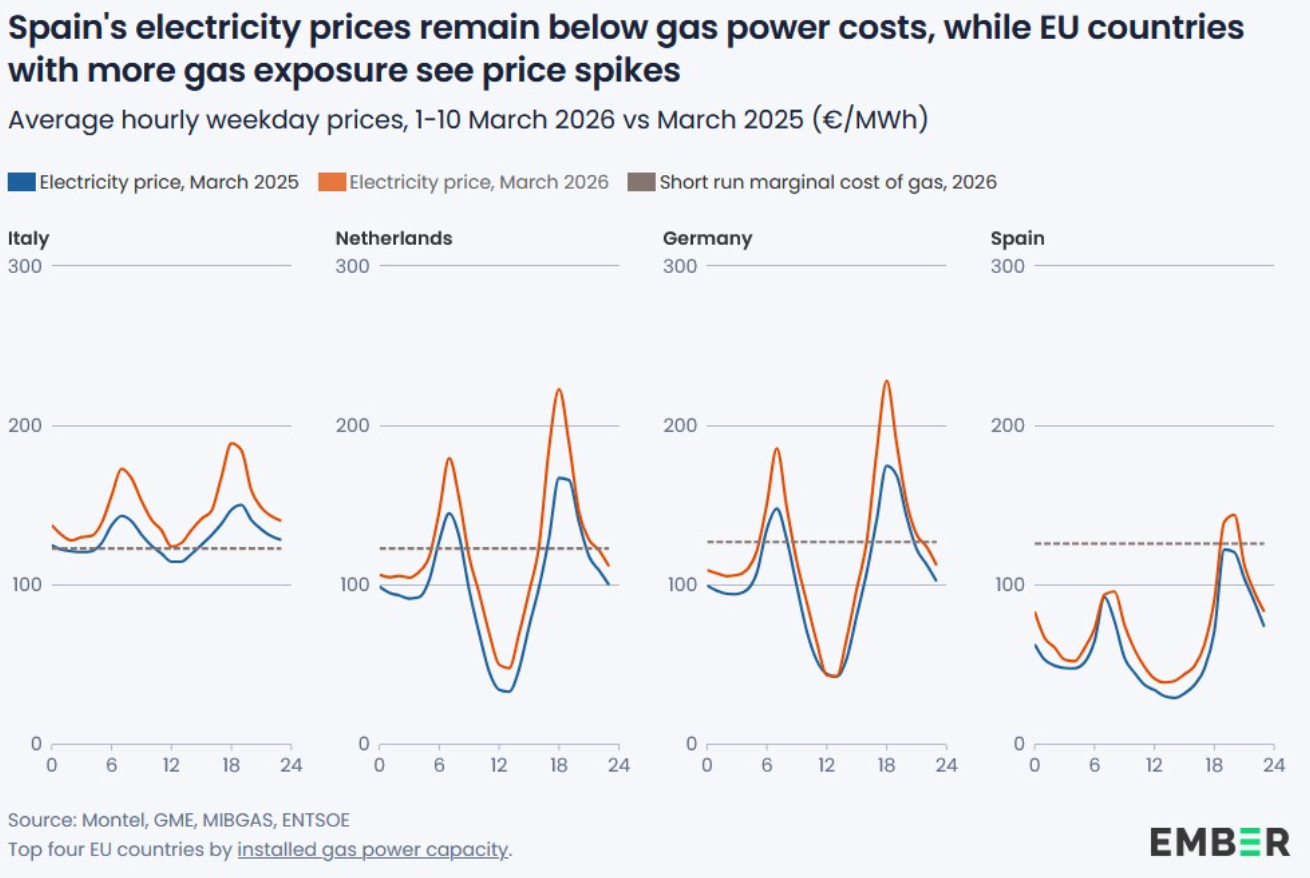
For a company, the logic is the same as at the national level: the higher the share of renewable energy, the less the business is exposed to fluctuations in gas and oil prices.
Several levers exist to accelerate your energy transition today.
Solar self-consumption allows your company to regain control of its energy bill.
By installing photovoltaic panels on your roofs or parking lots, you reap multiple benefits:
A Power Purchase Agreement (PPA) allows you to purchase renewable electricity over the long term directly from a green energy producer.
This type of contract allows you to:
Looking to secure your electricity costs for the long term? With Sirenergies, negotiate and structure your contracts to pay the right price for your energy.
"From the very first year, we saved almost 20% compared to the initial budget of the new contract. We had a budget of €600,000 with the new contract, and thanks to the optimization, we brought our all-inclusive electricity costs down to €450,000." - François Cordier, CEO, Pom'Ligne Services used: consulting, sourcing, Pilott
Discover our client testimonials →
{{ask-sourcing="/ctas"}}
Energy Savings Certificates are a powerful financial lever to support investments in renewable energy or energy efficiency. They can be used to help fund the installation of a heat pump or a geothermal system.
These bonuses paid by energy suppliers help to:
Dependence on fossil fuels is also a dependence on geopolitical crises. The conflict in the Middle East is a reminder of this.
Faced with this reality, renewable energies offer a more resilient alternative: local, carbon-free, and predictable energy that allows you to control costs, reduce exposure to international markets, and gain autonomy.
Just like in 2022, this crisis could act as an accelerator. The signs are already there. For Fatih Birol, Executive Director of the International Energy Agency (IEA), the momentum is underway. He anticipates an accelerated shift toward renewables in the coming months.
For businesses, the challenge is no longer just environmental. It is economic and strategic.
Do you want to reduce your exposure to rising energy prices? The experts at Sirenergies can advise you on how to reduce your electricity and gas bills.
{{ask-rdv="/ctas"}}
In a few clicks, organize an exchange with one of our experts.


weekly newsletter subscribers

4.9
