







Summarize with AI

November 10, 2026
5
Min reading

As of April 1, 2026, gas transmission tariffs are changing once again. The ATRT 8 is rising by 3.41%. While this increase remains contained, it has a direct impact on corporate gas bills.
After several years of high volatility in commodity prices, infrastructure costs are taking up an increasing share of the bill. In the background, the energy transition and decarbonization are driving new investment needs in gas transmission networks.
In a context where controlling energy costs has become a strategic priority, this development raises practical questions: what is the impact on your business gas bill? Which profiles are most exposed? How can you anticipate and manage this increase?
Sirenergies breaks down the changes to the ATRT 8 and the strategies for regaining control over your gas budget.
The ATRT 8 is increasing by 3.41% as of April 1, 2026, driven by inflation (+0.41%) and a CRCP regularization (+3%). Transmission tariffs account for an average of 5% of a business gas bill. The estimated overall impact on the total bill ranges from +0.2% to +1%, depending on the consumption profile.
Key takeaways
The ATRT is an essential component of the price of gas, just like the supply (the commodity itself) and taxes.
ATRT stands for "Accès des Tiers aux Réseaux de Transport" (Third-Party Access to Transmission Networks). This transmission tariff funds the operation, maintenance, and development of gas transmission networks managed by NaTran (formerly GRTgaz) and Téréga.
Set by the French Energy Regulatory Commission (CRE) for four-year periods, this regulated tariff is revised every year on April 1.
The ATRT 8 came into effect in 2024. After a decrease in 2025, it is rising again in 2026. It is no longer just the price of the commodity that causes the bill to fluctuate: the structure of network costs is playing an increasingly significant role.
The increase in the ATRT in 2026 is due to changes in tariff mechanisms and the profound transformations of the gas system in France.
In its deliberation of December 16, 2025the CRE has approved a 3.41% increase in ATRT 8 tariff terms. This change is due to two factors:
Beyond tariff adjustments, the rise in ATRT 8 reflects fundamental structural changes.
Decline in gas consumption: a direct impact on the transmission tariff
For several years, natural gas consumption has been declining in France. After a 5.2% drop in 2024, NaTran observed a further 3% decrease in 2025.
The cause: energy conservation efforts, driven by rising energy prices and environmental concerns.
With lower volumes being transported, fixed operating costs are spread across a smaller base.
Result: the unit cost of transmission increases for every consumer.
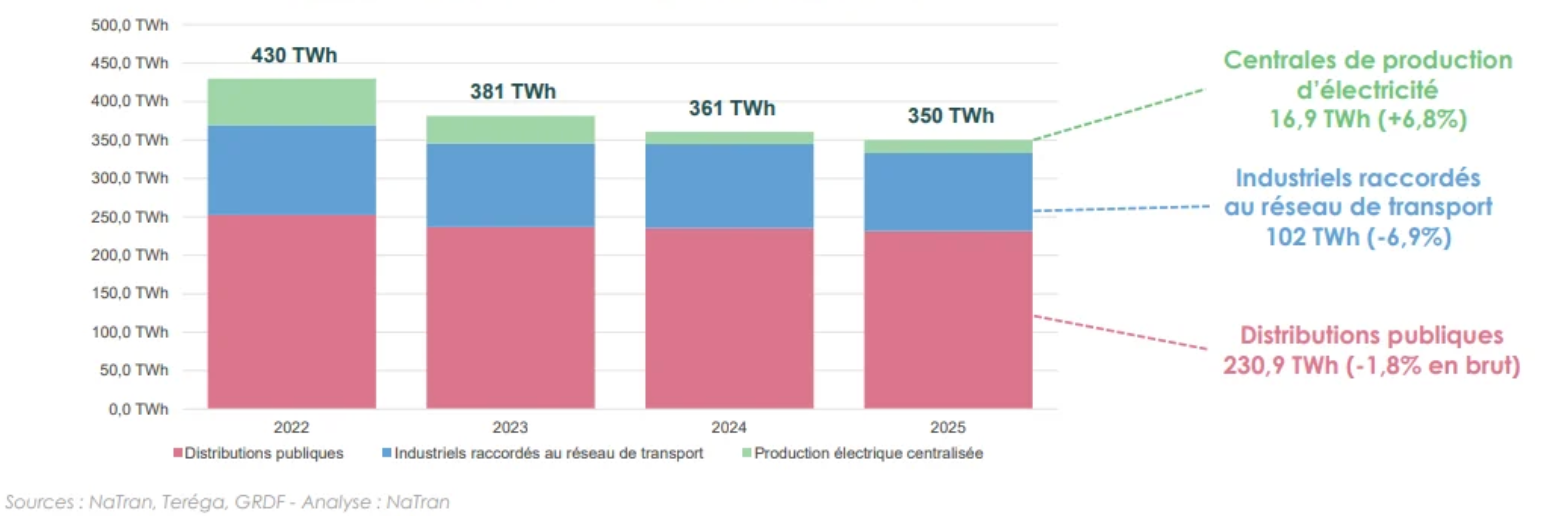
Source: NaTran, Téréga, GRDF - chart: connaissance des énergies
Energy transition: investments weighing on the ATRT
The increase in the ATRT is part of the ongoing transformation of the gas system. Network operators are accelerating the adaptation of infrastructure to meet energy challenges, with a focus on the decarbonization of professional and domestic usage. This involves, in particular, the development of low-carbon gases, such as biomethane and hydrogen. High investment costs are passed on to the transmission tariff.
The transport tariff accounts for an average of 5% of a professional gas bill. This share remains modest compared to other components: supply accounts for nearly 50% and taxes for 25%.
The 3.41% increase in the ATRT therefore has a measured impact on the gas budget, estimated between +0.2% and +1% depending on the consumption profile and subscribed transport capacities.
To adjust your subscribed capacities in real time and avoid extra costs related to the ATRT, test our management interface.
{{ask-pilott="/ctas"}}
The ATRT consists of both fixed and variable costs. Fixed costs are linked to the operation and maintenance of transport infrastructure; variable costs depend on the volumes of gas transported.
The actual impact of the increase in the transport tariff varies primarily based on subscribed capacities and contractual parameters. The estimates below provide orders of magnitude, based on the average share of the ATRT in professional bills and generally observed consumption structures.
Table 1 — Impact of the 2026 ATRT 8 increase by gas consumption profile
The regulatory increase in the ATRT does not, on its own, drastically change the total cost of a gas contract. Like any expense item, this tariff must be taken into account when comparing offers. There are ways to optimize the amount.
The ATRT is directly linked to the capacities reserved on the transport network. Oversizing generates unnecessary costs; conversely, underestimating can lead to penalties or adjustments.
An energy management tool, such as Pilott, allows you to visualize your consumption profile over time and adjust transport capacities as accurately as possible. This lever is particularly effective for large T3 and T4 consumers: for them, capacity optimization often has a significant financial impact.
A professional gas bill consists of three elements:
While consumers are subject to changes in transport tariffs, taxes, and contributions, purchasing the molecule at the best price can partially offset regulatory increases. Monitoring market prices is crucial for identifying the most favorable purchasing windows.
Choosing a gas supplier is about more than just the price of the commodity. Other factors influence your final bill: the contract structure, the quality of service, and the relevance of the advice provided.
Tailored support allows you to:
"Thanks to Sirenergies, I reduced my energy bill by more than 20% without changing my habits." — Bruno SKRZYPINSKI, Manager, VIVAL (SME) Discover the full testimonials from our clients
The ATRT 8 increase on April 1, 2026, is a regulatory requirement. An increase in your business gas bill is not. The impact of transmission tariffs can be managed by combining:
The expertise of an energy procurement consulting firm is the most effective lever for quickly identifying concrete and sustainable optimization opportunities.
{{ask-conseil="/ctas"}}
Benefit from a bespoke purchasing strategy to offset regulatory changes and secure your gas budget.
In a few clicks, organize an exchange with one of our experts.


weekly newsletter subscribers

4.9
