





Summarize with AI

October 28, 2026
9
Min reading
France is facing a concerning delay in the electrification of its energy usage.
Fossil fuels continue to dominate. They still account for more than half of final energy consumption, which contradicts the trajectory toward energy transition and carbon neutrality.
Yet, France possesses a major asset: electricity produced locally and largely decarbonized, thanks to nuclear power and renewable energy sources.
According to RTE, reaching climate goals requires doubling the pace of electrification. The ambition is clear: increase electricity consumption by 40% by 2050.
With the new multiannual energy program (PPE 3) and the upcoming national electrification plan, France intends to accelerate this shift.
Businesses are on the front lines.
Should you electrify your operations today? Why would waiting be a strategic mistake? How can you successfully implement this electrical transition?
Sirenergies is here to guide you.
France is currently facing an energy paradox: the country is producing more and more electricity, but its consumption is not increasing.
This stagnation is concerning. To achieve carbon neutrality, the electrification of energy usage must accelerate.
RTE's electricity report confirms the imbalance between production and consumption.
In 2025, French electricity production reached 547.5 terawatt-hours (TWh), an increase of 1.5% compared to 2024.
At the same time, national electricity consumption has stabilized at 451 TWh (+0.4% in one year). It remains 6% lower than the average consumption observed between 2014 and 2019.
This trend reflects France's lag in the electrification of transport, buildings, and industry.
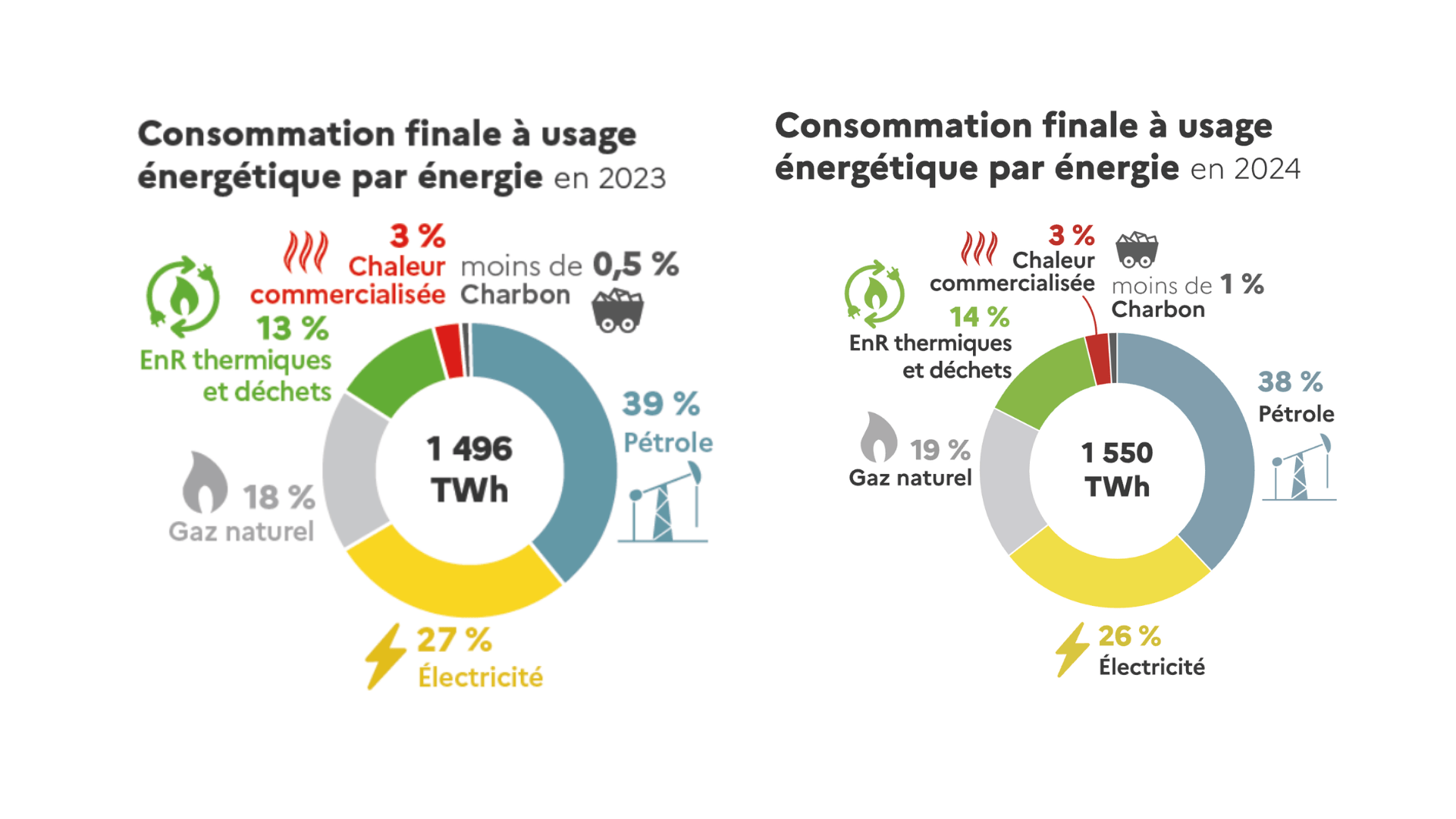
In 2024, electricity accounted for 26% of final energy consumption. This proportion is down one percentage point compared to 2023 (27%). With a 56% share, oil and natural gas remain the primary energy sources.
For France, the reality is sobering: energy sobriety and efficiency efforts by households and businesses are primarily targeting electricity consumption. The result: it is falling faster than that of fossil fuels. Yet, the energy transition and decarbonization require the exact opposite.
France therefore finds itself in a paradoxical situation:
The delay in electrification goes beyond just energy issues.
It raises broader concerns regarding energy sovereignty, economic stability, and the fight against climate change.
Dependence on oil and natural gas makes France vulnerable to international crises.
The war in the Middle East illustrates this once again. As soon as the global balance is disrupted, European countries immediately suffer the consequences in terms of energy supply and prices.
In this unstable context, accelerating the electrification of usage is more strategic than ever to:
{{ask-demo="/ctas"}}
Electrifying usage would also help stabilize energy costs.
During times of crisis, electricity prices rise more slowly than those of fossil fuels.France benefits from a structural advantage.
As noted by the Minister of the Economy, Roland Lescure, when asked about the war in Iran, the combination of nuclear and renewable energy:
"helps decouple electricity prices in France from the volatility of gas prices."
In normal times, a gradual increase in electricity consumption would allow for better balancing of supply and demand in the market. This adjustment would limit destabilizing episodes, such as negative prices during peaks in renewable electricity production.
Dominated by nuclear and renewable energy, the national electricity mix gives France a strategic advantage in reaching carbon neutrality by 2050.
According to RTE, halving the share of imported hydrocarbons in final energy consumption would reduce CO2 emissions by approximately 60% by 2035 compared to 1990.
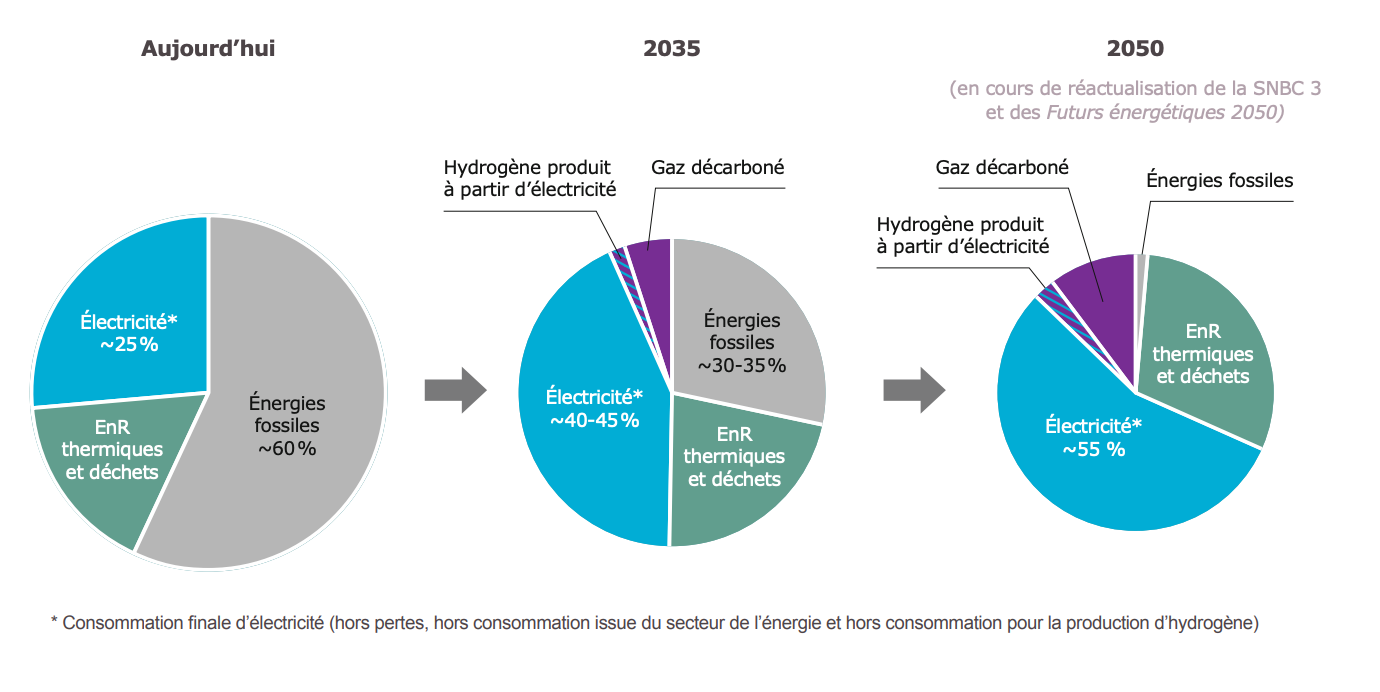
Long held back by technical, regulatory, and financial obstacles, the electrification of operations is entering a more favorable phase in France. The timing is now strategic for planning and investment.
For several years, grid operators have been investing heavily in the modernization of electrical infrastructure. The goal? To accommodate new electricity flows and reduce connection lead times.
In its new ten-year network development plan (SDDR), transmission system operator RTE has announced two key priorities:
For its part, the distribution network operator Enedis is accelerating connections. By 2025, 2.8 million electric charging points were connected, placing France second in Europe. Nearly 50 GW of renewable power is also connected.
Fiscal and regulatory uncertainty has left businesses and households in a wait-and-see mode.
The PPE 3 puts an end to this hesitation. It clearly confirms the priority given to the electrification of end-uses.
This strategy is set to be reinforced in 2026 with the publication of two foundational documents:
Currently under consultation, the draft SNBC 3 aims for the following by 2030:
The goal? Phasing out coal by 2030, oil by 2045, and fossil gas by 2050.
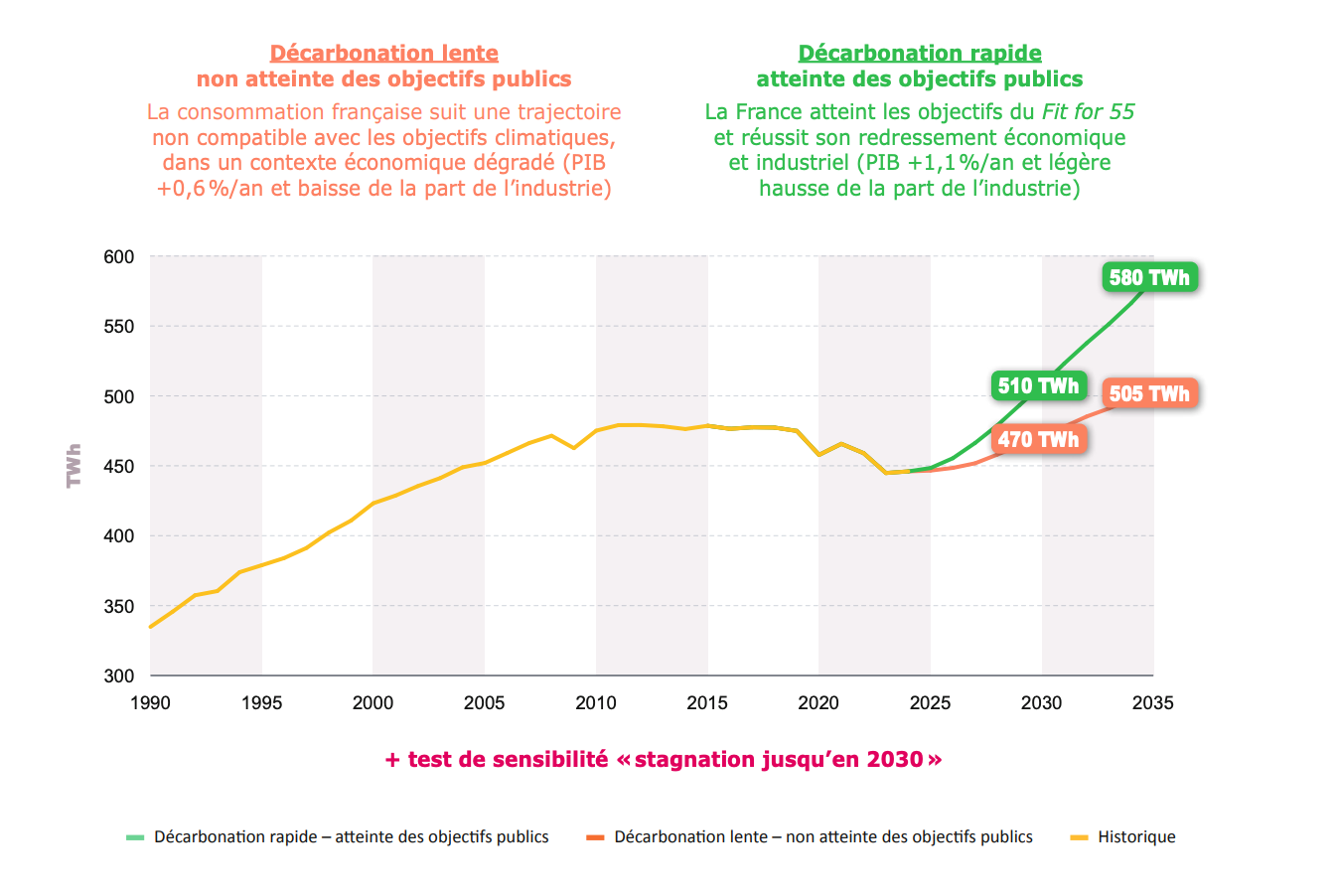
The cost of the electrical transition is a key issue for businesses. However, the current climate is favorable for investment, thanks to:
The draft SNBC 3 also provides an initial response to the ongoing debate regarding electricity taxation. It introduces "the guarantee of a competitive price for low-carbon electricity compared to fossil fuel solutions."
Electrifying operations is both an environmental and economic choice. The current climate is favorable, but how can you successfully implement this transition? This transformation is structured around several key steps.
An energy audit is the cornerstone of an effective investment strategy. It helps identify primary consumption areas and the energy sources currently in use.
With this analysis, a company can prioritize which operations to electrify, by evaluating several criteria:
Note: for some companies, anenergy audit became mandatory in 2026.
With the assessment in hand, the company can identify the areas where electrification will be most efficient and cost-effective. The technical feasibility and financial viability of each project must be studied on a case-by-case basis.
Three areas are often prioritized:
To mitigate the risks of price volatility, companies can protect themselves by securing their long-term purchasing strategy through:
With Sirenergies, secure your electricity prices through a customized purchasing strategy.
{{ask-conseil="/ctas"}}
Businesses can reduce the cost of electrification by taking advantage of current opportunities. They can benefit from:
Electrification is currently the most effective lever for decarbonizing the economy and reducing dependence on fossil fuels. Yet, despite a surplus of low-carbon production, France is struggling to electrify its energy usage.
This lag in electrification opens a window of opportunity for businesses. Those that seize it will be able to benefit from energy that is more stable, lower-carbon, and more competitive.
Admittedly, political uncertainties persist. But in the long term, the future will be sustainable, or it will not exist at all.
Failing to invest today means exposing yourself to future regulatory changes, fossil fuel market volatility, and decarbonization constraints.
With Sirenergies, electrify your operations today. Seize the opportunities in the electricity market and take advantage of available grants.
{{know-more-services="/ctas"}}
In a few clicks, organize an exchange with one of our experts.


weekly newsletter subscribers

4.9


The €/MWh is a price unit used in wholesale markets, while kWh is the unit visible on your bills.
One invoice consists of several elements: consumption, supplier share, taxes and contributions. The analysis of each line makes it possible to identify possible errors and to check the consistency with the signed contract.
Yes. The supplier guarantees an offer 100% renewable via the official Guarantees of Origin (GO) mechanism.
For the most demanding companies, the offer GREENVOLT+ ensures very low carbon intensity electricity, sourced exclusively from independent French producers (hydraulic, wind, solar).
This makes it possible to choose the right time to contract, secure your budgets and anticipate increases.
Ce seuil est jugé élevé par rapport aux prévisions actuelles du marché. Si le prix de l'électricité reste en dessous de 78 €/MWh, les entreprises ne bénéficieront d'aucune redistribution. Cela signifie que la protection promise par la réforme pourrait être inexistante dans un marché baissier, d'où l'importance de stratégies de sourcing agiles et d'outils de monitoring comme Pilott.
Sourcing offers better visibility on the market and promotes the selection of competitive contracts. It helps to reduce the risks associated with price volatility and to optimize the energy budget.
The subscribed power must be calculated according to the consumption profile and uses (heating, industrial processes, tertiary equipment). One fine analysis makes it possible to ensure the adequacy between real need and contract.
En 2026, les principaux leviers sont : la renégociation de votre contrat de fourniture au bon moment, l'optimisation de votre tarif d'acheminement (TURPE), la vérification de votre éligibilité aux taux réduits de taxes (Accise), et la réduction de votre consommation (efficacité énergétique, autoconsommation).
The industry is concerned by TICFE, TICGN and other contributions that may represent an important part of invoices. Sirenergies identifies cases of exemption and accompanies the procedures to benefit from them.
Instauré en 2017, ce dispositif répond à un enjeu de sécurité nationale.
L'électricité ne se stockant pas à grande échelle, le réseau doit être capable de répondre instantanément à la demande, même lors des pics de froid hivernaux. Le mécanisme incite financièrement les producteurs à maintenir leurs centrales disponibles et les entreprises à réduire leur consommation (effacement) lors de ces périodes critiques.
Tertiary companies are concerned by taxes such as TICFE or TICGN. Sirenergies checks the accuracy of invoices, identifies possible exemptions, and helps correct errors to sustainably reduce costs.
Oui, sous certaines conditions de taille.
Depuis le 1er février 2025, le critère de puissance a été supprimé.
Pour être éligible, votre entreprise ou collectivité doit compter moins de 10 salariés et réaliser un chiffre d’affaires (ou des recettes) inférieur à 2 millions d’euros.
Exceeding capacity leads to financial penalties and can impact the size of the contract. Adjust the correctly subscribed power makes it possible to avoid these additional costs.
Among the taxes include TICFE, TICGN, CTA, CJA and TURPE. They represent a significant part of the bill and vary according to consumption profiles. Understanding them well is essential to optimize costs.
Industrial companies consume large volumes of energy for their production processes. They have to deal with the volatility of prizes, multi-site management and specific taxes. Controlling costs is essential to remain competitive.
Les coopératives de taille ETI ou grande entreprise peuvent être soumises à l'audit énergétique réglementaire (norme NF EN 16247). Sirenergies n'a ni la compétence ni l'accréditation pour réaliser cet audit : nous vous orientons vers un bureau d'études partenaire accrédité, et vous accompagnons en amont sur vos achats et en aval sur le pilotage.
Tertiary companies must manage their energy costs while guaranteeing the comfort of users (offices, shops, services). Consumption is often linked to heating, air conditioning and lighting, which requires precise monitoring to avoid budgetary excesses.
Les profits include a direct reduction in bills, strengthened budgetary forecasting and better control of consumption. Businesses gain visibility and efficiency thanks to adapted tools.
L'ARENH est remplacé par le VNU (Versement Nucléaire Universel), un mécanisme de redistribution des revenus excédentaires d'EDF en cas de prix très élevés, et par les CAPN, des contrats long terme pour les gros industriels.
La Vente de Nucléaire Universelle (VNU) est le nouveau mécanisme de régulation des prix de l'électricité en France. Contrairement à l'ARENH, il ne s'agit plus d'un volume fixe à prix réduit, mais d'une redistribution financière des revenus excédentaires d'EDF aux consommateurs, basée sur les prix de marché et les coûts de production du nucléaire historique.
The central objective of PPE 3 is to engage France towards carbon neutrality by 2050 by breaking the country's historical dependence on fossil fuels.
Today, approximately 60% of final energy consumption in France still relies on imported oil and natural gas. PPE 3 aims to radically reverse this trend by setting an ambitious target: to reach 60% of carbon-free energies in final consumption by 2030.
To achieve this, PPE 3 pursues three major sub-objectives:
C'est le levier le plus rapide pour obtenir des résultats visibles. L'éclairage représente environ 40 % de la consommation d'électricité d'une commune.
Passer au LED avec pilotage intelligent permet de réduire la facture de 50 à 80 %, avec un retour sur investissement (ROI) rapide, souvent estimé à 2 ou 3 ans.
Absolument. La réforme des heures creuses vise à absorber la surproduction solaire en milieu de journée. Les créneaux d'heures creuses se déplacent progressivement vers la plage 11h00 – 17h00, notamment en été. C'est une opportunité majeure pour les sites industriels ou tertiaires capables de flexibilité.
Conseil stratégique :
Communities are subject to taxes such as TICFE or TICGN. Sirenergies analyzes invoices, identifies exemption possibilities and fixes possible errors to reduce the tax burden.
Le calendrier 2026 impose deux échéances majeures :
Pour simplifier ces démarches, vous pouvez centraliser vos données de consommation avec la plateforme Pilott de Sirenergies, garantissant ainsi la conformité de vos rapports réglementaires.
Car les marchés dépendent de facteurs exogènes imprévisibles (géopolitique, météo soudaine, politique) que les modèles basés sur l'historique ne peuvent pas anticiper, tout comme on ne prédit pas le Loto.
Non. L'IA traite la donnée (data processing), mais l'analyste apporte la compréhension du contexte (market sentiment) et la prise de décision stratégique.
Le VNU repose sur les revenus excédentaires d'EDF.
Si les prix de marché dépassent les coûts de production du nucléaire (estimés à 60,3 €/MWh), EDF reverse une partie de ses profits à l'État.
Le prix Forward est fixé à l'avance (sécurité budgétaire), tandis que le prix Spot varie heure par heure selon le marché (opportunité mais risque élevé).
Changing suppliers can allow you to benefit from more competitive prices, adapted services or better contractual conditions. Thanks to sourcing, change is happening without interruption of supply.
La fin de l'ARENH (Accès Régulé à l'Électricité Nucléaire Historique) marque l'arrêt de la fourniture d'électricité à prix fixe garanti (42 €/MWh).
Dès le 1er janvier 2026, les entreprises sont exposées aux prix de marché, mais deux nouveaux mécanismes de régulation prennent le relais, bien que leur logique soit différente :
Conseil stratégique : Ne comptez pas sur le VNU pour réduire votre facture en 2026 si les marchés restent stables. Auditez vos contrats dès maintenant pour intégrer une part de prix fixe ou explorer des "Power Purchase Agreements" (PPA) pour sécuriser vos coûts sur le long terme.
Some businesses may obtain a partial or total exemption from the TICFE or the TICGN, depending on their activity and energy intensity. The support of an expert makes it possible to identify the eligibility criteria and to put together the file.
La Multiannual Energy Programming (PPE) is the strategic management tool for France's energy policy. Established by the 2015 law on energy transition for green growth (LTECV), it serves as a compass for the State, communities and businesses.
Concretely, the PPE sets the priorities for action of the public authorities for the management of all forms of energy on the national territory. It covers a period of ten years, divided into two periods of five years, and must be revised periodically to adapt to technological and economic developments.
It deals with major topics such as:
It is crucial not to confuse it with National Low Carbon Strategy (SNBC). While SNBC sets carbon budgets (the ceilings for greenhouse gas emissions by sector), the PPE determines the technical and energy resources to achieve them.
In 2025, the supplier had a NPS (Net Promoter Score) of +16 and a note of 4,17/5.
Satisfaction is based on a “zero solicitation” model and 100% in-house customer service in Toulon, guaranteeing proximity and responsiveness that cannot be found with major historical suppliers.
Sourcing consists in identifying and analysing the offers of several electricity and gas suppliers. This approach makes it possible to obtain contracts adapted to the consumption profile and budgetary constraints of the company.
Idéalement entre 6 et 12 mois avant l'échéance, de préférence au printemps ou au début de l'été lorsque la demande est plus faible.
Pas nécessairement sur votre facture finale. Si les prix de gros (le prix de l'énergie brute) ont baissé, les coûts d'acheminement (TURPE) et certaines taxes augmentent, compensant souvent la baisse de la part énergie.
L'impact dépendra des prix de marché. Le mécanisme prévoit une redistribution si les prix dépassent 78 €/MWh. Cependant, si les cours restent bas (actuellement autour de 60 €/MWh), le dispositif ne s'activera pas. La facture sera alors indexée à 100% sur les prix de marché, rendant le choix du fournisseur et du moment d'achat critiques.
Farms must deal with high seasonal needs (greenhouse heating, irrigation, storage) and high volatility of prizes. Controlling these costs is essential to maintain profitability and secure the business.
Un appel d’offres permet de mettre en concurrence plusieurs fournisseurs d’électricité et de gaz afin d’obtenir des conditions contractuelles optimisées. C’est une démarche transparente qui permet de choisir l’offre la plus adaptée aux besoins budgétaires et techniques de l’organisation.
Plusieurs leviers existent pour préserver la fiscalité locale :
Chaque modèle d'IA répond à un besoin spécifique du cycle d'achat :
L'expertise humaine reste néanmoins indispensable.
La réussite d'un projet collectif énergie repose sur trois piliers fondamentaux :
L'ARENH n'est pas remplacé par un dispositif unique, mais par une combinaison de mécanismes visant à stabiliser les prix.
Le principal est le Versement Nucléaire Universel (VNU), un système de redistribution qui s'appliquera à tous les consommateurs. Pour les très gros sites industriels (> 7 GWh/an), des contrats de long terme spécifiques, les CAPN (Contrats d’Allocation de Production Nucléaire), sont également proposés par EDF.
To calculate Scope 2 emissions, use the following formula:
Energy quantity (kWh) × Emission factor (kg CO₂ e/kWh).
Use databases like ADEME for precision.
Farms are subject to taxes such as TICFE or TICGN. Sirenergies verifies their application, identifies cases of exemption and accompanies the procedures to reduce the tax burden.
It allows you to prove your commitment to the energy transition and to meet regulatory requirements.
En analysant votre courbe de charge pour identifier la puissance réelle appelée, puis en demandant un ajustement à votre fournisseur ou via un expert en énergie.
Le dispositif ARENH a laissé place au VNU (Versement Nucléaire Universel).
Ce changement structurel expose davantage les entreprises aux prix de gros, rendant la gestion des risques plus complexe qu'auparavant.
Il devient alors indispensable de définir une stratégie d'achat d'électricité avec Sirenergies pour lisser l'impact de la volatilité des marchés sur votre budget.
Même le bâtiment le plus moderne et le mieux isolé perd son efficacité si ses usages sont inadaptés. La technologie et les normes ne suffisent pas : la transition énergétique est avant tout une transformation humaine.
Derrière chaque kilowattheure consommé se cache une habitude.
Un collaborateur sensibilisé comprend qu'ouvrir une fenêtre alors que le chauffage est allumé ou laisser un ordinateur en veille consomme de l'énergie inutilement. En replaçant l'humain au centre de la stratégie de gestion de l'énergie, l'entreprise s'assure que ses équipements performants sont utilisés de manière optimale, garantissant ainsi une rentabilité durable et un impact environnemental réduit.
All businesses, from SMEs to large organizations, can benefit from this service. Les local authorities also find it a lever to better control their budgets.
The range E @sy is available in four pricing structures to adapt to each risk profile:

Malgré une production d'électricité largement décarbonée (nucléaire et renouvelables), la France accuse un retard car la consommation d'électricité stagne face aux énergies fossiles.
En 2024, le pétrole et le gaz représentaient encore 56 % de la consommation finale, contre seulement 26 % pour l'électricité.
Ce paradoxe s'explique par des efforts de sobriété qui ont paradoxalement plus touché l'électrique que les fossiles, ainsi que par un attentisme réglementaire désormais en passe d'être levé par la PPE 3.
La nouvelle Programmation Pluriannuelle de l'Énergie (PPE 3) et la SNBC 3 visent une accélération massive pour atteindre la neutralité carbone en 2050. Les objectifs clés pour 2030 incluent :
Vos contrats et taxes sont audités en quelques semaines. Les gains sur les taxes (remboursements d'accises) et les ajustements de puissance souscrite sont immédiats. Pour le gaz de chauffage, l’impact financier est verrouillé dès la signature de votre stratégie de couverture, avant le début de votre saison de chauffe.