




Summarize with AI

March 31, 2026
5
Min reading
Today, at the time of the energy transition, new consumer uses are emerging. They are the result of technological innovations. They represent a response to new problems in the world of energy. More and more French electricity consumers are interested in these new ways of consuming.
As such, we often hear about self-consumption. If you don't know where to start on this promising topic: don't panic, SirEnergies is there to guide you. Self-consumption is a subject in which energy efficiency and the reduction of bills go hand in hand.
Self-consumption of energy or self-production is the act of consuming energy that you produce yourself, as a company or even as an individual customer. This production can be done independently. It can represent all or part of the customer's consumption.
If production is not sufficient, the supplement can be provided by a traditional supplier.
Between 2018 and 2021, the number of installations in France almost doubled! Today, there are no less than 105,000 installations according to Enedis at the end of the first quarter of 2021. Many of our European neighbours are ahead of us in terms of the number of installations (especially Spain and Italy).
It is therefore a new and growing use that reinforces the trend of decentralization in the sector. This is often part of an energy efficiency approach, but also a policy of cost reduction.
The installation of photovoltaic panels is simple, inexpensive and generally requires little area. It is for these reasons that it is attracting more and more French people today.
To start, you need to install photovoltaic solar panels on a surface exposed to the sun. It is recommended to install them in a position that favors their exposure to the sun's rays. Your production varies according to your geographical location.
Once plugged in, the panels will produce electricity using direct current. It will therefore have to be transformed into alternating current before it can be consumed. Therefore, inverters are installed in order to carry out this operation.
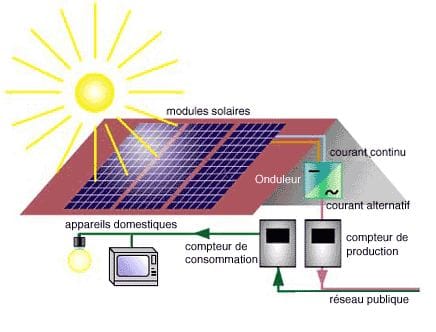
Source: Sustainable
In this way, the panels produce all or part of the electricity consumed by the household. It is a way to reduce the overall demand for electricity from conventional producers. Decentralization is one of the vectors of energy transition.
It should also be noted that the quantity of energy produced and consumed on site will not pass through the electricity network. Usually, the energy that powers our lamps has travelled a long distance before reaching our sockets. Along the way, the heating of the power lines creates losses (Joule effect). It is all French consumers who finance these losses through the TURP.
We therefore note that self-consumption projects could contribute to reducing losses and are part of an ecological transition process. If we leave aside the problems of constructing photovoltaic panels (we need a full-fledged article on the subject!) , it is true that solar technology still meets several essential criteria. It is an energy that does not emit CO2 during its production of electricity, which is inexpensive and easy to access.
The price of a photovoltaic installation fell significantly over the decade 2010-2020. It can be seen that prices have been halved over this period. This is mainly due to the arrival on the market of inexpensive photovoltaic cells, mainly produced in Asia.
However, we have also seen the appearance of quality products at more attractive prices. Improving the performance of these panels is a key factor in increasing the profitability of these projects. The more electricity a panel produces, the more profitable it is.
The government has put in place several grants to finance energy efficiency projects. First of all The photovoltaic self-consumption bonus. This is a bonus paid directly by EDF Obligation d'Achat. This bonus is spread over the first 5 years of activity.

There is also guaranteed feed-in rates. That is to say, all autoproducers can choose to sell all or part of their productions on the network. In the same way, EDF Obligation d'Achat is responsible for paying them. The purchase price is advantageous compared to selling prices on the financial electricity markets.
example
For a photovoltaic installation of 3 kWc, the Ministry of Economy and Finance indicates that we can collect €184.9/MWh by selling all of its production or €100/MWh by only selling the surplus.
Source
These rates are much more attractive than the average prices on the market.
In addition, there is Exemptions from taxes like CSPE and TCFE for autoproducers:
Network tariffs (TURPE) usually apply to all electricity consumption. They represent around 30% of the total bill. Self-generated electricity does not pass through the grid, as it is immediately consumed or stored using batteries.
Self-producing customers are therefore not liable for the variable portion of TURPE for the electricity they produce. This represents an additional source of bill reduction for customers who choose to start self-consumption.
We can therefore see today, through its ease of installation, these savings in bills and its relatively low cost, that self-consumption has many advantages. It is a sustainable and simple solution to reduce energy bills while participating in the energy transition.
Do not hesitate to continue reading with these two topics on self-consumption:
Recognizing the climate emergency, SirEnergies offers professionals and businesses the opportunity to limit the ecological impact in terms of energy.
We have made the choice to work with key players in solar photovoltaic to offer you support solutions dedicated to your photovoltaic self-consumption projects.
Click below for more information:
In a few clicks, organize an exchange with one of our experts.


weekly newsletter subscribers

4.9
