





Summarize with AI

November 3, 2026
6
Min reading

The deployment of the Linky meter in France officially began on December 1, 2015 for private consumers.
At the beginning of 2022, Enedis almost finalized its deployment and nearly 90% of target consumers were equipped at the end of 2021.
This is a revolution for the private sector, but you should know that the use of smart meters is very common when it comes to larger sites (shops, offices, factories, etc.).
Smart meters improve both network management and services provided to consumers. Their use reduces the overall cost for the community; these results can be observed in a few years.
However, is the data that passes through these meters secure? At a time when cybercrime is developing at breakneck speed, it is legitimate to question data security, especially in a sensitive sector such as electricity.
The Linky Is the smart meter deployed by The network operator Enedis for its individual customers. Since 2016, more than 35 million meters have been installed across France. This counter allows you to Store then to send daily consumption data at a predefined and adjustable frequency.
This counter therefore allows you to Count consumption accurately, and to no longer wait for an Enedis technician to come by in order to know its consumption more precisely.
Unlike the old so-called electromechanical counters, the Linky is numerical. It therefore allows you to communicate directly with The network manager distribution via PLC (line carrier current).
This information arrives in the concentrator (generally located in the transformer station) to which the site is attached. They are then sent to Enedis. This technology therefore makes it possible to send information directly to the manager's information system.
This meter therefore makes it possible to give a better view of the consumption of a household, thus giving back to the consumer An actor in the energy transition.
But it also makes it possible to replace 70% of physical interventions (according to Enedis) by remote actions to read meters.
Gas network operators are also concerned by these technological innovations in data metering. GRDF, which is the company responsible for managing gas distribution networks, has developed its smart meter model. Unlike Linky, Gazpar For its part, uses radio waves to send consumption information.
This box transmits its data twice a day, so information is sent by radio waves from the box to the hub, on the 169 MHz frequency. Each of these shipments takes less than one second.
Finally, the concentrator, generally located high up, on the roof of a building for example, will be in charge of Communicate consumer information to GRDF information systems via GSM waves. The technologies used are therefore different from Linky, but the overall functioning remains the same.
There is a very clear European regulation on this subject, which dates from 2010. The European Directive 2009/72/EC provided that 80% of the meters installed should be communicating by the end of 2020. This directive has been transcribed into French law in the Energy Code: Decree No. 2010-1022 which” Makes the implementation of smart meters by Enedis mandatory ”.
This directive only applies to managers with at least 100,000 delivery points. Network operators are therefore obliged to modernise their infrastructures, with the meters belonging to the network manager. Therefore, Smart meters are actually mandatory. On the other hand, it should be noted that there are currently no clear legal provisions to punish a recalcitrant customer.
For more information, do not hesitate to consult our article on: Is Linky mandatory?
In general, smart meters will send daily and monthly consumption data from a delivery point at a selected frequency. Thus, as an end consumer, you can have your consumption curve up to one half-clockwise granularity (a curve at a 30-minute interval). It depends on the consumer's choice, he can activate or deactivate it at will via his customer area.
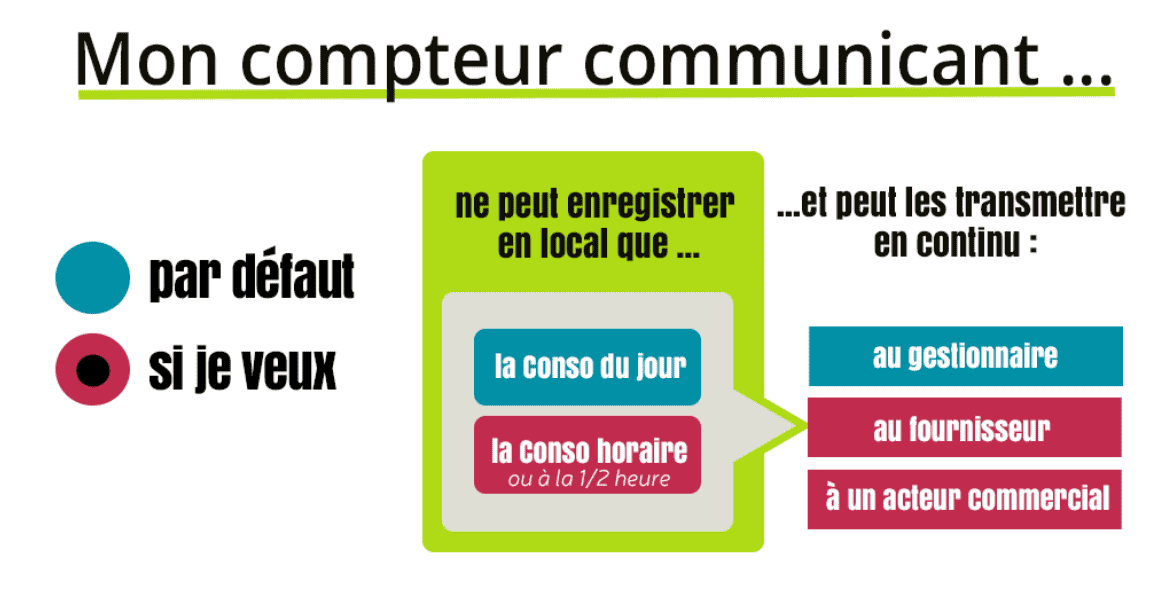
Source: CNIL
Thanks to its fine counting of consumption, the Linky also makes it possible to recover the maximum power reached. The data is global in relation to housing and does not give details on the consumption of each device.
To perform this type of operation, it is necessary to connect numerous sensors directly to the devices.
It's the CNIL which is responsible for protecting the interests of French consumers in terms of personal data. It is a independent administrative authority, like the Energy Regulatory Commission (CRE), which may have recourse to dissuasive sanctions.
For example, the CNIL put the energy supplier Direct Énergie on notice, because it considered that the way in which it obtained the consent of customers for the exploitation of their data was abusive. Data that, according to the law, “can however only be collected after obtaining the consent of the persons concerned”.
The role of the CNIL has taken on particular importance since the European regulation relating to personal data (RGPD).
Access to consumption data and consumption indexes has been simplified with the arrival of Linky. Customers can visualize or upload their data directly from their client area. They can go through their energy suppliers, who need to recover their data and expose it.
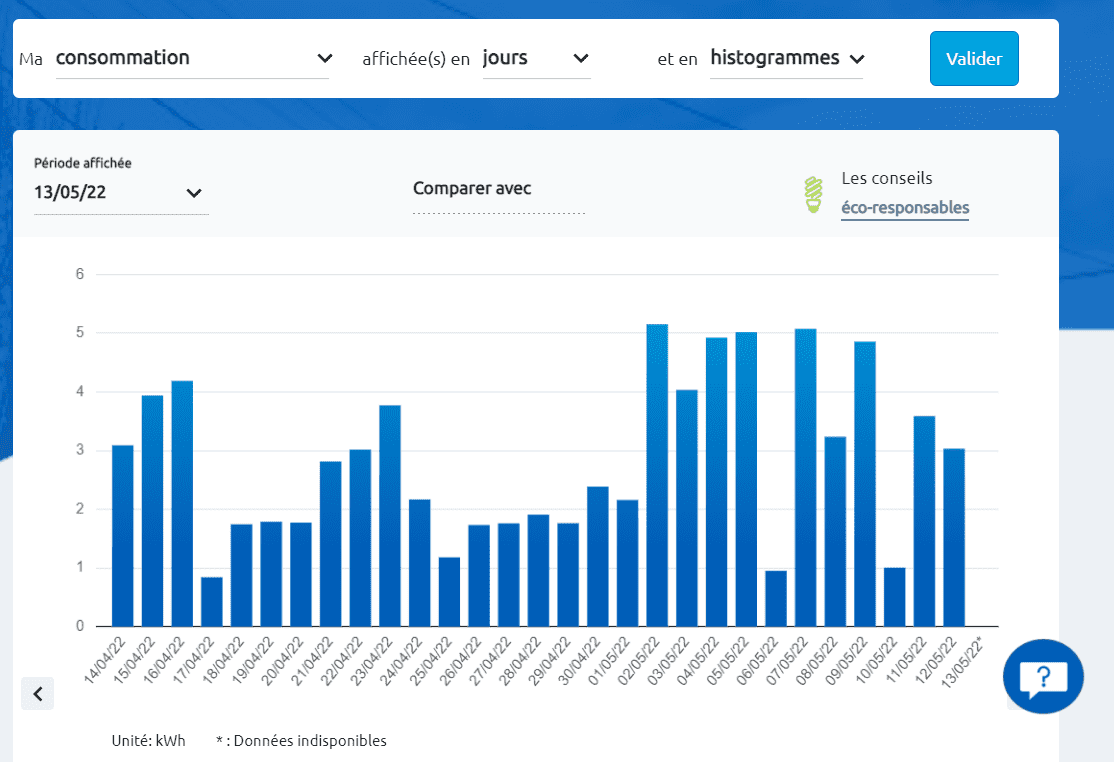
Source: Enedis customer area
In this respect, we must commend Enedis's efforts to digitize and make data available in order to provide access to this data. This represents a considerable amount of work in terms of information systems management.
Smart meters have existed for many years in the energy landscape. In electricity, we can cite in particular SAPHIR or PME-PMI counters which continue to equip businesses today. Their democratization among individuals appeared with Linky and Gazpar.
At a time of energy transition, it is crucial for consumers to become energy players. Companies and associations have every interest in exploiting this data to accelerate energy sobriety.
This includes knowing their energy-related data, so that we can each take the necessary measures concerning, among other things, energy waste.
Finally, it is thanks to the modernization of the network that Enedis makes operations possible of self-consumption. Operations that promote the environment and the fight against global warming.
The consumption data export feature allows you to closely monitor your electricity consumption with data that is updated daily.
No need to wait until the end of the month to find out how much you consumed, you are now monitoring your consumption in real time!
In a few clicks, organize an exchange with one of our experts.


weekly newsletter subscribers

4.9
