




Summarize with AI

November 4, 2026
14
Min reading
This article was written in early March 2022, a few days after Russia invaded Ukraine: the figures and the situation it describes are those of that time.
Less than 48 hours after Russian President Vladimir Putin's martial speech, a war of nerves, or rather of gas, has begun.
German Chancellor Olaf Scholz announced Germany's response yesterday:
“I have asked the Ministry of Economic Affairs to withdraw its report on security of energy supply from the regulator, so that the pipeline cannot be certified. Without this certification, Nord Stream 2 cannot be put into operation.”
By freezing the Nord Stream 2 pipeline project, which links Russia to Germany, Berlin hopes to put a thorn in the side of the Russians, who were counting on the project to boost their gas exports to Europe. This diplomatic pressure cuts both ways, because the Russians also have the means to put pressure on Europeans, who depend heavily on their gas.
If Russia slows its exports to Europe, gas prices could soar and hit European citizens directly in the wallet. This scenario is also being watched closely in the United States, where it is mainly a possible rise in the price of a barrel of oil that worries Joe Biden's administration, which is doing all it can to keep American businesses and citizens from paying more at the pump.
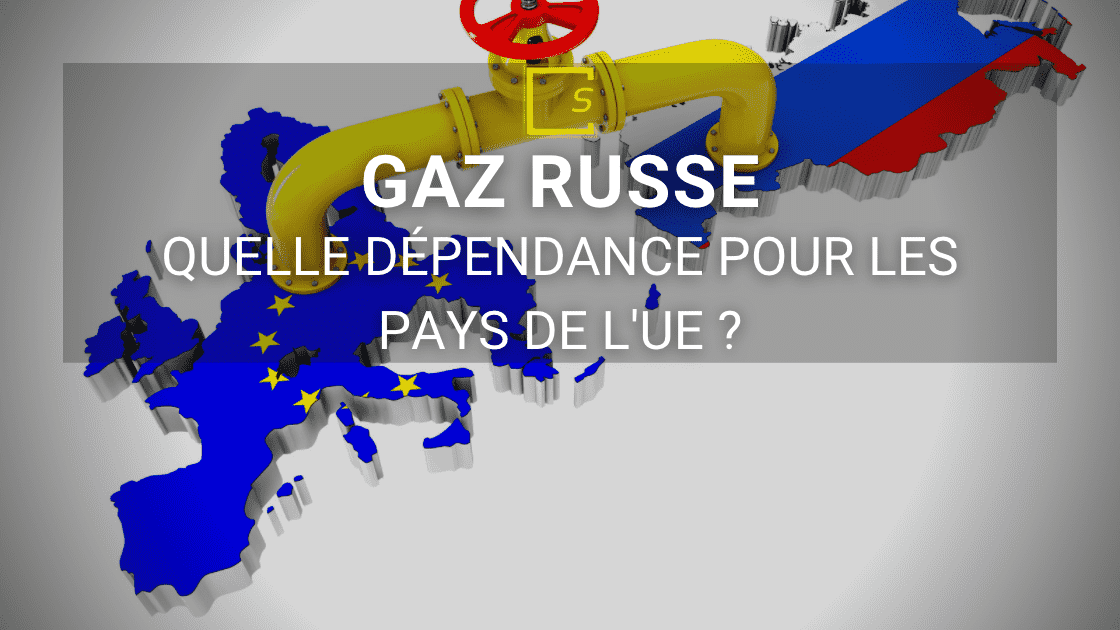
According to Eurostat, 48.4% of gas imports into the European Union come from Russia, making it the EU's leading supplier, far ahead of Norway, which covers 18% of needs, and Algeria, with a 13.2% share.
The United States supply less than 6%, and Qatar's share is around 4.4%.
These last two countries supply their gas as LNG, which we discuss below.
Europe has depended on Russian gas for many years now.
In fact, Europe's dependence has grown steadily over time. Russian gas production increased and became an essential source of supply for the EU.
At the same time, gas sources within Europe have dried up or declined, particularly in the Netherlands and Norway.
EU countries do not depend on Russian gas to the same extent. Two factors come into play:
Among the EU's other very large gas suppliers, which could supply more to reduce dependence on Russian gas:
Dependence varies widely from country to country:
These different levels of dependence stem from the fact that gas is something of an intermediate energy, between the most polluting energies, such as oil or coal, on the one hand, and renewable energies on the other.
Countries that are determined to develop renewable energies face the intermittency of these energies, caught between renewables on one side and coal on the other to make up for the lack of wind or sun.
These different levels of dependence also cause friction between EU countries over the policy to adopt:
The new geopolitical reality, just a week old, is Russia's invasion of Ukraine. All Europeans are wondering where to find gas in the current crisis to make up for a potential collapse in Russian imports.
The question is therefore: where in the world can gas be found in large quantities?
As the gas market is regional, one of the key issues is pipelines. The main ones from Russia are:
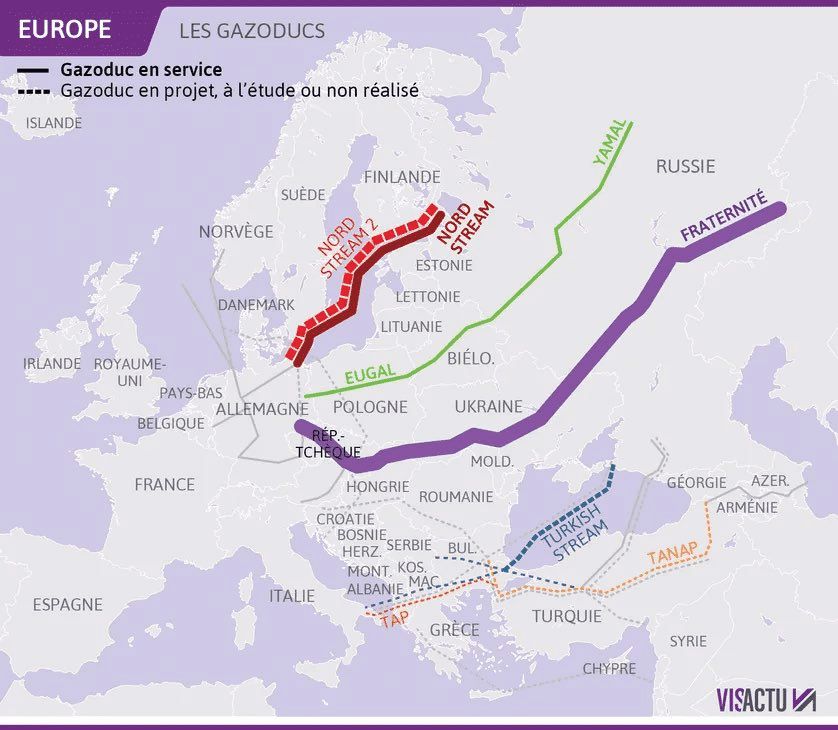
Finally, Nord Stream 2 was built to increase direct gas imports from Russia to Germany, but is not in operation to date.
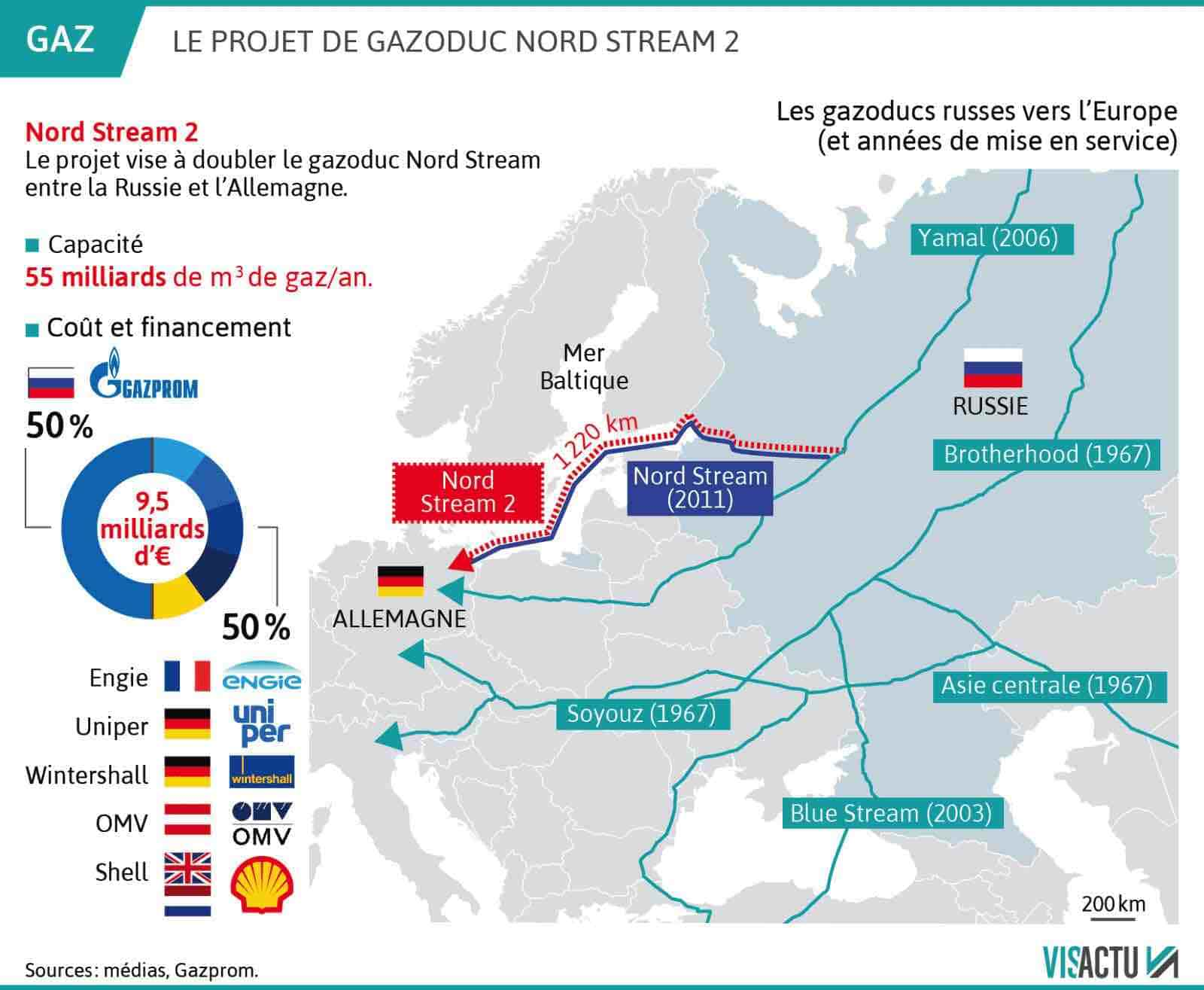
Source: Gazprom
The reality is that suspending the certification of Nord Stream 2 concerns gas that does not exist! In practical terms, it changes absolutely nothing to the EU's supply today.
So yes, the Nord Stream 2 pipeline will not be certified tomorrow, and perhaps not even in ten years.
The idea behind Nord Stream 2 was, on the one hand, to increase the EU's dependence on Russian gas and, on the other, to allow Russia to avoid sending its gas through Ukraine.
With Nord Stream 2, the question now is: will we accept being even more dependent on Russian gas tomorrow? This was already the debate between the Greens and Olaf Scholz when the German coalition was formed.
It should be borne in mind that Nord Stream 2 would have raised Germany's dependence on Russian gas from 55% to 70%. In 2012, Germany depended on Russian gas for 40%. Germany's very high dependence on Russian gas is therefore recent, the result of a political choice made alongside the nuclear phase-out.
We should also remember the very close ties between Gerhard Schröder, German chancellor from 1998 to 2005, who became a lobbyist working for Vladimir Putin, and the Russian gas giants.
Gerhard Schröder chaired the shareholders' committee of Nord Stream 2. He currently chairs the supervisory board of the Russian oil company Rosneft. And now, in February 2022, he is a candidate for Gazprom's board of directors…
Europe is at risk on gas, yet at the same time there is much talk of climate change and the need to cut CO2 emissions.
Less than a year ago, to general surprise, the IEA (International Energy Agency) stated that no new oil and gas fields should be developed. This contributed to a lack of investment in the gas industry and, as a result, a shortage of gas on the market, while demand for gas keeps growing slowly because gas is relatively clean compared with oil.
The situation in Europe was already uncomfortable:
Today, the situation is made worse on two counts: a post-Covid economic recovery that is driving up demand for gas, and the Ukrainian crisis, which has caused gas prices to soar.
However, as things stand, experts believe the EU is not at risk:
All of the above shows that the EU is highly dependent on Russia, which controls storage and deliveries and uses them to influence prices.
In the light of the latest events in Ukraine, it also appears that all this had been planned to prepare for war: storage left unfilled at the start of winter, then reduced deliveries at the end of last year.
European governments are taking measures to protect their populations from energy prices.
In France, the Ministry of the Economy announced in December that it would freeze gas tariffs for households. The Minister of the Economy, Bruno Le Maire, has told the French again in recent days that they would be protected and that their bills would not change.
The fact is that capping the price of gas for consumers is not sustainable for suppliers in the medium term. With the war in Ukraine and the open crisis between the EU and Russia, maintaining a tariff shield is becoming much less straightforward.
As for the natural gas bill of French businesses and SMEs, it is soaring and no tariff shield is planned to date. Some companies are already expecting their bill to be multiplied by 3 to 5 in 2023.
The difference between natural gas and LNG (liquefied natural gas) lies mainly in how it is transported.
LNG can be carried by LNG carrier. As its name suggests, the benefit of LNG is liquefaction, which allows it to be stored in tanks and shipped by sea. In practice, an LNG carrier often sets off without a fixed destination, which can be decided, or even changed, during the voyage depending on the best offer.
Conventional natural gas is carried by pipelines, which have to be built.
A pipeline is very expensive (as Nord Stream 2 showed, at 9.5 billion euros), which then requires very long-term contracts between producing and consuming countries to make the investment pay off.
In the current situation, rising gas prices are a risk. Gas prices were already very high at the end of 2021, so a new surge in prices in the coming weeks is highly likely.
Liquefied natural gas can cushion this shock to some extent: the United States can supply LNG, Qatar can contribute to a lesser extent and new sources of LNG supply can be found, but this will not be enough.
The EU is highly dependent on Russia:
Doing without Russian gas would be very complex to put into practice.
Moreover, at the moment the prices of many energies, gas and oil alike, are soaring, which raises real questions for the energy mix as a whole.
In France, half of current inflation is linked to the cost of energy, which consumers obviously end up feeling.
The rise in gas prices comes at a very particular moment:
The sanctions against Russia recently announced by the EU do not yet cover gas imports. In 2014, after the annexation of Crimea, EU sanctions against Russia never covered gas imports either.
Nord Stream 2 matters little in reality, because the existing pipelines are in operation today. No one in the EU has suggested shutting them down to put pressure on Russia.
This is easy to understand: if the EU stopped importing Russian gas, it would be a real disaster, with a shortfall of 40 to 50% of its gas.
The EU depends on Russian gas for its supply, but Russia depends on the EU for foreign currency.
For Russia, however, oil matters far more. Russia exports as much oil as gas in calorific terms, but it earns much more money from a barrel of oil.
Russia depends on its gas exports to Europe, which account for 15% of its GDP according to Eurostat. For several years, Russia has been trying to diversify its customers by turning to emerging countries such as Brazil, India and, above all, China.
On 4 February, Vladimir Putin, in Beijing for the opening of the Winter Olympics, signed an agreement with the Chinese leader for the delivery of an additional 10 billion cubic metres of Russian gas per year between the two countries.
The strategic turning point dates back to 2014, barely two months after Russia's annexation of Crimea: Vladimir Putin was already planning ahead. In a first show of strength, he signed a historic gas deal with China worth 400 billion dollars over 30 years.
Since then, a first pipeline has been built and was inaugurated in 2019 (Power of Siberia).
Moscow would now like to convince Beijing to build a second one, but China, aware of its strong position, does not seem in a hurry to conclude these talks and is using them to negotiate prices.
“Russia is far more dependent on its European customer than the European customer is on its Russian supplier, which is, moreover, a reliable supplier.” These are Vladimir Putin's own words.
Looking at the volumes, there is currently no comparison: Russia needs its European customer and is likely to need it for a long time to come.
Moreover, it is not the same gas: Russia is not trying to sell gas from the same fields to China. This gas is produced in eastern Russia, and it would not be very profitable to bring it west.
Geography thwarts Putin's geopolitics, even though Russia and China staged the signing of a historic agreement in the middle of an international crisis on Tuesday 1 March.
At the moment, Russia and China are able to put on a show to pressure Europe. Putin seems to be telling Europeans: “If you no longer want to buy my gas, that's fine, I will sell it to China!”
And that is indeed what is happening. After being guest of honour at the opening of the Winter Olympics, Vladimir Putin signed, on Tuesday 1 March 2022, in the middle of an international crisis, a contract to build a giant gas pipeline that will supply China via Mongolia.
This huge new project will carry up to 50 billion cubic metres of gas per year, or 25% of the volume Russia currently supplies to the EU, and the same volume that Nord Stream 2 was due to carry to Germany.
A stinging snub to the international community, which met the next day, Wednesday 2 March, at the United Nations General Assembly to vote on a resolution demanding that Russia immediately end its offensive against Ukraine, with China abstaining.
In reality, however, even though this contract is exceptional, it is not the same gas and the project will take time to complete. In practice, Russia cannot do without its European customer.
Defending freedom comes at a price for the West and could trigger an energy shock through soaring energy prices. The EU and Russia are currently highly interdependent:
Russia cannot do without its European customer, which in turn cannot do without Russian gas.
In a few clicks, organize an exchange with one of our experts.


weekly newsletter subscribers

4.9
