





Summarize with AI

March 31, 2026
7
Min reading
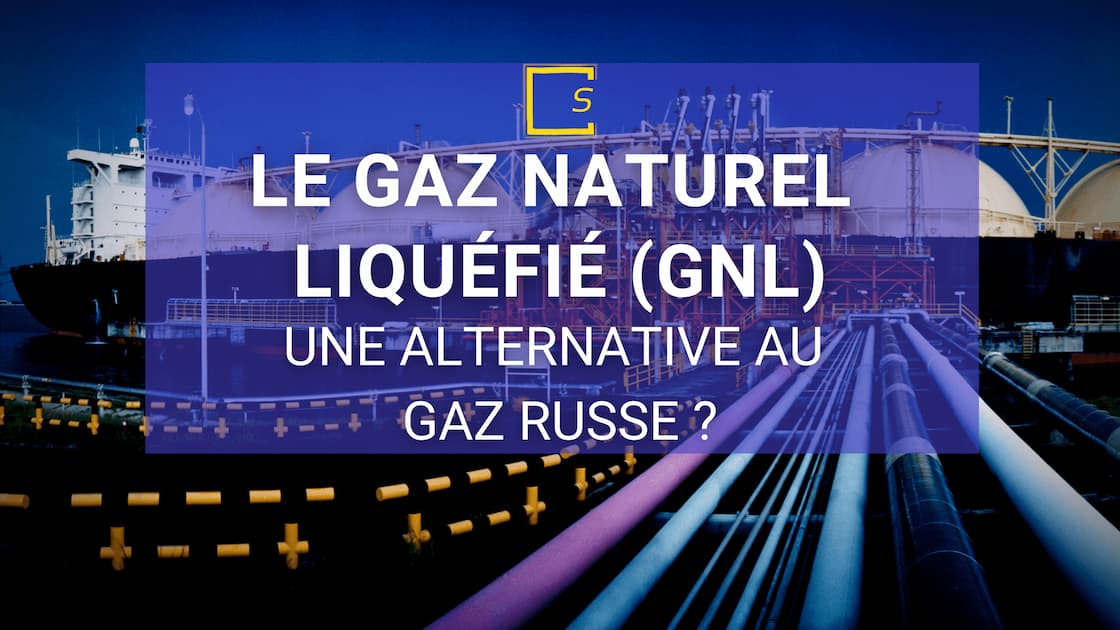
On 26 March 2022, the public authorities announced the project to install a brand new LNG terminal floating with a capacity of 3.9 million tons of LNG per year.
An opportunity for SirEnergies to recall what liquefied natural gas (LNG) is, another energy resource considered by Westerners to reduce the European Union's dependence on Russian gas pipelines.
In this article, we present to you the main differences between natural gas and LNG (Liquefied Natural Gas), but also its supply chain, which, in the context of the war in Ukraine, offers real advantages in geopolitical terms.
Liquefied natural gas (LNG) is natural gas that has been purified and then cooled in order to change its state to become liquid at atmospheric pressure.
LNG is a transparent, odourless, light-colored, non-corrosive, and non-toxic liquid. It is lighter than water with a density of 465 kg/m³.
Its PCS (higher calorific value), which is the thermal energy released during its combustion, is of the order of 11 to 12 kWh/Nm³.
Natural gas, to become liquid, undergoes several treatments: purification, dehydration, precooling and finally liquefaction. Liquefaction requires the temperature of natural gas to be reduced to -160°C to become liquid at atmospheric pressure.
The liquefaction of natural gas makes it possible to reduce its volume by nearly 600 times and to make its storing and its transport simpler and more economical.
After extraction, natural gas is sent to processing, liquefaction and storage units:
The LNG (Liquefied Natural Gas) thus obtained is transported in LNG tankers (boats specially designed for the transport of LNG). The LNG is then delivered to ports specially equipped with LNG terminals.
In these units, LNG (Liquefied Natural Gas) is pumped from the bunkers of ships to storages and then regasified by heating. Liquid gas becomes gaseous again and can then be injected into the distribution networks of consumer countries.
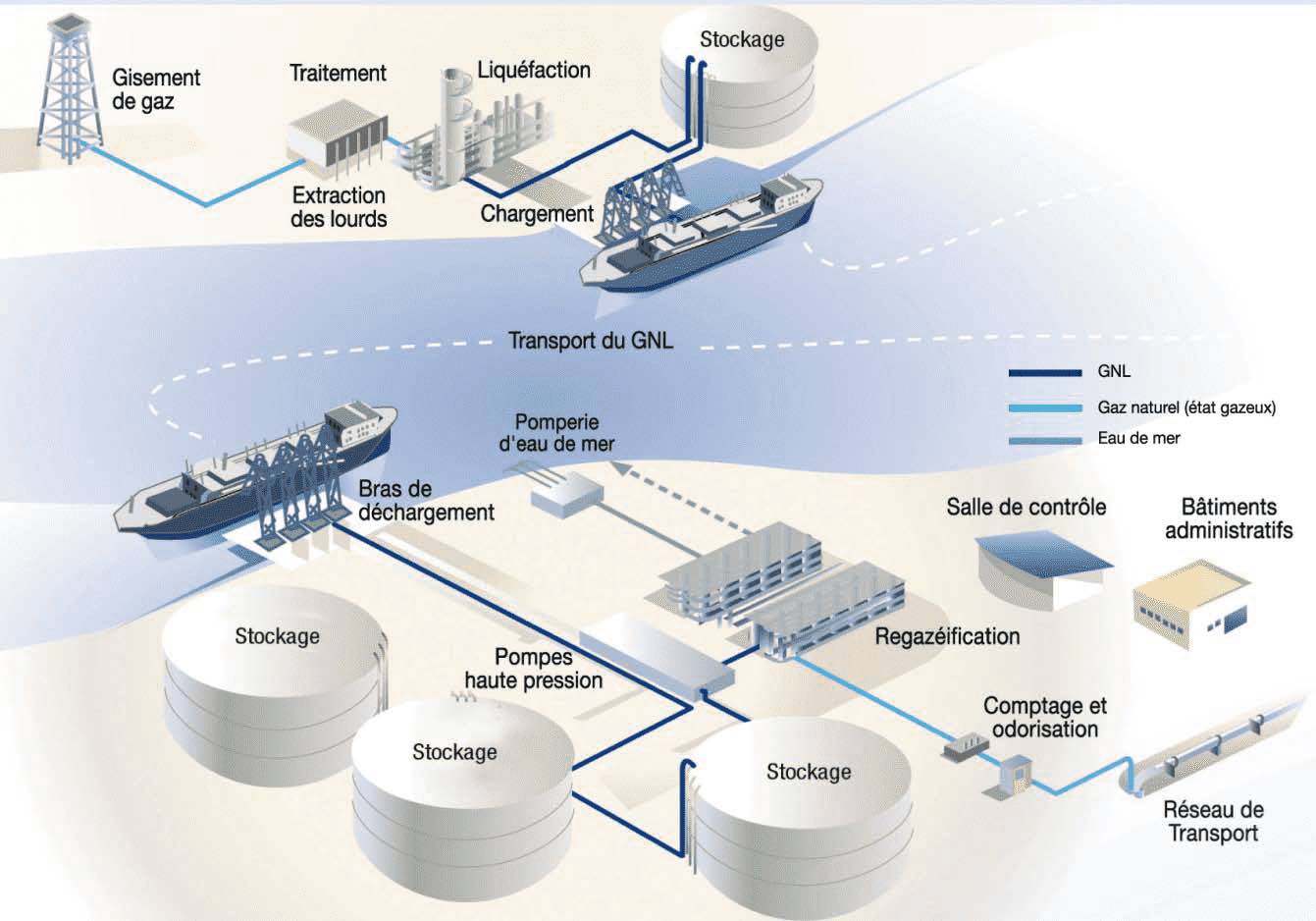
Source: Elengy
The gas supply chain is based on liquefaction plants, LNG tankers and regasification units.
In the world, it exists today 26 liquefaction terminals, spread over 15 countries, and 60 regasification terminals, spread over 18 countries. There are around sixty liquefaction terminal projects, and just over 180 regasification terminal projects, many of which will probably never see the light of day due to the gradual abandonment of fossil fuels.
France commissioned its first import LNG terminal in Le Havre in 1965 (dismantled in 1989) and now has terminals in Fos-Tonkin (1972), Montoir-de-Bretagne (1980), Fos-Cavaou (2010) and Dunkerque (2015). France participates in this way to the strategy for diversifying European supplies and plans to increase it by installing, in particular, a floating storage and regasification terminal in the port of Le Havre.
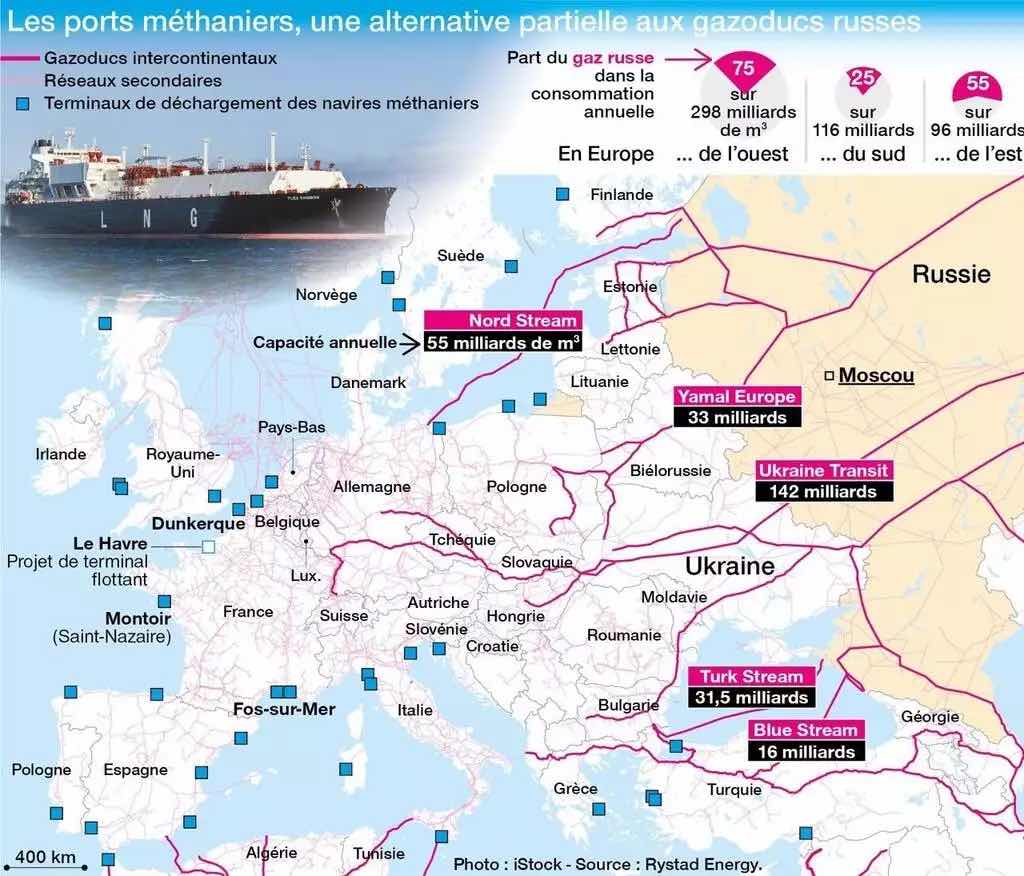
Source: Rystad Energy
In order to reduce its dependence on Russian gas, Europe is counting on liquefied natural gas (LNG). LNG (Liquefied Natural Gas) is a solution more flexible than natural gas of a gas pipeline, because it can come from any producing country as long as it hasliquefaction units.
To date, LNG supply sources are diversified and spread mainly over 3 major exporters: the United States, Qatar and Australia. In total, there are around twenty countries in the world that export LNG. In 2021, global demand continued to increase by 6%, driven in particular by Asia, with China in the lead of course.
Currently, the European Union buys no less than 200 billion cubic meters of gas from Russia. However, according to BP, nearly 500 billion cubic meters of natural gas in the form of LNG were transported in 2019 around the world.
Theoretically, Europe could source LNG. However, account must be taken of the existing long-term contracts that link producing countries and consumers on A market already very tense.
Indeed, importers are competing for the same cargoes in a context of sharp rise in prices where it is not uncommon to see an LNG tanker change buyers three times during navigation to deliver to the highest bidder.
It is estimated that Europe could capture just over 50% of the additional 35 billion cubic meters that will be put on the market this year. The other part being imported by China. Europe could thus increase its share of LNG imports by around 20 billion cubic meters, or 10% of Russian gas imports, which remains very insufficient in view of current challenges.
After the freeze in the commissioning of the Nord Stream 2 gas pipeline, on March 7, 2022, Germany, in partnership with the Dutch company Gasunie, embarked on the construction of its very first LNG terminal in the mouth of the Elbe. Germany does not have any such infrastructure for importing LNG.
The project should allow the import of 8 billion cubic meters of gas per year, compared to the 140 billion cubic meters that Germany imports each year by gas pipelines from Russia.
The exploitation of gas requires large-scale international installations, very long gas pipelines such as those that cross eastern Europe (cf. the LNG port logistics chain).
The establishment of these international infrastructures creates very strong links between exporting countries and importing countries. Relationships of mutual dependence for the establishment of the “gas chain”, where transit countries, such as Ukraine, are in a strategic position.
Relations between Russia and the European Union perfectly illustrate the geopolitical dimension of gas. Russia's main customer is Europe and fears for its export opportunities. Europe, whose main supplier is Russia, is worried about its security of supply.
In the current context of the Russia/Ukraine conflict, natural gas represents a major geopolitical issue between the European Union and Russia. LNG (Liquefied Natural Gas) from the United States, Qatar and Australia is becoming an alternative to Russian gas for the European Union.
Investment decisions in liquefaction capacity are increasing sharply in the United States, representing a real opportunity to diversify supplies to the European Union:
In Europe, LNG imports have increased by 555 TWh since 2017, or + 47%. In 2019, total imports represented 1,193 TWh.
The year 2018 was characterized by the sustained delivery of LNG cargoes to Asia at the expense of Europe. The market is driven by high demand and by a more attractive Asian price and correlated to the rise in oil prices to which many Asian contracts are indexed.
The year 2019 is part of a less favorable economic context for Asia, which leads to the unloading of LNG, and in particular Russian LNG from Yamal, directly into Europe.
The year 2020 saw the largest LNG arrival of the decade in France, which became the largest LNG importer in Europe ahead of Spain.
France benefits from a privileged location in Europe with strong terrestrial import capacities (interconnection), LNG import and LNG storage capacities.
The other major European countries do not all benefit from the same flexibility. Germany has no LNG terminals and is heavily dependent on Russian gas. Spain has a single interconnection with Europe, few storages and is highly dependent on LNG.
In a context of climate change and the war in Ukraine, LNG is a transition energy resource complementary to renewables and a geostrategic issue.
The current gas crisis and the geostrategic challenges linked to the dependence on gas pipelines between the EU and Russia favor the emergence of LNG, a gas that is more easily transportable and relies on more flexible multi-supplier infrastructures.
Not all European countries are equal, with Eastern countries remaining geographically more dependent on Russia, and Western countries benefiting from the Atlantic coast.
France is particularly well positioned to be the main entry point for LNG into Europe, even if the capacity of existing LNG infrastructures is far from being able to compete with the capacity of gas pipelines from Russia.
France, with its project of floating terminal in the port of Le Havre, and Germany, with its planned terminal at the mouth of the Elbe, intends to diversify their supplies outside Russia.
To go further, do not hesitate to read our article” War in Ukraine — What dependence on Russian gas for EU countries? ”
In a few clicks, organize an exchange with one of our experts.


weekly newsletter subscribers

4.9

.png)

L'augmentation s'explique par la revalorisation de l'Accise sur le gaz à 16,39 €/MWh et la hausse de 3,41 % du tarif de transport (ATRT 8).
S'y ajoute l'entrée en vigueur des Certificats de Production de Biogaz (CPB), un nouveau coût réglementaire pour soutenir le biométhane.
Face à ces évolutions, Sirenergies vous accompagne dans l'achat de gaz naturel pour sécuriser vos prix malgré la volatilité du marché.