





Summarize with AI

March 6, 2026
6
Min reading
Maybe you recently heard about the new Nord Stream 2 gas pipeline 2, formerly known as North European Gas Pipeline (NEGP). Indeed, the latter appeared in the media at the end of its construction. However, it has been the subject of debate and questions for several years.
This new gas route is being created because it meets a growing European need for gas. It is gas that is the transition energy. Indeed, to compensate for the intermittency of renewables, gas is burned in several European countries.
This new gas pipeline also poses questions and new risks of various kinds for France and its European neighbors.
Started in 1997, this huge project, which will have cost a total of 10 billion euros, has a capacity to transport more than 55 billion cubic meters of gas per year.
This nearly 1,200 km long tube passes under the Baltic Sea and connects Russia to Germany.
The new gas pipeline should make it possible to double the quantities of gas in Europe if current figures are to be believed.
In reality, it is not a new project. Indeed, there is already a first version of this gas pipeline with Nord Stream 1. The initial project follows the same route and has been operating and operating since 2012. Nord Stream 2 therefore runs perfectly along the route of the first gas pipeline.
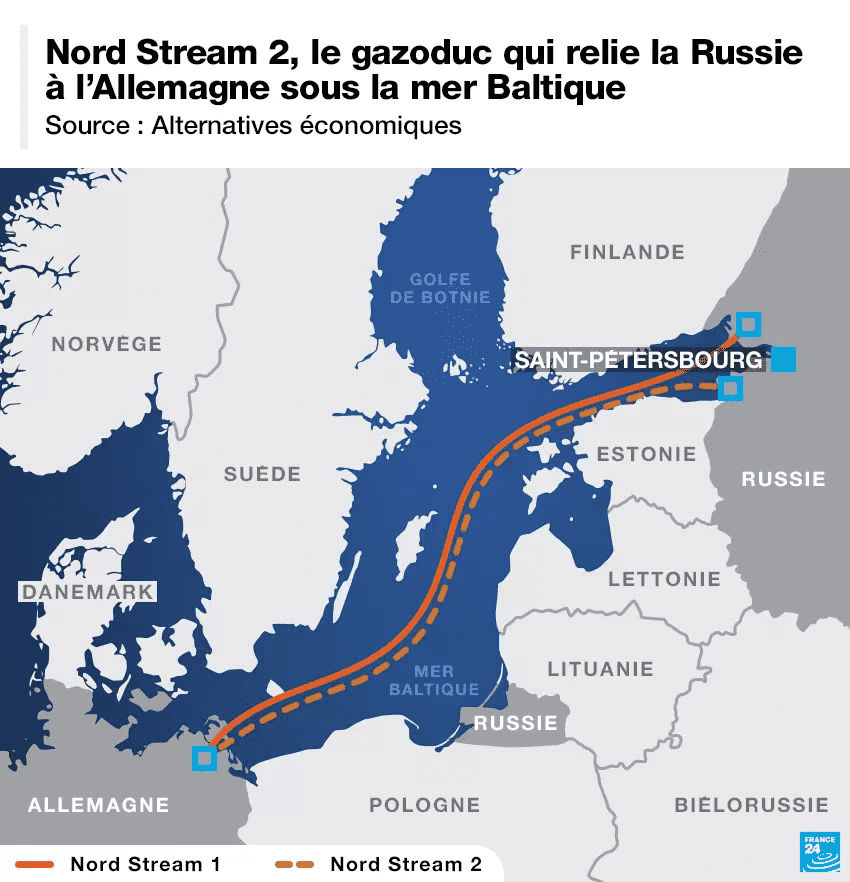
Route of Nord Stream and Nord Stream 2 - Source: Alternatives Économiques/France 24
Given the geopolitical tensions, in particular because of the conflict between Ukraine and Russia, the project has many detractors. At the front row, the United States, Ukraine and therefore a few European countries.
This project finds detractors in Europe, but also allies. In fact, the five companies that financed the project are all European: The French Engie, the Anglo-Dutch Shell, the Austrian OMV, the Austrian OMV, the German Uniper and Wintershall. Nevertheless, Gazprom remains the 100% shareholder of the project.
On the other hand, there are actors in Eastern Europe who oppose this project. The armed conflict that took place in Ukraine a few years ago with Russia significantly deteriorated their relations. Ukraine and Poland are vehemently opposed to it.
Germany, and more specifically Angela Merkel, has had an ambiguous role on the subject. As her country is highly dependent on gas (the country having quit nuclear power through the Energiewende), the chancellor could not afford a confrontation. It will content itself with condemning the use of hydrocarbons as a means of pressure.
The European Union is rather in favour of the project, guided by primarily economic objectives, and sees this as a procurement opportunity for Europe.
The gas structure passes through the territorial waters of many different countries (Denmark, Germany...). This requires the agreement of all these countries; in times of geopolitical tensions, this can become a real balancing act. For a time, Denmark refused to allow the project to be developed in its maritime space.
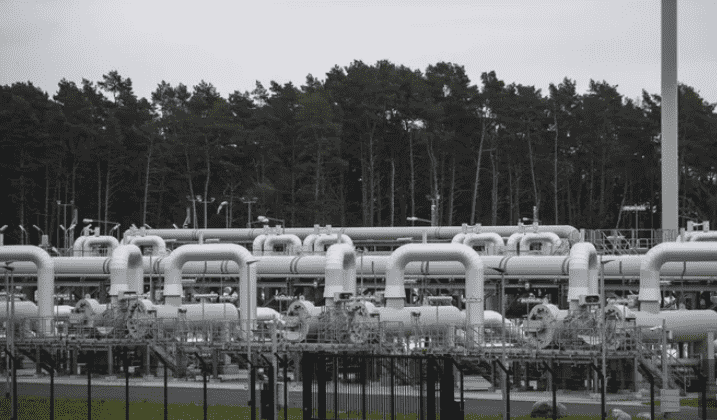
Exit point of the Nord Stream 2 gas pipeline in Germany - Source: Le Figaro
As early as 2017, the American government put pressure on all of its European partners in order to abandon the project. The United States takes a very bad view of the establishment of Russian gas delivery facilities. These are obviously historical geopolitical rivalries dating back to the 20th century between the former Soviet Bloc and the USA.
Donald Trump has tried numerous times to make the project fail. He passed the law allowing him to sanctioning the companies that participated in the construction of the project. These sanctions are slowing down the project; as such, the company Allseas (specializing in the construction of underwater projects) is withdrawing from the project.
The US strategy is to threaten sanctions, in particular subcontractors linked to Nord Stream 2. The aim is to discourage companies specializing in the installation or maintenance of equipment from working on this project. This even applies to insurance companies!
Several European heads of state have spoken out against this new gas transport project. Indeed, these heads of government fear the use of this pipeline as a weapon of mass negotiation.
Some countries in the east are heavily dependent on Russian gas supplies. The establishment of this new transport axis reinforces these already favorable conditions in the Kremlin. Ukraine is among the first detractors. And for good reason, Nord Stream 2 does not pass through Ukrainian territory, unlike other gas pipelines that bring high revenues to the country.
The project therefore deprives Ukraine of very significant revenues from the transit of Russian gas on its territory. Relations between the two countries exploded during the armed conflict in 2014. Crimea and the Donbass region are still currently the scene of clashes. It is therefore quite normal for Kiev to take a very negative view of the development of this new gas route.
In the past, Russia has already cut off gas supplies to Ukraine; no sanctions have been issued against Russians. Ukrainian President Volodymyr Zelensky said that Nord Stream 2 was simply a” dangerous geopolitical weapon ”.
It is not necessary to analyze the impact of Nord Stream 2 on the climate directly, but in a way indirect.
The average lifespan of underground structures is often in the tens of years. GRTgaz In particular, estimates the lifespan of such structures at over 50 years. Made by welding several thousand watertight steel tubes, this type of structure is protected from bad weather.
However, Europe announces her carbon neutrality with the aim of the year 2050. A quick calculation makes us understand that the goal of zero CO2 emissions has already been abandoned. In the race to know what will be the energy of the future, or rather the energy of transition, gas is the favorite.
We are already hearing this kind of speech, especially in the energy sector, especially at the gas giant. TotalEnergies. Its leader P. Pouyanné declared on October 1, 2021 in the columns of Les Échos:” Gas is a fossil fuel, but it makes it possible to overcome the intermittency of renewable energies ”.
The construction of this new connection therefore confirms this clever calculation. In this sense, Germany is very invested in this project, because the massive installation of wind turbines forces them to maintain a source of flexibility. For this reason, energy giants continue to invest in gas as a source of electricity generation. This project is likely to slow down the EU in its quest for carbon neutrality linked to the energy transition.
As an avid reader of our articles, you know that gas prices have soared in recent months to reach new heights. The post-Covid recovery as well as strong Asian demand in the face of stagnant production have caused prices to explode.
European gas prices may ease if the pipeline is quickly put into service. Mechanically, If supply covers demand, the shortage situation then disappears.
This could lead to lower gas prices; unfortunately, it is very difficult to say anything in this area. If the parameters we currently know (level of demand, normal seasonal temperatures, etc.) are maintained, it is likely to see prices fall. However, we are not immune to news that could change the situation. In particular, the American market should be monitored.
Today, this international project has been completed. It is currently being certified and completed. German regulators must give their final green light to the use of this gas pipeline. It is very likely that we will hear more about this project in the coming months.
The United States seems to have abandoned the idea of sanctioning this gas pipeline; however, political developments in Europe may change the situation. Whether it's a new election (in France or Germany) or a rise in the EU, we're likely to hear about it very quickly!
Do not hesitate to consult our article on the War in Ukraine - What dependence on Russian gas for EU countries?
In a few clicks, organize an exchange with one of our experts.


weekly newsletter subscribers

4.9

.png)

L'augmentation s'explique par la revalorisation de l'Accise sur le gaz à 16,39 €/MWh et la hausse de 3,41 % du tarif de transport (ATRT 8).
S'y ajoute l'entrée en vigueur des Certificats de Production de Biogaz (CPB), un nouveau coût réglementaire pour soutenir le biométhane.
Face à ces évolutions, Sirenergies vous accompagne dans l'achat de gaz naturel pour sécuriser vos prix malgré la volatilité du marché.