

Laurence
MOUEZY RAMOGNINO
Sirenergies Communication Director
Table of contents


What are the differences between GRDF and GRTgaz?
March 6, 2026
6
Min reading
For many, the energy sector seems complex because it is full of acronyms and incomprehensible technical words. In this context, it is difficult to find your way around. In order to see things more clearly, this article focuses on the differences between two major energy players in the gas sector, GRDF and GRTgaz.
The process of transporting natural gas in France
Before explaining the differences between GRDF and GRTgaz, let's remember that natural gas is delivered to France in two distinct ways:
- By gas pipeline (underground or submarine pipes);
- By liquefied natural gas (LNG).
Feel free to go through this article for more information: How is natural gas extracted, processed, and refined?
GRDF, the gas distribution network operator in France
History and creation of GRDF
Formerly Gaz de France, GRDF was created in 2008 following the creation of the European market and the liberalization of the energy market in France.
The supply, production and distribution activities of the energy company are then separated to create independent entities. Distribution is a public utility and is not intended to be a commercial activity.
This is also why it is monitored by three public actors: the CRE (Commission for Energy Regulation), local authorities and the State. We can draw a parallel with EDF (supplier) and Enedis (distributor), which were also originally a single entity (EDF).
Today, every 5 years, GRDF renews a public service contract with the State that regulates its activity. It defines the commitments and missions of the company.
Missions and responsibilities of GRDF
GRDF fulfills 6 essential missions:
- Ensuring the security of gas supply of its customers and ensure the continuity of public service.
- Be responsible for network security and the installations for which it is in charge through the concessions granted by the local authorities.
- Maintaining relationships qualitative with all customers, support poor customers and collaborate with the National Energy Ombudsman.
- Develop in a balanced way the network in metropolitan France by taking into account the expectations of local authorities.
- Perform a energy transition to reduce greenhouse gas emissions by supporting local authorities in the energy transition of territories and project managers and end consumers in energy efficiency of their new construction and renovation projects.
- Innovate, research and develop services and technologies for a low-carbon future.
In a few words, its role is toensure distribution sustainable gas in France in the best conditions to give the greatest number of people access to this energy at the heart of the life of the territories.
Thanks to his distribution network approximately 200,000 km long, it covers more than three quarters of French territory. Other distributors, mostly ELD (Local Distribution Companies) or agencies, manage the rest of the concessions.
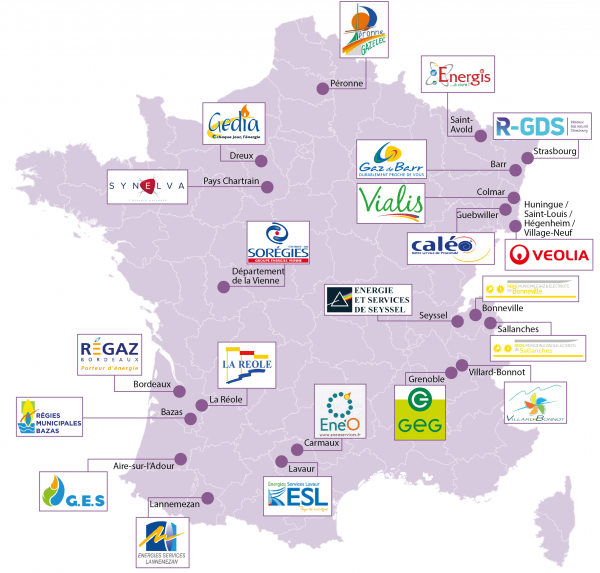
ELD - Natural gas distribution networks - Source CRE
Relationships with players in the sector
GRDF depends on the public authorities, in particular the CRE. Les delivery rates are his only source of income and these are determined by CRE.
Controlling prices ensures that all vendors benefit from the same conditions of access to the distribution network. This tariff is then approved by a joint decree of the Minister of Energy and the Minister of the Economy and re-evaluated every year on 1Er July.
The distributor's relationship with suppliers is centered around two principles:
- The distributor treats suppliers on an equal footing; there is no preferential treatment to preserve competition;
- GRDF transmits a lot of crucial data to suppliers so that they can take care of their customer portfolio in the best possible way: index, thermal coefficient, frequency of readings, allocations, profiles. This data allows suppliers to know everything about determining the quantities that are sent to customers.
GRTgaz, the gas transmission system operator in France
The history of GRTgaz
Created in 2005, GRTgaz is today a subsidiary of the industrial group Engie holding around 61% of the shares and of a public consortium called Société d'infrastructures gazières (SIG) holding around 39% of the shares.
At the time of its creation, GRTgaz was a subsidiary of the Gaz de France group, which then merged with the Suez group to form GDF SUEZ. In May 2015, GDF SUEZ was renamed Engie.
Missions and responsibilities of GRTgaz
As the owner and operator of the natural gas transmission network covering most of France, GRTgaz plays a key role in the national gas sector. The rest of the territory is managed by the company Teréga (formerly TIGF).
The French transport network is divided into two parts:
- A main network composed of large high-pressure pipes that connect the interconnection points with neighboring networks, underground storages And the LNG terminals. There is a limited number of customers directly connected to this network;
- A regional network connected to the main network, which ensures the transport of natural gas to the distribution networks and to other major consumer end customers directly connected to this network.
Network maintenance is the main responsibility of GRTgaz in order to guarantee the continuity of gas delivery to its customers over nearly 32,000 km of pipeline.
Relationships with gas market players
GRTgaz's activity is in the public interest, so it must offer the same quality of service to all its customers (consumers and suppliers). Moreover, because of its natural monopoly, it is important that all actors are on an equal footing. Otherwise, unfair competition or exorbitant transport prices could be harmful to the French.
The CRE plays the role of guardrail, it:
- Guarantees access to gas infrastructures and determines access rules;
- Determines access rates to transport networks as well as to underground natural gas storage infrastructures and LNG terminals;
- Contributes to the work of ACER (Agency for the Cooperation of Energy Regulators) aimed at harmonizing the functioning of infrastructures across Europe.
She maintains close relationships with the managers of gas storage, which manage the storages and therefore the supply of the main network.
Finally, it coordinates with the French distribution network to supply small consumers.
Comparison between GRDF and GRTgaz
Differences/similarities between missions and responsibilities
The relationship between GRDF and GRTgaz is comparable to the road network: GRDF is the equivalent of streets, avenues and departmental roads, while GRTgaz represents motorways and national roads.
In other words: GRDF manages the distribution network and GRTgaz manages the transport network.
As you can see, their missions seem similar, but each entity operates at a different scale in the gas sector. GRDF works at a local level to distribute gas to small industries and individuals.
While GRTgaz acts on a national or even international scale with neighboring countries. It also transports gas to the largest consumers who cannot meet their needs via the distribution network.
The two companies work hand in hand to manage the delivery of volumes corresponding to supplier contracts and estimate each day, on a provisional basis, the quantities brought the day before for consumers.
Differences in pricing and costs
As specified above, it is the CRE that determines pricing and develops with operators the long-term vision for gas networks in France.
The cost of delivery is broken down as follows:
- The rates ART (Third-Party Access to Transport Networks), updated every 1Er April;
- The rates LATE (Third-Party Access to Distribution Networks), updated on 1Er July.
To determine the cost of delivery, there are several rate options (T1, T2, T3, T4, T4, TP and Transport sites) which depend on the volume of gas consumed per year.
Who are the other natural gas transmission and distribution managers in France?
There is only one other transport manager, Teréga (ex-TIGF), which is in charge of south-western France, in particular the interconnection with Spain. Its concerns are exactly the same as those of GRTgaz. For structural and practical reasons, this duopoly has been maintained since the liberalization of the market.
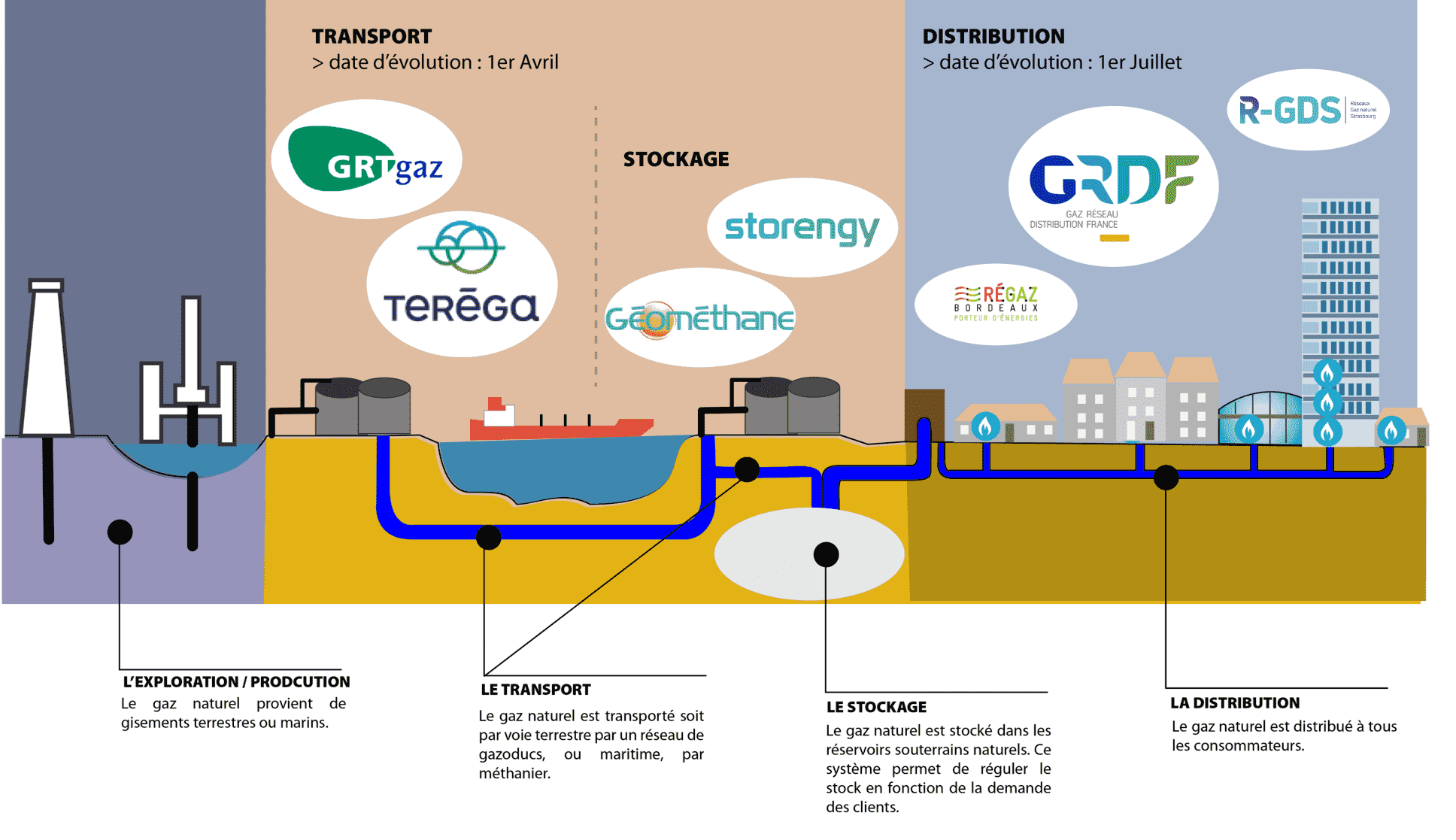
Natural gas: how does it work? - Source: Dyneff Gaz
To summarize:
- GRTgaz integrates gas imports from abroad into its transport network and uses it to transport gas to major final consumers or to the distribution network.
- GRDF, as the distribution system operator, receives its gas from the transmission network and delivers it to professional and private consumers on its distribution network.

Natural gas transport and distribution networks in France - Source CRE
To go further, do not hesitate to consult our article on The differences between Engie and GRDF.


Take the first step towards optimization
In a few clicks, organize an exchange with one of our experts.





weekly newsletter subscribers

4.9
