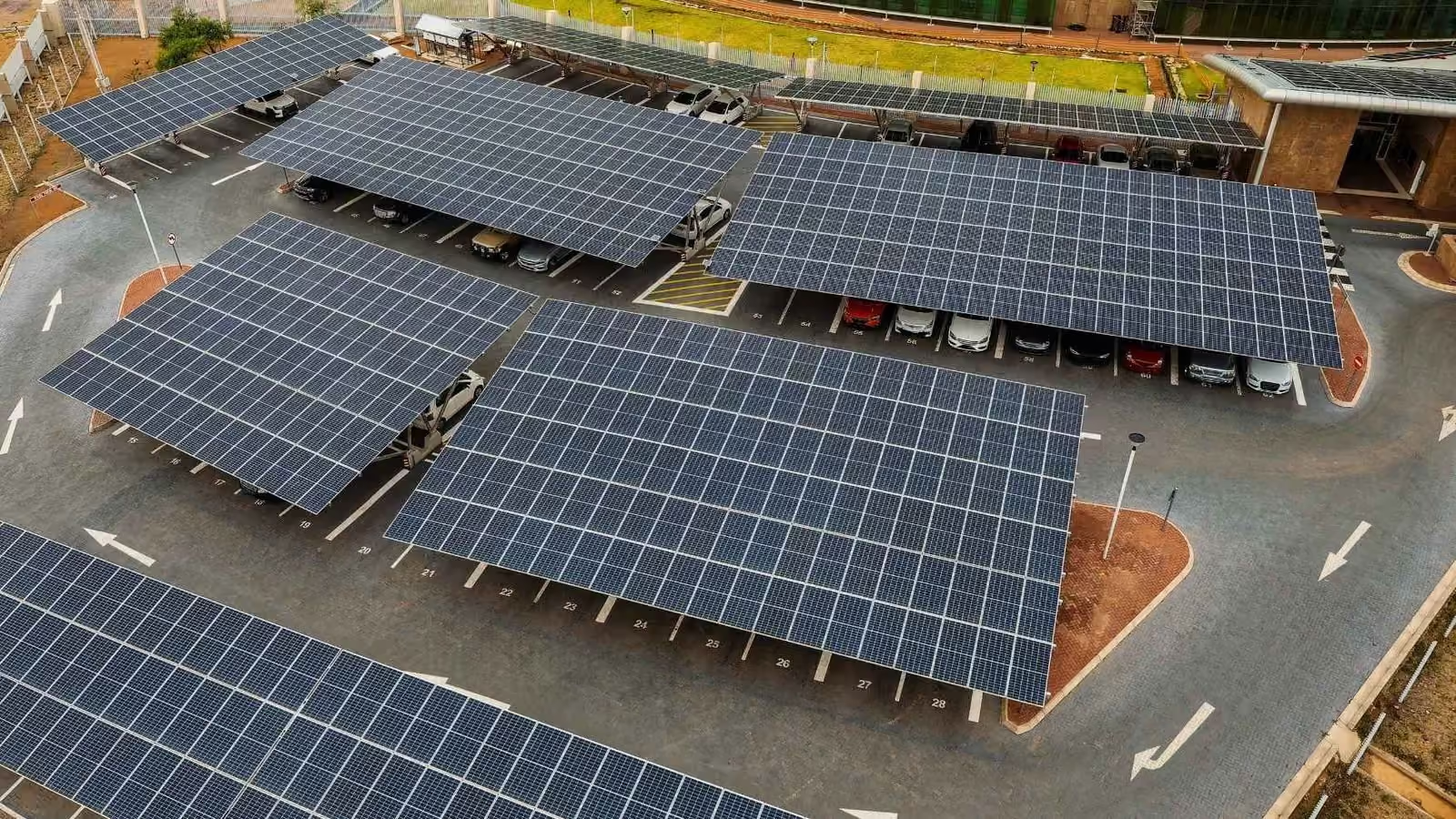
July 2026 is a key deadline for companies with outdoor parking lots larger than 10,000 m²: these must now be equipped with solar carports. Another requirement is being strengthened: the mandatory photovoltaic or green roof coverage rate for new non-residential buildings is increasing to 40%.
These measures stem from the APER law, passed in 2023. Behind this acronym lies a clear objective: to accelerate the deployment of renewable energy in France.
The challenge for businesses is not just regulatory. These solar requirements represent an environmental and financial opportunity. Producing solar electricity sustainably reduces energy bills, strengthens a company's energy independence, and accelerates its transition toward a more efficient and resilient model.
Obligations, deadlines, penalties, exemptions, and solutions: here is what you need to anticipate now to bring your business into compliance with the APER law.
Key takeaways
- The APER law imposes solar energy requirements on businesses.
- Starting July 1st , 2026, 40% of the surface area of parking lots larger than 10,000 m² must be covered by solar installations.
- As of July 1st st, 2026, the required photovoltaic or green roof coverage rate for new non-residential buildings increases to 40%.
- Between now and 2028, these requirements will be strengthened and gradually extended to all existing parking lots and non-residential buildings.
- Technical and financial levers are available to help companies approach this transition with confidence.
1. What is the APER law for the acceleration of renewable energy?
1.1 The origins of the APER law
In 2023, despite existing environmental legislation, France was struggling with renewable energy. It had yet to reach the target set by the 2009 European directive, which aimed for 23% of final energy consumption to come from renewable sources.
Against this backdrop, the war in Ukraine exposed the fragility of a persistent dependence on imported fossil fuels.
Faced with the climate emergency and energy vulnerability, renewable energy production needs to scale up significantly.
The law on the acceleration of renewable energy production (known as the APER law), adopted on March 10, 2023, addresses this dual strategic imperative.
1.2 Key pillars of the APER Act
The APER Act is structured around seven pillars:
- Planning "renewable energy acceleration zones" (ZAER) with local authorities to anchor renewable energy projects locally and foster their acceptance.
- Simplifying procedures and shortening processing times to accelerate project development.
- Utilizing land that has already been developed to avoid encroaching on agricultural or natural land.
- Accelerating solar energy, particularly through new photovoltaic requirements for businesses.
- Developing offshore wind power through a simplified legal framework.
- Sharing the value and economic benefits of renewable projects with local communities and residents.
- Reconciling biodiversity and renewable energy.
1.3 The APER Act, the Climate and Resilience Act, and the Huwart Act: how do they work together?
The APER Act is a continuation of the Climate and Resilience Act.
In 2021, the Climate and Resilience Act established the general framework for the national energy transition. The text introduced initial photovoltaic requirements for new non-residential buildings and their associated parking lots.
In 2023, the APER Act stepped on the accelerator. Focused on renewable energy, it strengthens and expands photovoltaic requirements for businesses.
In 2025, the Huwart Act adjusted the framework, taking into account initial feedback. Without calling the overall trajectory into question, it relaxed the rules and timelines.
💡
Loi APER : qui est concerné ?
Les secteurs disposant de vastes parkings et toitures sont les plus directement impactés par les obligations de la loi APER :
- Grande distribution,
- industrie et logistique
- Tertiaire
- Collectivités
- Établissements de santé.
2. 2026 APER Act: what are the obligations and penalties for businesses?
The APER Act imposes concrete obligations on businesses regarding renewable energy production. They are affected by two components: the installation of solar panels on outdoor parking lots and rooftop photovoltaic installations, with deadlines in July 2026.
Here is a comparative summary of the two requirements:
| Critère |
Parkings extérieurs |
Toitures (bâtiments non résidentiels) |
| Surface concernée |
Plus de 10 000 m² dès 2026 ; 1 500 à 10 000 m² ensuite |
Plus de 500 m² d'emprise au sol |
| Échéance principale |
1er juillet 2026 (plus de 10 000 m²) |
Neufs depuis 2025 ; existants à partir de 2028 |
| Échéance secondaire |
1er juillet 2028 (report possible au 1er juillet 2030 via la loi Huwart) |
— |
| Taux de couverture |
40 % en 2026, puis 50 % en 2027 |
30 % en 2025, 40 % au 1er juillet 2026, 50 % au 1er juillet 2027 |
| Solution acceptée |
Ombrières photovoltaïques (+ végétalisation possible) |
Production d'ENR (photovoltaïque) ou végétalisation |
| Sanction (non-conformité) |
40 000 €/an (plus de 10 000 m²) ; 20 000 €/an en dessous |
— |
2.1 Solarizing outdoor parking lots
The APER law mandates the partial coverage of outdoor parking lots with solar carports. Lots larger than 10,000 m² are affected starting July 1, 2026. The deadline is extended to July 1, 2028, for areas between 1,500 m² and 10,000 m².
The coverage rate is progressive:
- 40% in July 2026.
- 50% in July 2027.
The Huwart Law of November 26, 2025, relaxed certain requirements:
- It allows for a combination of solar carports and greening to reach the 50% target, provided that at least 35% of half the total parking area is covered by solar panels (i.e., 17.5%).
- It maintains the July 1, 2026, deadline for parking lots over 10,000 m². It authorizes a postponement from July 1, 2028, to July 1, 2030, for parking lots between 1,500 and 10,000 m².
In case of non-compliance, financial penalties of 40,000 euros per year apply for parking lots over 10,000 m² (20,000 euros for those under 10,000 m²).
Good to know: For parking lots operated under a concession, public service delegation (DSP), or temporary occupation permit (AOT), the responsibility for compliance is transferred to the operator. The deadline is shifted to the contract renewal date.
2.2 Rooftop solar requirements
Stemming from the Climate and Resilience Law, the solar requirement for non-residential buildings has applied to new buildings since 2025.
The APER law extends this to all existing non-residential buildings starting in 2028.
In practical terms, roofs of buildings with a footprint of more than 500 m² must incorporate:
- either a renewable energy production system (most commonly solar panels);
- or a green roof system.
The roof coverage area increases from 30% in 2025 to:
- 40% starting July 1, 2026.
- 50% starting July 1, 2027.
3. Levers for bringing your company into compliance with the APER law
The APER law entails costs for businesses. However, a structured, managed, and coherent approach makes it possible to maximize project profitability and, in the long run, achieve financial savings.
3.1 Building and managing your renewable energy strategy from A to Z
A high-performance photovoltaic project is built by following key steps:
- Assess the site's solar potential, taking into account roof orientation and tilt, shading, and the technical constraints of the supporting structures.
- Conduct a technical and financial feasibility study to determine the installable capacity, investment and operating costs, as well as the optimal business model (self-consumption and resale rates).
- Manage administrative and technical procedures: planning permits, grid connection requests, competitive bidding for installers, construction, and commissioning.
- Monitor, optimize, and manage performance to detect malfunctions, verify actual production, optimize self-consumption, adjust usage, and measure actual financial savings.
Optimize your usage, manage your consumption, and secure your profitability with our Pilott energy management platform.
{{pilott-conso="/ctas"}}
3.2 Self-consumption or resale: making your photovoltaic installation profitable
Three business models are possible: self-consuming the entire production; reselling the entire production; or combining both solutions.
- Solar self-consumption involves consuming the electricity produced by photovoltaic panels or solar carports directly on-site. Every kilowatt-hour self-consumed is a kilowatt-hour not purchased from the grid. The impact on your bill is immediate and measurable.
- Resale involves selling electricity to EDF Obligation d'Achat (OA) at a regulated rate.
By combining self-consumption with the resale of surplus energy, the return on investment is generally between 6 and 10 years, depending on the size of the installation, the consumption profile, and the subsidies obtained.
3.3 Financing your photovoltaic project
Subsidies help reduce the cost of a photovoltaic project and accelerate the return on investment.
- Self-consumption bonus (for grid-connected installations under 100 kWp): the amount depends on the power capacity and the current scale. For example, in June 2026, a 36 kWp installation qualifies for 4,320 euros.
- Regulated feed-in tariff: the EDF Purchase Obligation (EDF OA) contract secures revenue from selling electricity to the grid. The rate is guaranteed for 20 years.
- Tenders CRE (for installations over 100 kWp connected to the grid): large-scale photovoltaic plants can secure a feed-in tariff by applying to the Energy Regulatory Commission's tenders.
- Regional subsidies: certain regions, such as Grand Est or Normandy, support renewable electricity production. Until December 31, 2026, theADEME also funds feasibility studies for renewable electricity production in overseas territories and Corsica. The Chamber of Commerce and Industry (CCI) can guide you toward existing local grants.
- Accounting depreciation: depreciation is not a financial grant, but this tax lever reduces the company's taxable income. Panels, inverters, and solar carports are tangible assets that can be depreciated over 8 to 25 years.
💡
Le saviez-vous ?
Le tiers-investissement, une solution plébiscitée par les entreprises Le tiers-investissement permet aux entreprises de respecter leur obligation réglementaire sans investir. Un opérateur tiers finance et gère la construction et l'exploitation de l'installation photovoltaïque. Deux montages existent : soit le tiers récupère les recettes de la vente de l'électricité sur le réseau et reverse un loyer à l'entreprise pour l'usage de la toiture ou du parking ; soit l'entreprise consomme directement l'électricité renouvelable produite en bénéficiant d'un prix stable et compétitif, fixé via un contrat PPA (Power Purchase Agreement).
Grants, third-party investment, self-consumption: the right setup depends on your consumption profile and financial strategy.
{{ask-conseil="/ctas"}}
Conclusion
Parking lots, rooftops, new builds, existing buildings: the deadlines for the APER law are rolling out through 2028. The development lead times for a photovoltaic project mean you cannot afford to wait. Anticipation starts today.
When well-planned, a photovoltaic installation is not just another mandatory regulatory expense. It is a profitable investment. Lower energy bills, reduced grid dependency, and increased property value: companies that commit today gain a regulatory, environmental, and economic head start.
"As an industrial player, energy is no longer just a cost item; it's a strategic lever. We needed a clear, real-time vision to shift to proactive management of our purchasing and consumption." - Raphaël Dehlinger, CFO, Sotralentz Construction.
See all testimonials
Sirenergies analyzes your consumption profile to build high-performance photovoltaic projects and reduce your electricity bill.
{{ask-rdv="/ctas"}}