




Summarize with AI

August 28, 2026
6
Min reading

The energy transition pushes us to change our habits. Indeed, it is shaking up our consumption patterns and our perception of energy resources.
Globally, in the wake of the Second World War, our societies developed at a breakneck pace. To do this, we needed considerable volumes of energy. Humanity has therefore become accustomed to energy that is abundant, cheap and available at all times.
Today, the upheavals induced by the Global warming push us to change our vision of our consumption patterns. The time is at energy sobriety.
This is why the majority of countries in the world are committed to reducing their CO emissions.2. But energy efficiency and renovation are also at the heart of the debates.
Indeed, the public authorities want to encourage businesses to reduce their consumption in the coming decades. So there are many challenges of energy transition who are behind measures such as The tertiary decree. The challenge is obviously to reach carbon neutrality in the long term.
First of all, it should be remembered that the building sector plays a major role in achieving the energy goals set. You should know that tertiary buildings represent 83% of the French real estate stock.
The sector is responsible for 45% of final energy consumption in France (nearly 25% of greenhouse gas emissions as well). It is therefore an important source of potential savings.
Today, with the tertiary decree, these obligations extend across a much larger set of companies.
It is important to remember that it is possible to turn these obligations into opportunities for your business. Indeed, each company can set up an energy management strategy, and thus incorporate energy efficiency projects.
In this way, we meet the criteria of sobriety while reducing costs.
As we said in the introduction, it is imperative to successfully carry out a campaign to reduce consumption at tertiary sites.
This is why the ELAN law (Evolution of Housing, Development and Digital Technology) amended the Construction and Housing Code. Today, all owners of commercial areas of more than 1,000 m² must reduce their energy consumption.
In particular, it was subsequently the tertiary decree, which came into force in October 2019, which specified how it worked:
Therefore, there are energy consumption goals: the decree plans to reduce them by 40% in 2030, 50% in 2040 and 60% in 2050.
This reduction is compared to a reference year. The company can therefore choose this year between the years 2010-2020 (at standardized temperatures).
Obviously, there are sanctions associated with this mechanism. In the event of non-compliance with obligations, the company is exposed to a fine of up to €7,500.
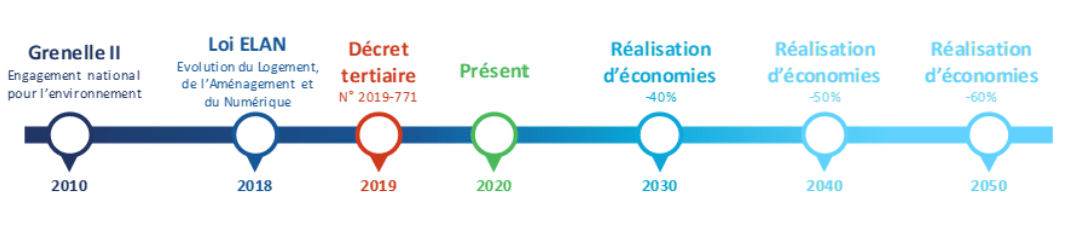
Source: DEXMA
In practice, it is possible to choose between two calculation methods: relative or absolute values.
Depending on the method chosen, the consumption reduction thresholds to be achieved may therefore vary.
New decrees will specify the calculation methods in question. In all likelihood, they should be published in 2021.
Each year, the companies concerned will have to report their consumption data on The OPERAT platform.
ADEME will then check the declarations of the various actors. The consumptions will be calculated and, in this way, control is made possible.
Roles and responsibilities are shared between owner and occupier. This must be clearly stated in the rental lease.
There are rare exemptions concerning certain special buildings. For example, there are places of worship or even those related to defense and the army.
Each company must declare its information on the OPERAT platform imperatively before September 2021. Indeed, it is important information such as the choice of the reference year, the surface of the buildings...
It is good to know that when a business moves, it is then giving up its old obligations to the new tenants. You can find all the details of the calculation in the decree.
We will now look at how a business can achieve its consumption reduction goals.
The objectives of this decree are colossal. Indeed, it is essential to implement an energy management strategy in order to achieve them. For this, there are several solutions, with new technologies bringing considerable developments in this respect.
It is interesting to note that this system has an obligation of result. That is, companies are free to choose their method (s), the important thing is to achieve the objective. This makes it possible to make the mechanism more flexible and to give businesses some freedom.
There are different types of energy efficiency projects:
Many energy performance projects are compatible with cost savings. Their profitability is generally less than 10 years.
These cuts and the achievement of the objectives of the tertiary decree are two good reasons for a company to invest in them. It is important to be supported in this type of project. Do not hesitate to contact us in order to develop your energy management strategy.
Today, it is clear that the implementation of this type of projects is in the interest of tertiary companies.
It is essential to understand the energy transition in order to make it an opportunity more than a cost.
The introduction of these goals can contribute to the breakthrough of the digital world in the energy sector. The emergence of new energy management technologies now makes possible the concept of Smart City.
Intelligent temperature control software, or connected objects, will contribute to achieving the objectives of the tertiary decree. These are two groundbreakers that are already changing the way we consume.
Resulting from a desire of the French government, the Tertiary Eco-Efficiency System (DEET), also called Tertiary decree, requires a gradual reduction in energy consumption for French tertiary buildings greater than 1,000 m².
This regulation aims to save 60% of final energy in these buildings by 2050.
We support you in the compliance tertiary buildings in order to comply with the obligations of the tertiary decree.
Click below for more information:
In a few clicks, organize an exchange with one of our experts.


weekly newsletter subscribers

4.9

.png)

The subscribed power must be calculated according to the consumption profile and uses (heating, industrial processes, tertiary equipment). One fine analysis makes it possible to ensure the adequacy between real need and contract.
Among the taxes include TICFE, TICGN, CTA, CJA and TURPE. They represent a significant part of the bill and vary according to consumption profiles. Understanding them well is essential to optimize costs.
Ce seuil est jugé élevé par rapport aux prévisions actuelles du marché. Si le prix de l'électricité reste en dessous de 78 €/MWh, les entreprises ne bénéficieront d'aucune redistribution. Cela signifie que la protection promise par la réforme pourrait être inexistante dans un marché baissier, d'où l'importance de stratégies de sourcing agiles et d'outils de monitoring comme Pilott.
Plusieurs leviers existent pour préserver la fiscalité locale :
One invoice consists of several elements: consumption, supplier share, taxes and contributions. The analysis of each line makes it possible to identify possible errors and to check the consistency with the signed contract.
C'est le levier le plus rapide pour obtenir des résultats visibles. L'éclairage représente environ 40 % de la consommation d'électricité d'une commune.
Passer au LED avec pilotage intelligent permet de réduire la facture de 50 à 80 %, avec un retour sur investissement (ROI) rapide, souvent estimé à 2 ou 3 ans.
Les profits include a direct reduction in bills, strengthened budgetary forecasting and better control of consumption. Businesses gain visibility and efficiency thanks to adapted tools.
Pas nécessairement sur votre facture finale. Si les prix de gros (le prix de l'énergie brute) ont baissé, les coûts d'acheminement (TURPE) et certaines taxes augmentent, compensant souvent la baisse de la part énergie.
Absolument. La réforme des heures creuses vise à absorber la surproduction solaire en milieu de journée. Les créneaux d'heures creuses se déplacent progressivement vers la plage 11h00 – 17h00, notamment en été. C'est une opportunité majeure pour les sites industriels ou tertiaires capables de flexibilité.
Conseil stratégique :
L'impact dépendra des prix de marché. Le mécanisme prévoit une redistribution si les prix dépassent 78 €/MWh. Cependant, si les cours restent bas (actuellement autour de 60 €/MWh), le dispositif ne s'activera pas. La facture sera alors indexée à 100% sur les prix de marché, rendant le choix du fournisseur et du moment d'achat critiques.
This makes it possible to choose the right time to contract, secure your budgets and anticipate increases.
Changing suppliers can allow you to benefit from more competitive prices, adapted services or better contractual conditions. Thanks to sourcing, change is happening without interruption of supply.
The range E @sy is available in four pricing structures to adapt to each risk profile:
En analysant votre courbe de charge pour identifier la puissance réelle appelée, puis en demandant un ajustement à votre fournisseur ou via un expert en énergie.
Même le bâtiment le plus moderne et le mieux isolé perd son efficacité si ses usages sont inadaptés. La technologie et les normes ne suffisent pas : la transition énergétique est avant tout une transformation humaine.
Derrière chaque kilowattheure consommé se cache une habitude.
Un collaborateur sensibilisé comprend qu'ouvrir une fenêtre alors que le chauffage est allumé ou laisser un ordinateur en veille consomme de l'énergie inutilement. En replaçant l'humain au centre de la stratégie de gestion de l'énergie, l'entreprise s'assure que ses équipements performants sont utilisés de manière optimale, garantissant ainsi une rentabilité durable et un impact environnemental réduit.
Industrial companies consume large volumes of energy for their production processes. They have to deal with the volatility of prizes, multi-site management and specific taxes. Controlling costs is essential to remain competitive.
Non. L'IA traite la donnée (data processing), mais l'analyste apporte la compréhension du contexte (market sentiment) et la prise de décision stratégique.
The €/MWh is a price unit used in wholesale markets, while kWh is the unit visible on your bills.
Les coopératives de taille ETI ou grande entreprise peuvent être soumises à l'audit énergétique réglementaire (norme NF EN 16247). Sirenergies n'a ni la compétence ni l'accréditation pour réaliser cet audit : nous vous orientons vers un bureau d'études partenaire accrédité, et vous accompagnons en amont sur vos achats et en aval sur le pilotage.
In 2025, the supplier had a NPS (Net Promoter Score) of +16 and a note of 4,17/5.
Satisfaction is based on a “zero solicitation” model and 100% in-house customer service in Toulon, guaranteeing proximity and responsiveness that cannot be found with major historical suppliers.
Tertiary companies are concerned by taxes such as TICFE or TICGN. Sirenergies checks the accuracy of invoices, identifies possible exemptions, and helps correct errors to sustainably reduce costs.
Farms are subject to taxes such as TICFE or TICGN. Sirenergies verifies their application, identifies cases of exemption and accompanies the procedures to reduce the tax burden.
Sourcing offers better visibility on the market and promotes the selection of competitive contracts. It helps to reduce the risks associated with price volatility and to optimize the energy budget.
Le dispositif ARENH a laissé place au VNU (Versement Nucléaire Universel).
Ce changement structurel expose davantage les entreprises aux prix de gros, rendant la gestion des risques plus complexe qu'auparavant.
Il devient alors indispensable de définir une stratégie d'achat d'électricité avec Sirenergies pour lisser l'impact de la volatilité des marchés sur votre budget.
En 2026, les principaux leviers sont : la renégociation de votre contrat de fourniture au bon moment, l'optimisation de votre tarif d'acheminement (TURPE), la vérification de votre éligibilité aux taux réduits de taxes (Accise), et la réduction de votre consommation (efficacité énergétique, autoconsommation).
Un appel d’offres permet de mettre en concurrence plusieurs fournisseurs d’électricité et de gaz afin d’obtenir des conditions contractuelles optimisées. C’est une démarche transparente qui permet de choisir l’offre la plus adaptée aux besoins budgétaires et techniques de l’organisation.
L'ARENH est remplacé par le VNU (Versement Nucléaire Universel), un mécanisme de redistribution des revenus excédentaires d'EDF en cas de prix très élevés, et par les CAPN, des contrats long terme pour les gros industriels.
Sourcing consists in identifying and analysing the offers of several electricity and gas suppliers. This approach makes it possible to obtain contracts adapted to the consumption profile and budgetary constraints of the company.
Instauré en 2017, ce dispositif répond à un enjeu de sécurité nationale.
L'électricité ne se stockant pas à grande échelle, le réseau doit être capable de répondre instantanément à la demande, même lors des pics de froid hivernaux. Le mécanisme incite financièrement les producteurs à maintenir leurs centrales disponibles et les entreprises à réduire leur consommation (effacement) lors de ces périodes critiques.
Car les marchés dépendent de facteurs exogènes imprévisibles (géopolitique, météo soudaine, politique) que les modèles basés sur l'historique ne peuvent pas anticiper, tout comme on ne prédit pas le Loto.
La Multiannual Energy Programming (PPE) is the strategic management tool for France's energy policy. Established by the 2015 law on energy transition for green growth (LTECV), it serves as a compass for the State, communities and businesses.
Concretely, the PPE sets the priorities for action of the public authorities for the management of all forms of energy on the national territory. It covers a period of ten years, divided into two periods of five years, and must be revised periodically to adapt to technological and economic developments.
It deals with major topics such as:
It is crucial not to confuse it with National Low Carbon Strategy (SNBC). While SNBC sets carbon budgets (the ceilings for greenhouse gas emissions by sector), the PPE determines the technical and energy resources to achieve them.
La Vente de Nucléaire Universelle (VNU) est le nouveau mécanisme de régulation des prix de l'électricité en France. Contrairement à l'ARENH, il ne s'agit plus d'un volume fixe à prix réduit, mais d'une redistribution financière des revenus excédentaires d'EDF aux consommateurs, basée sur les prix de marché et les coûts de production du nucléaire historique.
Idéalement entre 6 et 12 mois avant l'échéance, de préférence au printemps ou au début de l'été lorsque la demande est plus faible.
Farms must deal with high seasonal needs (greenhouse heating, irrigation, storage) and high volatility of prizes. Controlling these costs is essential to maintain profitability and secure the business.
La fin de l'ARENH (Accès Régulé à l'Électricité Nucléaire Historique) marque l'arrêt de la fourniture d'électricité à prix fixe garanti (42 €/MWh).
Dès le 1er janvier 2026, les entreprises sont exposées aux prix de marché, mais deux nouveaux mécanismes de régulation prennent le relais, bien que leur logique soit différente :
Conseil stratégique : Ne comptez pas sur le VNU pour réduire votre facture en 2026 si les marchés restent stables. Auditez vos contrats dès maintenant pour intégrer une part de prix fixe ou explorer des "Power Purchase Agreements" (PPA) pour sécuriser vos coûts sur le long terme.
Tertiary companies must manage their energy costs while guaranteeing the comfort of users (offices, shops, services). Consumption is often linked to heating, air conditioning and lighting, which requires precise monitoring to avoid budgetary excesses.
Le calendrier 2026 impose deux échéances majeures :
Pour simplifier ces démarches, vous pouvez centraliser vos données de consommation avec la plateforme Pilott de Sirenergies, garantissant ainsi la conformité de vos rapports réglementaires.
Le prix Forward est fixé à l'avance (sécurité budgétaire), tandis que le prix Spot varie heure par heure selon le marché (opportunité mais risque élevé).
Communities are subject to taxes such as TICFE or TICGN. Sirenergies analyzes invoices, identifies exemption possibilities and fixes possible errors to reduce the tax burden.
Chaque modèle d'IA répond à un besoin spécifique du cycle d'achat :
L'expertise humaine reste néanmoins indispensable.
The central objective of PPE 3 is to engage France towards carbon neutrality by 2050 by breaking the country's historical dependence on fossil fuels.
Today, approximately 60% of final energy consumption in France still relies on imported oil and natural gas. PPE 3 aims to radically reverse this trend by setting an ambitious target: to reach 60% of carbon-free energies in final consumption by 2030.
To achieve this, PPE 3 pursues three major sub-objectives:
La réussite d'un projet collectif énergie repose sur trois piliers fondamentaux :
Exceeding capacity leads to financial penalties and can impact the size of the contract. Adjust the correctly subscribed power makes it possible to avoid these additional costs.
All businesses, from SMEs to large organizations, can benefit from this service. Les local authorities also find it a lever to better control their budgets.
The industry is concerned by TICFE, TICGN and other contributions that may represent an important part of invoices. Sirenergies identifies cases of exemption and accompanies the procedures to benefit from them.
Some businesses may obtain a partial or total exemption from the TICFE or the TICGN, depending on their activity and energy intensity. The support of an expert makes it possible to identify the eligibility criteria and to put together the file.