




Summarize with AI

January 28, 2026
9
Min reading

After two years of pandemic followed by the war in Ukraine, Europe is plunged into one of the most serious energy crises in its history. Faced with this challenge, the government has launched an energy sobriety plan.
However, it now seems inevitable that global energy demand will continue to grow. For what reasons? What are the reasons for this? What is the situation by country and by energy source?
So many questions on which SirEnergies will try to shed some light.
Energy consumption per inhabitant varies widely around the world:
From these figures, let us remember that:
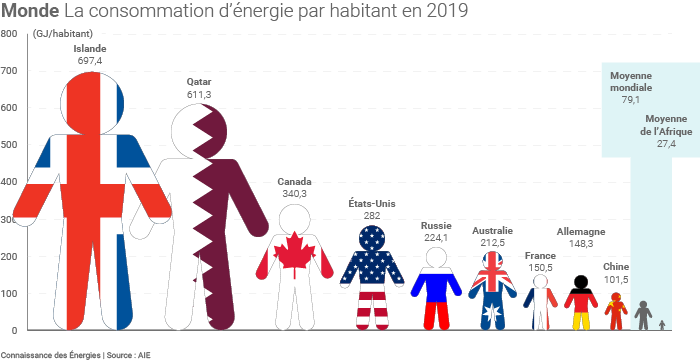
Energy consumption per inhabitant is impacted by lifestyles, in particular because of:
In fact, the 3 main energy-consuming countries in the world are:
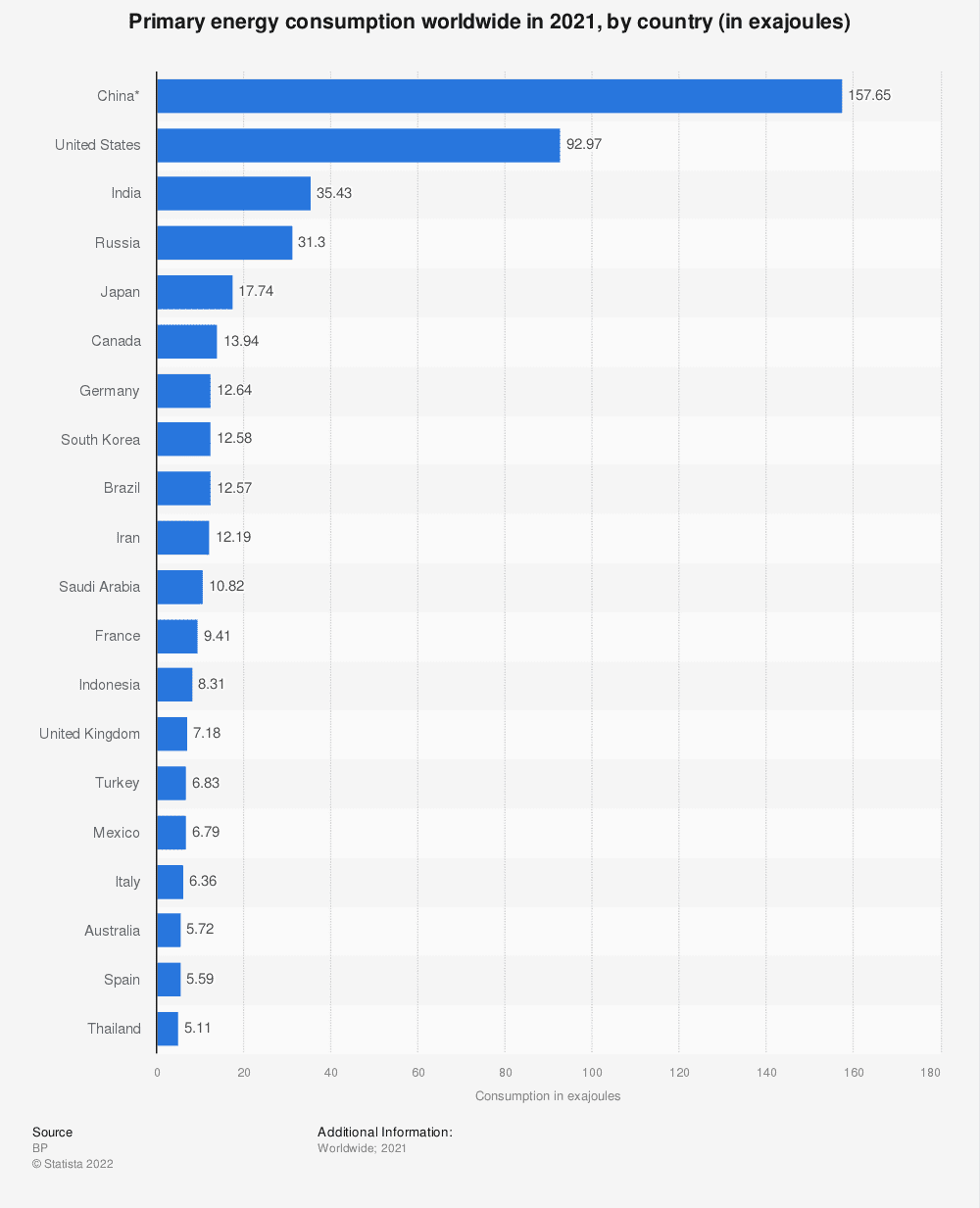
Indeed, developed or developing countries are also the largest consumers of energy. The factors that most influence a country's energy consumption are:
In 40 years, global energy demand has doubled:
This growth averaged 1.8% per year over 40 years. Since the advent of coal in the 1850s, global energy consumption has never stopped growing:
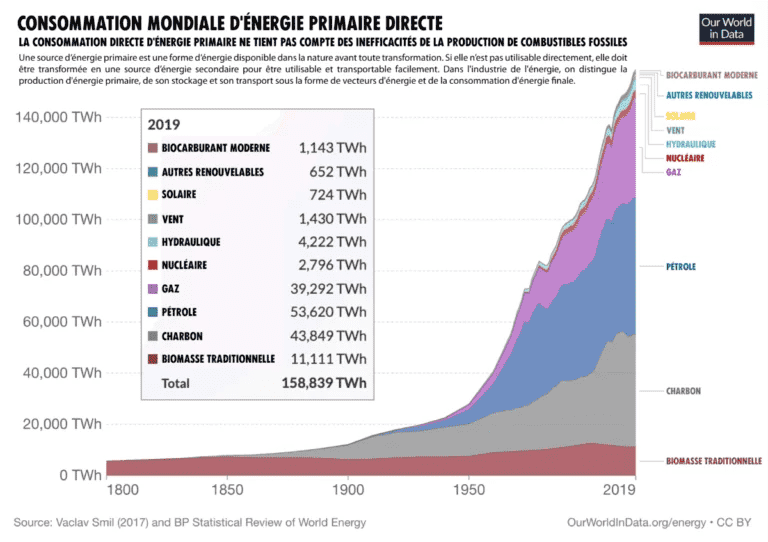
On a global scale, we observe that The energy mix is an ever more important thread and that one primary energy source has never been replaced by another.
Even if, in France, we see Coal like an energy of the past, globally it is not the case: we have never consumed as much coal as we do today.
Globally, there has never been a transition from one energy to another.
Our use of fossil fuels is so important that it is closely linked to the CO₂ we emit and to Global warming.
During the various COPs, one of the major challenges of negotiations between countries is the fact that some countries pollute much more than others. China, which produces 75% of its energy from coal, is often singled out.
However, since the start of the industrial era, China has emitted 2 times less than the US or the EU, as shown by the infographic produced by Our World in Data:

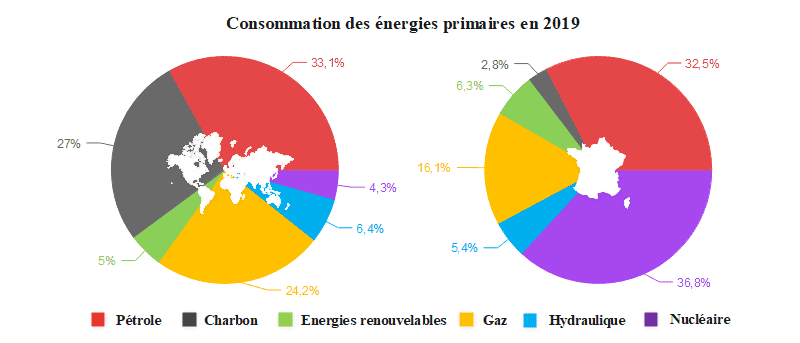
Unsurprisingly, Oil is the most used energy in the world.
Energy consumption is mainly divided between:
These fossil fuels, which are carbon by nature, represent 84% of global primary energy consumption.
According to The IPCC, to meet the Paris Agreement commitment and limit warming to 1.5°C by 2050, the use of coal, oil and gas will have to decrease by 95, 60 and 45%, respectively.
Despite the oil shocks of 1973 and 1979, oil consumption has never stopped growing and represents today 42% of global energy consumption.
In France, oil represented 28% of primary energy consumption in 2020, just after Nuclear energy (40%) and before natural gas (16%).
France produces 1% of its hydrocarbon needs from a few deposits located in the Paris basin and in the Aquitaine basin.
In 2020, the largest supplier of crude oil to France was Kazakhstan (15.6%), followed by the United States (12.7%) and Saudi Arabia (11.8%). Next are Norway, Algeria and Nigeria for 10% each, and finally Russia with 8.7%.
The year 2022 was a record year for global coal consumption, according to the IEA, with 8 billion tons, 50% of which was consumed by China.
Between 2000 and 2018, the installed capacity of thermal power plants Coal-fired power in the world has doubled, from 1 to 2 million MW installed according to Carbon Brief. The majority of these new power plants were installed in China, India and South Africa.
In France, coal consumption concerns:
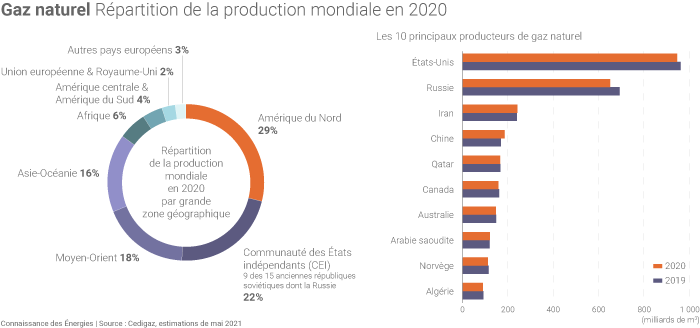
Every second, as simulated by the Planetoscope site, 110,000 m³ of natural gas are consumed in the world, i.e. 3.5 billion m³ per year.
The main producing countries are:
In France, the discovery in 1951 of the Lacq deposit in the Aquitaine basin made it possible to partially supply the network from 1957 to 2013.
In 2021, France imports natural gas from Norway (36%), Algeria, the Netherlands and Nigeria (8% each).
Finally, the share of Russian gas imports, which was 17% in 2021, now represents only 7% due to the consequences of the war in Ukraine.
Energy density represents energy per unit mass. Thus, 1 ton of oil (about 7 barrels) corresponds to:
Oil being easy to carry and energetically dense, it is widely used in vehicles and has contributed to the rise of the automobile, while waiting for the rise of the electric car.
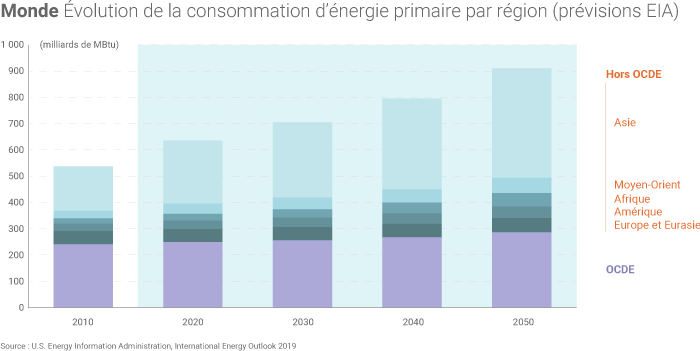
By 2050, global energy consumption could grow by 50% !
This increase could even reach nearly 70% in developing countries, or even 100% in Asia (including China and India).
Outside the OECD, this growth is explained by:
In OECD countries, consumption could grow by only 15% due to lower economic and population growth, and progress in ee.
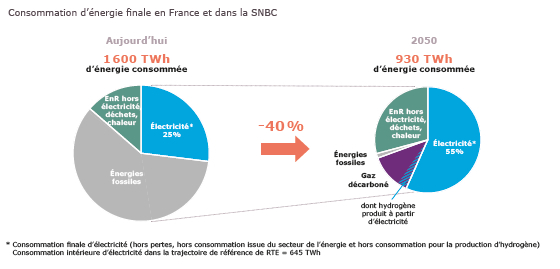
In France, several scenarios by 2050:
According to The IEA, the global consumption of all energy sources will grow by 2050, and fossil fuels will remain the majority in the energy mix with 69% (compared to 80% in 2018).
In the current context, the Prime Minister, Élisabeth Borne, presented on 6 October 2022 A sobriety plan aimed at reducing France's energy consumption.
This plan is based on 4 pillars:
This plan recalls the policy implemented under Valéry Giscard d'Estaing: “In France, we don't have oil, but we have ideas! ”. As in 1976, energy savings are required:
RTE (” Energy Futures 2050 ”) shows that energy consumption must fall by 40% in France, while electricity consumption must increase by 50%.
RTE recommends a strategy around 3 major axes:
All scenarios require:
As the IEA points out, there is every reason to believe that energy consumption will continue to grow in the world by 2050 for several reasons:
However, at the end of September, European Energy Ministers set a target of reducing gross electricity consumption in the Union by 10%. In France, the government has launched an ambitious energy sobriety plan.
We can see that the latter is bearing fruit: consumption has fallen over the last 4 weeks by − 6.5% compared to the same period from 2014 to 2019.
There is hope that the EU can find solutions and show the way for other countries in the world to move towards more energy efficiency, less consumption and fewer CO₂ emissions.
In a few clicks, organize an exchange with one of our experts.


weekly newsletter subscribers

4.9

.png)

These are signals sent by RTE during periods of tension on the electrical network. The Sirenergies tool informs you in real time to anticipate your uses.
Le dispositif ARENH a laissé place au VNU (Versement Nucléaire Universel).
Ce changement structurel expose davantage les entreprises aux prix de gros, rendant la gestion des risques plus complexe qu'auparavant.
Il devient alors indispensable de définir une stratégie d'achat d'électricité avec Sirenergies pour lisser l'impact de la volatilité des marchés sur votre budget.
Oui, elle est considérée comme une énergie renouvelable à faibles émissions de gaz à effet de serre.
De plus, l'eau ne subit aucune transformation chimique durant le cycle de production et réintègre son milieu naturel en aval.
Cependant, la construction de barrages nécessite des mesures pour protéger les écosystèmes (débit minimum, passes à poissons).
Tertiary companies must manage their energy costs while guaranteeing the comfort of users (offices, shops, services). Consumption is often linked to heating, air conditioning and lighting, which requires precise monitoring to avoid budgetary excesses.
Le calendrier 2026 impose deux échéances majeures :
Pour simplifier ces démarches, vous pouvez centraliser vos données de consommation avec la plateforme Pilott de Sirenergies, garantissant ainsi la conformité de vos rapports réglementaires.
In 2025, the supplier had a NPS (Net Promoter Score) of +16 and a note of 4,17/5.
Satisfaction is based on a “zero solicitation” model and 100% in-house customer service in Toulon, guaranteeing proximity and responsiveness that cannot be found with major historical suppliers.
Le transport (RTE) correspond aux "autoroutes" de l’électricité. Il s’agit de transporter de très grandes quantités d'énergie sur de longues distances, depuis les centrales de production (nucléaires, barrages, parcs éoliens offshore) vers les régions de consommation.
La distribution (Enedis) s'apparente aux "routes départementales" et aux rues. Elle récupère l'électricité à la sortie du réseau de transport pour la livrer directement chez le client final, en abaissant la tension pour qu'elle soit utilisable par vos appareils.
The €/MWh is a price unit used in wholesale markets, while kWh is the unit visible on your bills.
La réussite d'un projet collectif énergie repose sur trois piliers fondamentaux :
The subscribed power must be calculated according to the consumption profile and uses (heating, industrial processes, tertiary equipment). One fine analysis makes it possible to ensure the adequacy between real need and contract.
Parce que la puissance souscrite en kVA détermine le prix de l'abonnement et que tout dépassement peut entraîner des surcoûts importants.
Tertiary companies are concerned by taxes such as TICFE or TICGN. Sirenergies checks the accuracy of invoices, identifies possible exemptions, and helps correct errors to sustainably reduce costs.
Farms are subject to taxes such as TICFE or TICGN. Sirenergies verifies their application, identifies cases of exemption and accompanies the procedures to reduce the tax burden.
Among the taxes include TICFE, TICGN, CTA, CJA and TURPE. They represent a significant part of the bill and vary according to consumption profiles. Understanding them well is essential to optimize costs.
It allows you to prove your commitment to the energy transition and to meet regulatory requirements.
Yes. The supplier guarantees an offer 100% renewable via the official Guarantees of Origin (GO) mechanism.
For the most demanding companies, the offer GREENVOLT+ ensures very low carbon intensity electricity, sourced exclusively from independent French producers (hydraulic, wind, solar).
The range E @sy is available in four pricing structures to adapt to each risk profile:
One invoice consists of several elements: consumption, supplier share, taxes and contributions. The analysis of each line makes it possible to identify possible errors and to check the consistency with the signed contract.
Un appel d’offres permet de mettre en concurrence plusieurs fournisseurs d’électricité et de gaz afin d’obtenir des conditions contractuelles optimisées. C’est une démarche transparente qui permet de choisir l’offre la plus adaptée aux besoins budgétaires et techniques de l’organisation.
The industry is concerned by TICFE, TICGN and other contributions that may represent an important part of invoices. Sirenergies identifies cases of exemption and accompanies the procedures to benefit from them.
Exceeding capacity leads to financial penalties and can impact the size of the contract. Adjust the correctly subscribed power makes it possible to avoid these additional costs.
Le kVA mesure la capacité maximale que votre compteur peut supporter à un instant T, tandis que le kWh mesure la quantité d'énergie consommée sur une durée.
C'est le levier le plus rapide pour obtenir des résultats visibles. L'éclairage représente environ 40 % de la consommation d'électricité d'une commune.
Passer au LED avec pilotage intelligent permet de réduire la facture de 50 à 80 %, avec un retour sur investissement (ROI) rapide, souvent estimé à 2 ou 3 ans.
Le processus repose sur l'utilisation de la force de l'eau (énergie cinétique) issue des courants, des chutes d'eau ou des dénivelés. Le fonctionnement suit trois étapes clés :
L'abondance de production française tire les prix du marché de gros vers le bas.
En vertu du mécanisme de l'Ordre de Mérite (Merit Order), les centrales les moins coûteuses (nucléaire, renouvelables) couvrent la demande plus souvent, évinçant les centrales à gaz ou charbon plus onéreuses.
Cela multiplie les épisodes de prix bas, voire négatifs, sur le marché spot.
L'augmentation s'explique par la revalorisation de l'Accise sur le gaz à 16,39 €/MWh et la hausse de 3,41 % du tarif de transport (ATRT 8).
S'y ajoute l'entrée en vigueur des Certificats de Production de Biogaz (CPB), un nouveau coût réglementaire pour soutenir le biométhane.
Face à ces évolutions, Sirenergies vous accompagne dans l'achat de gaz naturel pour sécuriser vos prix malgré la volatilité du marché.
To calculate Scope 2 emissions, use the following formula:
Energy quantity (kWh) × Emission factor (kg CO₂ e/kWh).
Use databases like ADEME for precision.
Sourcing consists in identifying and analysing the offers of several electricity and gas suppliers. This approach makes it possible to obtain contracts adapted to the consumption profile and budgetary constraints of the company.
Some businesses may obtain a partial or total exemption from the TICFE or the TICGN, depending on their activity and energy intensity. The support of an expert makes it possible to identify the eligibility criteria and to put together the file.
Ce record de 92,3 TWh s'explique par la conjonction de trois facteurs :
C'est l'indicateur d'efficacité d'un appareil électrique ; il représente le ratio entre la puissance active (utile) et la puissance apparente (totale).
En 2025, la France a atteint un solde exportateur net de 92,3 TWh, battant le précédent record de 2024 (89 TWh).
This makes it possible to choose the right time to contract, secure your budgets and anticipate increases.
Communities are subject to taxes such as TICFE or TICGN. Sirenergies analyzes invoices, identifies exemption possibilities and fixes possible errors to reduce the tax burden.