





Summarize with AI

March 6, 2026
6
Min reading
27%: it is the increase in the level of obligation imposed on energy suppliers for the 6th period of Energy Savings Certificates (CEE) that Opens on January 1, 2026.
This rise in power illustrates France's determination to achieve carbon neutrality in 2050.
Often criticized for its complexity, its risks of fraud or its financial impacts on consumers, the EWC system remains an effective lever for the energy transition.
Since 2021, it has helped fund more than one million operations every year.
Extended over five years to align with the Multiannual Energy Programming (PPE), the sixth period intends to further accelerate the momentum, while responding to criticisms.
What is changing concretely for 2026-2030?
What impacts should you expect on your energy bill and your projects?
How to anticipate and transform CEEs into real opportunities?
Decryption of the decree of October 30, 2025 and the developments to come in 2026.
Since 2005, the Energy Saving Certificates (CEE) play a central role in financing the energy transition in France.
This extrabudgetary system is based on private investment and the principle of “polluter pays”.
Electricity, gas and fuel suppliers are required to finance actions ofee to offset the environmental impact of their activities.
To prove their commitment, the “obliged” actors must obtain EECs.
These certificates attest to the energy savings generated thanks to the projects they supported.
The objective is clear: to accelerate the energy transition without weighing on the State budget.
Households, businesses, communities or condominiums: CEEs are accessible to everyone to alleviate the cost of renovation, decarbonization and energy efficiency.
Effectiveness : this is the key word of the sixth CEE period (also called P6 period).
The objective: to achieve carbon neutrality in 2050, in accordance with the National Low-Carbon Strategy (SNBC).
To respond to criticisms, the focus is on the efficient operations of decarbonization And of renovation Energetic.
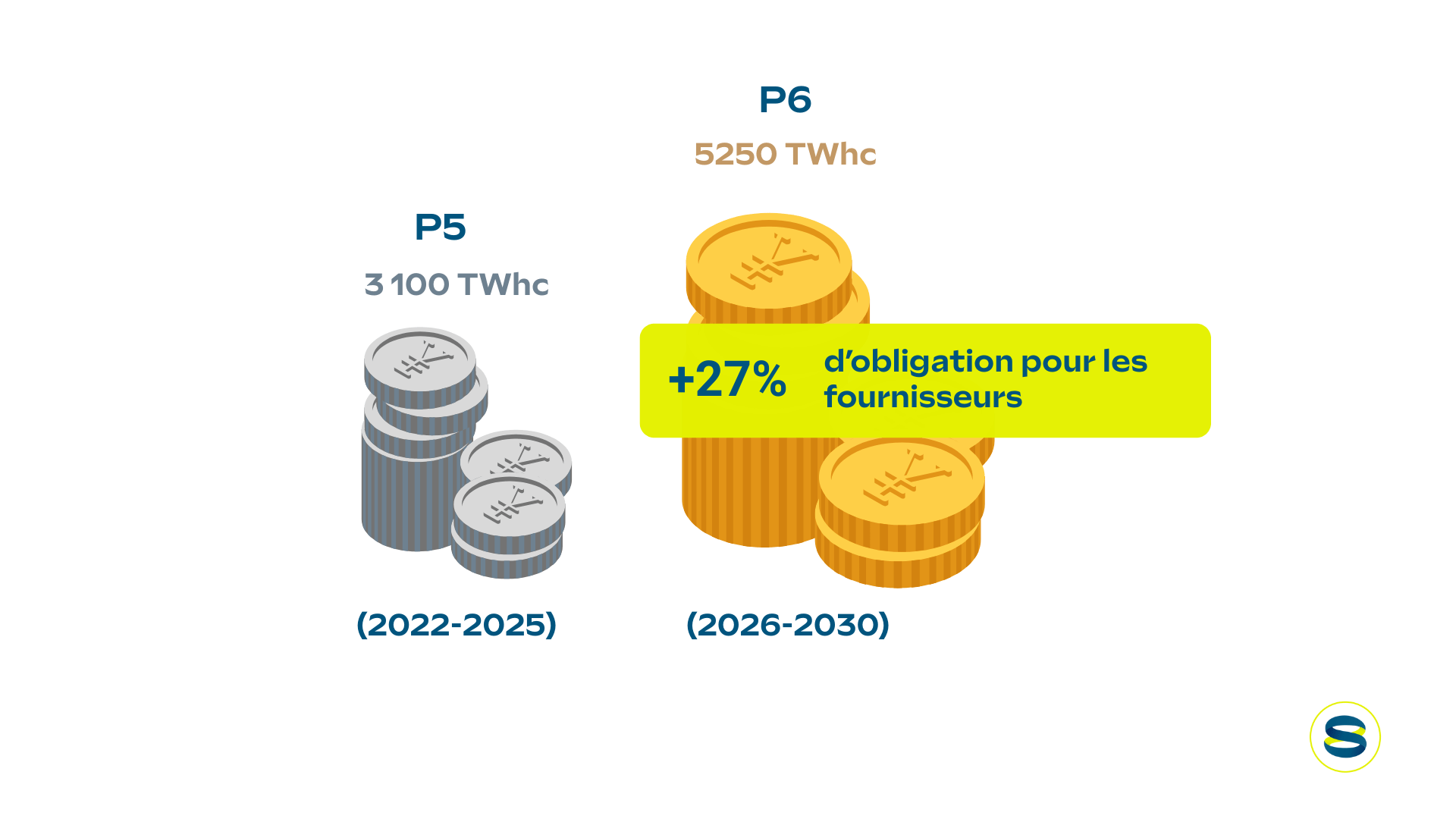
Faced with the climate emergency, the sixth EWC period confirms the continuous increase in the level of obligations imposed on electricity, gas and fuel suppliers.
Over the next five years, these actors will have to generate annually A volume of 1,050 TWh cumac energy savings, for a total of 5,250 TWhc.
The increase reached 27% compared to the years 2023 to 2025.
As part of the fight against fuel poverty, 25% of the annual obligation (i.e. a volume of 280 TWhc) is reserved for the most modest households via the Precarity EEC.
In financial terms, the envelope increase from 6 to 8 billion euros in 2026.
However, some experts denounce a sleight of hand, with the transfer of certain State aid to the EEC mechanism (in particular those relating to electric mobility and global renovation).
Source: EEC bonds by period - ecologie.gouv.fr
For this sixth period, the Energy Savings Certificates system is being tightened in order to focus subsidies on the most efficient energy efficiency and decarbonization actions.
Concretely, these developments are reflected in:
In total, more than 200 energy-saving operations are eligible.
Industries and businesses will also benefit from reinforced EEC aid with:
Faced with the still high risks of fraud, the sixth EWC period strengthens the management and control system in order to guarantee ever greater transparency and efficiency:
Don't suffer the 6th period, pilot it.
Audit, competition between suppliers and optimal valuation of your premiums: entrust your energy sourcing to experts.
{{ask-sourcing=” /ctas "}}
It's a fact: energy and fuel suppliers pass on the cost of Energy Savings Certificates to final consumers' bills.
In 2023, a report by the Court of Auditors estimated that this device cost each year 164 euros on average for households, or around 4% of the energy bill.
With the 27% increase in the level of EEC obligations over the sixth period, the financial impact for consumers remains difficult to assess.
The volatility of the EEC market leaves uncertainty over price developments.
While the government insists on remaining vigilant, An increase in bills is still likely...
Professionals, businesses and local authorities have several levers to take advantage of the CEE system without incurring the costs:
EECs are an essential tool for financing the energy transition of households, businesses and communities. However, their implementation is complex, requiring a good understanding of administrative procedures, standardized forms and technical criteria.
Do you want to finance your energy efficiency projects with Energy Savings Certificates? Sirenergies helps you to master this system.
Discover our solutions to make the most of CEEs and reduce the impact of their cost on your bill: Our services to manage your energy
{{know-more-services=” /ctas "}}
In a few clicks, organize an exchange with one of our experts.


weekly newsletter subscribers

4.9

.png)

The range E @sy is available in four pricing structures to adapt to each risk profile:
Yes. The supplier guarantees an offer 100% renewable via the official Guarantees of Origin (GO) mechanism.
For the most demanding companies, the offer GREENVOLT+ ensures very low carbon intensity electricity, sourced exclusively from independent French producers (hydraulic, wind, solar).
Les caves coopératives de taille ETI ou grande entreprise peuvent être soumises à l'audit énergétique réglementaire (norme NF EN 16247). Sirenergies n'a ni la compétence ni l'accréditation pour réaliser cet audit : nous vous orientons vers un bureau d'études partenaire accrédité, et vous accompagnons en amont sur vos achats et en aval sur le pilotage.

The €/MWh is a price unit used in wholesale markets, while kWh is the unit visible on your bills.
The news covers the life of Sirenergies and market trends. Find them in The Energy News.
Our customers are noticing significant savings, better budgetary foresight and administrative time savings. Many also highlight the proximity of consultants and the clarity provided by our tools.