





Summarize with AI

March 3, 2026
6
Min reading
In recent years, professionals, businesses and individuals have been affected by rising energy costs. Among the factors influencing electricity and gas prices, the European carbon market pleads guilty. Established in 2005 to reduce greenhouse gases (GHG), carbon quotas impact energy markets.
What is the carbon market? How do CO2, electricity and gas prices interact? How can you mitigate the effect of the CO2 market on your energy bills?
After the presentation of wholesale electricity markets And of natural gas, dive into the world of carbon quotas.
The carbon market is a binding tool for reducing greenhouse gases (GHG). Since 2005, it has been the basis of European climate policy.
The end of the 20th centuryE century marks the beginning of environmental awareness. Faced with the first effects of climate change, the reduction of emissions of greenhouse gases is required.
This conviction leads to the Signature of the Kyoto protocol in 1997 in the framework of COP3. Thirty-eight countries commit to reduce their carbon emissions by at least 5% in 2012 compared to 1990.
The Kyoto protocol came into force in 2005.
In Europe, it gives rise to the largest carbon market in the world. The European greenhouse gas emissions trading system (ETS) aims to encourage companies to reduce their carbon emissions. It is based on the “polluter pays” principle.
Companies in the most polluting sectors or with a power greater than 20 MW are awarded carbon quotas according to their activity (electricity production, steel industry, chemistry, chemical industry, oil refineries, cement factory, district heating, commercial aviation, etc.).
If their GHG emissions exceed the allocated limit, companies must buy new allowances on the carbon market.
On the other hand, if they keep their carbon emissions below the ceiling, they can resell their excess allowances or save them.
The price of CO2 is determined by the Encounter between supply and demand.
For fifteen years, the European carbon market did not keep all its promises. The system favors a low price for CO2 for fear of threatening the competitiveness of European companies. With the economic crisis of 2008 and the drop in production, the demand for CO2 quotas is falling. For businesses, it is then more profitable to buy additional allowances than to reduce their greenhouse gas emissions.
Starting in 2018, the situation is gradually changing. The abolition of free quotas, the guarantee of a minimum price for CO2, the reduction of quotas allocated to companies and the arrival of hedge funds are increasing the demand for CO2 certificates and regulating the supply. The price of CO2 is rising.
In 2024, it averaged around 70 euros per ton.
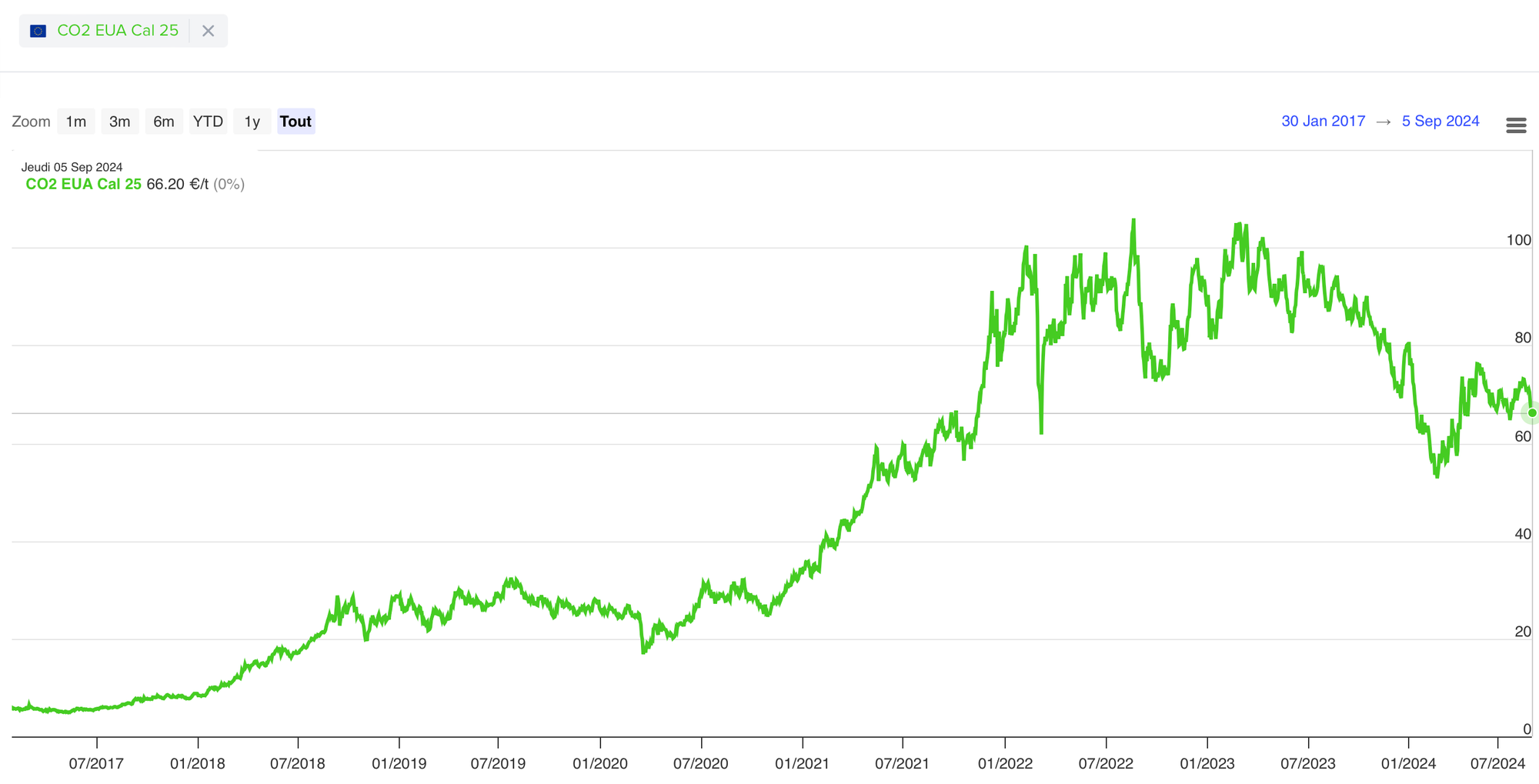
Monitoring of market prices (CO2) - Source: Sirenergies
Carbon and energy markets are linked. CO2 prices impact the cost of producing electricity and gas, with an impact on the bill of final consumers.
Except in France, the majority of European power plants are thermal power plants, running on gas, coal or oil. The main emitters of greenhouse gases in Europe, they are subject to the carbon market. Buying CO2 quotas to offset their polluting emissions increases the cost of electricity production.
However, during peaks in electricity consumption, thermal power plants are mobilized to meet the demand on the electricity market. The combination of a higher cost of production and an imbalance between supply and demand is causing the price of electricity to rise. This price increase is passed on by suppliers to consumers' energy bills. Mathematically, when the price per ton of CO2 increases, the price of electricity follows.
In the same way, The rise in the price of CO2 impacts the natural gas market to which producers turn primarily during peak consumption.
A high price of CO2 strengthens the competitiveness of nuclear electricity and renewables compared to fossil fuels. It also encourages businesses to invest in decarbonization solutions and energy transition to reduce their GHG emissions and expenses related to the purchase of CO2 allowances.
Nearly twenty years after its birth, the CO2 market is beginning to reach its goals. According to a report by the European Environment Agency, greenhouse gas emissions fell by 32% in Europe between 1990 and 2020.
What's at stake? Achieving an acceptable balance with a cost per ton of CO2 high enough to encourage businesses to reduce their greenhouse gas emissions, but also reasonable enough not to drive up consumer bills.
In recent years, the evolution of CO2 prices has contributed to the rise in electricity and gas bills. Solutions exist to optimize your consumption and control your budget.
Freeing yourself from dependence on electricity and gas networks is the ideal solution to reduce energy bills.
Numerous solutions exist for self-produce and self-consume its own green, local, renewable and low-carbon energy :
If these solutions require an investment, their profitability is guaranteed in the long term. On average, installing photovoltaic panels reduces the electricity bill by 20 to 50%.
If your budget is tight, you can choose a supply of electricity and/or green gas. The supplier guarantees to inject electricity and gas from renewable energies into the networks, in quantities equivalent to that consumed by its customers.
The deployment of a computerized energy management system (SME) and intelligent management makes it possible to optimize energy consumption.
With the energy management, you can monitor and analyze your company's consumption, detect malfunctions, identify energy-consuming equipment and adjust consumption to real needs.
You want know your energy consumption and their evolution month by month, year by year?
The SirEnergies app allows you to track all your data and optimize your invoices. Contact one of our experts today for personalized support.
To reduce your carbon footprint, there are many ways to do this: improving industrial processes, choosing more efficient lighting and equipment, thermal insulation of buildings, etc. Sobriety, energy efficiency, renewable energies and proactive management are the winning quarter of a reduced energy bill.
Established to reduce greenhouse gas emissions, the European carbon market impacts consumers' electricity and gas bills.
Although the price per ton of CO2 fell in 2024 in a context of economic and geopolitical uncertainty, the upward trend of the last few years should be confirmed with the announced reform of the CO2 market.
Debate since 2021, it plans to abolish carbon quotas that are still free and to extend the carbon market to other sectors (maritime sector, road transport and building heating).
What's at stake? Achieve the energy transition objective set by the European Green Deal, namely the reduction of carbon emissions by 55% by 2030.
Faced with this complexity and instability of the CO2 price, the energy consulting firm SirEnergies offers professionals, businesses and communities personalized support to subscribe to tailor-made electricity and gas offers and control your energy budget.
In a few clicks, organize an exchange with one of our experts.


weekly newsletter subscribers

4.9

.png)

Absolument. La réforme des heures creuses vise à absorber la surproduction solaire en milieu de journée. Les créneaux d'heures creuses se déplacent progressivement vers la plage 11h00 – 17h00, notamment en été. C'est une opportunité majeure pour les sites industriels ou tertiaires capables de flexibilité.
Conseil stratégique :
Car les marchés dépendent de facteurs exogènes imprévisibles (géopolitique, météo soudaine, politique) que les modèles basés sur l'historique ne peuvent pas anticiper, tout comme on ne prédit pas le Loto.
Le prix Forward est fixé à l'avance (sécurité budgétaire), tandis que le prix Spot varie heure par heure selon le marché (opportunité mais risque élevé).
Instauré en 2017, ce dispositif répond à un enjeu de sécurité nationale.
L'électricité ne se stockant pas à grande échelle, le réseau doit être capable de répondre instantanément à la demande, même lors des pics de froid hivernaux. Le mécanisme incite financièrement les producteurs à maintenir leurs centrales disponibles et les entreprises à réduire leur consommation (effacement) lors de ces périodes critiques.
To calculate Scope 2 emissions, use the following formula:
Energy quantity (kWh) × Emission factor (kg CO₂ e/kWh).
Use databases like ADEME for precision.
Le calendrier 2026 impose deux échéances majeures :
Pour simplifier ces démarches, vous pouvez centraliser vos données de consommation avec la plateforme Pilott de Sirenergies, garantissant ainsi la conformité de vos rapports réglementaires.
La Multiannual Energy Programming (PPE) is the strategic management tool for France's energy policy. Established by the 2015 law on energy transition for green growth (LTECV), it serves as a compass for the State, communities and businesses.
Concretely, the PPE sets the priorities for action of the public authorities for the management of all forms of energy on the national territory. It covers a period of ten years, divided into two periods of five years, and must be revised periodically to adapt to technological and economic developments.
It deals with major topics such as:
It is crucial not to confuse it with National Low Carbon Strategy (SNBC). While SNBC sets carbon budgets (the ceilings for greenhouse gas emissions by sector), the PPE determines the technical and energy resources to achieve them.
La réussite d'un projet collectif énergie repose sur trois piliers fondamentaux :
La Vente de Nucléaire Universelle (VNU) est le nouveau mécanisme de régulation des prix de l'électricité en France. Contrairement à l'ARENH, il ne s'agit plus d'un volume fixe à prix réduit, mais d'une redistribution financière des revenus excédentaires d'EDF aux consommateurs, basée sur les prix de marché et les coûts de production du nucléaire historique.
Chaque modèle d'IA répond à un besoin spécifique du cycle d'achat :
L'expertise humaine reste néanmoins indispensable.
Les coopératives de taille ETI ou grande entreprise peuvent être soumises à l'audit énergétique réglementaire (norme NF EN 16247). Sirenergies n'a ni la compétence ni l'accréditation pour réaliser cet audit : nous vous orientons vers un bureau d'études partenaire accrédité, et vous accompagnons en amont sur vos achats et en aval sur le pilotage.
It allows you to prove your commitment to the energy transition and to meet regulatory requirements.
L'impact dépendra des prix de marché. Le mécanisme prévoit une redistribution si les prix dépassent 78 €/MWh. Cependant, si les cours restent bas (actuellement autour de 60 €/MWh), le dispositif ne s'activera pas. La facture sera alors indexée à 100% sur les prix de marché, rendant le choix du fournisseur et du moment d'achat critiques.
La fin de l'ARENH (Accès Régulé à l'Électricité Nucléaire Historique) marque l'arrêt de la fourniture d'électricité à prix fixe garanti (42 €/MWh).
Dès le 1er janvier 2026, les entreprises sont exposées aux prix de marché, mais deux nouveaux mécanismes de régulation prennent le relais, bien que leur logique soit différente :
Conseil stratégique : Ne comptez pas sur le VNU pour réduire votre facture en 2026 si les marchés restent stables. Auditez vos contrats dès maintenant pour intégrer une part de prix fixe ou explorer des "Power Purchase Agreements" (PPA) pour sécuriser vos coûts sur le long terme.
Ce seuil est jugé élevé par rapport aux prévisions actuelles du marché. Si le prix de l'électricité reste en dessous de 78 €/MWh, les entreprises ne bénéficieront d'aucune redistribution. Cela signifie que la protection promise par la réforme pourrait être inexistante dans un marché baissier, d'où l'importance de stratégies de sourcing agiles et d'outils de monitoring comme Pilott.
In 2025, the supplier had a NPS (Net Promoter Score) of +16 and a note of 4,17/5.
Satisfaction is based on a “zero solicitation” model and 100% in-house customer service in Toulon, guaranteeing proximity and responsiveness that cannot be found with major historical suppliers.
Non. L'IA traite la donnée (data processing), mais l'analyste apporte la compréhension du contexte (market sentiment) et la prise de décision stratégique.
The central objective of PPE 3 is to engage France towards carbon neutrality by 2050 by breaking the country's historical dependence on fossil fuels.
Today, approximately 60% of final energy consumption in France still relies on imported oil and natural gas. PPE 3 aims to radically reverse this trend by setting an ambitious target: to reach 60% of carbon-free energies in final consumption by 2030.
To achieve this, PPE 3 pursues three major sub-objectives:
The range E @sy is available in four pricing structures to adapt to each risk profile:
Yes. The supplier guarantees an offer 100% renewable via the official Guarantees of Origin (GO) mechanism.
For the most demanding companies, the offer GREENVOLT+ ensures very low carbon intensity electricity, sourced exclusively from independent French producers (hydraulic, wind, solar).