




Summarize with AI

March 6, 2026
8
Min reading

Since the 1Er January 2026, the Universal Nuclear Payment replaces the ARENH.
But as soon as it came into force, the device gave rise to numerous debates.
As a consumer protection mechanism, UNV is based on a new logic: the retrospective redistribution of EDF's nuclear revenues.
Far from reassuring, this post-ARENH paradigm shift is generating new uncertainty for businesses and communities.
How does UNV really work for businesses? Does it offer effective protection against the volatility of electricity prices? How to manage your energy strategy after the end of ARENH?
Sirenergies identifies the levers to adapt your energy purchases to this new regulatory framework.
Successor ofARENH (Regulated Access to Historic Nuclear Electricity), the VNU (Universal Nuclear Payment) profoundly changes the protection Of consumers in the face of fluctuations in electricity prices.
The UNV is a contractual arrangement, concluded between the State and EDF.
This mechanism for redistributing nuclear income attempts to reconcile two apparently contradictory objectives:
Where ARENH guaranteed a regulated purchase price, UNV adopts a more liberal logic. EDF now sells 100% of its nuclear production at market prices.
Consumer protection comes after the fact, via a conditional redistribution mechanism.
Concretely:
The activation thresholds of the VNU are set by ministerial decree, on the proposal of the Commission for Energy Regulation (CRE).
They are calculated from Cost of nuclear power generation, plus a margin (5 to 25 €/MWh for the first threshold; 35 to 55 €/MWh for the second).
For 2026-2028, the CRE estimated the production cost at €60.3/MWh.
According to the draft decree, the applicable thresholds of 1Er January 2026 at 1Er December 2028 should be:
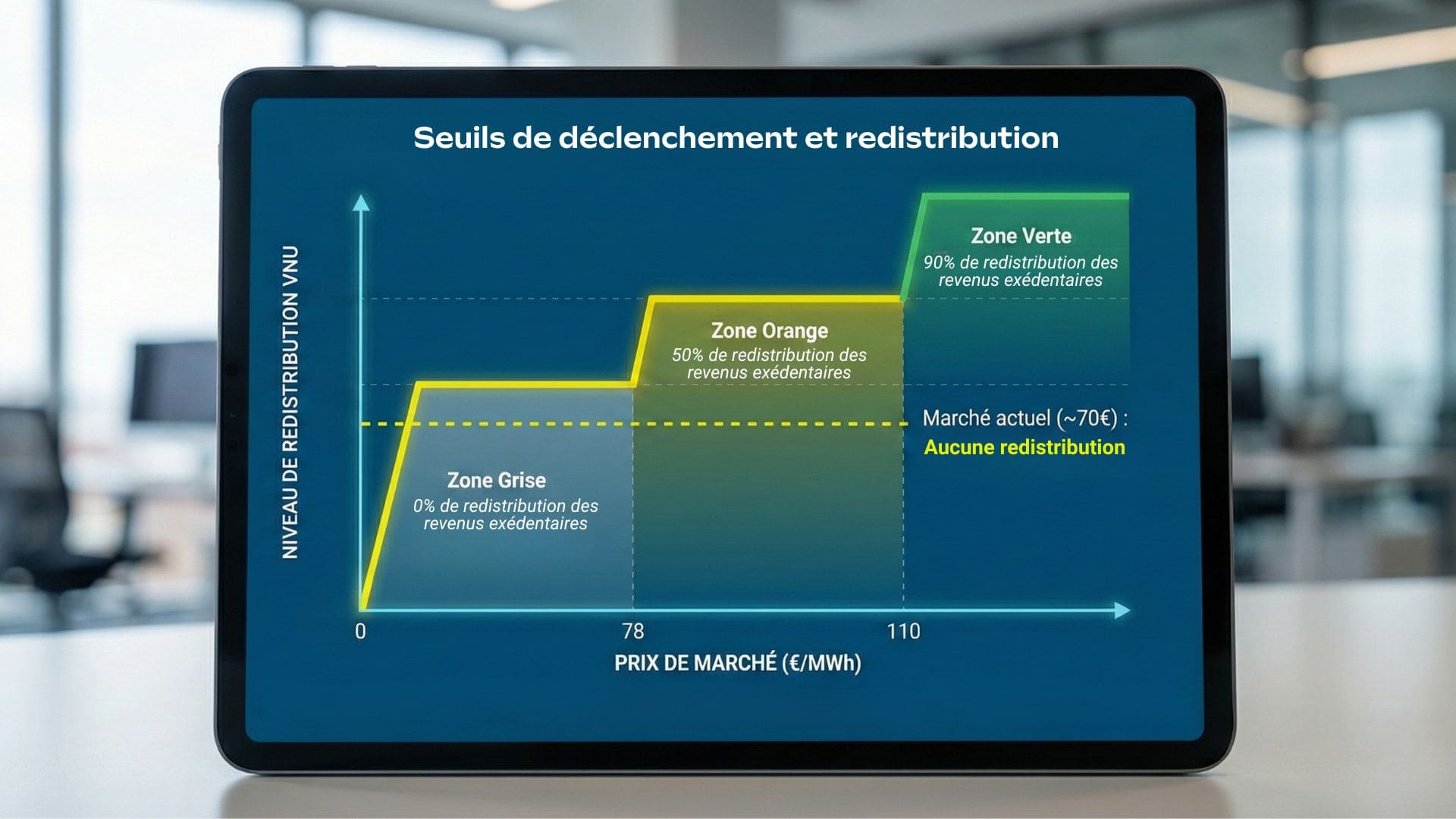
The periodic revision of thresholds and the dependence on market prices create a structural fiscal uncertainty. Businesses cannot anticipate the activation of the system or assess the impact of UNV on their electricity bill.
Is your 2026 budget in danger?
Don't be left in uncertainty. We dissect your consumer profiles to build a tailor-made purchasing strategy, aligned with the realities of the 2026 market.
{{ask-rdv=” /ctas "}}
The UNV will appear on the bill in the form of a line of deduction, applied to the total amount to be paid.
In practice:
He is difficult to anticipate the impact of UNV on electricity bills businesses.
It depends on both the evolution of market prices and regulatory decisions.
The market is changing, so is your strategy.
With the end of ARENH, buying energy is becoming a matter of timing.
The platform Pilott alerts you in real time as soon as a price window becomes more competitive than the UNV threshold.
{{ask-demo=” /ctas "}}
ARENH offered a relatively stable and legible pricing framework.
UNV works differently: it acts like a corrective mechanism, without trigger guarantee.
The impact of UNV on businesses' electricity bills varies according to market prices.
In the table opposite, it is appropriate to look at the price difference between the two solutions and not at the price itself because we took into account a “convenience” price only, without the supplier's costs. We show the example of a customer for whom Arenh represented around 40% of their consumption after capping.
This is not the case for all customers.
In fact, the percentage of Arenh was linked to the consumption profile, so a golf course that consumes mainly in summer received more Arenh than a mountain resort open mainly in the winter months. This principle remains true with the new UNV system.
Our consultants can help you simulate the impact adapted to your case. All the modalities of application of UNV are not known to date, but one thing is certain: the futures market is currently very favorable and it is strongly recommended to take positions. To do this, Sirenergies consultants can guide you in your choices, in complete transparency, thanks to our market price monitoring tool: Pilott.
- Béatrice Passeport, SirEnergies Sales Director
Even before its entry into force, the UNV system raised numerous reservations. The signals observed on the electricity markets in 2026 tend to confirm these concerns.
The UNV is based on a Bullish hypothesis : market prices high enough to trigger redistribution.
However, the analyses converge on a scenario of sustainably moderate prices, below the first trigger threshold.
On wholesale markets, baseload contracts for 2026 trade in a range between 58 and 70 €/MWh.
Under these conditions, UNV should remain inoperable from its first year of application.
At first glance, the current bear market may seem favorable to consumers.
However, even with prices considered to be low, businesses can pay more for their electricity than at the time of ARENH, without benefiting from any protection mechanism.
In fact, no compensation is provided below €78/MWh. We are far from the regulated ARENH price, fixed at €42/MWh...
Businesses today find themselves without a real safety net.
UNV creates a structural paradox: it does not Protects consumers only at relatively high price levels.
But it does not protect against moderate, more frequent increases.
UNV is based on CRE projections. However, the State invited the Commission to be cautious in its estimates, in order to avoid catch-up mechanisms.
For 2026 and 2027, CRE estimates confirm insufficient price levels to trigger UNV :
UNV comes into force in a rapidly changing energy system, with therise of renewable energies.
Excess supply - observed during periods of high solar or wind production - lead to very low prices, even negatives.
In this context, meeting the conditions for the outbreak of UNV becomes even less likely. This operational reality reinforces doubts about the real effectiveness of the system in the short and medium term.
The end of ARENH is profoundly transforming energy purchases.
In a more uncertain and less protective environment, buying electricity is no longer a simple technical act. It becomes a strategic financial variable.
Faced with the uncertainty of electricity prices, businesses must move from a Volume logic to price logic.
The Timing of purchase becomes decisive.
To smooth out price changes, resilient buying strategies rely on:
Electricity markets regularly offer very attractive price windows, sometimes very short (day-ahead, intraday).
Control “by clicks” consists of buy targeted volumes, as close as possible to real consumption, when market conditions are favourable. This approach is particularly suitable for sites with flexible consumption or controllable uses (electric vehicle charging, modular industrial processes, etc.)
While it offers financial opportunities, “by clicks” control requires:
Faced with a drop in the level of protection, intuitive or one-time buying decisions become risky. One proactive approach of the markets is essential to understand the signals and to capture the opportunities.
The most effective strategies rely on a combination of two levers :
Sirenergies combines the performance of technology with human expertise.
With the Pilott application and our support, transform the uncertainty of the electricity markets into a sustainable competitive advantage.
{{ask-demo=” /ctas "}}
The end of ARENH in 2026 marks the end of the illusion of permanently cheap nuclear power. With UNV, consumer protection is changing in nature: dependent on market levels, it becomes uncertain and conditional.
In this new post-ARENH framework, forecasting, expertise and strategic management of energy purchases are more essential than ever to control businesses' electricity bills.
With Sirenergies, make the volatility of the energy markets a performance driver, and not a risk suffered.
{{ask-demo=” /ctas "}}
In a few clicks, organize an exchange with one of our experts.


weekly newsletter subscribers

4.9

.png)

Ce seuil est jugé élevé par rapport aux prévisions actuelles du marché. Si le prix de l'électricité reste en dessous de 78 €/MWh, les entreprises ne bénéficieront d'aucune redistribution. Cela signifie que la protection promise par la réforme pourrait être inexistante dans un marché baissier, d'où l'importance de stratégies de sourcing agiles et d'outils de monitoring comme Pilott.
Chaque modèle d'IA répond à un besoin spécifique du cycle d'achat :
L'expertise humaine reste néanmoins indispensable.
Non. L'IA traite la donnée (data processing), mais l'analyste apporte la compréhension du contexte (market sentiment) et la prise de décision stratégique.
La fin de l'ARENH (Accès Régulé à l'Électricité Nucléaire Historique) marque l'arrêt de la fourniture d'électricité à prix fixe garanti (42 €/MWh).
Dès le 1er janvier 2026, les entreprises sont exposées aux prix de marché, mais deux nouveaux mécanismes de régulation prennent le relais, bien que leur logique soit différente :
Conseil stratégique : Ne comptez pas sur le VNU pour réduire votre facture en 2026 si les marchés restent stables. Auditez vos contrats dès maintenant pour intégrer une part de prix fixe ou explorer des "Power Purchase Agreements" (PPA) pour sécuriser vos coûts sur le long terme.
La Vente de Nucléaire Universelle (VNU) est le nouveau mécanisme de régulation des prix de l'électricité en France. Contrairement à l'ARENH, il ne s'agit plus d'un volume fixe à prix réduit, mais d'une redistribution financière des revenus excédentaires d'EDF aux consommateurs, basée sur les prix de marché et les coûts de production du nucléaire historique.
In 2025, the supplier had a NPS (Net Promoter Score) of +16 and a note of 4,17/5.
Satisfaction is based on a “zero solicitation” model and 100% in-house customer service in Toulon, guaranteeing proximity and responsiveness that cannot be found with major historical suppliers.
La Multiannual Energy Programming (PPE) is the strategic management tool for France's energy policy. Established by the 2015 law on energy transition for green growth (LTECV), it serves as a compass for the State, communities and businesses.
Concretely, the PPE sets the priorities for action of the public authorities for the management of all forms of energy on the national territory. It covers a period of ten years, divided into two periods of five years, and must be revised periodically to adapt to technological and economic developments.
It deals with major topics such as:
It is crucial not to confuse it with National Low Carbon Strategy (SNBC). While SNBC sets carbon budgets (the ceilings for greenhouse gas emissions by sector), the PPE determines the technical and energy resources to achieve them.
Le prix Forward est fixé à l'avance (sécurité budgétaire), tandis que le prix Spot varie heure par heure selon le marché (opportunité mais risque élevé).
Absolument. La réforme des heures creuses vise à absorber la surproduction solaire en milieu de journée. Les créneaux d'heures creuses se déplacent progressivement vers la plage 11h00 – 17h00, notamment en été. C'est une opportunité majeure pour les sites industriels ou tertiaires capables de flexibilité.
Conseil stratégique :
The range E @sy is available in four pricing structures to adapt to each risk profile:
Car les marchés dépendent de facteurs exogènes imprévisibles (géopolitique, météo soudaine, politique) que les modèles basés sur l'historique ne peuvent pas anticiper, tout comme on ne prédit pas le Loto.
Instauré en 2017, ce dispositif répond à un enjeu de sécurité nationale.
L'électricité ne se stockant pas à grande échelle, le réseau doit être capable de répondre instantanément à la demande, même lors des pics de froid hivernaux. Le mécanisme incite financièrement les producteurs à maintenir leurs centrales disponibles et les entreprises à réduire leur consommation (effacement) lors de ces périodes critiques.
The central objective of PPE 3 is to engage France towards carbon neutrality by 2050 by breaking the country's historical dependence on fossil fuels.
Today, approximately 60% of final energy consumption in France still relies on imported oil and natural gas. PPE 3 aims to radically reverse this trend by setting an ambitious target: to reach 60% of carbon-free energies in final consumption by 2030.
To achieve this, PPE 3 pursues three major sub-objectives:
L'impact dépendra des prix de marché. Le mécanisme prévoit une redistribution si les prix dépassent 78 €/MWh. Cependant, si les cours restent bas (actuellement autour de 60 €/MWh), le dispositif ne s'activera pas. La facture sera alors indexée à 100% sur les prix de marché, rendant le choix du fournisseur et du moment d'achat critiques.

Ce seuil est jugé élevé par rapport aux prévisions actuelles du marché. Si le prix de l'électricité reste en dessous de 78 €/MWh, les entreprises ne bénéficieront d'aucune redistribution. Cela signifie que la protection promise par la réforme pourrait être inexistante dans un marché baissier, d'où l'importance de stratégies de sourcing agiles et d'outils de monitoring comme Pilott.
L'impact dépendra des prix de marché. Le mécanisme prévoit une redistribution si les prix dépassent 78 €/MWh. Cependant, si les cours restent bas (actuellement autour de 60 €/MWh), le dispositif ne s'activera pas. La facture sera alors indexée à 100% sur les prix de marché, rendant le choix du fournisseur et du moment d'achat critiques.
La Vente de Nucléaire Universelle (VNU) est le nouveau mécanisme de régulation des prix de l'électricité en France. Contrairement à l'ARENH, il ne s'agit plus d'un volume fixe à prix réduit, mais d'une redistribution financière des revenus excédentaires d'EDF aux consommateurs, basée sur les prix de marché et les coûts de production du nucléaire historique.
Il remplace l'ARENH et lisse vos prix. Voir notre page PME-PMI.