




Summarize with AI

March 6, 2026
6
Min reading
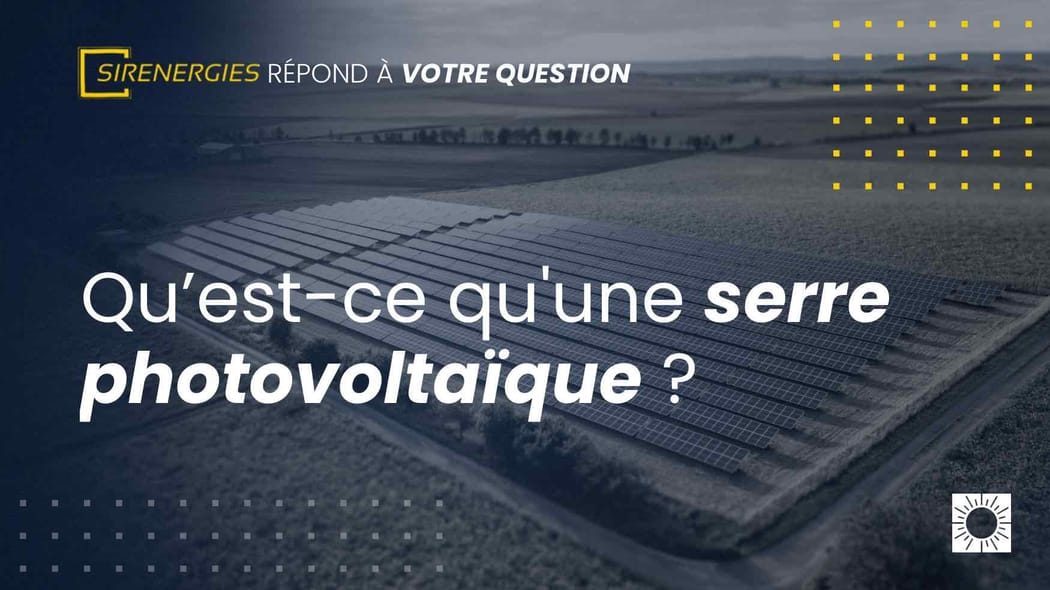
Combining agricultural production and green energy production: this is the principle of Agrivoltaics. Photovoltaic greenhouses are part of this movement that promotes a rational agricultural model, preserving the environment, the climate and food sovereignty. In recent years, greenhouse projects integrating solar panels have multiplied in France.
What is a photovoltaic greenhouse? What are its advantages? How does it make it possible to combine agricultural production with that of renewable energies?
Committed to helping its customers control their energy budgets, SirEnergies invites you to discover this agrivoltaic solution.
The photovoltaic greenhouse — also called solar greenhouse — combines the interests of a classic greenhouse with those of a Photovoltaic power plant. It offers an ecological response to the problem of greenhouse heating, which is often singled out.
Photovoltaic greenhouses are models of agrivoltaics. They make it possible to optimize both agricultural production and solar production:
• Intensive farming system, The agricultural greenhouse promotes vegetable growing, horticulture or any other agricultural crop : vegetables, fruits and flowers can flourish under this protective shelter, protected from the vagaries of the weather. For farmers, it is almost certain to increase agricultural yields.
• Integrated directly into the greenhouse structure, Photovoltaic panels produce a renewable electricity , local and green. The farmer can choose self-consumption or resale, with the result a reduction in his energy bill and/or stable additional income.
Photovoltaic greenhouses allow many agricultural crops, from fruits to vegetables, flowers, aromatic plants and even vines.
It is also possible to opt for a very dark structure covered with solar modules, ideal for the germination of mushrooms.
Photovoltaic greenhouses work like all solar installations.
Integrated directly into the roof of the greenhouse, The solar panels produce electricity from the Sun brightness. The encounter between the light particles (photons) and the electrons in the photovoltaic modules produces a direct electric current. This is transformed into alternating current by the inverters and injected into the internal electrical network.
The battery stores electricity to cover periods of decline in solar production. Elle is not mandatory. This depends on the option chosen by the farmer between total self-consumption, partial self-consumption and/or resale of the solar electricity produced.
Agrivoltaics solutions, photovoltaic greenhouses offer numerous advantages for farmers. They combine increased agricultural yields and cheaper energy, and this without encroaching on agricultural land and without harming France's food sovereignty.
In a photovoltaic greenhouse, agricultural crops benefit from the benefits of Solar heat And of stable climatic conditions.
THEairtight envelope protects plants from bad weather, wind gusts and excessive temperature variations. It alleviates the consequences of hailstorms or late frosts, which are becoming more and more frequent due to climate change.
The solar greenhouse promotes growth of plants thanks to a good control of light and heat. It allows thelengthening of production cycles.
Elle optimizes crop rotation, thanks to earlier planting and harvesting. It also allows the farmer to diversify its productions, for example by growing agricultural products outside their area of origin (kiwi, avocado...).
By promoting local agriculture, photovoltaic greenhouses support short circuits, create local employment and secure national food sovereignty.
The energy produced by photovoltaic panels can be used in self-consumption to heat the greenhouse and cover the electrical requirement. The farmer can also choose to resell the energy produced to ensure a stable income supplement.
Whether partial or total, the self-consumption of local, green and renewable energy reduces the energy bill and dependence on the public distribution network. It cushions the continuing rise in electricity and gas prices.
With the construction of a Photovoltaic greenhouse, any farmer can contribute to the national effort to promote the development of renewable energies and the energy transition.
The production of solar energy and the reduction of emissions of greenhouse gases Are assets that it can promote to demanding customers, in search of food consumption that is more respectful of the environment and the climate.
The benefits of photovoltaic greenhouses can also backfire. But these disadvantages can be controlled thanks to an optimization of the operation of the solar installation and a good management of the climatic conditions inside the greenhouse.
Plants need light for photosynthesis. The integration of solar panels on the roof must respect a luminosity favorable to the growth of plants.
Technical solutions exist with photovoltaic modules semi-transparent that let some of the light rays pass through. They are composed of crystalline cells or cells in thin layers that are partly transparent.
If the solar greenhouse maintains a mild heat throughout the year, extreme temperatures during heatwaves can be brutal for agricultural crops.
The solution: ensure an adequate water supply and good aeration of the greenhouse to maintain a temperature that is bearable for plants.
The hermetic envelope of the photovoltaic greenhouse protects the plantations from diseases, such as mildew. It attacks tomatoes and potatoes thanks to mild temperatures and heavy rains.
But, if a disease attacks the plants under the greenhouse, confinement contributes to its rapid spread. The maintaining good ventilation And a autonomous control of temperature and humidity protect against the risk of moisture accumulation.
The solar greenhouse protects plants from destructive insects. But it also blocks the passage of beneficial pollinating insects.
Greenhouse cultivation can therefore force the farmer to carry out a complementary manual or mechanical pollination. It may also try to voluntarily introduce pollinating species into the building.
On average, a photovoltaic greenhouse costs 10 times more than a conventional tunnel. But its lifespan is higher, more than 30 years. However, construction, maintenance and operating costs can be controlled. The technical and financial feasibility study helps to frame the project and its financing.
The price of photovoltaic greenhouses varies according to several criteria: power And the acreage of the project, the number And the type of panels sunglasses, theSunshine, etc.
The construction of a solar greenhouse makes it possible tooptimize orientation and inclination solar panels to maximize renewable energy production.
On the other hand, a project to install photovoltaic modules on an existing structure will be more expensive, due to the complexity of the work. The difficulty? Guarantee the solidity and watertightness of the existing building.
Farmers benefit fromfinancial aid for the financing of photovoltaic greenhouses. In particular, they have access to the Self-consumption bonus. Its amount varies according to the power of the photovoltaic power plant.
In addition, some local authorities pay subsidies to encourage the development of renewable energies and solar self-consumption. The Chambers of Agriculture are the main contacts for farmers to inform them about local aid.
The feasibility study of a photovoltaic greenhouse project must also take into account savings on the electricity bill. With the continuous increase in energy prices, the savings are exponential year by year.
In case of resale of all or part of solar energy produced, the solar greenhouse also guarantees the farmer a regular and stable income. This additional income offers financial visibility, in a sector of activity with random salaries.
To facilitate the financing of a solar building, some investors offer the full or partial coverage of construction work, as well as maintenance and operating costs of the photovoltaic greenhouse.
However, this offer is not not compatible with self-consumption. The installation is in fact operated by the investor who earns money on the sale of the solar energy produced. The farmer only becomes the owner of the greenhouse and the solar panels after the end of the lease for a period of 20 to 30 years.
Photovoltaic greenhouses are an interesting solution for farmers who want to save on their energy bills, while committed to the development of renewable energies and sustainable agriculture. The first step in a solar greenhouse construction project? Have a feasibility study carried out by a specialized and approved company. SirEnergies can support you and put you in touch with our partners.
In a few clicks, organize an exchange with one of our experts.


weekly newsletter subscribers

4.9

.png)

Exceeding capacity leads to financial penalties and can impact the size of the contract. Adjust the correctly subscribed power makes it possible to avoid these additional costs.
Sourcing consists in identifying and analysing the offers of several electricity and gas suppliers. This approach makes it possible to obtain contracts adapted to the consumption profile and budgetary constraints of the company.
L'abondance de production française tire les prix du marché de gros vers le bas.
En vertu du mécanisme de l'Ordre de Mérite (Merit Order), les centrales les moins coûteuses (nucléaire, renouvelables) couvrent la demande plus souvent, évinçant les centrales à gaz ou charbon plus onéreuses.
Cela multiplie les épisodes de prix bas, voire négatifs, sur le marché spot.
These are signals sent by RTE during periods of tension on the electrical network. The Sirenergies tool informs you in real time to anticipate your uses.
La réussite d'un projet collectif énergie repose sur trois piliers fondamentaux :
Farms are subject to taxes such as TICFE or TICGN. Sirenergies verifies their application, identifies cases of exemption and accompanies the procedures to reduce the tax burden.
C'est le levier le plus rapide pour obtenir des résultats visibles. L'éclairage représente environ 40 % de la consommation d'électricité d'une commune.
Passer au LED avec pilotage intelligent permet de réduire la facture de 50 à 80 %, avec un retour sur investissement (ROI) rapide, souvent estimé à 2 ou 3 ans.
Some businesses may obtain a partial or total exemption from the TICFE or the TICGN, depending on their activity and energy intensity. The support of an expert makes it possible to identify the eligibility criteria and to put together the file.
To calculate Scope 2 emissions, use the following formula:
Energy quantity (kWh) × Emission factor (kg CO₂ e/kWh).
Use databases like ADEME for precision.
The subscribed power must be calculated according to the consumption profile and uses (heating, industrial processes, tertiary equipment). One fine analysis makes it possible to ensure the adequacy between real need and contract.
It allows you to prove your commitment to the energy transition and to meet regulatory requirements.
Les coopératives de taille ETI ou grande entreprise peuvent être soumises à l'audit énergétique réglementaire (norme NF EN 16247). Sirenergies n'a ni la compétence ni l'accréditation pour réaliser cet audit : nous vous orientons vers un bureau d'études partenaire accrédité, et vous accompagnons en amont sur vos achats et en aval sur le pilotage.
One invoice consists of several elements: consumption, supplier share, taxes and contributions. The analysis of each line makes it possible to identify possible errors and to check the consistency with the signed contract.
Le dispositif ARENH a laissé place au VNU (Versement Nucléaire Universel).
Ce changement structurel expose davantage les entreprises aux prix de gros, rendant la gestion des risques plus complexe qu'auparavant.
Il devient alors indispensable de définir une stratégie d'achat d'électricité avec Sirenergies pour lisser l'impact de la volatilité des marchés sur votre budget.
Ce record de 92,3 TWh s'explique par la conjonction de trois facteurs :
Un appel d’offres permet de mettre en concurrence plusieurs fournisseurs d’électricité et de gaz afin d’obtenir des conditions contractuelles optimisées. C’est une démarche transparente qui permet de choisir l’offre la plus adaptée aux besoins budgétaires et techniques de l’organisation.
Communities are subject to taxes such as TICFE or TICGN. Sirenergies analyzes invoices, identifies exemption possibilities and fixes possible errors to reduce the tax burden.
Parce que la puissance souscrite en kVA détermine le prix de l'abonnement et que tout dépassement peut entraîner des surcoûts importants.
Among the taxes include TICFE, TICGN, CTA, CJA and TURPE. They represent a significant part of the bill and vary according to consumption profiles. Understanding them well is essential to optimize costs.
This makes it possible to choose the right time to contract, secure your budgets and anticipate increases.
Le processus repose sur l'utilisation de la force de l'eau (énergie cinétique) issue des courants, des chutes d'eau ou des dénivelés. Le fonctionnement suit trois étapes clés :
En 2025, la France a atteint un solde exportateur net de 92,3 TWh, battant le précédent record de 2024 (89 TWh).
Tertiary companies are concerned by taxes such as TICFE or TICGN. Sirenergies checks the accuracy of invoices, identifies possible exemptions, and helps correct errors to sustainably reduce costs.
The range E @sy is available in four pricing structures to adapt to each risk profile:
Le calendrier 2026 impose deux échéances majeures :
Pour simplifier ces démarches, vous pouvez centraliser vos données de consommation avec la plateforme Pilott de Sirenergies, garantissant ainsi la conformité de vos rapports réglementaires.
C'est l'indicateur d'efficacité d'un appareil électrique ; il représente le ratio entre la puissance active (utile) et la puissance apparente (totale).
The €/MWh is a price unit used in wholesale markets, while kWh is the unit visible on your bills.
Le kVA mesure la capacité maximale que votre compteur peut supporter à un instant T, tandis que le kWh mesure la quantité d'énergie consommée sur une durée.
Tertiary companies must manage their energy costs while guaranteeing the comfort of users (offices, shops, services). Consumption is often linked to heating, air conditioning and lighting, which requires precise monitoring to avoid budgetary excesses.
The industry is concerned by TICFE, TICGN and other contributions that may represent an important part of invoices. Sirenergies identifies cases of exemption and accompanies the procedures to benefit from them.
In 2025, the supplier had a NPS (Net Promoter Score) of +16 and a note of 4,17/5.
Satisfaction is based on a “zero solicitation” model and 100% in-house customer service in Toulon, guaranteeing proximity and responsiveness that cannot be found with major historical suppliers.
Les caves coopératives de taille ETI ou grande entreprise peuvent être soumises à l'audit énergétique réglementaire (norme NF EN 16247). Sirenergies n'a ni la compétence ni l'accréditation pour réaliser cet audit : nous vous orientons vers un bureau d'études partenaire accrédité, et vous accompagnons en amont sur vos achats et en aval sur le pilotage.
Oui, elle est considérée comme une énergie renouvelable à faibles émissions de gaz à effet de serre.
De plus, l'eau ne subit aucune transformation chimique durant le cycle de production et réintègre son milieu naturel en aval.
Cependant, la construction de barrages nécessite des mesures pour protéger les écosystèmes (débit minimum, passes à poissons).
Le transport (RTE) correspond aux "autoroutes" de l’électricité. Il s’agit de transporter de très grandes quantités d'énergie sur de longues distances, depuis les centrales de production (nucléaires, barrages, parcs éoliens offshore) vers les régions de consommation.
La distribution (Enedis) s'apparente aux "routes départementales" et aux rues. Elle récupère l'électricité à la sortie du réseau de transport pour la livrer directement chez le client final, en abaissant la tension pour qu'elle soit utilisable par vos appareils.
Yes. The supplier guarantees an offer 100% renewable via the official Guarantees of Origin (GO) mechanism.
For the most demanding companies, the offer GREENVOLT+ ensures very low carbon intensity electricity, sourced exclusively from independent French producers (hydraulic, wind, solar).