





Summarize with AI

November 4, 2026
5
Min reading
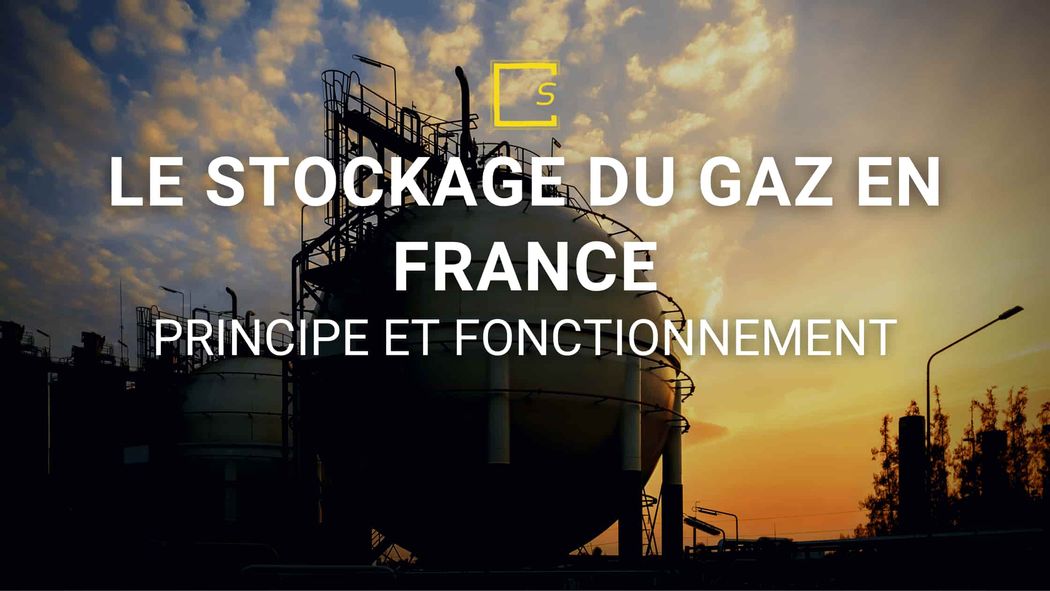
Electricity and gas are very different forms of energy. Some aspects may look alike, but the technical management of the two is radically different.
One of the most important differences is that gas can be stored on a large scale. You might point out that electric batteries exist. They do, but they cannot store enough electricity to supply, for example, an entire city (see our article « Can electricity be stored? » on this subject).
Gas plays by different rules. It can be stored in gaseous or liquid form, which means it can be stored or transported. This is one of the reasons why cargo ships cross the world's seas to deliver gas.
Gas storage is generally used to get through cold spells or geopolitical events.
Gas prices vary widely with the seasons, geopolitics and demand. Storage makes it possible to buy gas when prices are favourable and use it later.
We will first look at the methods used to store gas. We will then review the state of the storage network in France. Finally, we will explore the future uses of this technology, which is essential to the energy transition.
As mentioned above, gas can be stored in liquid form. When its temperature is lowered to around −160 °C, gas condenses and becomes liquid. It then takes up far less storage space (600 times less than in its gaseous state!).
This liquid gas is then kept in cylindrical tanks, so that it can be used later. These tanks are generally made of concrete or fitted with sealed linings that keep the gas at the right temperature. In France, this is not the dominant storage technology.
To find out more, read our article on LNG (liquefied natural gas).
One of the solutions available today is to store gas underground. These sites can be compared to artificial gas fields.
Rock formations containing salt layers are impermeable: a cavity dug into rock with salt layers will not let the gas inside it escape. A large enough cavity simply has to be dug into a salt formation. These impermeable caverns are created by injecting water.
These are former, exhausted fields that once held natural gas reserves. The impermeable properties of the rock are already present on site.
In nature, some gas fields lie in water-bearing rock. Usually dome-shaped, these formations hold gas trapped between the water and the rock. This technique reproduces those conditions: the injected gas pushes the water back against the walls.
Underground storage is the method used in France today.
In France, two groups share most of the gas storage capacity: Storengy and Teréga.
Storengy, a subsidiary of the ENGIE group, is the main gas storage operator in France. It runs some 14 storage sites using different technologies, which together can hold close to 10 billion cubic metres of gas. It is one of the largest players in this field in Europe.
Teréga is, with GRTgaz, one of the two gas transmission system operators in France.
France's total gas storage capacity is close to 130 TWh. That figure may not mean much on its own, but it represents nearly 33% of France's total annual consumption. When storage is full, France can hold almost a third of its yearly consumption.
Storengy operates almost all of the sites in number. Teréga owns two sites in south-west France, which nevertheless offer relatively large storage volumes.
Global energy markets are exposed to many uncertainties. Geopolitical tensions regularly shake gas markets. A major exporting country can, for example, apply pressure by threatening to limit its gas exports. Recent examples include the negotiations over the Nord Stream 2 pipeline and the tensions between Algeria and Morocco (source: Agence Ecofin).
Financial markets react to this kind of news, which can push prices up even when it remains a threat. Storage can be an effective safeguard: tanks are filled when prices are more favourable, and the reserves make it possible to stay independent of the markets. This does not last forever, but even a short period can sometimes prevent a surge in the cost of gas supply.
At the end of 2021, long-term and spot electricity and gas prices reached historic highs.
Storage can also play a major role in tomorrow's energy transition. There are gases of renewable origin, such as:
This opens the way to virtuous scenarios that combine renewable energy production with storage capacity.
The main drawback of renewable energies is that their output is intermittent. Storage makes it possible to store the energy produced when conditions are favourable, then use it later. This technology could therefore speed up the development of renewable energies and help decarbonise several European countries.
In a few clicks, organize an exchange with one of our experts.


weekly newsletter subscribers

4.9
