





Summarize with AI

November 3, 2026
5
Min reading
Global warming is in part the consequence of how we produce and consume energy. The effects of greenhouse gas emissions are far-reaching on the climate. To alleviate pollution, the production of green electricity is promoted by the State and local authorities.
However, one of the challenges to be met in order to make the energy transition effective is the management of the electricity produced. A prerequisite for 100% covering the energy needs of an entire country, electricity storage is it possible? SirEnergies gives you some answers here.
The storage of electricity and energy in general is a major challenge in order to achieve The carbon neutrality set as an objective by the French State, like other nations around the world. Electricity is a form of energy that is stored less well than fuel or gas. It is for this reason that, despite the high electrical production capacity of renewable sources, the latter cannot yet replace fossil sources.
Scientists are constantly exploring ways to balance electrical power generation in order toavoid electrical insufficiency or waste. Storage makes it possible to preserve excess electricity in case of overproduction in order to return it when production is less than demand. To maintain this surplus, electricity is converted into another form of energy that varies according to the technology used.
Electricity storage is possible thanks to STEP (Pumped Energy Transfer Stations). This technology utilizes mechanical energy Potential of water. To store electricity via the WWTPs, two basins are arranged at different heights. When electrical demand is low, the electric motor pumps water from the lower basin to the upper basin.
On the other hand, when demand is high, water flows back down from the upper basin to the lower basin through a turbine. In fact, the mechanical energy of water is used to produce clean electricity. The STEP system is inexpensive for an attractive yield (€50 per kWh). Pumped storage is a technology that is used to restore up to 5 gigawatts, which is equivalent to the production of six nuclear reactors.
Compressed air energy storage (or CAES for Compressed Air) Energy Storage) is carried out using a technology similar to that of STEP. But here, it is the air that is kept in the containers. The installation of CAES allows store large quantities of electricity for several weeks.
On the other hand, this thermodynamic storage technology consumes a lot of energy, which limits its use. In some countries such as Germany and the United States, this storage method is still used to conserve electricity due to its large-scale performance.
Individuals can make use of batteries and Of fuel cells to keep electricity in their homes. How? Through the installation of photovoltaic panels, for example. The electrical energy storage is possible with lithium-ion, sodium-sulfur, nickel-cadmium, and lead-acid batteries.
One of the weaknesses of batteries is that they only store energy for a short period of time. Also, they generally work in the short term.
Another danger also: the risk of fire, for example the Tesla Megapack that caught fire.
The good news is that research is continuing among the ranks of scientists to manufacture more efficient batteries. It is envisaged, for example, That organic batteries will be created soon.
Power to gas (conversion of electricity into gas) ! This is an exceptional technique that makes it possible to avoid energy waste. It is an electrochemical storage method that allows convert excess electricity into synthetic gas (hydrogen or methane). Power to gas makes it possible to store electricity over the medium and long term.
Electricity generated by solar radiation or wind movement can be subject to this type of storage and transformation. The use of this technology is part of the logic of controlling the production of green electricity. Thanks to Power to Gas, the surplus of solar photovoltaic or thermal energy is used to heat the house or power an electric vehicle.
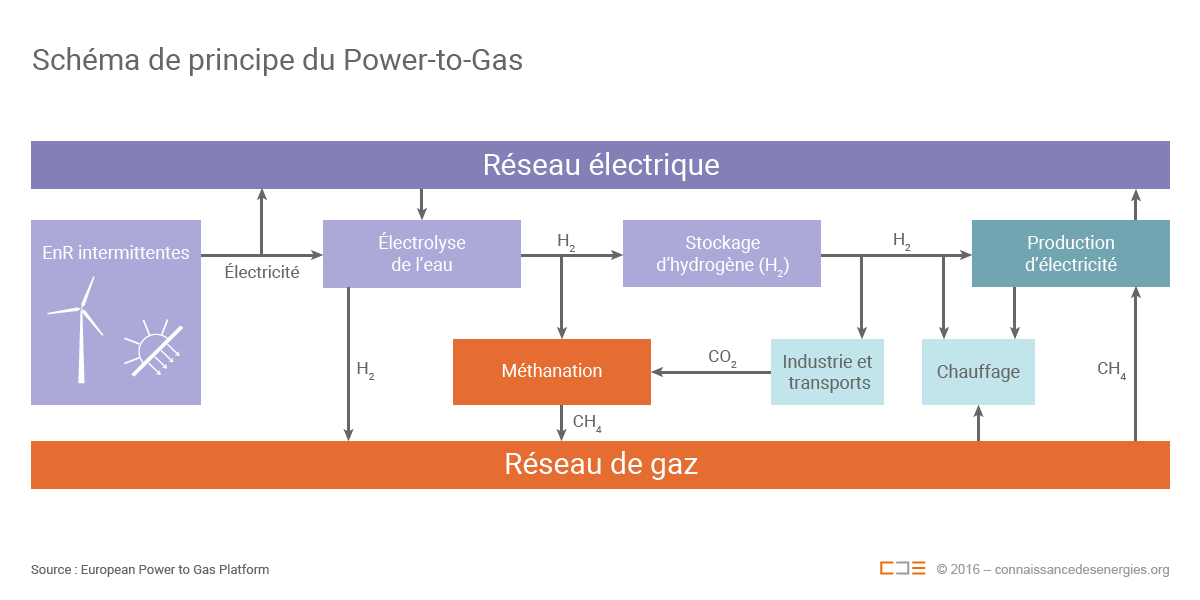
Source: European Power to Gas Platform
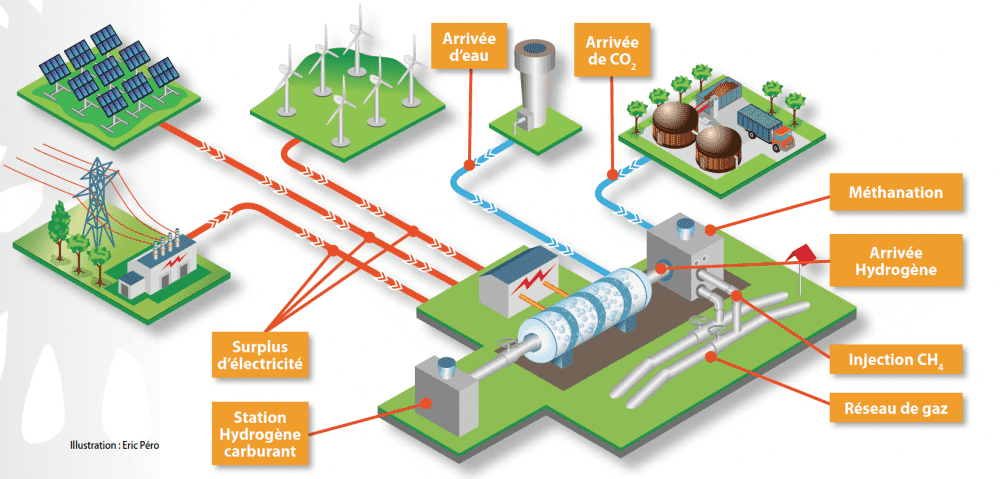
Converting electricity into gas to store energy — Source: Solagro
Electricity can be stored with a flywheel. No, a flywheel is not a state-of-the-art car accessory. It is simply a very heavy mass in the form of a wheel or cylinder. This equipment produces and stores electricity when it is rotated at an exponential speed by an electric motor.
The motor can rest when the wheel is started. The flywheel continues to rotate thanks to a magnetic rotation system. In fact, it produces energy that can be converted into electricity by a motor that returns kinetic energy. However, this technology allows a short term storage and still needs improvement.
Concrete blocks can be used to store electricity. This is what a Swiss startup, Energy Vault, proved. This technology consists in using a 6-branch crane to raise concrete blocks on a 120 m tower in case of overproduction of energy.
Later, to meet the demand for electricity, the concrete blocks went down again. In doing so, kinetic energy is transformed into electrical energy. Given the energy storage capacity of this technology (35 MWh), governments will soon be interested in it.
As you will have understood, the conservation of electricity is possible, and this, through multiple storage modes. While some technologies are only accessible on a large scale, others can be used at home.
Do you have a project to install a renewable energy production and storage system in your company or local authority? Call on the energy broker and expert SirEnergies to benefit from tailor-made services.
Do not hesitate to consult our article that answers the question: What is the speed of electricity?
Today, more than ever, electric mobility is one of the levers for achieving carbon neutrality. As such, businesses have a role to play in the energy transition.
You want to install charging stations and/or convert your company's vehicle fleet to electric? SirEnergies is there to help you and supports you in building an eco-responsible image for your business.
Click below for more information:
In a few clicks, organize an exchange with one of our experts.


weekly newsletter subscribers

4.9
