




Summarize with AI

March 6, 2026
7
Min reading
At a time of energy transition, it is crucial to be able to project yourself into the future and to foresee several scenarios. Indeed, public authorities will have to make absolutely crucial decisions concerning the future of energy in France.
What are the preferred production methods (nuclear power plants, renewable energies, biogas, etc.)? What will our level of global electricity consumption be in 2050? What will be the new electrical uses and needs of tomorrow?
These questions are essential in order to be able to build a coherent and efficient French energy landscape in the years to come.
Planning has often been at the center of all large-scale industrial developments during the 20th century. The French nuclear program, started in the 1970s, was the result of a reflection on the independence of France from an energy point of view.
The need not to depend on hydrocarbon exporting countries has prompted the French presidency to speed up on the subject.
Today, the thoughts are different. A full member of Europe, France is trying to imagine its future needs through the prism of European solidarity. The electrical system is interconnected and countries are dependent on each other.
In 2021, RTE has therefore attempted to do this by proposing a very serious study that tries to draw the different possible scenarios. We are therefore going to try to immerse ourselves in this study that is highly anticipated by the energy world. Here is the complete summary of Energy Futures 2050 by RTE.
It is crucial to discuss how this study was carried out. Indeed, generally, each theory mentioned in the world of energy is the subject of numerous questions in order to verify its reliability.
As this sector is mostly dominated by engineers, any lack of scientific rigor is frequently criticized. It is therefore very important to present the method used by RTE to try to imagine our future.
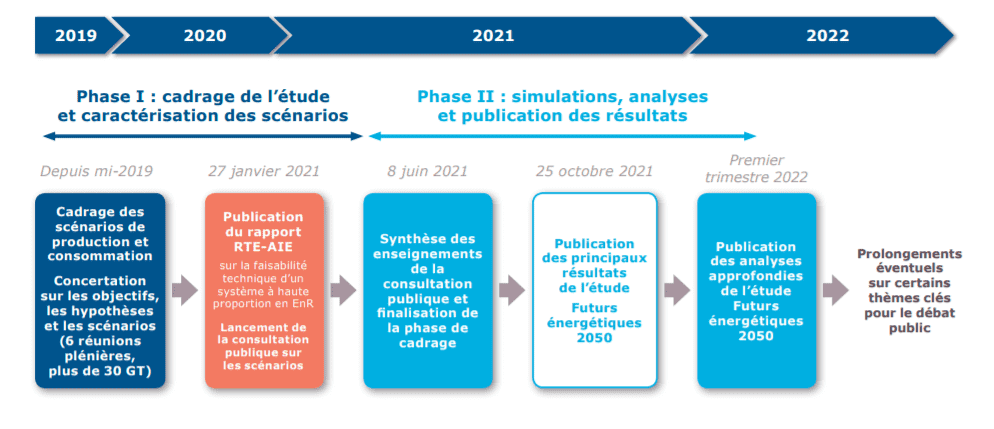
The project is divided into two main phases:
Source: RTE
RTE organized a large-scale public consultation that brought together nearly 4,000 organizations, institutions and individuals. The principle of public consultation is widely known and used in the energy sector. However, the quantity and precision of the responses indicate genuine interest on the part of the population as a whole.
The culmination of this project remains the publication of the results of the study on October 25, 2021. Indeed, after drawing lessons from the scoping phase and then carrying out the studies, the project makes perfect sense when the data is published.
This study was highly anticipated in the sector, but the general public only knew about its existence when it was published.
This document is supposed to serve as an energy compass for public authorities. However, it is likely to create a lot of debate, and sometimes confusion. To do this, it is enough to note certain political statements.
At SirEnergies, we like rely on facts and analyze an approach before criticizing it. It turns out that the consultation efforts, as well as the approach and the numerous parameters analyzed, allow us to attest to the seriousness of this study.
However, there are some points to be clarified that we will see in this article. However, given the complexity of the exercise, it is quite normal to see grey areas appear.
As electrical system manager, RTE is a player at the heart of the energy transition. It fulfills its public service mission, while developing its R&D activities.
He is therefore an actor who, thanks to his technical skills and his experience of network manager, can answer a lot of questions. The aim of this study is to anticipate: to do this, RTE is trying to model all the different parts of the electricity sector. The problem is not only physical but also economic and social.
To set up these scenarios, RTE uses numerous parameters:

Source: RTE
These parameters are numerous, complex to capture and very often uncertain. It is extremely difficult to estimate the means of flexibility of tomorrow. In particular, they depend on economic incentives.
The aim of this study is to draw from these parameters several long-term scenarios. All of these scenarios are aimed at carbon neutrality By 2050. The aim of this study is therefore to establish several feasible scenarios (at least in theory) in order to achieve the goals of reducing CO₂ emissions.
It should be understood that this study is not aimed at calculating the optimal situation (the least expensive and the most effective), but rather several plausible scenarios.
Obviously, these projections are subject to hazards, but also to numerous political and social choices.
RTE has therefore put in place scenarios of different energy mix in France by 2050. But it is also about different consumption trajectory scenarios.
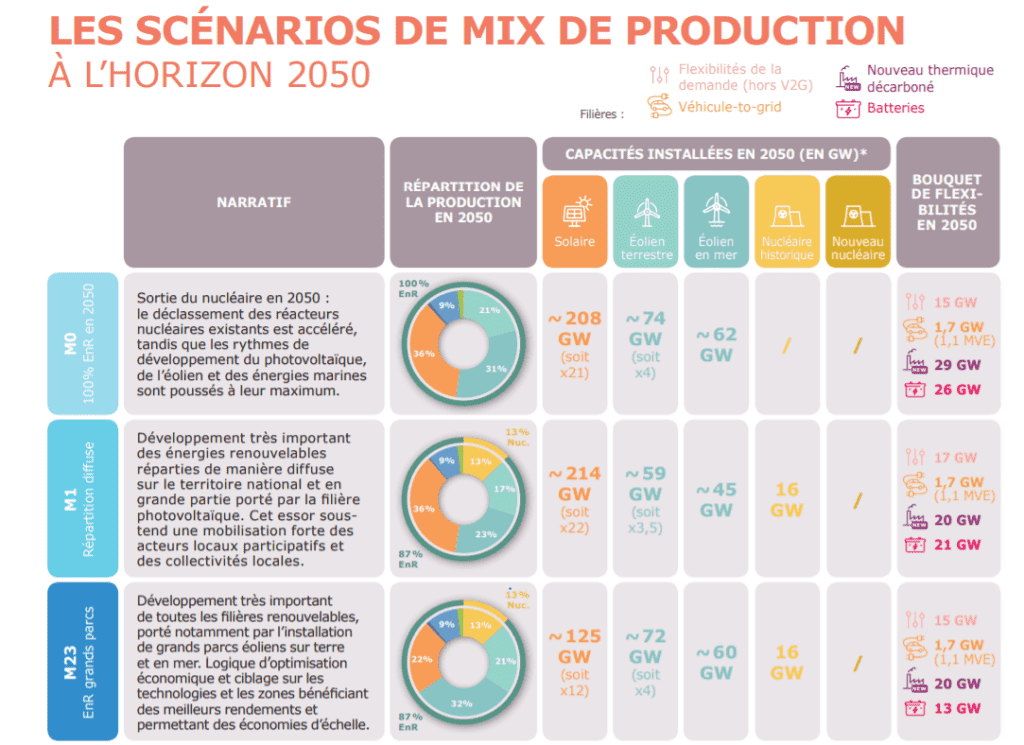
To simplify and summarize this work, we will first study the three scenarios that do not foresee any nuclear capacity under construction (Scenario M).
M scenarios — Source: RTE
These scenarios are back-tested several times. RTE tells us that, theoretically, it is possible to support the electrification of uses thanks to these various packages.
The spotlight is on renewables : solar panels, as well as wind power, represent most of the means of production. They are part of a national low-carbon strategy that is supposed to help us reach our goals.
The M0 is also a scenario without any nuclear energy ; the other two have no new capabilities. Nevertheless, it is interesting to note that RTE did not carry out the economic analysis of the M0 scenario. The development of renewable energies is nevertheless essential; it remains to be seen in what proportion.
In all these scenarios, the means of flexibility are essential, as they are the ones that reduce the effect of The intermittency of renewable energies. In particular, they all use an installed capacity of 1.7 GW of electric vehicles (V2G Vehicle to Grid). Indeed, security of supply is fundamental.
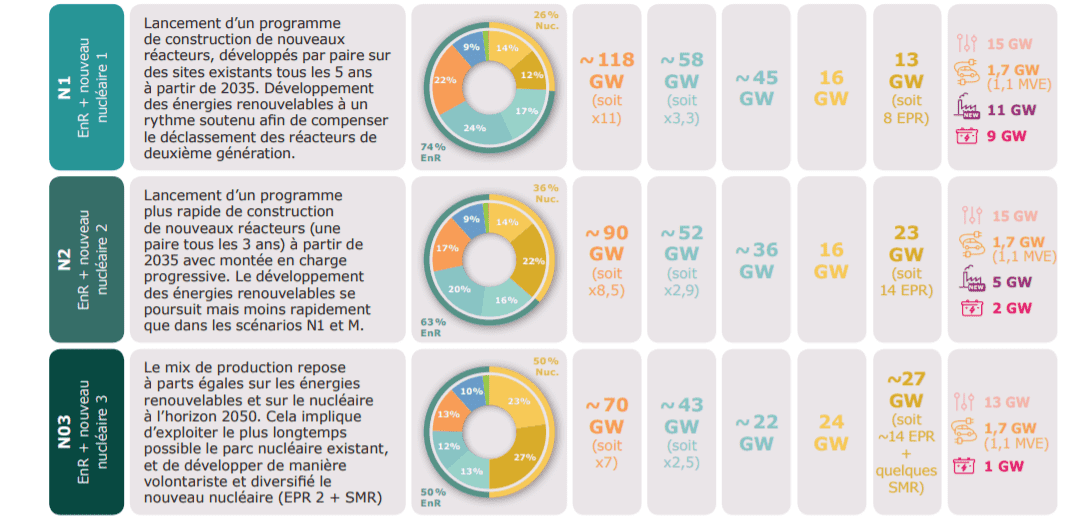
Finally, here are the scenarios N, which present a French energy landscape with new nuclear capabilities.
N scenarios — Source: RTE
These electrical mixes are more varied and have the merit of being, at the same time, more realistic. They highlight nuclear, modular and decarbonized technologies.
We therefore see the corollary of what we said earlier: the means of flexibility are clearly decreasing in these scenarios.
Source: RTE
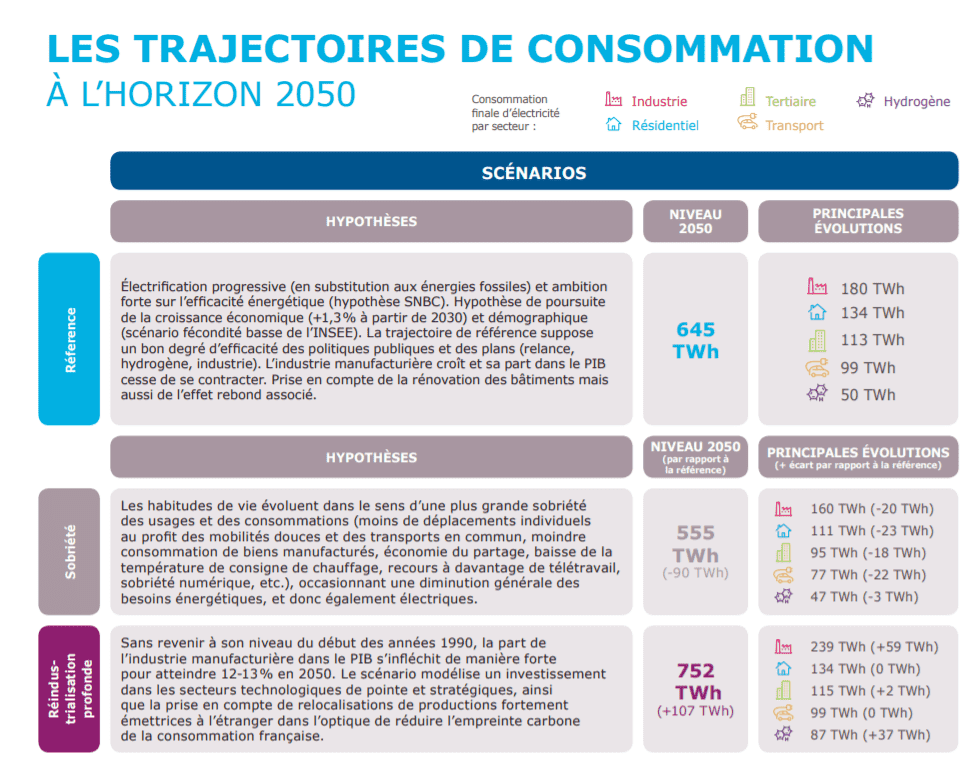
As we have said, it is impossible to dissociate means of production and electricity consumption. Different scenarios emerge, with several variants.
However, we decided to summarize the main lessons of this report:
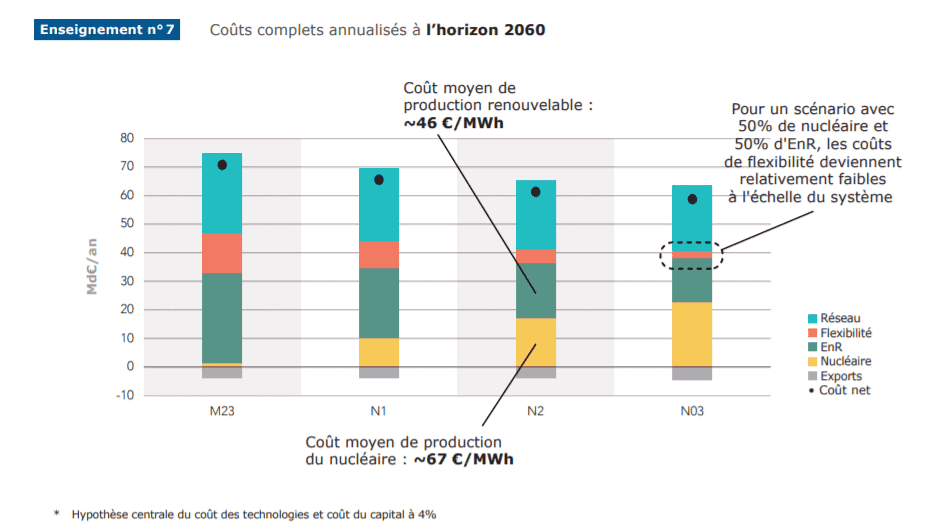
Source: RTE
So this study is comprehensive, dense and, like any study Foresight, uncertain. However, it is an absolutely essential exercise in order to give food for thought to tomorrow's decision-makers. Energy is a long, even a very long term industry. It requires investments, which are often massive.
Before investing, it is crucial to have tangible elements that can support or disprove certain investment projects. This is the role of this study, but there is no doubt that this exercise will increase over time in order to have an ever more precise vision of the immense challenges that await the world of The energy of tomorrow.
This study also has the merit of stimulating public debate and thus allowing citizens to take ownership of the subject. The energy sector is not quite like the others, it is essential and deserves this kind of long-term thinking. In all cases, economically viable technologies will have to be found in order to replace fossil fuels.
Do not hesitate to consult our article to know The differences between RTE and Enedis.
Resulting from a desire of the French government, the Tertiary Eco-Efficiency System (DEET), also called Tertiary decree, requires a gradual reduction in energy consumption for French tertiary buildings greater than 1,000 m².
This regulation aims to save 60% of final energy in these buildings by 2050.
We support you in the compliance tertiary buildings in order to comply with the obligations of the tertiary decree.
Click below for more information:
In a few clicks, organize an exchange with one of our experts.


weekly newsletter subscribers

4.9

.png)

La réussite d'un projet collectif énergie repose sur trois piliers fondamentaux :
To calculate Scope 2 emissions, use the following formula:
Energy quantity (kWh) × Emission factor (kg CO₂ e/kWh).
Use databases like ADEME for precision.
Car les marchés dépendent de facteurs exogènes imprévisibles (géopolitique, météo soudaine, politique) que les modèles basés sur l'historique ne peuvent pas anticiper, tout comme on ne prédit pas le Loto.
The central objective of PPE 3 is to engage France towards carbon neutrality by 2050 by breaking the country's historical dependence on fossil fuels.
Today, approximately 60% of final energy consumption in France still relies on imported oil and natural gas. PPE 3 aims to radically reverse this trend by setting an ambitious target: to reach 60% of carbon-free energies in final consumption by 2030.
To achieve this, PPE 3 pursues three major sub-objectives:
La Vente de Nucléaire Universelle (VNU) est le nouveau mécanisme de régulation des prix de l'électricité en France. Contrairement à l'ARENH, il ne s'agit plus d'un volume fixe à prix réduit, mais d'une redistribution financière des revenus excédentaires d'EDF aux consommateurs, basée sur les prix de marché et les coûts de production du nucléaire historique.
Non. L'IA traite la donnée (data processing), mais l'analyste apporte la compréhension du contexte (market sentiment) et la prise de décision stratégique.
Chaque modèle d'IA répond à un besoin spécifique du cycle d'achat :
L'expertise humaine reste néanmoins indispensable.
Les coopératives de taille ETI ou grande entreprise peuvent être soumises à l'audit énergétique réglementaire (norme NF EN 16247). Sirenergies n'a ni la compétence ni l'accréditation pour réaliser cet audit : nous vous orientons vers un bureau d'études partenaire accrédité, et vous accompagnons en amont sur vos achats et en aval sur le pilotage.
Instauré en 2017, ce dispositif répond à un enjeu de sécurité nationale.
L'électricité ne se stockant pas à grande échelle, le réseau doit être capable de répondre instantanément à la demande, même lors des pics de froid hivernaux. Le mécanisme incite financièrement les producteurs à maintenir leurs centrales disponibles et les entreprises à réduire leur consommation (effacement) lors de ces périodes critiques.
La fin de l'ARENH (Accès Régulé à l'Électricité Nucléaire Historique) marque l'arrêt de la fourniture d'électricité à prix fixe garanti (42 €/MWh).
Dès le 1er janvier 2026, les entreprises sont exposées aux prix de marché, mais deux nouveaux mécanismes de régulation prennent le relais, bien que leur logique soit différente :
Conseil stratégique : Ne comptez pas sur le VNU pour réduire votre facture en 2026 si les marchés restent stables. Auditez vos contrats dès maintenant pour intégrer une part de prix fixe ou explorer des "Power Purchase Agreements" (PPA) pour sécuriser vos coûts sur le long terme.
The range E @sy is available in four pricing structures to adapt to each risk profile:
La Multiannual Energy Programming (PPE) is the strategic management tool for France's energy policy. Established by the 2015 law on energy transition for green growth (LTECV), it serves as a compass for the State, communities and businesses.
Concretely, the PPE sets the priorities for action of the public authorities for the management of all forms of energy on the national territory. It covers a period of ten years, divided into two periods of five years, and must be revised periodically to adapt to technological and economic developments.
It deals with major topics such as:
It is crucial not to confuse it with National Low Carbon Strategy (SNBC). While SNBC sets carbon budgets (the ceilings for greenhouse gas emissions by sector), the PPE determines the technical and energy resources to achieve them.
Yes. The supplier guarantees an offer 100% renewable via the official Guarantees of Origin (GO) mechanism.
For the most demanding companies, the offer GREENVOLT+ ensures very low carbon intensity electricity, sourced exclusively from independent French producers (hydraulic, wind, solar).
Ce seuil est jugé élevé par rapport aux prévisions actuelles du marché. Si le prix de l'électricité reste en dessous de 78 €/MWh, les entreprises ne bénéficieront d'aucune redistribution. Cela signifie que la protection promise par la réforme pourrait être inexistante dans un marché baissier, d'où l'importance de stratégies de sourcing agiles et d'outils de monitoring comme Pilott.
Absolument. La réforme des heures creuses vise à absorber la surproduction solaire en milieu de journée. Les créneaux d'heures creuses se déplacent progressivement vers la plage 11h00 – 17h00, notamment en été. C'est une opportunité majeure pour les sites industriels ou tertiaires capables de flexibilité.
Conseil stratégique :
L'impact dépendra des prix de marché. Le mécanisme prévoit une redistribution si les prix dépassent 78 €/MWh. Cependant, si les cours restent bas (actuellement autour de 60 €/MWh), le dispositif ne s'activera pas. La facture sera alors indexée à 100% sur les prix de marché, rendant le choix du fournisseur et du moment d'achat critiques.
Le calendrier 2026 impose deux échéances majeures :
Pour simplifier ces démarches, vous pouvez centraliser vos données de consommation avec la plateforme Pilott de Sirenergies, garantissant ainsi la conformité de vos rapports réglementaires.
It allows you to prove your commitment to the energy transition and to meet regulatory requirements.
Le prix Forward est fixé à l'avance (sécurité budgétaire), tandis que le prix Spot varie heure par heure selon le marché (opportunité mais risque élevé).
In 2025, the supplier had a NPS (Net Promoter Score) of +16 and a note of 4,17/5.
Satisfaction is based on a “zero solicitation” model and 100% in-house customer service in Toulon, guaranteeing proximity and responsiveness that cannot be found with major historical suppliers.