




Summarize with AI

March 6, 2026
7
Min reading
At a time when ecological transition is at the heart of global development challenges, photovoltaic energy is attracting a lot of interest. The use of solar panels is becoming more widespread, but the functioning of the photovoltaic cell is not yet obvious to everyone.
A component at the origin of the photoelectric phenomenon, the photovoltaic cell makes it possible to convert the sun's rays into electricity.
It fits perfectly into the French energy mix promoted by the public authorities. Between a definitional concept, different types, operating principle and perspectives, SirEnergies invites you to discover how a photovoltaic cell works.
The photovoltaic cell is a “mini-power plant” made of several materials whose synergy makes it possible to convert light energy into electricity. Joining different layers of semiconducting materials together like a sandwich forms what we call a junction.
As soon as a photon crosses the junction, it deposits its energy there and triggers an electron transfer from the n zone (negative) to the p zone (positive) of the photovoltaic cell. All that remains is to connect each of the faces of the device to a conducting wire and we get electric current.
Each semiconductor material used, and more precisely the properties of the latter, determines the lifespan of the photovoltaic cell. The photovoltaic panel, candidate for the coveted position of energy of the future, must therefore consist of: durable, resistant and very ecological materials. A question then arises: why silicon in photovoltaics?
Silicon is omnipresent in electronics because of its semiconductor properties. There are two main reasons why it is used in the manufacture of photovoltaic cells. First, it facilitates the circulation of electron—hole pairs that are essential for the production of electricity.
Then, it is possible to substantially modify its chemical composition in order to optimize its electrical properties. The researchers in fact “doped” this material with atoms of a different nature.
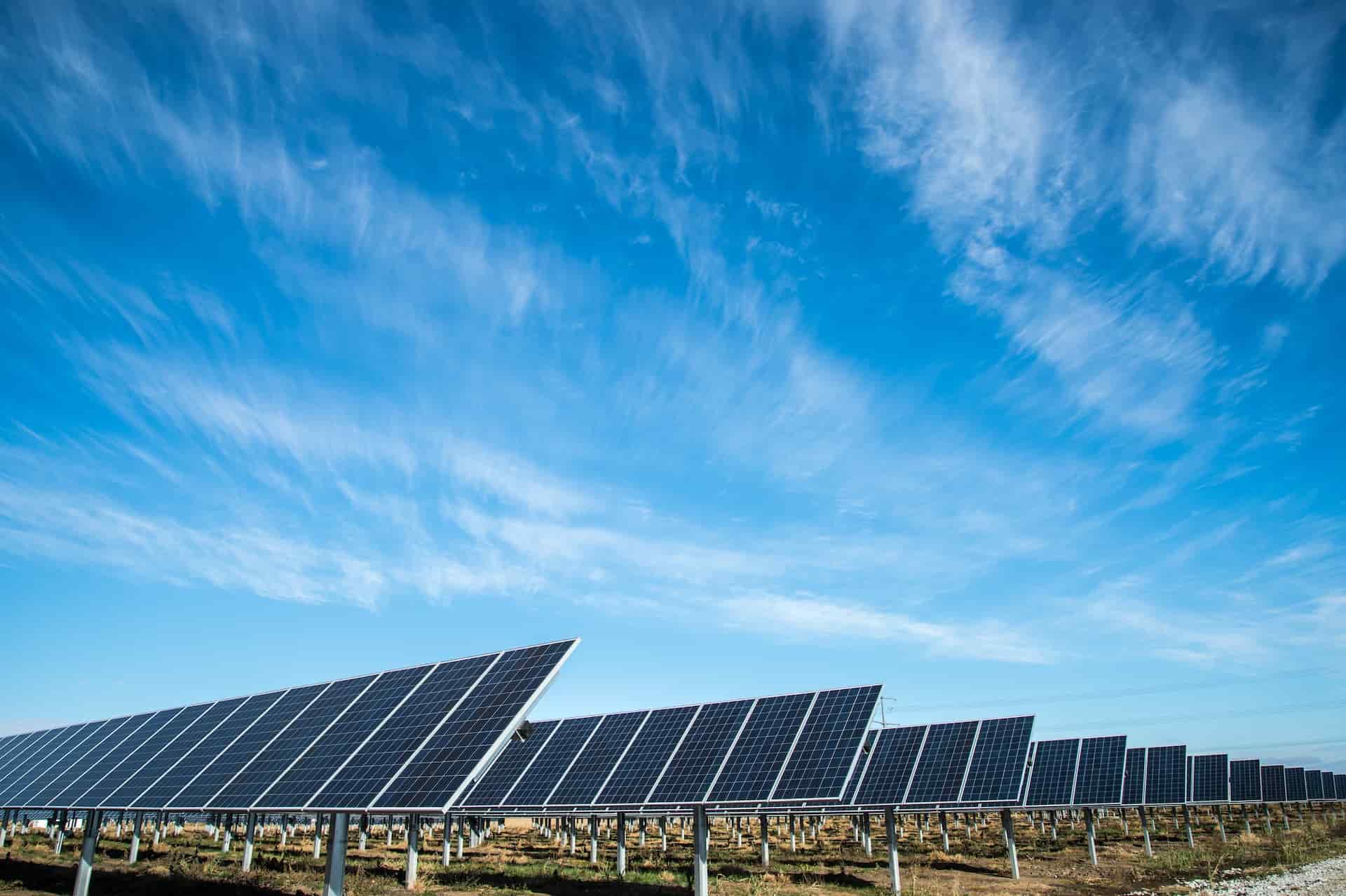
If the photovoltaic cell crystallizes so much attention, it is above all for the numerous possibilities it offers. In this respect, we distinguish three major families whose returns are constantly evolving!
Silicon cells represent more than 95% of the photovoltaic cell market, because silicon is present in abundance in the sands. The average efficiency of this type of component is also between 16.5 and 22% depending on the technology used for its manufacture.
In contrast to monocrystalline cells, silicon is composed of several crystals when it is obtained with a cold treatment. It is easy to produce. It can also be reconstituted into a large crystal when it is melted. We then obtain a monocrystalline material whose efficiency approaches 26.6% in the laboratory.
The classical approach, which consists in cutting silicon into thin wafers of about 200 microns in size, is being neglected by a group of researchers. It is now possible to place semiconductor materials with a thickness of a few microns on a substrate such as plastic or glass.
There is really no limit to the fields of possibilities. Cadmium and CIGS (copper/indium/gallium/selenium) have already been tested in the laboratory and the results are far from disappointing. They are even close to the figures obtained with silicon, i.e. respective results of 22.1 and 23.3% for these materials.
The discovery we are sharing with you does not spell the death knell for silicon, quite the opposite. It can be used in thin layers in its non-crystallized form. We also find this technology in calculators, but its efficiency is lower.
With organic cells, we are leaving the sphere of mineral semiconductors to explore another path: that of molecules. These components are based on The polymers of organic chemistry, but they are just beginning to have applications in photovoltaic modules.
The energy efficiency of organic cells is still low and their long-term stability is approximate. However, they could have a very low production cost, which is promising for the future.
Several production techniques are explored in the context of Photovoltaic cells. One of the main paths is that of photosensitive pigment cells whose functioning is inspired by plant photosynthesis. Their name? The dye cells!
To understand how a photovoltaic cell works, we need to go back to some physics concepts.
Photovoltaic cells use what we call the “photoelectric effect” to produce electrical current by absorbing solar radiation. Each cell placed on a photovoltaic panel continuously converts the light energy of the photons into electricity. The medium that facilitates this process by transporting electrical charges is none other than the semiconductor material.
Here we must take a break to discuss one of the aspects mentioned above: the doping of silicon crystals, especially with multijunction cells. Each atom of this mineral is composed of four peripheral electrons. The cell has two layers:
The photovoltaic effect is the name given to the phenomenon by which photovoltaic cells produce electricity. It sheds light on the reaction of silicon to The energy of the sun across the two layers of the cell.
Once the two sides are in contact, the excess electrons from material n pass to material p and the magic happens. The photons that pass through the solar cell strip electrons from the atoms in both layers. Now free of the p-layer, they move in all directions, take a circuit and return to the n-layer. Electricity is nothing but the result of this movement.
The photoelectric phenomenon occurs when The sun's rays hit the surface of a solar panel. From this situation arises a detachment of electrons which, oriented by the plates of each photovoltaic cell, move from one point to another: this is the birth of direct current! The inverter in the panel then transforms the direct current into alternating current to power your devices.
The efficiency is simply the ratio between the electrical power obtained and the light power that affects the photovoltaic cell. To determine this quantity, each cell in the panel is calibrated using a solar simulator. The conditions of the test? An ambient temperature of 25°C and a sun of 1,000 W of light for each square meter!
The electrical power produced or peak power is a fraction of the solar power received. It is expressed as a percentage. As an illustration, take the case of a 1 m² photovoltaic panel that produces a power of 200 W. Its efficiency is 20% and cannot exceed 33% according to the “Shockley-Queisser limit”.
The future ofsolar energy depends on its own advantages and disadvantages. So we are going to look at the issues of this green energy to determine if it is the energy of tomorrow.
On a human scale, solar energy is inexhaustible and available for free. Its advantages are:
The production of electricity thanks to photovoltaic installations is also not polluting during the operating phase. Les panels are also recyclable and can be used for small-scale domestic purposes.
Solar energy faces financial limitations. The technology is still very expensive despite the sharp decline in recent years. Conventional solar panels are also fragile, heavy and difficult to install.
The energy and environmental impact of solar energy is not zero. It takes approximately between 1 and 1.5 years for a photovoltaic cell to compensate for the energy required to manufacture it. Finally, the electricity produced is not immediately storable. Indirect storage technologies (batteries, kinetic accumulators, etc.) are very expensive.
It's hard to imagine the future without solar energy. Recognizing the challenges surrounding this energy, the photovoltaic industry is hard at work to develop techniques that are less expensive and less demanding in terms of resources. Concentrated solar energy, tape deposition, organic materials and thin film panels are some of the most promising approaches.
The photovoltaic cell operates on the basis of the photoelectric phenomenon and the difference in polarity between the layers of the component. While much progress is expected in this sector, what about Hydrogen And of The fuel cell ?
To go further, do not hesitate to consult our article on The history of solar energy.
Recognizing the climate emergency, SirEnergies offers professionals and businesses the opportunity to limit the ecological impact in terms of energy.
We have made the choice to work with key players in solar photovoltaic to offer you support solutions dedicated to your photovoltaic self-consumption projects.
Click below for more information:
In a few clicks, organize an exchange with one of our experts.


weekly newsletter subscribers

4.9

.png)

Un appel d’offres permet de mettre en concurrence plusieurs fournisseurs d’électricité et de gaz afin d’obtenir des conditions contractuelles optimisées. C’est une démarche transparente qui permet de choisir l’offre la plus adaptée aux besoins budgétaires et techniques de l’organisation.
Communities are subject to taxes such as TICFE or TICGN. Sirenergies analyzes invoices, identifies exemption possibilities and fixes possible errors to reduce the tax burden.
Le dispositif ARENH a laissé place au VNU (Versement Nucléaire Universel).
Ce changement structurel expose davantage les entreprises aux prix de gros, rendant la gestion des risques plus complexe qu'auparavant.
Il devient alors indispensable de définir une stratégie d'achat d'électricité avec Sirenergies pour lisser l'impact de la volatilité des marchés sur votre budget.
One invoice consists of several elements: consumption, supplier share, taxes and contributions. The analysis of each line makes it possible to identify possible errors and to check the consistency with the signed contract.
Ce record de 92,3 TWh s'explique par la conjonction de trois facteurs :
The €/MWh is a price unit used in wholesale markets, while kWh is the unit visible on your bills.
C'est le levier le plus rapide pour obtenir des résultats visibles. L'éclairage représente environ 40 % de la consommation d'électricité d'une commune.
Passer au LED avec pilotage intelligent permet de réduire la facture de 50 à 80 %, avec un retour sur investissement (ROI) rapide, souvent estimé à 2 ou 3 ans.
Les caves coopératives de taille ETI ou grande entreprise peuvent être soumises à l'audit énergétique réglementaire (norme NF EN 16247). Sirenergies n'a ni la compétence ni l'accréditation pour réaliser cet audit : nous vous orientons vers un bureau d'études partenaire accrédité, et vous accompagnons en amont sur vos achats et en aval sur le pilotage.
The range E @sy is available in four pricing structures to adapt to each risk profile:
L'abondance de production française tire les prix du marché de gros vers le bas.
En vertu du mécanisme de l'Ordre de Mérite (Merit Order), les centrales les moins coûteuses (nucléaire, renouvelables) couvrent la demande plus souvent, évinçant les centrales à gaz ou charbon plus onéreuses.
Cela multiplie les épisodes de prix bas, voire négatifs, sur le marché spot.
C'est l'indicateur d'efficacité d'un appareil électrique ; il représente le ratio entre la puissance active (utile) et la puissance apparente (totale).
The subscribed power must be calculated according to the consumption profile and uses (heating, industrial processes, tertiary equipment). One fine analysis makes it possible to ensure the adequacy between real need and contract.
Exceeding capacity leads to financial penalties and can impact the size of the contract. Adjust the correctly subscribed power makes it possible to avoid these additional costs.
Farms are subject to taxes such as TICFE or TICGN. Sirenergies verifies their application, identifies cases of exemption and accompanies the procedures to reduce the tax burden.
En 2025, la France a atteint un solde exportateur net de 92,3 TWh, battant le précédent record de 2024 (89 TWh).
Le transport (RTE) correspond aux "autoroutes" de l’électricité. Il s’agit de transporter de très grandes quantités d'énergie sur de longues distances, depuis les centrales de production (nucléaires, barrages, parcs éoliens offshore) vers les régions de consommation.
La distribution (Enedis) s'apparente aux "routes départementales" et aux rues. Elle récupère l'électricité à la sortie du réseau de transport pour la livrer directement chez le client final, en abaissant la tension pour qu'elle soit utilisable par vos appareils.
In 2025, the supplier had a NPS (Net Promoter Score) of +16 and a note of 4,17/5.
Satisfaction is based on a “zero solicitation” model and 100% in-house customer service in Toulon, guaranteeing proximity and responsiveness that cannot be found with major historical suppliers.
Some businesses may obtain a partial or total exemption from the TICFE or the TICGN, depending on their activity and energy intensity. The support of an expert makes it possible to identify the eligibility criteria and to put together the file.
Parce que la puissance souscrite en kVA détermine le prix de l'abonnement et que tout dépassement peut entraîner des surcoûts importants.
Sourcing consists in identifying and analysing the offers of several electricity and gas suppliers. This approach makes it possible to obtain contracts adapted to the consumption profile and budgetary constraints of the company.
The industry is concerned by TICFE, TICGN and other contributions that may represent an important part of invoices. Sirenergies identifies cases of exemption and accompanies the procedures to benefit from them.
Oui, elle est considérée comme une énergie renouvelable à faibles émissions de gaz à effet de serre.
De plus, l'eau ne subit aucune transformation chimique durant le cycle de production et réintègre son milieu naturel en aval.
Cependant, la construction de barrages nécessite des mesures pour protéger les écosystèmes (débit minimum, passes à poissons).
Among the taxes include TICFE, TICGN, CTA, CJA and TURPE. They represent a significant part of the bill and vary according to consumption profiles. Understanding them well is essential to optimize costs.
Le kVA mesure la capacité maximale que votre compteur peut supporter à un instant T, tandis que le kWh mesure la quantité d'énergie consommée sur une durée.
Tertiary companies are concerned by taxes such as TICFE or TICGN. Sirenergies checks the accuracy of invoices, identifies possible exemptions, and helps correct errors to sustainably reduce costs.
Yes. The supplier guarantees an offer 100% renewable via the official Guarantees of Origin (GO) mechanism.
For the most demanding companies, the offer GREENVOLT+ ensures very low carbon intensity electricity, sourced exclusively from independent French producers (hydraulic, wind, solar).
Le processus repose sur l'utilisation de la force de l'eau (énergie cinétique) issue des courants, des chutes d'eau ou des dénivelés. Le fonctionnement suit trois étapes clés :
This makes it possible to choose the right time to contract, secure your budgets and anticipate increases.
Tertiary companies must manage their energy costs while guaranteeing the comfort of users (offices, shops, services). Consumption is often linked to heating, air conditioning and lighting, which requires precise monitoring to avoid budgetary excesses.
These are signals sent by RTE during periods of tension on the electrical network. The Sirenergies tool informs you in real time to anticipate your uses.