





Summarize with AI

January 28, 2026
8
Min reading

Electricity circulates everywhere, in real time through the entire French electricity network. Electricity production and consumption must be equal at all times. It is this balance between supply and demand Who guarantees The unit of the electrical system. This electricity makes it possible to start up a large part of our economy, our uses and our processes.
A dispatcher is a electricity switch who works in electricity distribution centers called dispatchings. Under the responsibility of a team leader, dispatchers monitor the regional or national transport network every 7 a.m. to 12 p.m. A job at the heart of the electrical system.
After the separation of the electricity activities, two of them remained public services. It's about transport and distribution. Logically, these are two activities that would be difficult to open up to other actors.
The electrical network works thanks to a interconnected mesh allowing the entire territory to be supplied with electricity. Two operators are responsible for managing the electrical network: RTE for the transmission of electricity over long distances, Enedis for its distribution to users.
RTE (Electricity Transmission Network) takes care of the transport of high-voltage electricity, that is to say, it takes care of the transport that goes from the production sites to the low-voltage branches. Les superhighway, to repeat the parallel.
The role of RTE is also to balance the network between production and demand to avoid blackouts caused by too much demand (periods of extreme cold for example) or unnecessary overproduction for the French network.
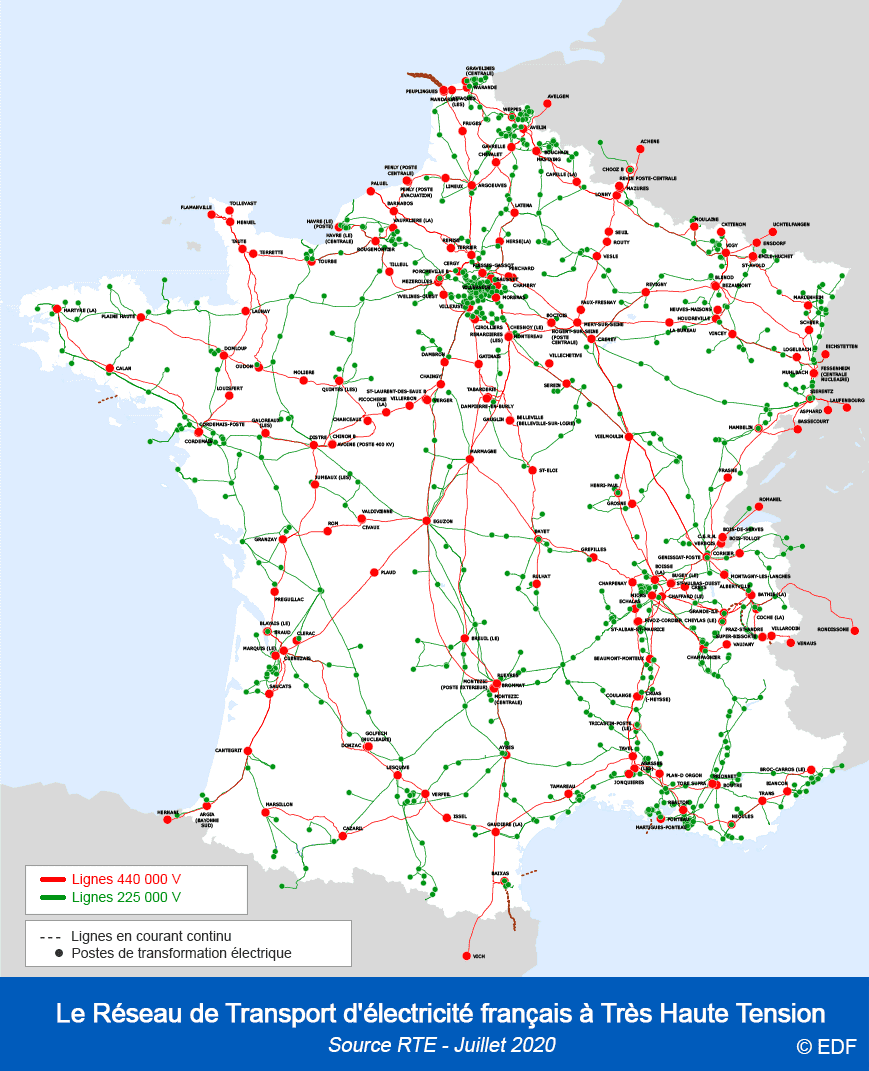
More than 105,000 km of Very High Voltage (THT) and High Voltage (HT) aerial lines including 5,000 km of underground lines and 46 cross-border lines operated, maintained and developed by Réseau Transport Électricity (RTE).
The THT network consists of lines to:
It is also 280,000 electrical pylons and 2,818 electrical substations.
The voltage on this network varies from 50,000 volts to over 400,000 volts. The voltage is also high because it makes it possible to transport electrical power over long distances by reducing losses.
There are industrial customers directly connected to this transport network, such as SNCF.
Enedis was formerly called ERDF (Électricity Réseau Distribution France) but was renamed that way just to avoid confusion with EDF since the activities are separate. Enedis takes care of low-voltage delivery and distribution to delivery points, the famous PDLs that suppliers ask you for.
In every place where there is an own consumption of electricity, there is a Counter Numbered by a PDL. It is this meter, also managed by Enedis, that makes it possible to measure the electricity consumption of a home.
To repeat the parallel, it is as if Enedis was taking care of the National roads, Departmental And paths that arrive at any location. But also of the postbox that allows you to receive mail.
In reality, Enedis is not the only one in charge of the distribution network. Some cities have had a monopoly on their own distribution network. We call them ELD, Local Distribution Companies.
They do the same job as Enedis in some dealerships. This is 5% of the territory. The most famous ELDs include GEG (Grenoble Gas and Electricity) or ES Strasbourg.
Enedis plays a different role: while the RTE network delivers electricity over long distances, once it arrives at the consumption center (at the entrance of urban areas) this electricity must be distributed down to the smallest lamp post.
The distribution network consists of two subnetworks: one in Low voltage And in Medium voltage.
The Enedis network consists of 1.4 million km of power lines, i.e. 35 times the circumference of the Earth.
The teams responsible for transporting electricity have the role of foresee And of manage as close as possible to real time the power flows that pass through these networks. This activity is called the Dispatching, and is the responsibility of RTE. Dispatching actions can be carried out on the distribution network but most of this activity takes place upstream.
Electricity demand varies constantly over the course of a day depending on work schedules, length of day, or temperature. Other criteria are also taken into account such as vacation periods, days of the week, the current season and calendar events.
Electricity produced by power plants Can't be stored. Also, for very precisely adjust production to demand, the network is based on power distribution centers : the dispatchings.
Of consumption forecasts Define the theoretical needs And tweaks take place continuously during the day.
In France, there are:

Source: RTE
Thanks to past measurements of electricity consumption, and weather forecasts, RTE determines a forecast consumption curve every day in order to be able to adjust production to electricity demand as closely as possible and in real time.
For the current day, the forecast curve is available on the RTE website. It is also possible to monitor consumption in real time in relation to the forecast load curve.
Electrical network controllers, 24 hours a day and 7 days a week, nearly 200 dispatchers take turns to control the flow of electricity flows from their sources of production to areas of consumption. There are several regional and national dispatching teams that cover the territory and ensure the good behavior of the electrical lines in the network.
The CNES (National System Operations Center located in Saint-Ouen) is the unit responsible for monitoring the supply-demand balance at the national level. Regional centers, on the other hand, make it possible to manage energy flows.
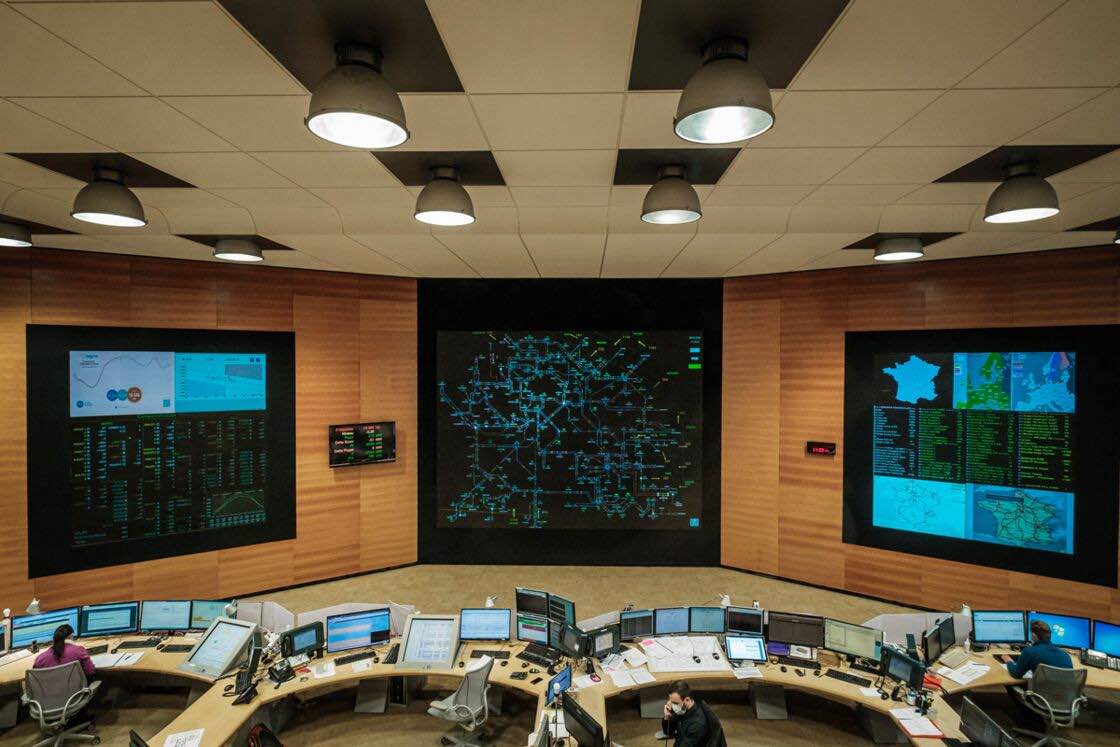
Saint-Ouen breakout room - Source: Capital.com
The dispatcher is in charge of the management of power line cuts for interventions by technical teams. Every day, RTE field agents work on lines, pylons or any other asset in the electricity transmission network. To be able to act and guarantee the safety of agents, it is imperative to cut the lines concerned during the intervention.
This is one of the missions of dispatchers who are responsible for finding a new way of transporting electricity and thus ensuring the electrical supply of the network. These operations are planned in advance (sometimes only a few days in advance), which gives the teams time to plan an alternative electrical route.
The network operating diagram is then modified to take account of this new data. This is why dispatchers are also called network switches.
Speaking of data, you should know that dispatch teams aggregate and analyze hundreds of thousands of pieces of information per day:
Today, there are nearly 200 dispatchers who take turns 24 hours a day, 7 days a week. In this way, the network can be developed and operated safely by field teams.
The role of dispatchers is also to Ensuring the integrity of the electrical network. If an unexpected event occurs, it is then the national and/or regional dispatch service that must react in a limited time.
Balance permanent between supply and demand is imperative to the proper functioning of the electrical network. If, for example, an operating nuclear power plant shuts down, this can cause Successive cuts Or even a total collapse of the electrical network (blackout).
To be able to act safely and as quickly as possible, dispatchers can change the network's operating pattern, but also use emergency mechanisms.
There are mobilisable power reserves by RTE at any given moment, these reserves only cover part of total French production.
Forecasting is at the heart of the job of managing and controlling the electrical network. Forecasts are established on production capacities and the expected level of consumption. If it turns out that this situation is not the reality, this discrepancy can be a problem. It will be identified a few hours in advance, the time for action is limited.
To give you an idea, a weather forecast error of only 1 degree Celsius Has a impact of more than 2,300 MW. If the temperature is underestimated, so is the consumption forecast. In this case, the production capacities to meet this demand will also be underestimated.
As a reminder, on average, our French nuclear reactors have nearly 900 MW of power in France. Forecasting tools, and in particular artificial intelligence, are tools that will reinforce their importance in this type of activity.
If necessary, RTE, as operator of the public electricity transmission system and responsible in real time for the balance of flows between production and consumption carried on the network, would activate The national plan for organized power cuts, in close collaboration with the public authorities.
They are planned by RTE and implemented remotely by electricity distributors (Enedis for 95% of the continental metropolitan area, and Local Distribution Companies (ELD) for the remaining 5%).
For technical reasons and to preserve the electrical system, RTE defines the main areas in which Enedis will have to make temporary cuts (load shedding).
Then, for each zone defined by RTE, Enedis will temporarily suspend the power supply to certain medium-voltage lines concerned. All customers on this medium voltage line will be affected by this punctual and controlled outage.
On the other hand, all customers positioned on medium-voltage outflows that cannot be relieved of a department (priority customers), are not affected by these temporary and controlled cuts, including customers who would have been delestable but who are on the same medium-voltage outputs as priority customers.
The plan for temporary cuts (load shedding) is national and all territories may be affected by these measures if the electrical situation balance between supply and demand so requires.
Good to know: Dispatchers pay particular attention to so-called “round” hours, especially in winter. At exactly the hour, the production and exchange programs with neighboring countries vary all of a sudden. This is not the case with consumption, which evolves more continuously.
To go further, do not hesitate to consult our article: What problems can network operators encounter?
In a few clicks, organize an exchange with one of our experts.

weekly newsletter subscribers

4.9

.png)

Communities are subject to taxes such as TICFE or TICGN. Sirenergies analyzes invoices, identifies exemption possibilities and fixes possible errors to reduce the tax burden.
Some businesses may obtain a partial or total exemption from the TICFE or the TICGN, depending on their activity and energy intensity. The support of an expert makes it possible to identify the eligibility criteria and to put together the file.
In 2025, the supplier had a NPS (Net Promoter Score) of +16 and a note of 4,17/5.
Satisfaction is based on a “zero solicitation” model and 100% in-house customer service in Toulon, guaranteeing proximity and responsiveness that cannot be found with major historical suppliers.
Tertiary companies must manage their energy costs while guaranteeing the comfort of users (offices, shops, services). Consumption is often linked to heating, air conditioning and lighting, which requires precise monitoring to avoid budgetary excesses.
The subscribed power must be calculated according to the consumption profile and uses (heating, industrial processes, tertiary equipment). One fine analysis makes it possible to ensure the adequacy between real need and contract.
Le processus repose sur l'utilisation de la force de l'eau (énergie cinétique) issue des courants, des chutes d'eau ou des dénivelés. Le fonctionnement suit trois étapes clés :
These are signals sent by RTE during periods of tension on the electrical network. The Sirenergies tool informs you in real time to anticipate your uses.
Sourcing consists in identifying and analysing the offers of several electricity and gas suppliers. This approach makes it possible to obtain contracts adapted to the consumption profile and budgetary constraints of the company.
Among the taxes include TICFE, TICGN, CTA, CJA and TURPE. They represent a significant part of the bill and vary according to consumption profiles. Understanding them well is essential to optimize costs.
Le kVA mesure la capacité maximale que votre compteur peut supporter à un instant T, tandis que le kWh mesure la quantité d'énergie consommée sur une durée.
The €/MWh is a price unit used in wholesale markets, while kWh is the unit visible on your bills.
The range E @sy is available in four pricing structures to adapt to each risk profile:
Le transport (RTE) correspond aux "autoroutes" de l’électricité. Il s’agit de transporter de très grandes quantités d'énergie sur de longues distances, depuis les centrales de production (nucléaires, barrages, parcs éoliens offshore) vers les régions de consommation.
La distribution (Enedis) s'apparente aux "routes départementales" et aux rues. Elle récupère l'électricité à la sortie du réseau de transport pour la livrer directement chez le client final, en abaissant la tension pour qu'elle soit utilisable par vos appareils.
Exceeding capacity leads to financial penalties and can impact the size of the contract. Adjust the correctly subscribed power makes it possible to avoid these additional costs.
C'est l'indicateur d'efficacité d'un appareil électrique ; il représente le ratio entre la puissance active (utile) et la puissance apparente (totale).
Parce que la puissance souscrite en kVA détermine le prix de l'abonnement et que tout dépassement peut entraîner des surcoûts importants.
Yes. The supplier guarantees an offer 100% renewable via the official Guarantees of Origin (GO) mechanism.
For the most demanding companies, the offer GREENVOLT+ ensures very low carbon intensity electricity, sourced exclusively from independent French producers (hydraulic, wind, solar).
C'est le levier le plus rapide pour obtenir des résultats visibles. L'éclairage représente environ 40 % de la consommation d'électricité d'une commune.
Passer au LED avec pilotage intelligent permet de réduire la facture de 50 à 80 %, avec un retour sur investissement (ROI) rapide, souvent estimé à 2 ou 3 ans.
One invoice consists of several elements: consumption, supplier share, taxes and contributions. The analysis of each line makes it possible to identify possible errors and to check the consistency with the signed contract.
Un appel d’offres permet de mettre en concurrence plusieurs fournisseurs d’électricité et de gaz afin d’obtenir des conditions contractuelles optimisées. C’est une démarche transparente qui permet de choisir l’offre la plus adaptée aux besoins budgétaires et techniques de l’organisation.
Oui, elle est considérée comme une énergie renouvelable à faibles émissions de gaz à effet de serre.
De plus, l'eau ne subit aucune transformation chimique durant le cycle de production et réintègre son milieu naturel en aval.
Cependant, la construction de barrages nécessite des mesures pour protéger les écosystèmes (débit minimum, passes à poissons).
Tertiary companies are concerned by taxes such as TICFE or TICGN. Sirenergies checks the accuracy of invoices, identifies possible exemptions, and helps correct errors to sustainably reduce costs.
This makes it possible to choose the right time to contract, secure your budgets and anticipate increases.
En 2025, la France a atteint un solde exportateur net de 92,3 TWh, battant le précédent record de 2024 (89 TWh).
Farms are subject to taxes such as TICFE or TICGN. Sirenergies verifies their application, identifies cases of exemption and accompanies the procedures to reduce the tax burden.
L'abondance de production française tire les prix du marché de gros vers le bas.
En vertu du mécanisme de l'Ordre de Mérite (Merit Order), les centrales les moins coûteuses (nucléaire, renouvelables) couvrent la demande plus souvent, évinçant les centrales à gaz ou charbon plus onéreuses.
Cela multiplie les épisodes de prix bas, voire négatifs, sur le marché spot.
Le dispositif ARENH a laissé place au VNU (Versement Nucléaire Universel).
Ce changement structurel expose davantage les entreprises aux prix de gros, rendant la gestion des risques plus complexe qu'auparavant.
Il devient alors indispensable de définir une stratégie d'achat d'électricité avec Sirenergies pour lisser l'impact de la volatilité des marchés sur votre budget.
The industry is concerned by TICFE, TICGN and other contributions that may represent an important part of invoices. Sirenergies identifies cases of exemption and accompanies the procedures to benefit from them.
Ce record de 92,3 TWh s'explique par la conjonction de trois facteurs :