






Summarize with AI


France breaks electricity export records: key figures and business purchasing strategies
March 6, 2026
8
Min reading
In 2022, France had to import electricity.
After this extraordinary year, the bar was raised in record time.
In 2025, France not only regained its historic role as an exporter, but crossed an unprecedented threshold. 92.3 TWh of electricity were exported, raising France to the top European ranking.
This figure reflects a strong return in French electricity production, favorable to the fall in market prices and to industrial competitiveness. But this record also reveals a structural imbalance and the delay in France in electrifying uses.
Between industrial competitiveness, change in purchasing strategies and the need to decarbonize, Sirenergies analyzes the hidden challenges behind these historic electricity exports.
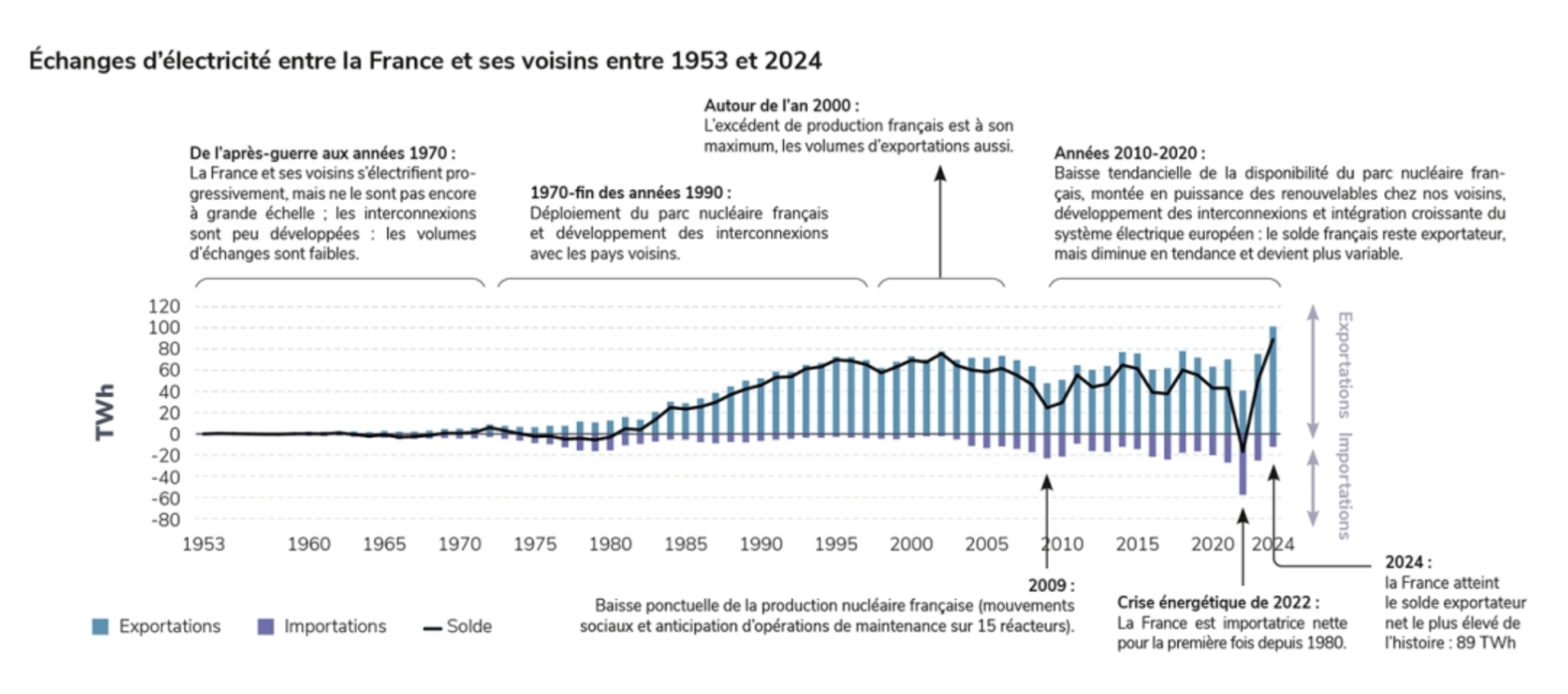
With 92.3 terawatt hours (TWh), France reached an unprecedented level of electricity exports in 2025.
This volume exceeds the previous record by 3.5% from 2024 (89 TWh). It falls far behind the historical reference of 2022 (77 TWh).
To measure the extent of this performance, the comparison is enlightening:
“We are talking about considerable volumes here: 92 TWh is more than the annual consumption of a country like Belgium”, recalls Thomas Veyrenc, Director General Economy of RTE.
This new record confirms a long-term trend.
For more than twenty years, France has been a net exporter of electricity to Europe.
A single year breaks this continuity. : 2022. France then had to import electricity.
The cause: a drop in nuclear production (linked to the phenomenon of corrosion on several reactors), combined with strong tensions on the energy markets.
Since 2023, the dynamic has been reversed.
The years 2024 and 2025 mark a real change of scale, with export volumes never seen before.
This dynamic is reflected in excess commercial revenue : 5 billion euros in 2024 and 5.4 billion euros in 2025.
Thanks to a highly interconnected European network, French electricity exports directly benefit border countries.
These interconnections balance the European electricity system, absorbing production surpluses and limiting market tensions.
European electric crossroads, France feeds first Italy, the main beneficiary exports. Next are Germany, Belgium, the United Kingdom, and Switzerland. Trade with Spain remains generally balanced.
Provisional data as of January 2, 2026. Source: RTE.
The “France Report” represents the consolidation of all border exchanges. France imports and exports simultaneously to optimize costs on the European market: it exports its carbon-free production surpluses (95% of the mix in 2025) and imports punctually when the electricity of its neighbours is more competitive or necessary for the balance of the network.
The record for French electricity exports is based on a structural imbalance. Domestic production is growing, while domestic demand remains sluggish.
After the difficulties of 2022, the nuclear industry has recovered. The first figures from EDF announce a production of 373 TWh in 2025, 11.3 TWh more than in 2024 (+3.1%).
This increase is the result of:
At the same time, renewable energies are continuing to gain momentum:
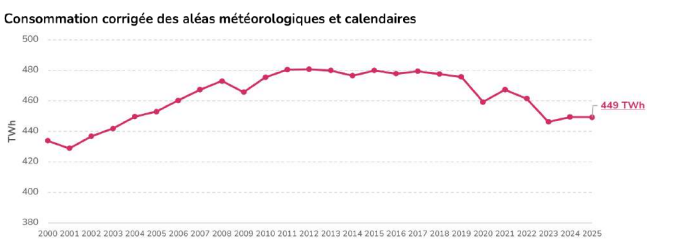
Faced with this high electricity production, national consumption is struggling to keep up.
According to provisional data from RTE, French electricity production reached 544 TWh in 2025.
Domestic consumption is established, for her part, to 449 TWh. For the third year in a row, it remains around 6% lower than the average observed between 2014 and 2019.
This sluggish consumption is explained by two dynamics:
For businesses, production and export levels are more than just a macroeconomic indicator. They constitute a key signal for power purchase strategies.
Market logic is relentless: when supply (production) exceeds demand (consumption), prices fall.
The surplus of French electricity production thus exerts a downward pressure on short-term prices ofthe “Spot” market.
This situation favors episodes of low prices, or even negative, favorable to businesses that buy in the short term.
This dynamic is reinforced by the Merit Order mechanism that governs the European electricity market.
This principle consists in mobilizing the means of production by increasing marginal cost (additional cost required to produce an additional unit of electricity).
Concretely:
The market price reflects the marginal cost of the last plant mobilized.
When fossil power plants are not called, due to moderate demand and high low-carbon production, prices are mechanically pulled down.
In this context of excess production and low prices, businesses may be tempted to review their buying strategy of electricity.
Offers indexed to the spot are gaining in attractiveness. By taking direct advantage of periods of low prices, businesses can generate significant savings.
However, this strategy is not without risks. The spot market remains a volatile market, especially in the event of peaks in consumption or tensions on production.
Full exposure to the spot can weaken businesses.
One balanced strategy often consists in combining:
With Sirenergies, find the right compromise between opportunity and security, according to your consumption profile, your risk tolerance and your energy management capacity.
{{ask-advice=” /ctas "}}
Behind the electricity export records, a wider challenge is emerging: France's ability to put its low-carbon production surpluses at the service of national and European decarbonization.
Produced at 95% from low-carbon and renewable sources, French electricity plays a key role in the European energy transition.
Each megawatt hour exported often replaces one fossil MWh, derived from coal or gas in a neighboring country. Far from being marginal, French exports thus contribute to the reduction of European emissions, while strengthening the security of supply.
This increase in exports is putting pressure on the transport network.
Although robust, European interconnections sometimes reach their physical limits during peak exports.
RTE has hired several interconnection projects. The objective? Support high trade flows, without compromising security of supply. By 2030, its Ten-Year Network Development Plan (SDDR) aims to:
These investments are accompanied by a strengthening the national network.
What's at stake? Prevent internal transit capacities from becoming border bottlenecks.
Exporting low-carbon electricity is an asset.
But export records also reveal a paradox: the delay taken by France in the electrification of its uses.
France is not fully exploiting its low-carbon electrical potential for its own energy transition. RTE highlights this paradox in its 2025 electricity report:
“France's electricity consumption is not in line with the goals of decarbonization and reindustrialization.”
The real challenge now is to Accelerate the electrification of national uses (transport, heat, industrial processes). This is the challenge of the electrification plan announced by the government in early 2026, which should be at the heart of the future. Multiannual Energy Programming (PPE).
Electricity export records support the competitiveness of French businesses thanks to lower market prices. But they highlight a structural paradox: France exports its low-carbon electricity massively, rather than devoting it to its own decarbonization.
The challenge of the coming years will be twofold and delicate: it is a question of accelerating national electrification, while maintaining the balance of the European market and industrial competitiveness.
In this changing environment, reading market signals and anticipating structural changes are crucial. This is the key to securing electricity purchases and controlling costs sustainably.
Fixed or indexed prices, market signals...: do you not have the expertise to understand and arbitrate?
With you, Sirenergies builds a personalized and efficient purchasing strategy for a controlled electricity bill.
{{ask-sourcing=” /ctas "}}
In a few clicks, organize an exchange with one of our experts.


weekly newsletter subscribers

4.9

.png)

One invoice consists of several elements: consumption, supplier share, taxes and contributions. The analysis of each line makes it possible to identify possible errors and to check the consistency with the signed contract.
Yes. The supplier guarantees an offer 100% renewable via the official Guarantees of Origin (GO) mechanism.
For the most demanding companies, the offer GREENVOLT+ ensures very low carbon intensity electricity, sourced exclusively from independent French producers (hydraulic, wind, solar).
L'abondance de production française tire les prix du marché de gros vers le bas.
En vertu du mécanisme de l'Ordre de Mérite (Merit Order), les centrales les moins coûteuses (nucléaire, renouvelables) couvrent la demande plus souvent, évinçant les centrales à gaz ou charbon plus onéreuses.
Cela multiplie les épisodes de prix bas, voire négatifs, sur le marché spot.
Parce que la puissance souscrite en kVA détermine le prix de l'abonnement et que tout dépassement peut entraîner des surcoûts importants.
Tertiary companies must manage their energy costs while guaranteeing the comfort of users (offices, shops, services). Consumption is often linked to heating, air conditioning and lighting, which requires precise monitoring to avoid budgetary excesses.
This makes it possible to choose the right time to contract, secure your budgets and anticipate increases.
Le transport (RTE) correspond aux "autoroutes" de l’électricité. Il s’agit de transporter de très grandes quantités d'énergie sur de longues distances, depuis les centrales de production (nucléaires, barrages, parcs éoliens offshore) vers les régions de consommation.
La distribution (Enedis) s'apparente aux "routes départementales" et aux rues. Elle récupère l'électricité à la sortie du réseau de transport pour la livrer directement chez le client final, en abaissant la tension pour qu'elle soit utilisable par vos appareils.
En 2025, la France a atteint un solde exportateur net de 92,3 TWh, battant le précédent record de 2024 (89 TWh).
Le dispositif ARENH a laissé place au VNU (Versement Nucléaire Universel).
Ce changement structurel expose davantage les entreprises aux prix de gros, rendant la gestion des risques plus complexe qu'auparavant.
Il devient alors indispensable de définir une stratégie d'achat d'électricité avec Sirenergies pour lisser l'impact de la volatilité des marchés sur votre budget.
Tertiary companies are concerned by taxes such as TICFE or TICGN. Sirenergies checks the accuracy of invoices, identifies possible exemptions, and helps correct errors to sustainably reduce costs.
The industry is concerned by TICFE, TICGN and other contributions that may represent an important part of invoices. Sirenergies identifies cases of exemption and accompanies the procedures to benefit from them.
Un appel d’offres permet de mettre en concurrence plusieurs fournisseurs d’électricité et de gaz afin d’obtenir des conditions contractuelles optimisées. C’est une démarche transparente qui permet de choisir l’offre la plus adaptée aux besoins budgétaires et techniques de l’organisation.
Farms are subject to taxes such as TICFE or TICGN. Sirenergies verifies their application, identifies cases of exemption and accompanies the procedures to reduce the tax burden.
Sourcing consists in identifying and analysing the offers of several electricity and gas suppliers. This approach makes it possible to obtain contracts adapted to the consumption profile and budgetary constraints of the company.
Some businesses may obtain a partial or total exemption from the TICFE or the TICGN, depending on their activity and energy intensity. The support of an expert makes it possible to identify the eligibility criteria and to put together the file.
Communities are subject to taxes such as TICFE or TICGN. Sirenergies analyzes invoices, identifies exemption possibilities and fixes possible errors to reduce the tax burden.
Oui, elle est considérée comme une énergie renouvelable à faibles émissions de gaz à effet de serre.
De plus, l'eau ne subit aucune transformation chimique durant le cycle de production et réintègre son milieu naturel en aval.
Cependant, la construction de barrages nécessite des mesures pour protéger les écosystèmes (débit minimum, passes à poissons).
The €/MWh is a price unit used in wholesale markets, while kWh is the unit visible on your bills.
In 2025, the supplier had a NPS (Net Promoter Score) of +16 and a note of 4,17/5.
Satisfaction is based on a “zero solicitation” model and 100% in-house customer service in Toulon, guaranteeing proximity and responsiveness that cannot be found with major historical suppliers.
Ce record de 92,3 TWh s'explique par la conjonction de trois facteurs :
Le kVA mesure la capacité maximale que votre compteur peut supporter à un instant T, tandis que le kWh mesure la quantité d'énergie consommée sur une durée.
Le processus repose sur l'utilisation de la force de l'eau (énergie cinétique) issue des courants, des chutes d'eau ou des dénivelés. Le fonctionnement suit trois étapes clés :
Among the taxes include TICFE, TICGN, CTA, CJA and TURPE. They represent a significant part of the bill and vary according to consumption profiles. Understanding them well is essential to optimize costs.
Exceeding capacity leads to financial penalties and can impact the size of the contract. Adjust the correctly subscribed power makes it possible to avoid these additional costs.
C'est le levier le plus rapide pour obtenir des résultats visibles. L'éclairage représente environ 40 % de la consommation d'électricité d'une commune.
Passer au LED avec pilotage intelligent permet de réduire la facture de 50 à 80 %, avec un retour sur investissement (ROI) rapide, souvent estimé à 2 ou 3 ans.
These are signals sent by RTE during periods of tension on the electrical network. The Sirenergies tool informs you in real time to anticipate your uses.
The range E @sy is available in four pricing structures to adapt to each risk profile:
The subscribed power must be calculated according to the consumption profile and uses (heating, industrial processes, tertiary equipment). One fine analysis makes it possible to ensure the adequacy between real need and contract.
C'est l'indicateur d'efficacité d'un appareil électrique ; il représente le ratio entre la puissance active (utile) et la puissance apparente (totale).

L'abondance de production française tire les prix du marché de gros vers le bas.
En vertu du mécanisme de l'Ordre de Mérite (Merit Order), les centrales les moins coûteuses (nucléaire, renouvelables) couvrent la demande plus souvent, évinçant les centrales à gaz ou charbon plus onéreuses.
Cela multiplie les épisodes de prix bas, voire négatifs, sur le marché spot.
Ce record de 92,3 TWh s'explique par la conjonction de trois facteurs :
En 2025, la France a atteint un solde exportateur net de 92,3 TWh, battant le précédent record de 2024 (89 TWh).