




Summarize with AI


Can Energy Savings Certificates (CEE) really reduce your dependence on fossil fuels?
08 April 2026
9
Min reading
Strengthening Energy Savings Certificates (CEE) to accelerate decarbonization, phase out fossil fuels, and electrify energy use: the trajectory set by the government in March 2026 is clear.
Against the backdrop of war in the Middle East and soaring energy prices, it addresses a triple pressure: geopolitical, economic, and energetic.
Behind the ambition, a question arises: can CEEs really help companies break free from their dependence on fossil fuels? Long focused on reducing consumption, can they support a genuine energy transition?
Energy Savings Certificates (CEE) fund energy efficiency projects and, since 2026, have directed subsidies toward replacing fossil-fuel equipment. They accelerate the return on investment, but they do not, on their own, guarantee a complete transformation of a company's energy model.
Once again, the war in the Middle East "sharply reminds us of our dependence on imported fossil fuels." Behind these words from Prime Minister Sébastien Lecornu, a reality is clear: dependence on gas and heating oil weakens France and its businesses.
In mid-March 2026, the price of gas jumped by 35% following strikes targeting energy infrastructure in the Middle East. As for oil, its price rose by more than 40% in a few weeks.
These brutal fluctuations are no longer exceptions. Since the 2022 crisis, instability in the fossil fuel markets has been constant. At the slightest geopolitical tension, prices soar.
This volatility reduces budget visibility for companies. Depending on gas and heating oil means exposing your costs to external factors that are impossible to control or anticipate.
To the pressure of the markets is added that of the regulators.
Tertiary Decree,energy audits,carbon footprints, sustainability reporting...: faced with the climate emergency, legal requirements are tightening to reduce energy consumption and corporate CO2 emissions.
It is no longer a matter of preparing for the energy transition. Environmental compliance is now mandatory, under penalty of financial, legal, or reputational sanctions.
Not all companies are affected equally by rising energy prices.
Those that remain dependent on fossil fuels are bearing the full brunt of market volatility. Conversely, companies already committed to the energy transition are better at absorbing shocks.
Dependence on gas and fuel oil is thus becoming a competitive disadvantage, which deepens with each passing crisis.
Beyond prices, another threat looms: the availability of resources.
International tensions can lead to supply restrictions, temporary shortages, or logistical disruptions.
For companies most dependent on fossil fuels, these difficulties can result in production slowdowns or even complete shutdowns.
Created in 2005, the Energy Savings Certificate (EEC) scheme is based on a simple principle: having energy suppliers fund the energy transition. This off-budget mechanism makes it possible to support investments without weighing on the state budget.
The EEC scheme requires electricity, gas, and fuel suppliers to fund energy-saving actions to offset their greenhouse gas emissions.
To meet their targets, these "obligated" parties pay EEC bonuses to businesses and individuals to fund energy efficiency projects. The amounts depend on the savings generated, the priorities set by the state, and the suppliers' own strategies.
The 6th EEC period (2026-2030), the objectives of which are detailed in the presentation of theDGEC, has increased the effort required from suppliers by 27%. The goal through 2030 is to generate 1,050 TWh cumac of Energy Savings Certificates (CEE) each year.
Originally, CEEs were primarily aimed at reducing energy consumption. Today, they still prioritize funding for:
However, the program is gradually evolving. The goal is no longer just to consume less, but to consume differently.
To achieve this, public authorities are gradually redirecting CEEs toward decarbonization. The decree of September 6, 2025, increases financial aid for replacing fossil fuels with low-carbon solutions. This momentum is expected to continue in 2026: in March, the Prime Minister clearly stated the intention to "more clearly reorient [CEEs] towardthe electrificationof usage."
The figures are clear: Energy Savings Certificates are one of the most effective tools for accelerating the energy transition in France.
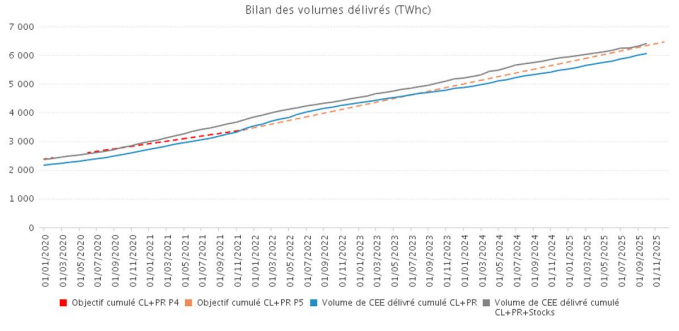
In practice, CEEs trigger real investment. According to theP5 CEE annual reportpublished by the Ministry of Ecological Transition, as of December 1, 2025, the following has been recorded:
Exceeding the targets set by the government proves the effectiveness of the program in mobilizing businesses and households.
In the industrial sector, more than 40,000 operations were supported between 2018 and 2024. In the tertiary sector, 21.7 TWh cumac were committed between 2020 and 2024 under the "Tertiary Building Heating Boost" program.
In the tertiary sector, 21.7 TWh cumac were committed between 2020 and 2024 under the "Tertiary Building Heating Boost" program.
Is your fossil fuel boiler replacement project eligible for the 2026 boosted CEEs?Sirenergies analyzes your situation and secures your CEE bonuses.
{{ask-rdv="/ctas"}}
Energy savings certificates are a powerful lever, but they are not a magic wand. If used incorrectly, their impact on reducing dependence on fossil fuels remains limited.
CEEs fund standardized, known, measurable, and reproducible operations. However, they struggle to support comprehensive, cross-functional, or innovative energy transformations. Some solutions remain poorly supported or unsupported:
For these types of projects, industries can look toward thePACTE Industrieprogram from ADEME.
While financially very attractive, the CEE system is complex. Companies must navigate standardized operation sheets, regular updates, and fluctuating bonus amounts.
Without guidance, there are many risks:
The result: companies miss out on financial opportunities.
This is one of the major limitations of the scheme. Initially, Energy Savings Certificates (CEE) were intended to promote energy savings. However, a company can insulate its buildings, optimize its industrial processes, and reduce its bills while still continuing to use gas or heating oil. In other words, CEEs improve efficiency, but they do not guarantee decarbonization.
By supporting standardized operations, CEEs sometimes encourage an opportunistic, project-by-project approach. But reducing dependence on fossil fuels is not just about consuming less. It requires switching energy sources.
Without a comprehensive strategy, the energy transition remains partial. The gains are real, but they are insufficient to sustainably transform the energy model and move away from fossil fuels.
Through the Energy Savings Certificate (ESC) scheme, you can finance your energy efficiency projects.
Sirenergies is here to support you in this process!
{{ask-sourcing="/ctas"}}
These limitations should not discourage you from using ESCs, especially as national policy is gradually reorienting them toward low-carbon technologies. The effectiveness of the scheme depends primarily on how it is used.
The ESC scheme is complex and constantly evolving. Working with an expert allows you to fully leverage the potential of these subsidies and:
To be truly effective, ESCs must be part of a holistic vision for the energy transition. They should not be viewed as a one-off financial boost, but as a genuine strategic tool.
These subsidies fund concrete actions, but they do not set the course. To reduce their dependence on gas and heating oil, companies must first define a clear energy strategy. Only then can they prioritize their actions and effectively mobilize ESCs. This is the only way these certificates will become a real driver of decarbonization.
Expert opinion from Sirenergies
The 2026 bonus ESCs represent a real financial opportunity for companies still dependent on gas or heating oil. However, we see it every day in the field: without a prior strategic framework, companies mobilize ESCs on an operation-by-operation basis, without overall coherence. The result: they reduce their bills, but they do not move away from fossil fuels. Our recommendation: start by defining your decarbonization trajectory, then use ESCs as a lever to finance that path. In this approach, the grants are no longer just a bonus; they become an accelerator for your competitiveness.
Energy Savings Certificates are a concrete and immediately actionable lever for financing the energy transition. They accelerate project profitability. But they are not magic. Used alone and focused solely on energy efficiency, they reduce consumption and bills. To reduce dependence on fossil fuels, however, they must be integrated into a comprehensive strategy.
With ESCs alone, a company suffers a little less. With an energy strategy, it regains control.
Would you like to know which energy projects can be financed by ESCs and to what extent?
Sirenergies helps you secure your ESC grants and build your energy supply strategy.
{{ask-conseil="/ctas"}}
In a few clicks, organize an exchange with one of our experts.


weekly newsletter subscribers

4.9


The amount of a CEE bonus depends on the type of equipment installed, its capacity, and the site location.
In 2026, bonuses will cover 30 to 40% of the total cost of a project to replace a gas boiler with a heat pump.
For an SME, this represents between €40,000 and €50,000 on an investment of €120,000 to €180,000.
Yes. Energy Savings Certificates (CEE) can be combined with other public schemes such as MaPrimeRénov' Industrie, ADEME grants (notably via the PACTE Industrie) or certain regional subsidies. However, this combination must comply with regulatory caps.
Expert guidance helps identify all available grants and maximize the total funding for your decarbonization project.
Les caves coopératives de taille ETI ou grande entreprise peuvent être soumises à l'audit énergétique réglementaire (norme NF EN 16247). Sirenergies n'a ni la compétence ni l'accréditation pour réaliser cet audit : nous vous orientons vers un bureau d'études partenaire accrédité, et vous accompagnons en amont sur vos achats et en aval sur le pilotage.