






Summarize with AI

March 6, 2026
9
Min reading
The energy transition has become a major challenge in current public policies. Its application to mobility through the electric vehicle leads to the emergence of new concepts at the crossroads of the automobile, electrical networks, renewable energies and buildings.
In this article, we present to you the concept of vehicle-to-grid: what is it for? How does that work? And what are the advantages, especially for businesses.
In English, “vehicle-to-grid” (V2G) means from the vehicle to the electrical network : it is a technology that allows the energy stored in the battery to be transferred to the electrical network.
Many concepts have been developed around the electric vehicle, the V2G is just one example among others:
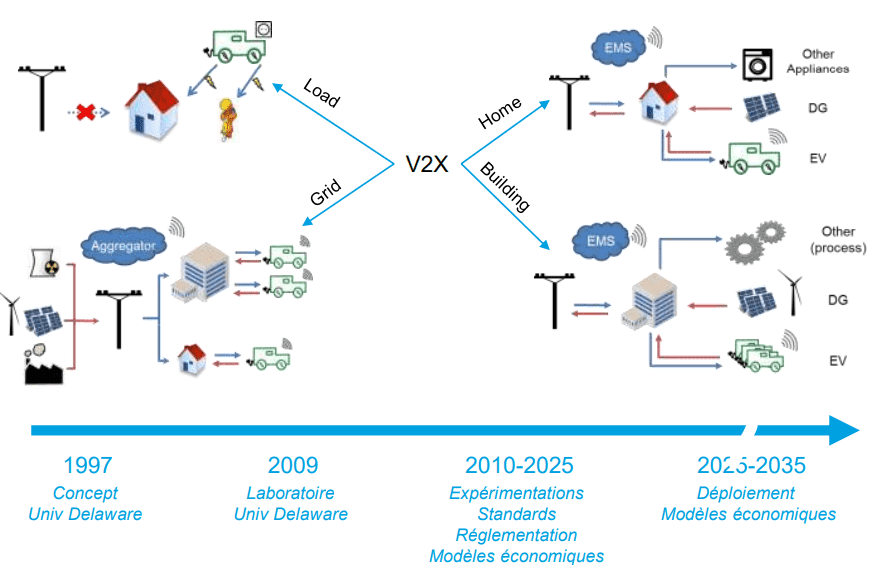
Source: CentraleSupélec
Here, we will focus in particular on everything related to technologies related to energy transfer.
The idea of vehicle-to-grid is to use batteries parked electric cars like storage capacity to participate in The balance of the network. Like stationary batteries, these batteries can store electricity when the production fed into the grid exceeds the demand, and, on the contrary, supply energy to the grid when consumers draw more than the power plants can produce.
This technology makes it possible to exploit the charging and discharging of electric vehicle batteries to support the electrical network when they are connected to it.

Source: RossiniEnergy
By contributing to the balance of the network, V2G will contribute more and more to the integration of intermittent renewable energies.
The main function of batteries in an electric vehicle is to store energy to power its propulsion. The V2G must therefore take into account the future use of the car.
To do this, its battery must be sufficiently charged so that its autonomy can allow future trips.
V2G is closely linked to another concept, that of smart charging, which is based on the use of smart meters And of smart charging stations capable of automating and optimizing priority management.
Automating the charging of electric vehicles also requires the implementation of regulations to ensure interoperability between vehicles and infrastructures, such as Charging stations. That's where the vehicle-to-everything (V2X), so that standardized messages can be interpreted by all stakeholders. Communication security is based in particular on PKI architectures allowing various objects (car, charging station, etc.) to exchange certificates to identify themselves.
Intelligent vehicle charging is based on the principle that a data communication is established between the vehicle and the charging station to which it is connected.
If this charging station is part of a Smart grid, the battery charge can be optimized according to the prices per kWh, the needs of the electrical network, peak demand, intermittent renewable productions, etc.
These technologies are beneficial for the electrical network, which can control the charging of the batteries at the best time, and for the consumer, who will pay less to recharge their vehicle.
A company that has a fleet of vehicles has every interest in installing communicating and adapted charging stations on its sites. The way in which company vehicles are used is often very closely linked to the company's activity. The charge and discharge cycle is predictable; vehicles are often parked in company car parks in the evenings and weekends, or even for part of the day.
Therefore, thanks to technologies such as V2G, it is possible to make these batteries profitable during downtime by making battery storage capacity available at the service of the network. The V2G can be combined with fleet management tools so that vehicle load management can be constantly adapted to the daily needs of the company's activity.
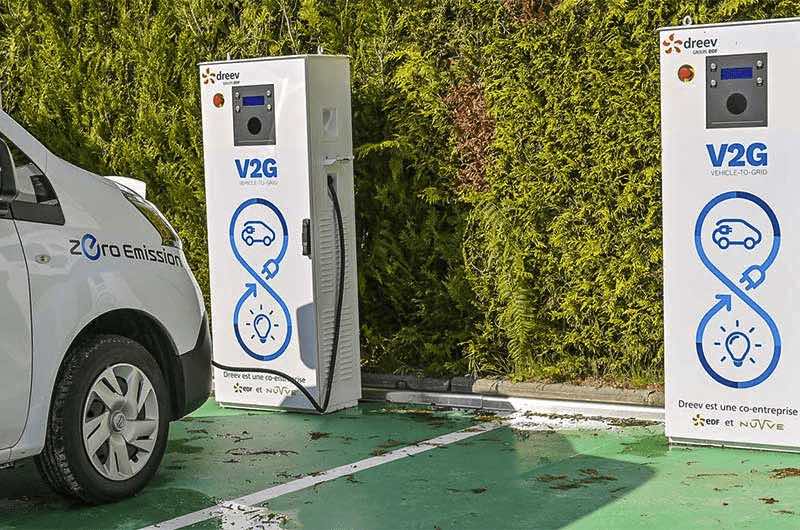
Source: PV-Magazine
Vehicle-to-grid (V2G) is an innovative technology at the heart of an ecosystem rich in actors and complex in interaction, which makes it possible to accelerate the development of the electric vehicle.
This technology offers numerous opportunities for companies using these vehicles, fleet managers, car manufacturers, electricity suppliers, electrical networks, capacity aggregators, the managers of charging station infrastructures, the manufacturers of these terminals, etc.
The Vehicle-to-Grid allows:
Let's take a closer look at the benefits for the electrical network, real estate buildings and users.
One of the main missions of transmission system operator (RTE) Is to ensure the balance between supply and demand. With V2G, the electrical network will be able to rely more and more on storage capacities distributed throughout the country, which will make it possible to:
For the electrical network, this balancing energy has other interesting characteristics:
To take advantage of all the advantages of V2G technologies in real estate constructions, they must be equipped with communicating charging stations directly connected to the building's electrical installations.
Thus, these charging stations located in or on car parks will be particularly interesting during peak consumption, the energy stored in the batteries of parked vehicles coming directly to power the building in the event of congestion on the electrical network.
For corporate buildings and large shopping centers, this is all the more true as their attendance is directly proportional to the number of vehicles parked.
The V2G therefore allows real estate constructions to increase their security of supply, or even, if they are equipped with photovoltaic panels, to approach the concept of autonomous building.
All the advantages listed above depend entirely on the acceptance of users. Users who connect their electric vehicles to the grid and accept V2G are needed for this technology and all the infrastructures deployed to be of economic interest for all stakeholders.
Two conditions are necessary for this. First of all, the user must be able to use their vehicle without fear of running out of battery while traveling. Second, the financial incentive must be attractive enough to motivate users to lend their vehicle batteries.
It is therefore a subtle balance between constraints and benefits that must be offered to users. This includes the ability to plan the use of an electric vehicle every day: schedules and durations of trips.
For this, the user will certainly be called upon to declare their future use before leaving the vehicle or using their smartphone; and the recording of known information on the past use and condition of the vehicle will be decisive in optimizing the use of the battery in V2G connected mode and generating financial income for the user.
First of all, you should know that a Obligation to green vehicle fleets weighs on businesses. Indeed, the Environmental Code sets out obligations concerning the share of low-emission vehicles (VFE) in public procurement during the annual renewal of vehicle fleets.
For private companies, this obligation is increasing: at least 10% from 2022, then 20% in 2024, 40% in 2027, and finally 70% in 2030.
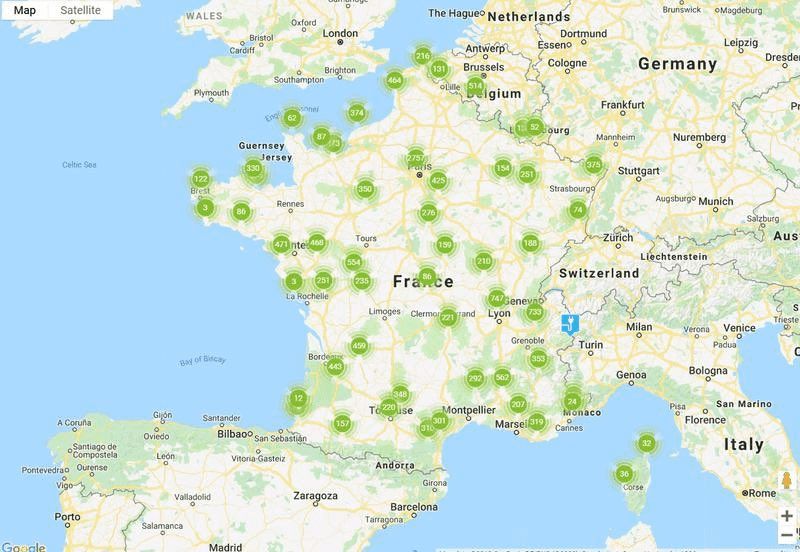
It should also be noted that the 2019 Mobility Orientation Act sets out, among other things, obligations concerning the installation of charging stations. In non-residential buildings, the obligation is to have at least 20% of equipped spaces.
Source: data.gouv.fr
Finally, the Climate and Resilience Law, promulgated and published in the Official Journal on August 24, 2021, requires the installation of photovoltaic panels in commercial areas, car parks of more than 500 m² and office buildings of more than 1,000 m².
It is therefore entirely appropriate for companies to associate V2G technologies with the management of their electric vehicle fleet in order to promote, for the benefit of the balance of the network, the batteries of electric vehicles parked in their car parks.
Businesses can thus take part in the energy transition by offering an additional service to their customers and employees using an electric vehicle.
Vehicle-to-grid is a rapidly expanding technology that goes hand in hand with the development of electric vehicles and charging stations by extension.
It should be noted with interest that manufacturers are testing vehicle-to-grid (V2G). Renault, for example, is experimenting on the small island of Porto Santo with an ecosystem combining electricity and smart charging systems. Analysts believe that the switch to electromobility will lead to 15 to 20% increase in electricity consumption.
We therefore understand the risks and opportunities that the electric vehicle inherently carries: risks associated with the significant increase in electrical consumption in a context of both energy sobriety and energy transition to clean energies; and opportunities to valorize the batteries of parked vehicles on the electrical network to support the growth of electricity needs and the development of intermittent renewable energies such as wind power or photovoltaic energy.
The vehicle-to-grid is therefore becoming a major industrial challenge for car manufacturers, network operators and businesses.
It is obvious that all actors must agree on technical and commercial standards so that a vehicle can connect to any station to recharge and/or participate in the balance of electrical networks, like industrial tools that contribute in their own way to the balance of the network by stopping consumption during peak consumption.
Today, more than ever, electric mobility is one of the levers for achieving carbon neutrality. As such, businesses have a role to play in the energy transition.
You want to install charging stations and/or convert your company's vehicle fleet to electric? SirEnergies is there to help you and supports you in building an eco-responsible image for your business.
Click below for more information:
In a few clicks, organize an exchange with one of our experts.


weekly newsletter subscribers

4.9

.png)

Yes. The supplier guarantees an offer 100% renewable via the official Guarantees of Origin (GO) mechanism.
For the most demanding companies, the offer GREENVOLT+ ensures very low carbon intensity electricity, sourced exclusively from independent French producers (hydraulic, wind, solar).
Un appel d’offres permet de mettre en concurrence plusieurs fournisseurs d’électricité et de gaz afin d’obtenir des conditions contractuelles optimisées. C’est une démarche transparente qui permet de choisir l’offre la plus adaptée aux besoins budgétaires et techniques de l’organisation.
The €/MWh is a price unit used in wholesale markets, while kWh is the unit visible on your bills.
Le calendrier 2026 impose deux échéances majeures :
Pour simplifier ces démarches, vous pouvez centraliser vos données de consommation avec la plateforme Pilott de Sirenergies, garantissant ainsi la conformité de vos rapports réglementaires.
The range E @sy is available in four pricing structures to adapt to each risk profile:
In 2025, the supplier had a NPS (Net Promoter Score) of +16 and a note of 4,17/5.
Satisfaction is based on a “zero solicitation” model and 100% in-house customer service in Toulon, guaranteeing proximity and responsiveness that cannot be found with major historical suppliers.
Les caves coopératives de taille ETI ou grande entreprise peuvent être soumises à l'audit énergétique réglementaire (norme NF EN 16247). Sirenergies n'a ni la compétence ni l'accréditation pour réaliser cet audit : nous vous orientons vers un bureau d'études partenaire accrédité, et vous accompagnons en amont sur vos achats et en aval sur le pilotage.
Communities are subject to taxes such as TICFE or TICGN. Sirenergies analyzes invoices, identifies exemption possibilities and fixes possible errors to reduce the tax burden.
Sourcing consists in identifying and analysing the offers of several electricity and gas suppliers. This approach makes it possible to obtain contracts adapted to the consumption profile and budgetary constraints of the company.
Exceeding capacity leads to financial penalties and can impact the size of the contract. Adjust the correctly subscribed power makes it possible to avoid these additional costs.
L'abondance de production française tire les prix du marché de gros vers le bas.
En vertu du mécanisme de l'Ordre de Mérite (Merit Order), les centrales les moins coûteuses (nucléaire, renouvelables) couvrent la demande plus souvent, évinçant les centrales à gaz ou charbon plus onéreuses.
Cela multiplie les épisodes de prix bas, voire négatifs, sur le marché spot.
Tertiary companies must manage their energy costs while guaranteeing the comfort of users (offices, shops, services). Consumption is often linked to heating, air conditioning and lighting, which requires precise monitoring to avoid budgetary excesses.
Le kVA mesure la capacité maximale que votre compteur peut supporter à un instant T, tandis que le kWh mesure la quantité d'énergie consommée sur une durée.
C'est le levier le plus rapide pour obtenir des résultats visibles. L'éclairage représente environ 40 % de la consommation d'électricité d'une commune.
Passer au LED avec pilotage intelligent permet de réduire la facture de 50 à 80 %, avec un retour sur investissement (ROI) rapide, souvent estimé à 2 ou 3 ans.
La réussite d'un projet collectif énergie repose sur trois piliers fondamentaux :
Among the taxes include TICFE, TICGN, CTA, CJA and TURPE. They represent a significant part of the bill and vary according to consumption profiles. Understanding them well is essential to optimize costs.
It allows you to prove your commitment to the energy transition and to meet regulatory requirements.
The subscribed power must be calculated according to the consumption profile and uses (heating, industrial processes, tertiary equipment). One fine analysis makes it possible to ensure the adequacy between real need and contract.
C'est l'indicateur d'efficacité d'un appareil électrique ; il représente le ratio entre la puissance active (utile) et la puissance apparente (totale).
Tertiary companies are concerned by taxes such as TICFE or TICGN. Sirenergies checks the accuracy of invoices, identifies possible exemptions, and helps correct errors to sustainably reduce costs.
Le transport (RTE) correspond aux "autoroutes" de l’électricité. Il s’agit de transporter de très grandes quantités d'énergie sur de longues distances, depuis les centrales de production (nucléaires, barrages, parcs éoliens offshore) vers les régions de consommation.
La distribution (Enedis) s'apparente aux "routes départementales" et aux rues. Elle récupère l'électricité à la sortie du réseau de transport pour la livrer directement chez le client final, en abaissant la tension pour qu'elle soit utilisable par vos appareils.
Le dispositif ARENH a laissé place au VNU (Versement Nucléaire Universel).
Ce changement structurel expose davantage les entreprises aux prix de gros, rendant la gestion des risques plus complexe qu'auparavant.
Il devient alors indispensable de définir une stratégie d'achat d'électricité avec Sirenergies pour lisser l'impact de la volatilité des marchés sur votre budget.
Ce record de 92,3 TWh s'explique par la conjonction de trois facteurs :
Parce que la puissance souscrite en kVA détermine le prix de l'abonnement et que tout dépassement peut entraîner des surcoûts importants.
Oui, elle est considérée comme une énergie renouvelable à faibles émissions de gaz à effet de serre.
De plus, l'eau ne subit aucune transformation chimique durant le cycle de production et réintègre son milieu naturel en aval.
Cependant, la construction de barrages nécessite des mesures pour protéger les écosystèmes (débit minimum, passes à poissons).
This makes it possible to choose the right time to contract, secure your budgets and anticipate increases.
Le processus repose sur l'utilisation de la force de l'eau (énergie cinétique) issue des courants, des chutes d'eau ou des dénivelés. Le fonctionnement suit trois étapes clés :
The industry is concerned by TICFE, TICGN and other contributions that may represent an important part of invoices. Sirenergies identifies cases of exemption and accompanies the procedures to benefit from them.
These are signals sent by RTE during periods of tension on the electrical network. The Sirenergies tool informs you in real time to anticipate your uses.
One invoice consists of several elements: consumption, supplier share, taxes and contributions. The analysis of each line makes it possible to identify possible errors and to check the consistency with the signed contract.
To calculate Scope 2 emissions, use the following formula:
Energy quantity (kWh) × Emission factor (kg CO₂ e/kWh).
Use databases like ADEME for precision.
Les coopératives de taille ETI ou grande entreprise peuvent être soumises à l'audit énergétique réglementaire (norme NF EN 16247). Sirenergies n'a ni la compétence ni l'accréditation pour réaliser cet audit : nous vous orientons vers un bureau d'études partenaire accrédité, et vous accompagnons en amont sur vos achats et en aval sur le pilotage.
En 2025, la France a atteint un solde exportateur net de 92,3 TWh, battant le précédent record de 2024 (89 TWh).
Farms are subject to taxes such as TICFE or TICGN. Sirenergies verifies their application, identifies cases of exemption and accompanies the procedures to reduce the tax burden.
Some businesses may obtain a partial or total exemption from the TICFE or the TICGN, depending on their activity and energy intensity. The support of an expert makes it possible to identify the eligibility criteria and to put together the file.