






Summarize with AI


Everything you need to know about the TICFE tax, the Domestic Tax on Final Electricity Consumption.
23 November 2026
5
Min reading

TICFE refers to the “domestic tax on the final consumption of electricity”, collected through electricity bills. It was established in 2004 under the name of Contribution to the Public Electricity Service (CSPE). It is paid by electricity consumers.
First of all, it is good to remember that an electricity bill is divided into three parts:
We invite you to read our article on the subject to understand everything at your electricity bill. One of the most important taxes on your electricity bill is CSPE. In fact, the Contribution to the Public Electricity Service can represent a very significant amount for professionals. This tax is now called TICFE, but the term CSPE is still widely used.
In this article, we will therefore see what this tax covers and what is its impact on your bill.
We will then see the various exemptions that can be considered. Exemption from this tax is one of the most important optimization levers when it comes to electricity bills. It is therefore interesting for each professional to know this tax as well as the eligibility conditions in terms of exemption.
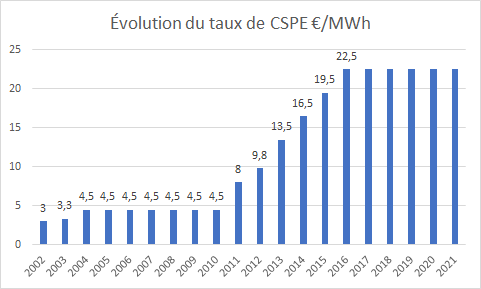
Since its creation in 2004, the CSPE continued to increase until 2016 to reach the rate we know today: €22.50/MWh. In addition to the amount, this tax has also undergone numerous changes in terms of its structure.
Originally, the CSPE was intended to cover a number of expenses related to the public electricity service. Indeed, this tax was created when the electricity markets were opened at the dawn of the 2000s. It was intended to compensate for a certain number of expenses incurred by companies responsible for providing public services in the energy sector, such as:
Indeed, all French people, regardless of their geographical location, pay the same rate of TURP. However, in reality, there are disparities in costs for ENEDIS ; this difference is compensated by the State. We can therefore see that since its inception, the CSPE has covered the cost of certain very important mechanisms in the energy sector.
Source: SirEnergies
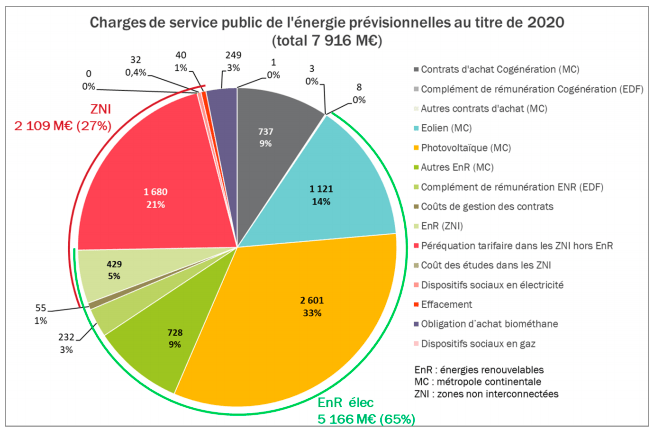
In 2015, an amended finance law modified the scope covered by the CSPE. This law changed the distribution of these costs over several different taxes. Indeed, it was important to have the energy transition financed not only through electricity consumption. There was therefore a transfer of expenses to the consumption offossil fuels in particular (fuel taxes).
The TICFE (Internal Tax on Final Electricity Consumption) was therefore absorbed with the CSPE. Today, there is therefore only TICFE, but the name CSPE remains widely used.
In the context of the sharp rise in electricity prices and in order to limit the increase in regulated electricity rates to 4% in 1Er In February 2022, the State decided to set up a tariff shield. The TICFE level has thus been defined at its minimum, i.e. 1 €/MWh for individuals, and has been since 1Er February 2022.
Since then, it has gradually returned to its pre-tariff shield level. It was raised last February from 1 to 21 €/MWh, is today at 22.50 €/MWh and was scheduled to return to 1Er February 2025 its pre-crisis level, i.e. €32/MWh. The latest government indiscretions show that it is being considered rather than going beyond it. Parliament will have the final word on the 2025 budget proposal.
Source: Energy Regulatory Commission for the year 2020
The TICFE rate has been fixed since 2016. It is €22.50/MWh (or 2.25 €/kWh). However, depending on your activity, it is possible to obtain a reduced rate or, in some cases, a total exemption. The Customs Code details these conditions. This tax system is divided into three distinct parts.
The aim of this system is to protect the competitiveness of French manufacturers. To do this, the relationship between electricity consumption and the company's accounting value added (VA) is calculated. We therefore obtain a rate in kWh per € of added value.
If a company obtains a rate of more than 6 kWh/€ of VA, and its competitive intensity exceeds 25%, then it is considered to be hyper-electro-intensive. This rule is defined in particular by the Energy Code and article 10 bis of European Directive 2003/87/EC.
There are therefore several reduced TICFE rates for these companies ranging from 7.5 €/MWh to 0.5 €/MWh, instead of 22.5 €/MWh.
There are also total exemptions from CSPE/TICFE for certain activities, such as:
Do not hesitate to contact us below, a SirEnergies expert will assist you in this process in order to find out your eligibility for this device.
To go further, do not hesitate to read our 5 tips to reduce your professional electricity bill.
You can benefit from rollback See Exemption taxes according to your consumption profile and your sector of activity.
Our experts perform a in-depth and personalized study of your company's energy taxation.
Click below for more information:
In a few clicks, organize an exchange with one of our experts.


weekly newsletter subscribers

4.9
