




Summarize with AI

March 6, 2026
5
Min reading
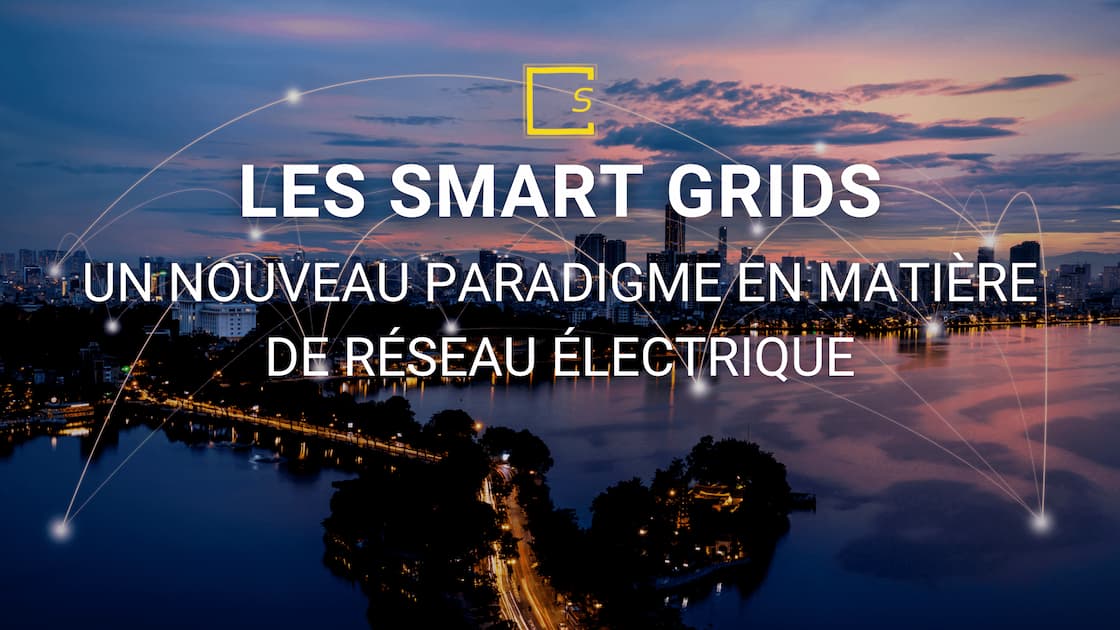
At the time of the energy transition and of the digital revolution, the Smart Grids logically find their full place. Indeed, the centralized network model known until now is beginning to know its limits.
The emergence of intermittent means of electricity production such as wind turbines or solar panels is creating new needs. Uses and consumption patterns are also changing. We can no longer manage networks as in the past when demand and production were easier to predict than today (that said, it is still a perilous exercise).
The democratization of new modes of production has also reinforced this need. In fact, self-consumption or electric vehicles can lead to new difficulties in terms of network management.
Technological progress allows us to look forward to the future with greater peace of mind. Smart Grids are a response to these new problems. For example, we can imagine the local electricity networks of tomorrow, equipped with smart meters (Linky). The latter will be able to facilitate the management of decentralized production such as the self-consumption of the households concerned.
The use of new information technologies is key in the Smart Grid system. Consumer data, as we will see, is also at the center of these exchanges.
We can define A Smart Grid as being a smart power grid equipped with information and communication technologies. It is a set of networks and sensors that cover the entire electricity network.
In addition, there is a whole technological ecosystem around these new networks. The counters and the various sensors installed on the network make it possible to retrieve much more data than before. There is therefore also new software capable of processing all of this data.
This gives an optimal vision of electricity consumption on the network in real time. These computer technologies make it possible to improve the maintenance of the network as well as its development.
There is therefore, on the one hand, the physical part of networks, which is changing with new smart meters as well as sensors and batteries, and on the other hand, an evolution of energy management software.
This fits perfectly into the framework of the third industrial revolution, which this time is digital.
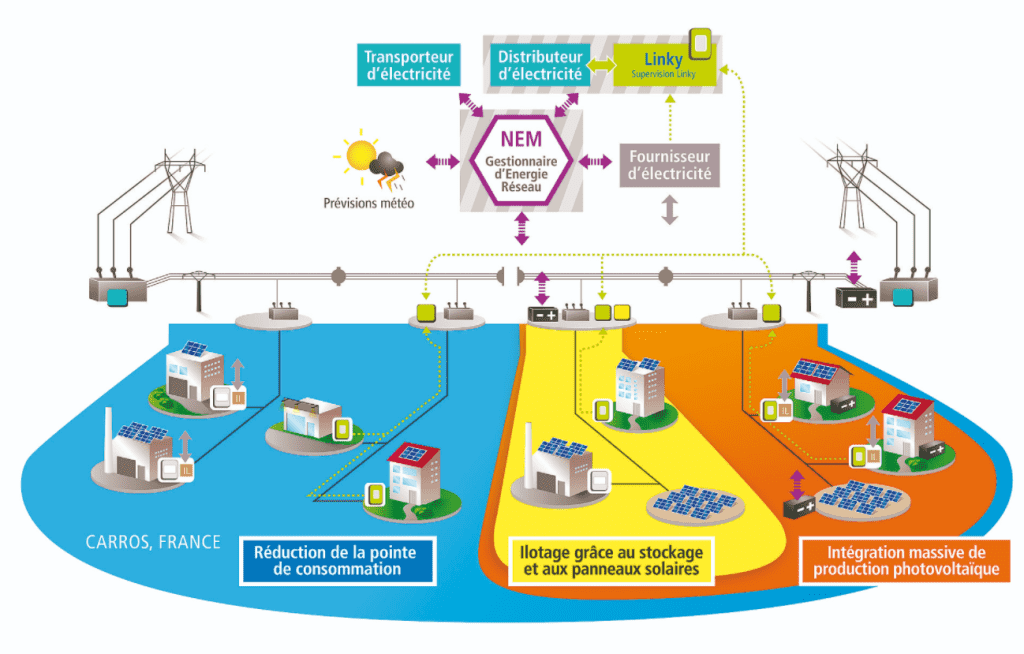
Smart Grid example (NICE project in Carros) - Source Wikipedia
They can be at the scale of a neighborhood, a group of buildings, or more rarely over an entire city. We then talk about Smart City.
In the past, the logic of building networks was focused on the physical part. The aim is to manage the transport of electricity by multiplying the lines. It was necessary to have emergency lines all over France in order to mitigate incidents.
Today, Smart Grids make it possible to limit this effect. You could even say that they are in a way reversing the roles.
Indeed, until recently, the balance of the system was mainly achieved by controlling the energy supply (production) according to customer demand (consumption). With Smart Grids, it becomes possible to adapt consumption to production thanks to new technologies.
Obviously this is not 100% possible, but it is a question of gaining flexibility by playing on the storing for example. Batteries can allow us to store “surplus” energy and feed it back into the grid later. All this being automated by optimization software.
Investments in network infrastructures must therefore be reviewed in the light of these disruptive technological developments.
This is the main criticism made to the integration of renewables in our electrical networks. Indeed, the wind and the sun are by definition not controllable, it is difficult to be certain of being able to produce electricity during consumption peaks in particular. However, at a time of sustainable development, renewable energies are essential to fight against global warming.
This problem is well known and widely commented on in the energy sector. Lithium-ion batteries can provide a solution to this problem but only on a small scale (like the RINGO project led by RTE).
The power variations induced by renewable energies can be compensated for by batteries. This system could make it possible to smooth the energy that passes through the entire network. It is the smart grid that allows this by deciding when to inject or store energy.
To find out more, do not hesitate to read our article” What is the intermittency of renewable energies? ”
One of the advantages of Smart Grids is to promote the development of electric mobility. It is quite possible to take advantage of the large number of batteries that will be connected to the network.
To recharge, the vehicles will connect their batteries to the network. One can then imagine a use of this available power. We can go further with the concept of smart charging. For example, the vehicle can be charged on demand, based on prior instructions. These processes can make it possible to favor local or renewable energy.
However, in the same way as for renewable energies, there is a major challenge for electric vehicles to meet: managing peak consumption.
If many users charge their vehicles at the same time (6 p.m. during rush hour) this can cause power spikes. We then fall back into a classical problem of network sizing.
The city of Issy-les-Moulineaux is home to one of the great successes in terms of Smart Grid. Indeed, there are renewable energy productions supervised using energy management software as mentioned above.
The operation involves more than:
The VIGIE software that oversees everything allows, among other things, to visualize the detailed data of the various customers.
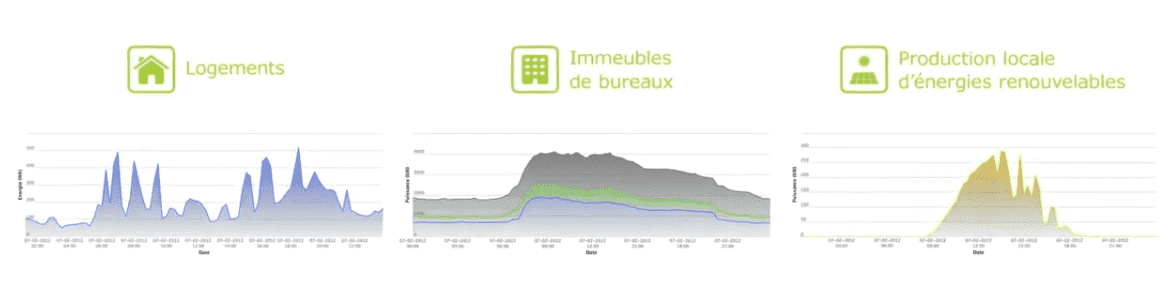
Source: Issy Grid
Source: Issy Grid
This type of solution also gives access to elaborate dashboards, all in the general interest.
This is an example that is often cited in the Smart Grid sector. Indeed, this network allows “peer-to-peer” exchanges of energy between neighbors. That is to say, your neighbor can consume your surplus of photovoltaic production and thus optimize the entire system.
Blockchain technology allows contracts to be signed very quickly and confidently. This network has the advantage of being local, i.e. if a storm or hurricane occurs (as is often the case in the US) we can hope that this part of the network will remain functional.
Thus we see to what extent Smart Grids can respond to two revolutions already under way in France: The revolution numerical and environmental. They have their assets to make a place of choice during this transition phase and to provide answers to many problems. Like all cluster innovations, it is also necessary for batteries to evolve in order to make the best use of these networks of tomorrow.
Do not hesitate to read our article to find out What will be the energies of tomorrow.
In a few clicks, organize an exchange with one of our experts.


weekly newsletter subscribers

4.9

.png)

La réussite d'un projet collectif énergie repose sur trois piliers fondamentaux :
Les coopératives de taille ETI ou grande entreprise peuvent être soumises à l'audit énergétique réglementaire (norme NF EN 16247). Sirenergies n'a ni la compétence ni l'accréditation pour réaliser cet audit : nous vous orientons vers un bureau d'études partenaire accrédité, et vous accompagnons en amont sur vos achats et en aval sur le pilotage.
To calculate Scope 2 emissions, use the following formula:
Energy quantity (kWh) × Emission factor (kg CO₂ e/kWh).
Use databases like ADEME for precision.
It allows you to prove your commitment to the energy transition and to meet regulatory requirements.
Le calendrier 2026 impose deux échéances majeures :
Pour simplifier ces démarches, vous pouvez centraliser vos données de consommation avec la plateforme Pilott de Sirenergies, garantissant ainsi la conformité de vos rapports réglementaires.
Yes. The supplier guarantees an offer 100% renewable via the official Guarantees of Origin (GO) mechanism.
For the most demanding companies, the offer GREENVOLT+ ensures very low carbon intensity electricity, sourced exclusively from independent French producers (hydraulic, wind, solar).