






Summarize with AI


Power Purchase Agreement (PPA): A purchasing solution to secure your company's energy?
October 29, 2026
8
Min reading
Between energy price volatility and tightening environmental requirements, companies are operating in a high-pressure environment. They must now tackle three simultaneous challenges: controlling costs, securing supply, and decarbonizing.
In this context, an electricity purchasing solution is gaining momentum in France: the Power Purchase Agreement. A PPA is a long-term contract through which a company buys electricity—typically renewable—directly from a producer at a pre-fixed price (learn more about Green corporate PPAs).
Is a PPA right for your company? Who can actually access one? Which type of contract should you choose based on your consumption profile? How do you decide between a PPA and a green energy offer?
Our analysis.
A Power Purchase Agreement (PPA) is a long-term electricity supply contract between a company and a renewable energy producer at a pre-fixed price. It helps secure costs, guarantees a supply of traceable green energy, and contributes directly to decarbonization (Scope 2). In France, the PPA market has been accelerating since 2022, with over 150 active contracts in 2025.
Long held back by a low-carbon electricity mix, Power Purchase Agreements are now accelerating in France. These renewable energy purchasing contracts are gradually establishing themselves as a strategic tool for securing costs and accelerating corporate energy transitions.
In its first PPA observatory published in March 2025, the French Energy Regulatory Commission (CRE) analyzed a panel of 116 contracts reported by 47 players, representing 2.2 GW of installed capacity and approximately 3.3 TWh/year of production. This panel remains partial: the CRE itself recommends establishing a reporting obligation to ensure comprehensive monitoring. The actual market is estimated at between 150 and 200 contracts.
This development is still recent. For a long time, France lagged behind pioneer countries like Spain and the Nordic nations.
The 2022 energy crisis marked a turning point. Corporate interest in PPAs has grown in tandem with rising electricity prices.
Today, the number of PPAs in France is estimated to be between 150 and 200. While still modest, this volume is steadily increasing, as evidenced by the growing number of PPAs signed by SNCF.
The structuring of the legal framework in 2023 has helped make the PPA market more transparent and attractive.
The APER law, supplemented by the decree of June 27, 2024, now requires renewable energy producers to obtain administrative authorization from the CRE.
Through this law, the State aims to secure contracts and strengthen the confidence of economic stakeholders.
The pricing and regulatory environment also favors the signing of PPAs:
This unpredictable and demanding environment is pushing companies to seek more stable and sustainable energy procurement solutions.
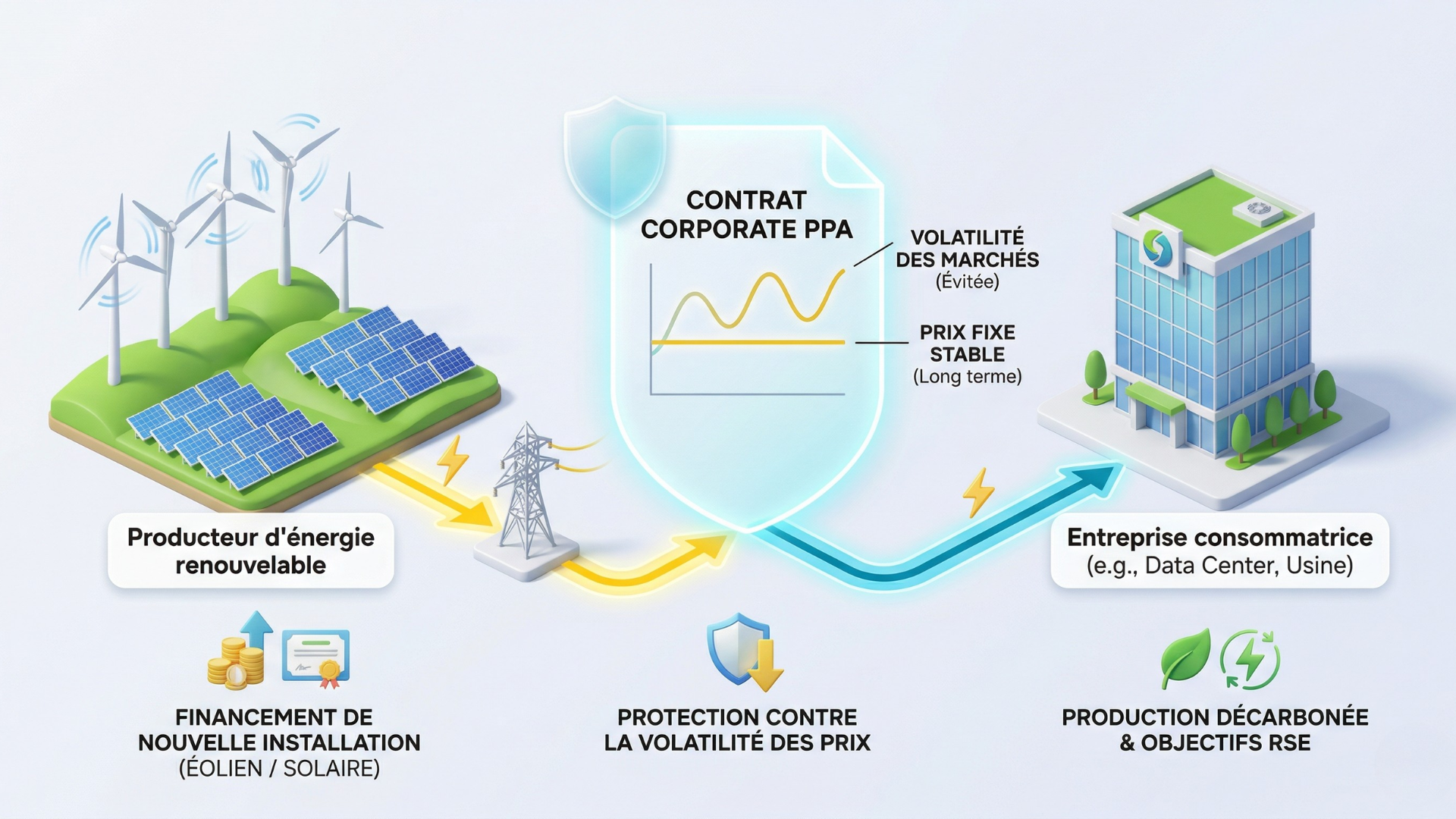
PPAs provide them with a dual solution: a fixed price to secure costs and renewable energy to green their consumption.
Would you like to evaluate the benefits of a PPA for your organization? Our experts will analyze your situation and guide you toward the best energy procurement strategy.
{{ask-conseil="/ctas"}}
The French Power Purchase Agreement market is structured around three main models, each with very different rationales.
In France, the majority of Corporate PPAs involve off-site power plants (ground-mounted, grid-connected), as on-site PPAs are less common in terms of volume due to land constraints.
The producer commits to a specific volume and duration under a supply contract.
As a local, short-circuit solution, the on-site physical PPA reduces grid dependency.
In an off-site physical PPA, renewable electricity is generated at a remote location and then injected into the public grid.
A portion of this production is allocated to the company via a supply contract.
This model secures large volumes of green electricity without land constraints.
In a financial PPA, the company agrees to purchase a quantity of renewable electricity from a producer without consuming it. The power is sold on the market, and the company continues to source its electricity from its usual supplier.
In return, the company receives the guarantees of origin associated with the renewable production.
This model allows for the offsetting of CO₂ emissions without the physical delivery of green electricity.
Contrary to popular belief, Power Purchase Agreements are no longer reserved for large corporations and industrial players. New models are emerging, opening up access to SMEs and mid-sized companies.
PPAs are primarily aimed at large electricity consumers, for whom they become a structural lever for CSR policy:
Electro-intensive industries looking to secure large volumes of electricity, decarbonize their consumption, and protect themselves against price volatility (hedging strategy).
Service-sector companies, which are subject to increasing regulatory requirements.
Local authorities, which face tight budget constraints and expectations for environmental leadership.
A new dynamic is emerging to open Power Purchase Agreements to smaller consumers. These new PPAs allow multiple buyers to share the output of a single renewable energy facility.
The first multi-buyer PPA was signed in June 2025 by 9 industrial mid-sized companies in the Nouvelle-Aquitaine region. For 15 years, starting at the end of 2026, a quarter of their energy consumption will be covered by a solar power plant built and operated by the producer VALECO.
Before committing to a PPA, a company must meet several key requirements:
Expert opinion from Sirenergies
"A PPA is a powerful but demanding tool. For a CEO or CFO, the question is not whether a PPA is interesting 'in theory,' but whether the company's consumption profile, commitment capacity, and contractual maturity justify this type of arrangement. Analyzing the load curve is the essential starting point. Without this granular insight, the risk is signing a poorly calibrated contract, with gaps between renewable production and actual consumption that weigh on the contract's economic performance."
Do you consume more than 2 GWh/year and want to structure your energy procurement strategy? Let's review your eligibility and options.
{{ask-rdv="/ctas"}}
For a long time, green offers from electricity suppliers were the only option for sourcing renewable energy. The PPA offers a new alternative.
The two models differ in many respects. In summary, a standard green offer is a simple and flexible solution for quickly greening your consumption, without long-term commitments or contractual complexity. However, it does not guarantee stable supply and costs over time.
Another notable difference: green energy plans often rely on a compensation mechanism using guarantees of origin, whereas a physical PPA ensures the direct consumption of truly renewable energy.
Faced with lasting energy market volatility and increasing pressure from environmental requirements, Power Purchase Agreements are becoming a strategic tool for businesses.
By combining budget visibility, supply security, and a concrete contribution to the energy transition, it addresses both economic and non-financial challenges.
The model is demanding, involving long-term commitments and contractual complexity. However, it is becoming more accessible thanks to the emergence of structures adapted for mid-sized companies.
Structuring a PPA is not something to be improvised. From analyzing consumption profiles and selecting producers to securing contracts, Sirenergies supports you at every step for a secure, efficient, and sustainable electricity supply.
{{ask-rdv="/ctas"}}
"The Pilott tool has become our control tower. But beyond the platform, it is the accessibility and technical expertise of the Sirenergies consultants that make the difference. They translate the complexity of energy markets into simple operational decisions for us."
Raphaël Dehlinger, Chief Financial Officer, Sotralentz Construction
Discover our client testimonials
In a few clicks, organize an exchange with one of our experts.


weekly newsletter subscribers

4.9


La plupart des PPA exigent un volume annuel d'au moins 2 à 3 GWh. Cependant, les montages multi-acheteurs récents permettent désormais à des ETI de mutualiser leurs volumes pour accéder à un PPA.
Sirenergies accompagne les entreprises dans l'analyse de leur profil de consommation pour déterminer l'éligibilité et la pertinence d'un tel contrat.
L'offre verte s'appuie principalement sur un mécanisme de garanties d'origine, sans lien direct entre la production renouvelable et la consommation de l'entreprise.
Le PPA physique, lui, garantit la consommation d'une énergie traçable et identifiée, avec un prix sécurisé sur le long terme.
Pour les entreprises soumises à des obligations de décarbonation (Scope 2), le PPA constitue un levier bien plus structurant.