




Summarize with AI

March 31, 2026
6
Min reading
Can industry remain competitive while improving its energy performance?
This complex equation is at the heart of a sustainable and resilient future, as industry weighs heavily on energy consumption and greenhouse gas emissions.
It is also the key to maintaining energy independence in a world under stress.
While industrial decarbonization remains a challenge, signs of hope are emerging.
Between concrete solutions, innovations, incentive policies and cooperation, the transition is under way and reveals an encouraging reality: combining production, sustainability and energy performance is possible for all industries, regardless of their size and sector of activity.
Energy performance — or energy efficiency — refers to the ability of an industry to reduce energy consumption, without compromising productivity, quality and continuity of its production.
Energy performance values the company : it improves its carbon footprint, strengthens its environmental image, seduces customers, attracts investors, and attracts talent and retains it.
At the heart of the attention of stakeholders, it is fully in line with the “E” of CSR (Social and Environmental Responsibility) and extra-financial ESG criteria (Environment, Social, Governance). It is also scrutinized by contractors to preserve the scope 3 of their carbon balance.
“Encouraging efforts but still significant room for improvement” : this is how we could summarize the assessment of the energy performance of industry in France. A nuanced but nevertheless promising observation in a world where the industry is struggling to decarbonize.
With 283 TWh consumed in 2023, the industry represents 19% of national energy consumption.
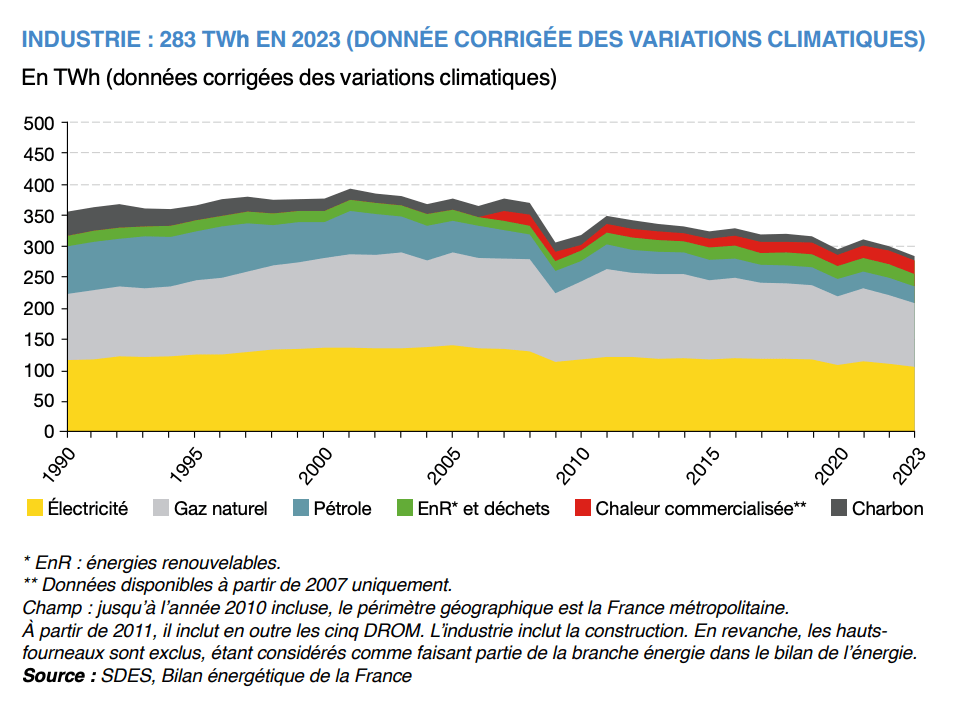
In one year, its consumption fell by 5.2%, confirming the downward trend observed since 2011 (- 1.7% on average each year). While this evolution reflects industry's efforts to improve energy performance, it also reflects a less encouraging reality: the decline in industrial activity.
Energy intensity — that is to say the relationship between energy consumption and added value - better sheds light on the progress made. Between 1990 and 2023, this indicator fell by 35% in French industry.
However, France remains above the European average, with 954 MWh per million dollars, compared to 872 for the European Union.
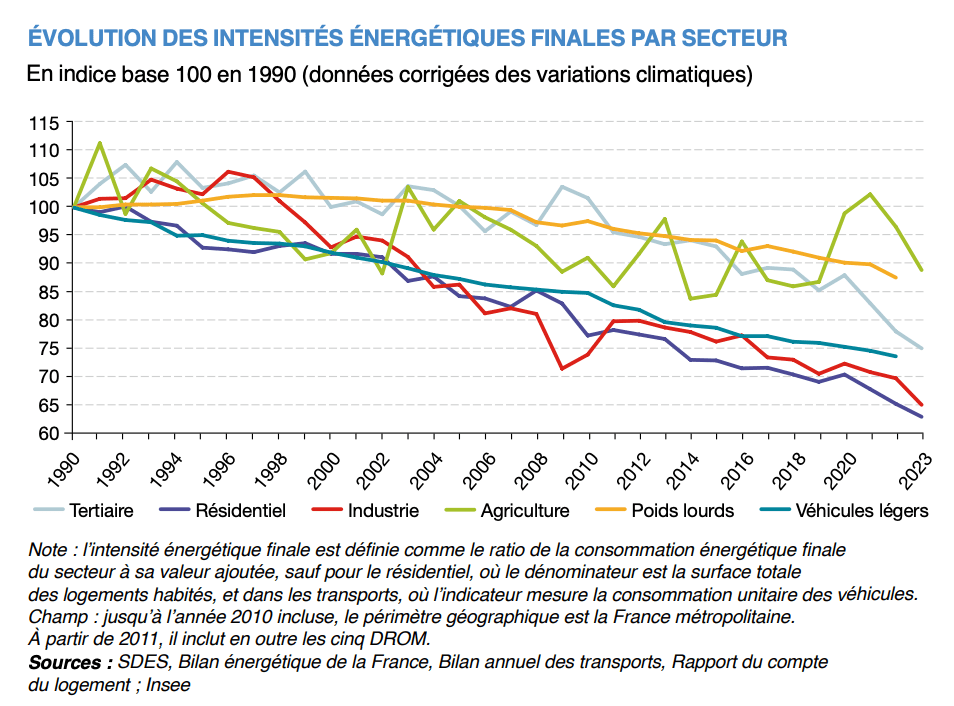
The energy mix of French industry is largely dominated by electricity (37%) and natural gas (36%), followed by oil (10%), heat (8%), renewables (7%) and coal (2%).
This profile places France among the countries most advanced in the industrial energy transition, in contrast to a global landscape largely dominated by fossil fuels.
In France, industry accounts for 17% of greenhouse gas emissions.
In 2023, it emitted 65 million tons of CO2 equivalent, or a drop of 54% since 1990.

One sector is an exception: Construction, whose emissions increased by 3% over the same period.
These results rank France among the good students in the world. With 9 Gt of CO2 emitted in 2022 (i.e. +70% since 2000), industry accounts for a quarter of global emissions.
These figures highlight a reality: the difficulty for the industrial sector to decarbonize, linked to highly polluting transformation processes.
In France, chemistry, non-metallic minerals (cement, lime, lime, glass, plastic...), construction materials, metallurgy and agri-food concentrate 80% of industrial emissions.
In France and around the world, governments are multiplying initiatives to support industry towards a more economical and resilient energy model.
The decarbonization of industry is part of the international framework of Net Zero Emission (NZE) screenplay. Based on the Paris Agreements, it aims to achieve zero carbon emissions by 2050 in order to limit global warming to 1.5°C.
In Europe, the Fit for 55 legislative package sets a first key step: reducing greenhouse gas emissions by 55% by 2030.
France is pursuing this objective via the National Low Carbon Strategy (SNBC) which plans to achieve carbon neutrality in 2050.
In France, the momentum of decarbonization and energy performance in industry is launched.
Supported by an incentive policy, it is based on several key measures:
The bulky energy consumption of industry is not inevitable. Between simple, easily accessible solutions, and technological innovations, energy performance is becoming a concrete reality for all industries.
THEenergy audit, Thethermal insulation of the buildings, the replacement of energy-intensive equipment And the energy sobriety are the four pillars of an effective consumption reduction approach. The good news? They are available to all businesses.
The energy management on a daily basis allows you to go even further. Thanks to IoT (Internet of Things) meters and sensors, intelligent energy management offers a real-time view of consumption, facilitates the detection of anomalies and optimizes the management of equipment. The result: an estimated reduction in electricity consumption between 10 and 30%.
With Pilott, manage the energy performance of your industry, day after day. From a centralized interface and with the support of an expert, visualize your consumption, detect your differences and identify concrete levers to optimize your uses and reduce your bills.
Industrial processes are particularly energy-intensive, especially those involving refrigeration or raising high temperatures. To improve their energy performance, two levers derived from thermodynamics are essential:
La predictive maintenance is another asset for improving the energy performance of production. Thanks to IoT and Artificial Intelligence (AI), it anticipates breakdowns, reduces shutdowns and maintains equipment performance. More generally, The AI can also model consumption needs, adjust energy flows and avoid waste.
Decarbonizing industry is a priority of the France 2030 plan.
The objective: to replace fossil fuels with renewable and low-carbon sources. Three disruptive technologies are particularly encouraged:
The State supports this decarbonization, through energy transition contracts Signed with the 50 industrial sites that emit the most CO2 (ArcelorMittal, TotalEnergies, Solvay, Naphtachimie, etc.) ADEME also carries several Calls for projects, dedicated to Low Carbon Industrial Zones or to Hydrogen Innovation.
Decarbonization involves the need to modernise networks in order to integrate renewable and low-carbon energies. In France, NaTran, GRDF and Teréga are actively working to adapt existing infrastructures and develop new networks. to transport hydrogen and biomethane.
At the European level, a vast hydrogen backbone project is currently being deployed, involving 28 countries. At the same time, regional networks emerging to connect producers to consumer industrial sites, such as in the Rhine region, in Dunkerque or in the Fos-Marseille basin.
Meeting energy challenges requires the industry to provide large-scale solutions, often based on technologies that are still innovative, experimental and expensive. This transformation cannot be done alone: it is based on a close collaboration between manufacturers and energy companies.
Numerous projects bear witness to this. It is observed in the deployment of solar power plants on industrial sites (Toyota, TRA-C Industrie, Baudin...) or in pilot projects carried out in industrial areas. In Fos-sur-Mer, the demonstrator Jupiter 1000 associates producers, transporters and manufacturers to test the production, storage, injection and consumption of green hydrogen.
The same logic underlies CO2 capture and storage projects (BATTERIES). In Saint-Nazaire, Elengy works with several manufacturers to capture and transport CO2 to geological storage areas.
The transition to a more sustainable industry also involves an evolution of internal practices and the development of a culture of sustainability, at all levels of the company.
Beyond major projects, energy performance is also a factor in daily choices. With Sirenergies, benefit from local support to co-build concrete tailor-made solutions, in line with your field challenges.
{{ask-rdv=” /ctas "}}
Linking energy performance and industrial competitiveness is an arduous challenge. But it is now within the reach of all industries thanks to accessible concrete solutions and innovative technologies. Regardless of its size and sector of activity, each industry can strengthen its resilience and sustainability, while maintaining its production.
While the road to carbon neutrality is still long and full of pitfalls, current progress shows that the transition is under way. Do you want to join the movement?
Sirenergies helps you imagine concrete solutions at your scale and transform your industry into a sustainable and efficient industry.
{{pilot-conso=” /ctas "}}
In a few clicks, organize an exchange with one of our experts.


weekly newsletter subscribers

4.9

.png)

Sourcing offers better visibility on the market and promotes the selection of competitive contracts. It helps to reduce the risks associated with price volatility and to optimize the energy budget.
Même le bâtiment le plus moderne et le mieux isolé perd son efficacité si ses usages sont inadaptés. La technologie et les normes ne suffisent pas : la transition énergétique est avant tout une transformation humaine.
Derrière chaque kilowattheure consommé se cache une habitude.
Un collaborateur sensibilisé comprend qu'ouvrir une fenêtre alors que le chauffage est allumé ou laisser un ordinateur en veille consomme de l'énergie inutilement. En replaçant l'humain au centre de la stratégie de gestion de l'énergie, l'entreprise s'assure que ses équipements performants sont utilisés de manière optimale, garantissant ainsi une rentabilité durable et un impact environnemental réduit.
The subscribed power must be calculated according to the consumption profile and uses (heating, industrial processes, tertiary equipment). One fine analysis makes it possible to ensure the adequacy between real need and contract.
Le dispositif ARENH a laissé place au VNU (Versement Nucléaire Universel).
Ce changement structurel expose davantage les entreprises aux prix de gros, rendant la gestion des risques plus complexe qu'auparavant.
Il devient alors indispensable de définir une stratégie d'achat d'électricité avec Sirenergies pour lisser l'impact de la volatilité des marchés sur votre budget.
Farms are subject to taxes such as TICFE or TICGN. Sirenergies verifies their application, identifies cases of exemption and accompanies the procedures to reduce the tax burden.
Les profits include a direct reduction in bills, strengthened budgetary forecasting and better control of consumption. Businesses gain visibility and efficiency thanks to adapted tools.
Les coopératives de taille ETI ou grande entreprise peuvent être soumises à l'audit énergétique réglementaire (norme NF EN 16247). Sirenergies n'a ni la compétence ni l'accréditation pour réaliser cet audit : nous vous orientons vers un bureau d'études partenaire accrédité, et vous accompagnons en amont sur vos achats et en aval sur le pilotage.
Le calendrier 2026 impose deux échéances majeures :
Pour simplifier ces démarches, vous pouvez centraliser vos données de consommation avec la plateforme Pilott de Sirenergies, garantissant ainsi la conformité de vos rapports réglementaires.
This makes it possible to choose the right time to contract, secure your budgets and anticipate increases.
Yes. The supplier guarantees an offer 100% renewable via the official Guarantees of Origin (GO) mechanism.
For the most demanding companies, the offer GREENVOLT+ ensures very low carbon intensity electricity, sourced exclusively from independent French producers (hydraulic, wind, solar).
Les caves coopératives de taille ETI ou grande entreprise peuvent être soumises à l'audit énergétique réglementaire (norme NF EN 16247). Sirenergies n'a ni la compétence ni l'accréditation pour réaliser cet audit : nous vous orientons vers un bureau d'études partenaire accrédité, et vous accompagnons en amont sur vos achats et en aval sur le pilotage.
En analysant votre courbe de charge pour identifier la puissance réelle appelée, puis en demandant un ajustement à votre fournisseur ou via un expert en énergie.
L'ARENH est remplacé par le VNU (Versement Nucléaire Universel), un mécanisme de redistribution des revenus excédentaires d'EDF en cas de prix très élevés, et par les CAPN, des contrats long terme pour les gros industriels.
It allows you to prove your commitment to the energy transition and to meet regulatory requirements.
Industrial companies consume large volumes of energy for their production processes. They have to deal with the volatility of prizes, multi-site management and specific taxes. Controlling costs is essential to remain competitive.
To calculate Scope 2 emissions, use the following formula:
Energy quantity (kWh) × Emission factor (kg CO₂ e/kWh).
Use databases like ADEME for precision.
Pas nécessairement sur votre facture finale. Si les prix de gros (le prix de l'énergie brute) ont baissé, les coûts d'acheminement (TURPE) et certaines taxes augmentent, compensant souvent la baisse de la part énergie.
The €/MWh is a price unit used in wholesale markets, while kWh is the unit visible on your bills.
The industry is concerned by TICFE, TICGN and other contributions that may represent an important part of invoices. Sirenergies identifies cases of exemption and accompanies the procedures to benefit from them.
Communities are subject to taxes such as TICFE or TICGN. Sirenergies analyzes invoices, identifies exemption possibilities and fixes possible errors to reduce the tax burden.
Un appel d’offres permet de mettre en concurrence plusieurs fournisseurs d’électricité et de gaz afin d’obtenir des conditions contractuelles optimisées. C’est une démarche transparente qui permet de choisir l’offre la plus adaptée aux besoins budgétaires et techniques de l’organisation.
Idéalement entre 6 et 12 mois avant l'échéance, de préférence au printemps ou au début de l'été lorsque la demande est plus faible.
All businesses, from SMEs to large organizations, can benefit from this service. Les local authorities also find it a lever to better control their budgets.
Exceeding capacity leads to financial penalties and can impact the size of the contract. Adjust the correctly subscribed power makes it possible to avoid these additional costs.
One invoice consists of several elements: consumption, supplier share, taxes and contributions. The analysis of each line makes it possible to identify possible errors and to check the consistency with the signed contract.
C'est le levier le plus rapide pour obtenir des résultats visibles. L'éclairage représente environ 40 % de la consommation d'électricité d'une commune.
Passer au LED avec pilotage intelligent permet de réduire la facture de 50 à 80 %, avec un retour sur investissement (ROI) rapide, souvent estimé à 2 ou 3 ans.
The range E @sy is available in four pricing structures to adapt to each risk profile:
En 2026, les principaux leviers sont : la renégociation de votre contrat de fourniture au bon moment, l'optimisation de votre tarif d'acheminement (TURPE), la vérification de votre éligibilité aux taux réduits de taxes (Accise), et la réduction de votre consommation (efficacité énergétique, autoconsommation).
Changing suppliers can allow you to benefit from more competitive prices, adapted services or better contractual conditions. Thanks to sourcing, change is happening without interruption of supply.
Plusieurs leviers existent pour préserver la fiscalité locale :
Tertiary companies are concerned by taxes such as TICFE or TICGN. Sirenergies checks the accuracy of invoices, identifies possible exemptions, and helps correct errors to sustainably reduce costs.
La réussite d'un projet collectif énergie repose sur trois piliers fondamentaux :
Among the taxes include TICFE, TICGN, CTA, CJA and TURPE. They represent a significant part of the bill and vary according to consumption profiles. Understanding them well is essential to optimize costs.
Some businesses may obtain a partial or total exemption from the TICFE or the TICGN, depending on their activity and energy intensity. The support of an expert makes it possible to identify the eligibility criteria and to put together the file.
Sourcing consists in identifying and analysing the offers of several electricity and gas suppliers. This approach makes it possible to obtain contracts adapted to the consumption profile and budgetary constraints of the company.
Farms must deal with high seasonal needs (greenhouse heating, irrigation, storage) and high volatility of prizes. Controlling these costs is essential to maintain profitability and secure the business.
Tertiary companies must manage their energy costs while guaranteeing the comfort of users (offices, shops, services). Consumption is often linked to heating, air conditioning and lighting, which requires precise monitoring to avoid budgetary excesses.

Les undertakings accompanied by Sirenergies can choose to share their experience. With their agreement, their feedback is published on our site and integrated into our reference base.