




Summarize with AI

March 6, 2026
7
Min reading
Nuclear energy is by far the main source of electricity production in France. The availability rate of farms (the number of plants in working condition) is a fundamental indicator to monitor in order to understand the activity of energy markets.
At the beginning of 2023, several nuclear power plants are shut down, which has been pushing electricity prices up since spring 2022. The main reason for these shutdowns? Maintenance operations relating to the safety of nuclear power plants.
In general, these operations have been planned for a long time and are spread over time. The health crisis of 2020 changed this calendar and cyclical events were added to busy maintenance operations.
In this article, we will understand how the nuclear safety strategy is implemented in order to understand the impacts it can have on electricity markets.
Nuclear energy Is the main source of electricity production in France. In general terms, it refers to the technology that makes it possible to crack uranium atoms in order to release a large quantity of energy. The crack in a uranium atom causes the fission other neighboring atoms, and so on. This energy is then used to turn a turbine and thus produce electricity.
Water is a central element of this system. In fact, the energy released by this reaction heats water which is transformed into steam; this steam will feed a turbine equipped with magnets. The rotation of this turbine will allow the creation of electric current.
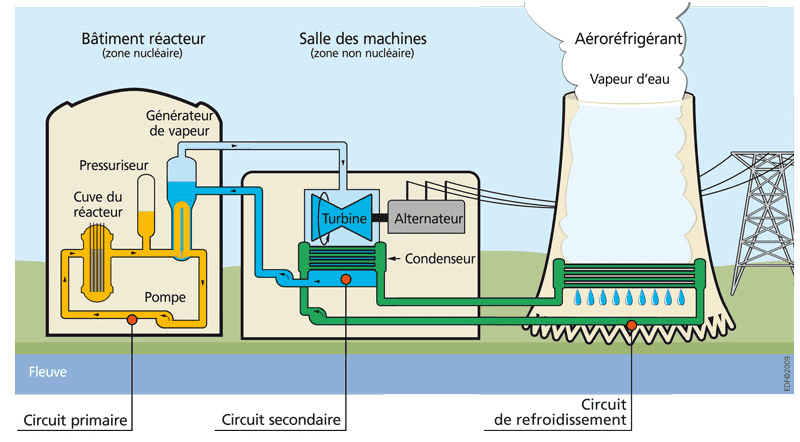
Source: EDF
The structure of a nuclear power plant may vary due to its geographical location but, in general, they consist of 4 main parts:
The primary and secondary circuits are independent of each other. The water that circulates through one of the pipes is never in contact with other parts of the power plant. These waters are then renewed.
This production source emits few CO₂ emissions (apart from the construction phase), but it is also controllable, which makes it a perfect energy to accompany The energy transition.
The question of dismantling power plants and waste management remains important, however, and raises questions about this source of production in the long term. As you will have understood, the safety and security of our power plants are the key element when it comes to evaluating the benefits of nuclear energy.
First of all, it is necessary to differentiate civil security actions from nuclear safety actions:
Nuclear safety is described in the following terms by the ASN (Nuclear Safety Authority):
“Nuclear safety is the set of technical provisions and organizational measures relating to the design, construction, operation, stopping and dismantling of basic nuclear installations, as well as to the transport of radioactive substances, taken in order to prevent accidents or to limit their effects.”
There are numerous protocols set up to ensure that the operation of the power plant does not present any danger of radioactive leaks. They describe the various successive lines of defense that are put in place in the event of an accidental situation. That's what we call defense in depth.
The different levels of intervention are shown in the diagram below:
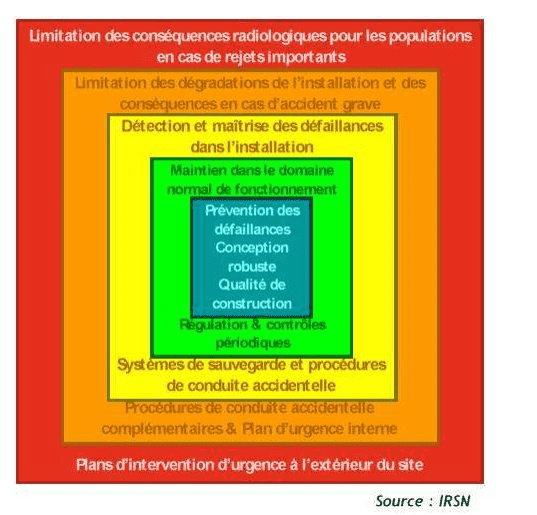
Like any industrial activity, risk exists and must be measured and managed in order to ensure the protection of people and property. It is even a national security issue.
Nuclear power plants do not fall under the SEVESO Directive. When the first power plants were designed, accidents such as Fukushima in Japan were not necessarily imagined.
Nuclear safety policies have evolved over time in order to achieve more and more stringent controls.
Today, ASN is publishing its various maintenance operations planned on all French power plants.
The Covid-19 health crisis has considerably slowed down the maintenance schedule; this delay is currently being compensated for in the years 2022, 2023.
Nuclear safety is organized around functions and safety barriers. There are three types of safety functions:
Security barriers are built specifically to manage the third risk. To do this, there are three types of independent barriers: Fuel jacket, reactor vessel and containment vessel.
These barriers aim to make airtight at the same time uranium, cooling water, the reactor core and the reactor itself. This system was designed by imagining several initiating events and the resulting scenarios that may lead to serious consequences for humans or the environment.
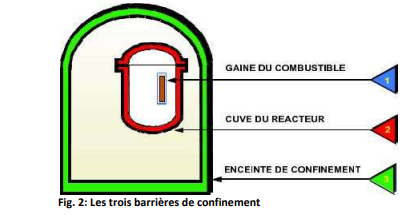
Source: ASN
In France, nuclear safety concerns many actors who depend on each other. A distinction is made between operators, TheNuclear Safety Authority (ASN), theInstitute for Radiation Protection and Nuclear Safety (IRSN) And its expert commissions, the public authorities (parliament) and finally, the citizen associations.
The State created the Nuclear Safety Authority (ASN) in order to guarantee a sufficient level of requirements and nuclear safety on French territory.
Like the Energy Regulatory Commission (CRE), it is an administrative authority independent of the State. Its main mission is to ensure that EDF, as an operator, meets the requirements of regulations in terms of nuclear safety.
Its three main missions are as follows:
This authority gives its opinion on the various hazard scenarios studied by EDF and has the power to trigger maintenance or study operations on the entire Nuclear park.
These operations are of paramount importance for the safety of French and European citizens, but also have significant repercussions on the electricity markets. Today, ASN's control is not limited to compliance with technical criteria; its control extends to the organizational and human challenges of nuclear power plants.
EDF is the operator of nuclear power plants in France. It is the main player and responsible for the safety of these industrial assets that are crucial for the functioning of our society. It is subject to all the regulations mentioned above, closely monitored by ASN and the public authorities.
In addition to ensuring the current operation of power plants, EDF is also responsible for extending the life of nuclear power plants. A maintenance, safety and quality process is essential to extend the lifespan, initially estimated at a minimum of 40 years.
Power plants are the subject of mandatory decennial visits. These “check-ups” are scheduled in such a way as not to affect the average availability of the fleet. The situation we are experiencing today is exceptional in view of the last fifty years.
Created in February 1999, theAssociation of Nuclear Safety Authorities of Western European Countries (WENRA - Western European Nuclear Regulators Association) is an association Independent, which implements and disseminates harmonized nuclear safety protocols and regulations.
At the European level, WENRA promotes harmonization of national nuclear safety regulations between the various Member States.
The Institute for Radiation Protection and Nuclear Safety (IRSN) is a French public industrial and commercial establishment (EPIC) under the supervision of the Ministries of Energy, Environment and Defense.
IRSN carries out research and expertise on nuclear and radiological risks. It is the institute that studies in particular the effects of ionizing radiation on health. These conclusions and opinions feed into the legal and operational decisions taken by ASN.
Nuclear safety is a major subject in France and in each country using this technology. Protocols issued at national level as well as at European level should be followed. Safety and security risks are mentioned by critics of this production source; however, incidents have been rare since its inception.
It is certain that nuclear energy will be the energy of transition in France; the fact that it is controllable and has no direct CO₂ emissions is a major asset. It is important to maintain an effective safety framework in order to achieve environmental goals and to successfully meet the climate challenge.
To go further, do not hesitate to consult our article on The history of nuclear energy in France.
In a few clicks, organize an exchange with one of our experts.


weekly newsletter subscribers

4.9
