






Summarize with AI

March 6, 2026
4
Min reading

Climate change caused by the impact of human activities on the ecosystem has become a cause for concern. Because of pollution, new ways to survive on Earth without giving up comfort are being sought. The considerable reduction in the emission of greenhouse gases in the atmosphere is the order of the day.
Unfortunately, most of the energy used by humans still comes from fossil fuels. They burn and release into the atmosphere an enormous quantity of highly polluting greenhouse gases.
However, there are alternatives and Hydrogen is one. Various categories of hydrogen differ from one another. SirEnergies presents them to you.
When we talk about fuels, we often tend to think of fossil fuels, which are still the most used, despite their devastating impact on the atmosphere. It does exist though clean fuel which can have a minimal impact on the ecosystem: it is Hydrogen.
There are lots of ways to extract and use hydrogen as fuel, but not all of them have zero impact. Each of these methods has been symbolically associated with a color to make them more easily recognizable. In fact, Hydrogen has no color: it is a transparent and invisible element in its gaseous state.
However, the jargon offers a color attribute to the different types of hydrogen. It depends on how hydrogen is extracted from the molecules in which it is combined and on its environmental impact.
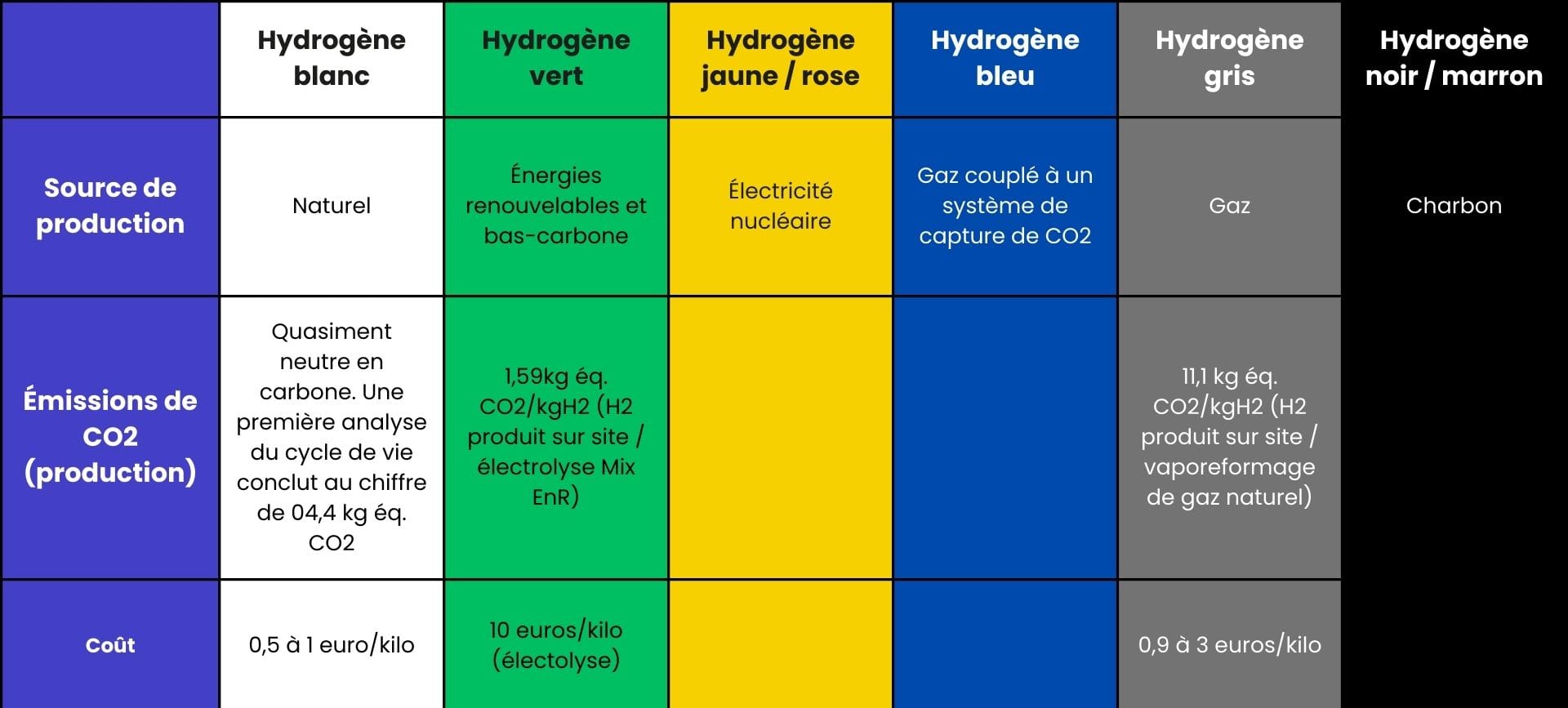
Comparative table of hydrogen types - Source: Sirenergies
The colors of hydrogen depend on its extraction process and its impact on the environment. The main colors of hydrogen are blue, green, and gray, but there are others.
Electrolysis is the process used to obtain green hydrogen. This method uses electric current to separate hydrogen from oxygen in water. Green hydrogen is obtained from renewable sources that do not emit carbon dioxide into the atmosphere.
It's about The best solution from an environmental point of view. Electricity from renewable energy sources such as hydroelectric power plants, wind farms and photovoltaic power plants is used to electrolyze water.
Green hydrogen does not exist in nature and must therefore be produced from certain energy sources. Obtaining it will lead to a real revolution by allowing an ever greater decarbonization of the use of machines, in industry and transport.
Here are some of the benefits of green hydrogen:
However, the viability of green hydrogen raises some questions because of its high production cost.
It is hydrogen produced from raw materials rich in hydrocarbons, such as methane gas, Coal or other fossil fuels. In particular, gray hydrogen is produced from natural gas using the steam reforming technique.
Today, it is tending to be used less and less. The reason for this is that its production process does not involve capturing emissions or using renewable energies.
It is called gray hydrogen because carbon dioxide is released into the atmosphere during the steam reforming process. This type of hydrogen thus contributes to the problem of global warming. In fact, to produce one ton of gray hydrogen, about 9 tons of CO2 are issued.
Blue hydrogen is similar in some ways to gray hydrogen, as it is based on the same reforming processes as natural gas. In this case, however, the production process is complemented by CO capture and storage systems.2 generated during the process. This CO2, which is polluting, is captured so that it does not reach the atmosphere and can also be used for other purposes.
Blue hydrogen is supposed to be an environmentally friendly alternative, it is produced in a roundabout way from methane. It is thus possible to burn fossil energy sources without CO2 not be released into the atmosphere.
In addition to these three main colors, there are others that designate hydrogen according to its production. Linked to gray, black hydrogen is also produced with fossil fuels and generates polluting emissions. Another type of hydrogen is brown hydrogen Who uses lignite (brown coal) instead of natural gas.
There is also Turquoise hydrogen, between blue and green, thanks to the low emissions obtained in the pyrolysis process. Heating natural gas or methane to a high temperature and without oxygen produces hydrogen in the form of gas and carbon in solid form.
White hydrogen is the one that is found in nature, in underground deposits. It could be extracted by fracking, although there is no viable exploitation strategy at this time.
There are other lesser-known variants like pink hydrogen, obtained by Nuclear energy thanks to the electrolysis process. Yellow hydrogen finally refers to the fuel obtained by electrolysis using solar energy.
Hydrogen thus has numerous advantages. It can be used as an energy source and as a raw material. It is odourless and non-toxic, has a high energy density in relation to its mass, and is easy to transport and store.
All of this makes hydrogen a hope for a climate-neutral transformation. These numerous advantages are offset by one major disadvantage. Hydrogen in pure form practically does not exist in nature. This means that it must be obtained from chemical compounds using energy.
In a few clicks, organize an exchange with one of our experts.


weekly newsletter subscribers

4.9

.png)

Les caves coopératives de taille ETI ou grande entreprise peuvent être soumises à l'audit énergétique réglementaire (norme NF EN 16247). Sirenergies n'a ni la compétence ni l'accréditation pour réaliser cet audit : nous vous orientons vers un bureau d'études partenaire accrédité, et vous accompagnons en amont sur vos achats et en aval sur le pilotage.
The range E @sy is available in four pricing structures to adapt to each risk profile:
Yes. The supplier guarantees an offer 100% renewable via the official Guarantees of Origin (GO) mechanism.
For the most demanding companies, the offer GREENVOLT+ ensures very low carbon intensity electricity, sourced exclusively from independent French producers (hydraulic, wind, solar).