






Summarize with AI

November 4, 2026
4
Min reading
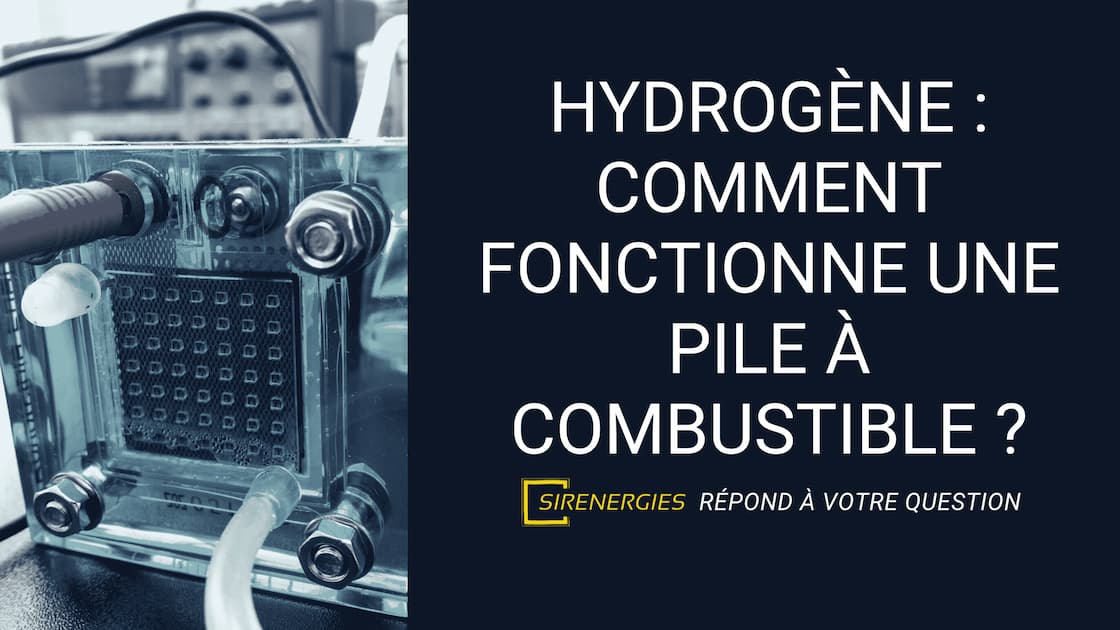
A fuel cell is a generator that converts a fuel directly into electricity. Its principle was discovered in 1839 by the German chemist Christian Friedrich Schönbein, and Francis T. Bacon turned it into a working device from the 1930s onwards. Fuel cells even powered the Apollo space missions. The most common type today is undoubtedly the hydrogen fuel cell.
Sirenergies explains how a fuel cell works.
The operating principle of a fuel cell has been known for more than 150 years. It is based on a redox (oxidation-reduction) reaction. A fuel cell has two electrodes: an anode, where oxidation takes place, and a cathode, where reduction takes place. These two electrodes are separated by a central electrolyte, with catalysts at the interfaces.
The electrolyte can be solid or liquid, and its main role is to let ions pass through. In proton exchange membrane cells, the membrane keeps the reactants at the anode and the cathode apart and blocks the passage of electrons.
The cell is continuously supplied with reactants: hydrogen at the anode and oxygen, usually taken from the air, at the cathode, in the case of a hydrogen fuel cell.
At the anode, the fuel is oxidised and releases electrons. Since the electrolyte only lets ions through, the electrons travel through an external circuit, which produces a direct electric current. The electrochemical oxidation of hydrogen at the anode is written: H2 → 2H+ + 2e−.
At the cathode, the electrons and ions meet and combine with the oxidant, generally oxygen. This reduction reaction produces water, heat and electric current.
A fuel cell therefore runs continuously for as long as it is supplied. The reduction of oxygen from the air at the cathode follows this reaction: 1⁄2 O2 + 2H+ + 2e− → H2O. The overall reaction in the fuel cell is: 2 H2 + O2 → 2 H2O.
Fuel cells are classified by the type of electrolyte and catalysts they use. Efficiency, operating temperature and uses vary widely from one type to another.
Some fuel cells run at low temperature, while others operate at temperatures of around 1,000 °C and are only suited to stationary uses.
Proton exchange membrane fuel cells (PEMFC) operate at low temperature (generally below 100 °C). Their efficiency is around 50%.
Their advantage is that they start quickly and at full power. This makes them suitable for vehicles (such as hydrogen cars) as well as small stationary installations. Their power ranges from a few milliwatts to several hundred kilowatts.
Alkaline fuel cells (AFC) were used notably in the Apollo space missions. Their optimal operating temperature is between 65 and 90 °C, but it can rise to 250 °C with a highly concentrated, pressurised electrolyte. Like PEMFCs, AFCs have an efficiency of around 50%.
Phosphoric acid fuel cells (PAFC) are among the most advanced fuel cells in terms of development and commercialisation. Operating between 180 and 210 °C, they can supply stationary installations of several megawatts. The large amount of heat they generate makes them suitable for cogeneration.
Solid oxide fuel cells (SOFC) operate at temperatures that can reach 800 or even 1,000 °C. These high temperatures significantly speed up the reaction kinetics.
With SOFCs, catalysts based on rare metals are no longer needed. However, their relatively slow start-up and high operating temperature require components that are highly heat-resistant. They are mainly used to produce electricity in stationary installations.
Molten carbonate fuel cells (MCFC) operate at fairly high temperatures (600 to 700 °C). Depending on the application, their efficiency is relatively high, from 60 to 80% (with heat recovery), and they are used for large stationary production.
In short, a fuel cell is a generator that produces energy through electrochemical combustion. It works on a simple redox reaction between an anode and a cathode that receives electrons, separated by an electrolyte. It emits no greenhouse gases where it is used, which makes it an attractive alternative, provided that the issues linked to hydrogen production are resolved.
Read our full article on hydrogen to find out more.
Are you a business finding it hard to make sense of the many natural gas and electricity offers? Wondering which energy contract best suits your company?
Sirenergies, an energy advisory firm, supports companies of all sizes in comparing supplier offers and choosing the contract that fits their needs.
Click below to find out more:
In a few clicks, organize an exchange with one of our experts.


weekly newsletter subscribers

4.9
