




Summarize with AI

March 6, 2026
8
Min reading
In 2023, the discovery of an exceptional white hydrogen deposit in Moselle made the news. Since then, the first exploration permit was granted in December 2023 in Pyrénées-Atlantiques.
President Emmanuel Macron also announced the end of 2023 “massive funding to explore the potential of white hydrogen” as part of the France 2030 investment plan.
And France is not the only country to embark on the race for natural hydrogen. With a neutral carbon footprint and a competitive price, would this pure and decarbonized form of hydrogen be the future “white gold”, heralding a new energy future?
What is white hydrogen? What are the potential reserves in France and around the world? Why the enthusiasm for this source of energy? What are its development prospects?
SirEnergies takes you on a journey to discover white hydrogen.
Combined with other molecules, Hydrogen is an abundant gas on Earth. It is found in water, hydrocarbons, methane, and all living organisms.
On the other hand, Hydrogen in its natural state has long been considered very rare. The latest discoveries are challenging this belief. Several billion tons of pure hydrogen would be available in the Earth's crust, opening up new hopes for carbon neutrality and the fight against global warming.
White hydrogen is a “natural” or “native” hydrogen, present in its pure state several thousand meters deep in the Earth's crust.
The first deposit was discovered in Mali in 1987, during the drilling of a water well. Since then, deposits have been discovered all over the world. Geologists still don't know how to determine its exact origin.. Several phenomena are mentioned to explain its formation:
Whatever its origin, native hydrogen would present a continuous production capacity in large quantities. The training process would only require a few years compared to several hundred million for the petroleum. If confirmed, these hypotheses would place this natural resource on the podium of renewable energies.
White hydrogen is the pure form of this natural gas. Other types of hydrogen are man-made. The H2 molecule is extracted from water (H2O), methane (CH4), hydrocarbons (HC) or biomass by chemical reaction.
Several production methods exist, using fossil fuels: steam reforming of natural gas, coal gasification or steam cracking.
The most promising technology is electrolysis, which France is banking on in its national hydrogen strategy. It consists in separating hydrogen atoms from water, under the action of an electric current.
All these production methods require large quantities of energy, most often fossils, and release carbon dioxide into the atmosphere.
In comparison, white hydrogen raises many hopes for the environment and to achieve the goal of net zero emissions. Its main assets for energy transition ? Inexpensive production, without CO2 emissions and potentially infinite.
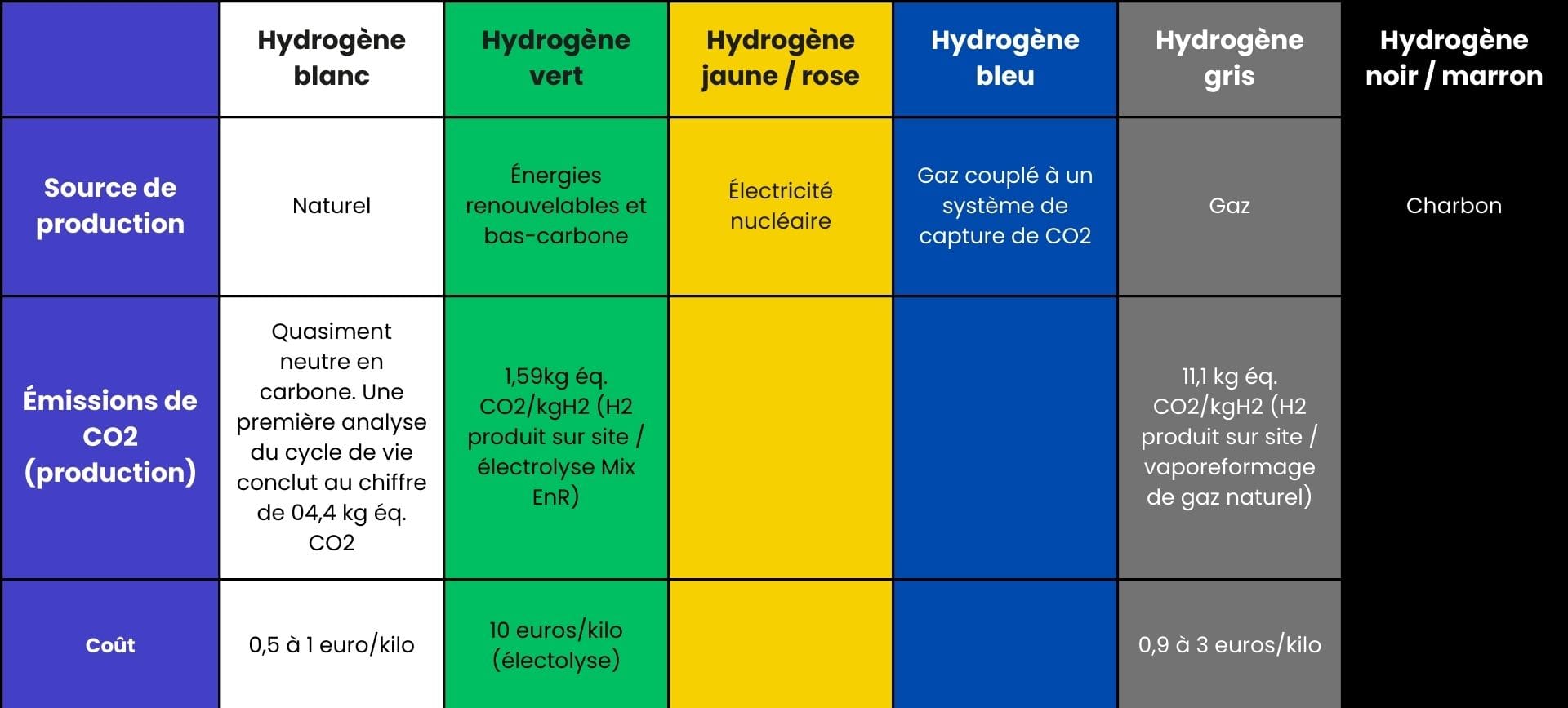
Comparative table of hydrogen types - Source: SirEnergies
Industry, transport, energy storage: the discovery of white hydrogen opens the opportunity to develop the experimental uses of hydrogen and to replace its black and gray form with a white, natural and decarbonized form.
The State states this in a press kit published in February 2023: “Hydrogen is the keystone for the decarbonization of industry”. 900,000 tons of hydrogen are already consumed each year in France by industry petroleum, chemical and steel industries.
This gas is used in industrial processes to produce ammonia and fertilizers, to refine petroleum products, to manufacture drugs and chemicals, to produce steel and cement.
But 96% of this hydrogen is now of fossil origin. Its production emits large quantities of carbon dioxide. Replacing it with white hydrogen would make France take a leap forward in the decarbonization of its industry.
An energy vector in the same way as electricity, hydrogen concentrates all hopes for decarbonizing heavy mobility. La SNCF announces its first trains running on hydrogen for 2025. The first prototypes of hydrogen-powered trucks are also being tested.
In maritime transport, the first boats sailing with e-methanol or e-ammonia are expected in 2025. And the aviation sector is wondering about this energy source, which is nevertheless hampered by the question of storage volumes.
Hydrogen is emerging as a solution for the future for electricity storage of renewable origin. It offers an effective response to mitigate the intermittency of renewable energies and manage production peaks.
The technologies of Power-to-Gas And of Power-to-Power are developing. The principle? Transforming renewable electricity into hydrogen for temporary storage. Hydrogen can then be directly reused or transformed back into electricity or gas.
Since 2018, France has been committed to an ambitious program to deploy hydrogen.
President Emmanuel Macron wants to make France “one of the pioneer countries in this energy of the future”. The discovery of exceptional deposits of white hydrogen on the national territory could help France take first place in Europe in this field.
French territory would have promising reserves in its subsoil. This hypothesis was affirmed in 2023 with the discovery of the largest potential deposit of white hydrogen in Europe at a depth of several thousand meters in a mining basin in Lorraine.
It could contain up to 46 million tons of natural hydrogen, with an infinite capacity for regeneration. If this forecast were confirmed, France would contain in its Lorraine subsoil a quantity of native hydrogen equal to half of the world's annual production of gray hydrogen!
Other regions could have high potential due to their geological characteristics. Studies have revealed the presence of native hydrogen in the Nouvelle-Aquitaine region, as well as in Drôme, Côte-d'Or, Cotentin and the Pyrenees.
However, these paths remain to be explored for assess the real extraction potential of natural hydrogen in France. In 2023, the State announced its desire to launch a vast exploratory study as part of the France 2030 strategy.
Since April 2022, natural hydrogen has been on the list of mineral resources. This Amendment to the Mining Code makes it possible to explore it in France.
A first project is already under way in the Pyrénées-Atlantiques following the awarding in December 2023 of the first exclusive research permit (PER). Granted for five years to TBH2 Aquitaine, the permit authorizes exploration work and seismic studies in an area of 225 km².
Five more permit applications are under investigation. They concern projects in the New Aquitaine region, in Moselle and Meurthe-et-Moselle, in Puy-de-Dôme and Ain.
But the exploration phase has only just begun. It will take many more years of research and procedures before considering the first drilling and exploitation of white hydrogen on French territory.
In the world, only one deposit of white hydrogen is in operation. Managed by the Canadian company Hydroma, The Bourakébougou pilot site in Mali supplies the village with electricity. The exploitation of natural hydrogen on a large scale will require the removal of numerous ecological and economic obstacles.
The United States Institute of Geological Studies (US Geological Survey) estimates that Earth's crust would contain several billion tons of white hydrogen.
But a lot of scientists are still cautious about the numbers. It is still impossible to know the exact quantities of natural hydrogen in the world's subsoil. And it is even more difficult to assess the volumes that can be extracted from the depths.
Integrate a map of the main reserves of white hydrogen in the world (see maps proposed in Infographics)
The extraction and production of white hydrogen confront engineers with new technological, economic and environmental challenges. Difficult to access, native hydrogen could prove difficult to exploit and require very complex and expensive techniques.
The challenges are numerous:
From a regulatory point of view, white hydrogen falls into the category of natural gas. The legislation for its exploration and exploitation is therefore already in place.
Many players in the energy sector are positioning themselves on this market. of the future. Major industrial groups such as TotalEnergies, BuruEnergy or Engie are beginning to integrate projects. But it's mostly the Start-ups which are leading the way, including 45-8 Energy, Storengy and TBH2 Aquitaine in Pyrénées-Atlantiques or the gas operator Française de l'Énergie (FDE) in Moselle.
In the world, The most active country is Australia with around thirty exploration permits in progress. In 2023, the United States began drilling for native hydrogen in Nebraska for the second time in the world after Mali, under the aegis of Natural Hydrogen Energy LLC. Deposits are also explored in the Sultanate of Oman, in New Caledonia, in New Caledonia, in the Philippines, in China, in Finland and in the Atlantic Ocean.
In Europe, the company Helios (a subsidiary of British Petroleum and Axion) displays its Ambition in Spain : to be the first company to produce natural hydrogen in Europe starting in 2029 in the Monzón well, in the Aragonese province.
Inexpensive, potentially unlimited and carbon-free, white hydrogen brings hope for the future of the planet and people.
Faced with media hype, however, scientists urge caution. The estimate of reserves is uncertain and extraction and production techniques are still immature. Only exploration and the first drilling will confirm the potential of native hydrogen.
In France, the State places white hydrogen at the heart of its strategy for energy transition, carbon neutrality and energy independence. The stated objective: to build a complete French hydrogen industry, combining white, green and yellow hydrogen.
In a few clicks, organize an exchange with one of our experts.


weekly newsletter subscribers

4.9
