




Summarize with AI

March 6, 2026
7
Min reading
The last IPCC report challenges us about the exhaustion of global resources. Indeed, when it comes torenewable energy and batteries, it is often a question of rare earths or other materials. Despite the fact that these means of production do not use fossil energy to function, their constructions still require the use of finite resources.
The energy transition requires an increase in the number of Photovoltaic power plants or the creation of fuel cells to Hydrogen.
Electric mobility will also experience significant growth. Thus, the use of lithium, cobalt and nickel will inevitably increase. These resources are not endless and pose different problems.
The expanded use of batteries, as well as electric motors, raises questions about the availability of these resources in the long term, mainly in periods of political instability.
As we will see, rare earths also raise other questions about their use, although necessary, in the long term.
First of all, it is important to classify the metals in question. There are several categories of natural resources:
As you can see, these metals are not equivalent in terms of abundance on Earth. We can measure the abundance of a metal thanks to The PPM index (parts per million). To give an idea of the differences that exist between these metals, the PPM index of gold is less than 1 PPM while it is more than 1000 PPM for iron.
Metals and rare earths should not be confused. Indeed, rare earths bear this name because they are a set of metals that, when discovered, were difficult to extract. However, they are present in abundance, homogeneously on the planet's surface. They are now important in the construction of computer hardware or even in wind energy technologies.
Finally, there are what we call specialty metals, very specific to an industry. Their evolutions may experience unexpected rebounds. Les Metals of Nuclear energy are a good example.
Copper is the essential element in an electrical system. Indeed, it is a metal that is present from the coils of the generator, to the outlet that arrives in your home.
It is the driver with the best quality/price/efficiency ratio. Copper atoms have enough free electrons to make the current flow.
Here is a non-exhaustive list of Uses of copper today in the world of electricity:
The energy transition must involve the electrification of our processes in order to gradually get rid of fossil fuels.
The millions of kilometers of power lines installed in the world use copper. Several studies show that the known reserves of copper today amount to Exhaustion before 2050.
The energy transition will increase the use of solar photovoltaic technologies. But also batteries, electric vehicles, etc.
Cobalt is a metal that has very interesting properties because it maintains its magnetic and resistance capacities under very high temperatures. It is therefore very useful in fields such as aerospace, batteries or the chemical industry.
98% of cobalt is extracted from copper or salt mines. It is therefore a “by-product” of existing resources. There is only one mine in the world (Morocco) that has made cobalt its main ore.
There are said to be nearly a hundred million tons of cobalt buried in the seabed. Their exploitation seems highly improbable at the moment.
The nickel is a resource that is present relatively homogeneously on the surface of the globe. There are two different types: laterite or sulphide.
The laterite type is easier to exploit, so at first it was the one that was used in priority.
Then there are various classes of nickel, and nickel class 1 is widely used in batteries. It is also used in the steel industry, which tends to increase pressure on farms.
The United States and Europe have excluded nickel from the list of 35 critical metals to watch closely, however many American companies such as Tesla have already warned of a possible shortage of class 1 nickel by 2025.
In all transition scenarios, the lithium plays an important role. The exponential increase in the fleet of electric vehicles and the need for lithium ion is driving this trend. But batteries are present in many tertiary or industrial installations.
The geographical distribution of lithium is not at all homogeneous. Chile, Argentina and Bolivia alone account for over 60% of the world's reserves.
China, which holds only 7% of the world's reserves, has specialized in all chains of exploitation of this strategic resource for the global energy future.
As we have seen, mineral resources are not homogeneous in their distribution across the globe. Some countries therefore have considerable resources, to be exchanged according to their own policies.
One of the most glaring examples of this risk remains the Democratic Republic of Congo. Indeed, this country has been plagued by political instability for many years but has more than 70% of the world's cobalt resources.
This political instability leads to dangerous exploitation of this mineral.
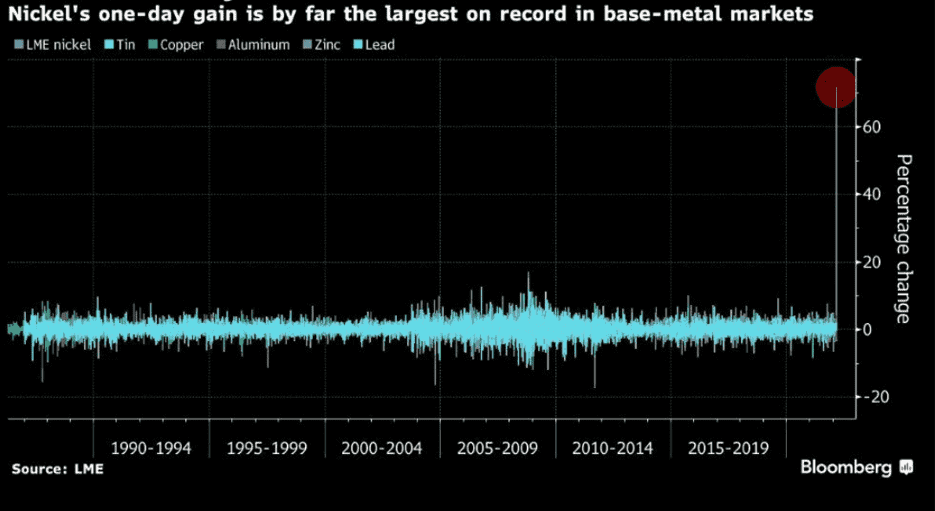
Increase in volatility and tension on the Nickel market following the Russian-Ukrainian conflict - Source: LME
The fact that a State is sovereign in the exploitation of these resources makes us fear tough negotiations in the future. We will try to take two current examples in order to illustrate the point.
Russia's invasion of Ukraine highlights the close relationship between resource and geopolitics.
Indeed, today, Russia produces nearly 40% of the world's palladium. It is also one of the main players in nickel production. It is very likely to attend a drastic reduction in exports of this country in the coming weeks/months.
As such, the European Lithium company had to exploit a new major lithium deposit located in Donbass, in the city of Shevchenkivske. The exploitation of this field would have elevated this group to the rank of leading producer of lithium-ion batteries.
This shows the importance of diplomatic relations that France will maintain with all countries producing natural resources essential to the energy transition.
Beyond the location of natural resources, the production chain is strategic. Today, China has made sure to become the world's largest producer of these metals.
You should therefore be wary of an actor who does not necessarily have significant resources, but who masters extraction or refinement technology. To check the concentration of competitors in a market, we can use The Herfindahl-Hirschman Index (HHI).
It is interesting to look at this index on two different objects on the metal markets: on the one hand reserves, then on the other hand production.
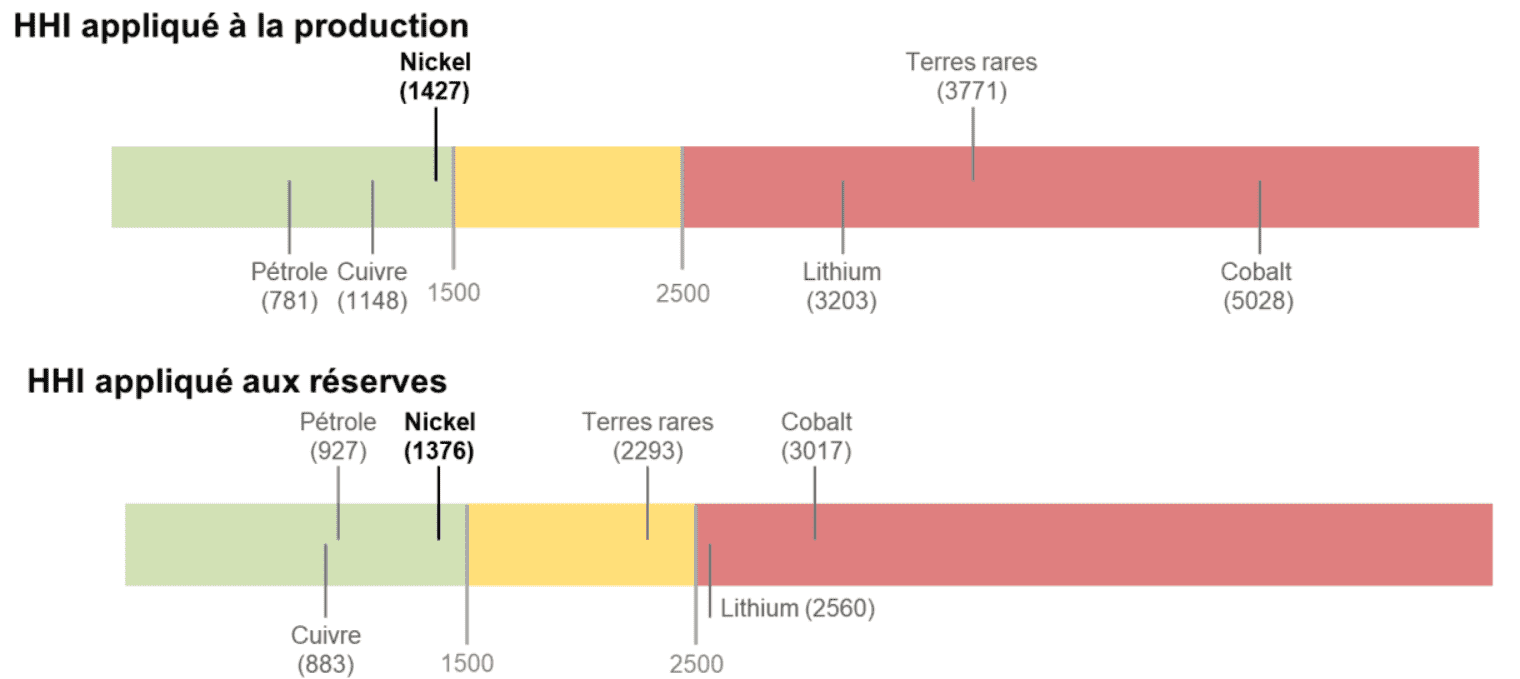
We can therefore see that lithium, cobalt or rare earths are hyperconcentrated markets, with a few dominant players. Five players share the entire lithium market, for example, one Chilean group, two Chinese groups.
Some countries such as Australia (one of the largest countries with reserves) send 80% of their mineral production to be refined by China.
Chile, which also produces considerable quantities, leaves refining to Japan, South Korea and China. “Through its various companies, Beijing thus controls 50% and 89% of the production of refined lithium worldwide” according to IFPEN experts.
Beyond armed conflicts, there is no doubt that the resources of these precious metals will decrease. There are numerous studies on the subject but not all indicate the same data.
As explained earlier, The demand for copper will increase. According to the work of the Institut Français du Pétrole, it is likely to reach between 78.3% and 89.4% total exhaustion of known copper resources in 2010, by 2050.
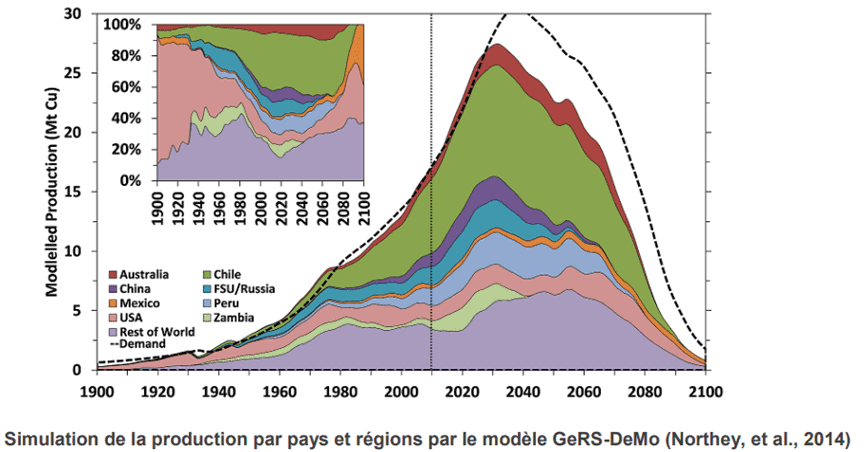
Modeling global copper reserves - Source: ADEME
There are also theories that evoke a “peak oil” that is already outdated. The same goes for copper.
It is possible to find new deposits, especially in the seabed. However, economic and technical reality leads us to believe that these deposits will only be exploited (if they are exploited one day) in several decades.
Metals are likely to represent The major challenge in the energy sector in the coming decades. The energy transition imagined in the West risks creating significant disturbances at the geological level on the one hand, but also from a geopolitical point of view.
As such, the study of global reserves will take up as much space in R&D as extraction or production technologies.
Geopolitical tensions also push us to strongly believe in energy independence of the states.
To go further, do not hesitate to read our topic concerning unused energy sources on this subject.
In a few clicks, organize an exchange with one of our experts.


weekly newsletter subscribers

4.9

.png)

To calculate Scope 2 emissions, use the following formula:
Energy quantity (kWh) × Emission factor (kg CO₂ e/kWh).
Use databases like ADEME for precision.
La réussite d'un projet collectif énergie repose sur trois piliers fondamentaux :
It allows you to prove your commitment to the energy transition and to meet regulatory requirements.
Le calendrier 2026 impose deux échéances majeures :
Pour simplifier ces démarches, vous pouvez centraliser vos données de consommation avec la plateforme Pilott de Sirenergies, garantissant ainsi la conformité de vos rapports réglementaires.
Yes. The supplier guarantees an offer 100% renewable via the official Guarantees of Origin (GO) mechanism.
For the most demanding companies, the offer GREENVOLT+ ensures very low carbon intensity electricity, sourced exclusively from independent French producers (hydraulic, wind, solar).
Les coopératives de taille ETI ou grande entreprise peuvent être soumises à l'audit énergétique réglementaire (norme NF EN 16247). Sirenergies n'a ni la compétence ni l'accréditation pour réaliser cet audit : nous vous orientons vers un bureau d'études partenaire accrédité, et vous accompagnons en amont sur vos achats et en aval sur le pilotage.