





Summarize with AI

November 3, 2026
6
Min reading
On October 12, 2020, Barbara Pompili, Minister for Ecological Transition, unveiled France's ambitions in terms of charging stations.
And it is true that the objectives set by the executive are very ambitious. France wants to have more than 100,000 charging stations by the end of 2021. This objective, which seems difficult to achieve, could allow France to catch up on a certain delay. In fact, when it comes to charging stations, France has nearly one station for every 14 users.
AVERE (which is the National Association for the Development of Electric Mobility) carries out and publishes studies on the subject. The latest reports announce the following figures: 43,700 charging stations installed in France for 620,639 electric vehicles in circulation in France.
The goal of 100,000 charging stations seems difficult to achieve, but sales of electric vehicles are increasing exponentially. Sales of electric and plug-in hybrid vehicles represented 37.6% of sales in June 2021, compared to 21.7% in 2020.
The European Commission is no slouch on the subject. The recent publication of Fit for 55 (a reference to reducing emissions by at least 55% by 2030) will certainly speed things up.
These figures are interesting because they put French ambition in this area into perspective. However, sometimes the reality is quite different. Indeed, there are, for example, major disparities between regions, or even a real problem of maintaining these terminals.
We will therefore take stock of the French network, before focusing on the challenges that remain to be met. Finally, it will be interesting to compare our situation to other countries in order to learn from them.

The democratization of this technology is relatively recent. Long considered to be an “too expensive” vehicle, the electric or hybrid car is becoming a credible alternative to thermal cars (gasoline or diesel). Today things are accelerating as recent studies show.
The French network has begun to develop seriously in recent years. The appearance of new technologies (lithium-ion) concerning batteries is one of the causes.
Today, there is a network of nearly 4.4 fast charging stations per 100 km. In theory, this allows you to be able to move around in a relatively simple way.
However, care must be taken when handling these numbers. They can be difficult to analyze and do not allow immediate conclusions to be drawn.
The installation of charging stations throughout the country is a key factor that does not appear in these statistics.
There are numerous private initiatives in this area. Groups such as Leclerc, Lidl and Système U intend to invest massively in the sector of charging stations for electric vehicles.
The group TotalEnergies is also pursuing its investment strategy in renewables. Their stated ambitions are to deploy 150,000 charging points throughout Europe by 2025. Being able to take advantage of its fleet of service areas (motorways, etc.) is a considerable advantage. The group has also just won the call for tenders from the city of Paris for the management of Autolib electric charging stations.
In order to know if a network is dense enough, it is also necessary to compare the number of vehicles with electric motors present.
The government's announcements come with significant resources. Indeed, it promises to invest nearly 100 million euros to densify the network of French charging stations.
The announcement of increased sales can be seen as a positive sign, it is undeniable. However, this rapid development may not be accompanied by sufficient network evolution.
Modernizing the network can take time, and if EV sales continue to grow at this speed, there is a risk of the opposite effect.
The first edition of The Observatory on the quality of electric charging services accessible to the public revealed some interesting things about it. In fact, out of nearly 22,000 charging points in France, around a quarter are unusable. Users report numerous bad experiences such as not being able to connect or a faulty cable.
Charging stations located on the street (such as Autolib) are the most damaged. More than 58% of users of the same study state that they have experienced breakdowns on this type of charging station.
The quality of the network is essential to ensure the massive adoption of EVs. In future, it will therefore be necessary for the public authorities to ensure that the sales of this type of vehicle are supported by modernizing the network.
Beyond the technical aspects, another major challenge must be taken into account in this equation. Indeed, a network must be sufficiently well distributed between regions to allow homogeneous development, but also to allow users to be able to travel long distances.
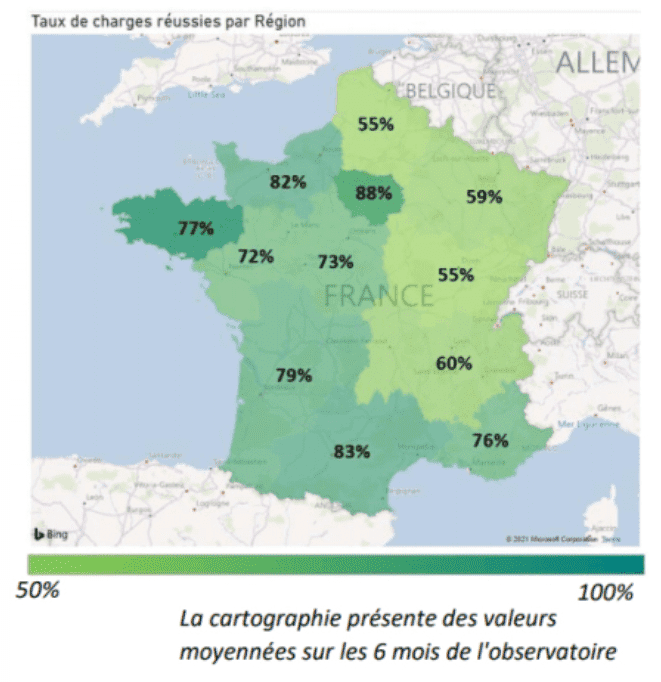
Source: L'argus.fr
Care must therefore be taken not to create too great disparities, even if it is natural to find greater density in cities.
The popularity of the electric vehicle is gaining ground, in particular thanks to the media coverage of the American brand Tesla. As we announced earlier, it is essential to have a mesh network to support this development.
Today, for example in Germany, we hope to reach a total of 72,000 charging stations of all types by the end of 2021.
These various ambitions are supported by a improving technologies used. Indeed, the problem of terminals is relatively simple: it is a question of delivering electrical current sufficiently quickly and that adapts to the new batteries.
The recharge time is a very important element to take into account. If the performance of the batteries increases, but the terminals do not evolve at the same pace, we risk causing charging times to explode.
The deployment of the terminals is therefore an essential aspect (sufficiently extensive and meshed) but not sufficient. The French and European charging network must therefore adapt to new charging technologies.
To enable this, a good number of companies have raised their quality criteria. The lack of certification recognized by the State forces these companies to set up control bodies themselves.
Industrial examples such as That EDF, which takes advantage of the significant resources it has in R&D to test the equipment of its suppliers. Fast charging technologies should be handled with care. The voltages delivered can be significant and damage outdated equipment.
Beyond charging time, one of the innovations concerns the different types of current used. There are terminals powered by alternating current Or in direct current.
This point is important, because one of the flagship innovations in charging stations is The V2G (Vehicle to Grid). The principle is simple: when an electric car is connected to the network, it can charge its battery thanks to this network. But the relationship can go either way!
In fact, the vehicle in question can also provide services to the grid with electricity already stored on the drum. In a society where the number of vehicles is quite large, the effects of proliferation can be beneficial to the network. This solution remains very theoretical, because it would be necessary that RTE be able to have a live view of all the vehicles available.
Be that as it may, there are already several hundred V2G terminals installed. The democratization of this technology is one of the major challenges for the development of the sector in France.
To go further, do not hesitate to consult our article on: Professional electromobility: the advantages of charging stations for your business.
Today, more than ever, electric mobility is one of the levers for achieving carbon neutrality. As such, businesses have a role to play in the energy transition.
You want to install charging stations and/or convert your company's vehicle fleet to electric? SirEnergies is there to help you and supports you in building an eco-responsible image for your business.
Click below for more information:
In a few clicks, organize an exchange with one of our experts.


weekly newsletter subscribers

4.9
