




Summarize with AI

March 6, 2026
5
Min reading
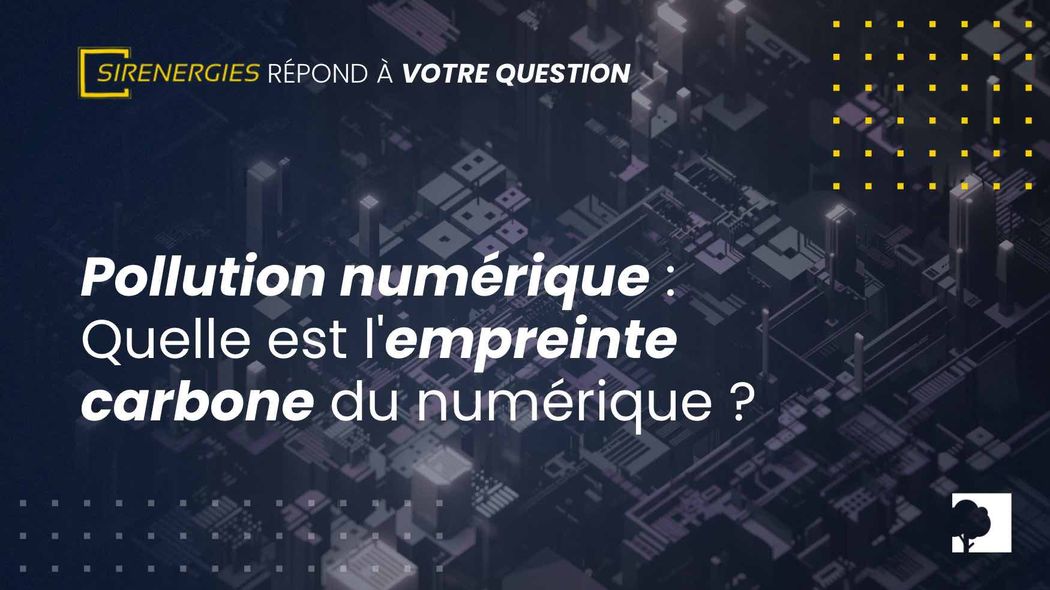
In May 2022, the Minister for Energy Transition, Agnès Pannier-Runacher said that sending an email with an attachment to multiple recipients consumes more energy than leaving the light on.
Obviously, this depends on many variables such as the price of energy, light bulbs, surface area... Moreover, there is currently no general consensus on the estimation of the energy cost of a single email.
In the fight against climate change, no subject should be avoided and the impact on the digital environment must be studied carefully in order to create data centers and computer networks that are ever more resilient. What is the impact of this sector on greenhouse gas emissions?
Digital pollution refers to all the impacts of the computer and information technology sector on the environment. Broadly speaking, this refers to the construction, use and recycling (or not) of all digital technologies and their impacts.
These impacts are diverse, such as emissions of greenhouse gases in all the different processes of the product life cycle. But it can also be chemical contamination, the disappearance of species and biodiversity, the production of electronic waste, etc.
Today, the share of digital technology in greenhouse gas emissions is Reduced. The think tank The Shift Project Believes that The carbon footprint Digital represented 4% of total emissions in 2019.
For the time being, it does not compete with industrial sectors; however, in the coming years, the use of energy-intensive technologies such as augmented reality, artificial intelligence, the metaverse, high-quality video streaming will accentuate this phenomenon.
Today, video streaming accounts for nearly 60% of the world's top-down internet streams. Digital technology is not yet a sector responsible for a significant part of negative externalities.
However, we note that during the first lockdown linked to the covid crisis in March 2020, the European Union required companies responsible for streaming platforms (Amazon, Netflix) to reduce their speeds and the quality of their videos.
The Internet network consists of many components such as cables, servers, computers... These components must be manufactured, but their uses also have an environmental cost.
The Video streaming represents a galloping part of Internet data flows; we must be interested in energy mix of the countries that host these data centers. In fact, if they use fossil fuels, their spectacular development can lead to greenhouse gas emissions, but also to component shortages.
Video streaming would represent nearly 1% global CO2 emissions.
All these digital devices must be manufactured at an ecological cost. Indeed, most technological components are manufactured in Asia, Coal remains the main raw material for electricity generation.
The industrial fabric of these regions is mostly powered by fossil fuels. As a result, these electronics and semiconductor factories release a significant amount of CO2 into the atmosphere.
La digital sobriety is a real subject and a solution when it comes to consumer appliances. Excessive smartphone consumption can thus generate shortages of raw materials. Today, stocks are no longer under stress; however, the news has shown us that the situation can change rapidly.
What is a data center? It is a center that hosts servers that store millions of computer data.
These installations, which can be extended in terms of surface area, are large electricity consumers :
These installations consume a lot of energy. This is why Google, the search engine giant, decided to create a subsidiary specialized in the supply of electricity. In this way, costs are reduced: Google, which consumes more than 15 TWh of energy (2020), is finding real interest in it.
It is now estimated that data centers represent around 1.5% of global electricity consumption.
As we mentioned earlier in this article, the increase in everyday digital objects such as computers, screens, smartphones poses a risk to the entire electronic production chain.
The coronavirus crisis has allowed The emergence of mass teleworking. Indeed, this lifestyle is very successful in many businesses; however, it requires solid internet networks.
Many businesses have had to adapt by increasing access to their servers remotely. This lifestyle will experience an expansion that must be taken into account in the sizing of new networks.
5G is a new mobile phone technology. Basically, in terms of energy, 5G is more efficient and consumes less (for equivalent use) than its predecessor 4G.
However, The volume of data Who is going to be treated by this system is much more important. This volume of data to be processed will lead to an increase in electricity consumption.
To be operational, this system requires new equipment and network infrastructures. This new hardware reinforces the risks of digital pollution mentioned above.
The question of energy sobriety is one of the keys to The energy transition. This is a subject that is too forgotten, but crucial for the success of our energy and environmental goals.
To do this, we must fight against waste and reduce our consumption when possible. The digital sector is fully in line with these principles if we are looking for short and medium term solutions.
There are solutions such as video quality limitation viewed, or even the change in habits with moderate smartphone use.
However, it seems more effective to look at physical equipment. Today's society pushes us to consume more and more by buying new versions.
It is important to know how to balance things by maintaining your devices throughout their life cycle. The production of electronic waste is one of the major risks inherent in the development of the sector.
Connected objects will multiply by increasing the quantities of data to be processed by data centers even more. The massive use of these technologies Engage in debates As for design of future infrastructures.
Some companies are at the forefront of research and are developing low-carbon solutions in order to guarantee sustainability and carbon neutrality telecommunications installations.
The actions to be taken in terms of energy sobriety are colossal and cannot be carried out by private initiatives alone. Public authorities have their role to play in promoting sobriety and reducing our consumption.
In a few clicks, organize an exchange with one of our experts.


weekly newsletter subscribers

4.9

.png)

To calculate Scope 2 emissions, use the following formula:
Energy quantity (kWh) × Emission factor (kg CO₂ e/kWh).
Use databases like ADEME for precision.
It allows you to prove your commitment to the energy transition and to meet regulatory requirements.
Les coopératives de taille ETI ou grande entreprise peuvent être soumises à l'audit énergétique réglementaire (norme NF EN 16247). Sirenergies n'a ni la compétence ni l'accréditation pour réaliser cet audit : nous vous orientons vers un bureau d'études partenaire accrédité, et vous accompagnons en amont sur vos achats et en aval sur le pilotage.
Yes. The supplier guarantees an offer 100% renewable via the official Guarantees of Origin (GO) mechanism.
For the most demanding companies, the offer GREENVOLT+ ensures very low carbon intensity electricity, sourced exclusively from independent French producers (hydraulic, wind, solar).
Le calendrier 2026 impose deux échéances majeures :
Pour simplifier ces démarches, vous pouvez centraliser vos données de consommation avec la plateforme Pilott de Sirenergies, garantissant ainsi la conformité de vos rapports réglementaires.
La réussite d'un projet collectif énergie repose sur trois piliers fondamentaux :