






Summarize with AI

November 3, 2026
7
Min reading
Spain and Portugal experienced a blackout, a giant outage on Monday, April 28, 2025. It brought the economy to a standstill. The exceptional blackout occurred on the Iberian Peninsula precisely because it is a peninsula. Blackouts occur very regularly in Corsica, for example, or even, like all of Italy, except Sardinia, was without electricity on September 28, 2003. There are fewer high-voltage lines that supply a territory when it is on a peninsula. So the network saturates and jumps in case of an unexpected problem.
One of the main objectives of market opening is to avoid Electric black-outs. We sometimes tend to forget it, but it is part of the first European directive on the subject.
Beyond offering access to networks without discrimination, Europe wants above all to secure its supply. Before thinking about price changes, safety comes first.
What is the situation today in France? As a Sirenergies subscriber, you are aware that electricity cannot be stored, at least on a large scale.
The network operator must constantly ensure the balance between production and consumption at all times. The balance of the system is fragile, because forecasting consumption is a complex exercise.
There are numerous examples throughout history where the means used have not been enough. Renewable energies, being Intermittent by nature, complicate the preservation of this balance.
The energy consulting and sourcing firm, SirEnergies supports companies determined to optimize their electricity and gas consumption and to succeed in their energy transition.
The balance of the electrical system is fragile, as we mentioned in the introduction.
Since the network operator cannot rely on stocks of electricity (such as gas), it must maintain an equivalence between production and consumption. It is the job of Dispatchers of RTE (Electricity Transport Network) who ensure this mission in real time.
The electrical network must therefore meet all the electricity demand at all times. In fact, the alternators rotate at a frequency of 50 hertz.
If demand exceeds supply, then this frequency will fall; conversely, if supply exceeds demand, then frequency increases. It is therefore this balance that RTE monitors, maintaining the frequency at 50 Hz.
Source: RTE
RTE therefore forecasts electricity demand in advance and asks producers to adjust their productions accordingly. However, there are several events that can cause malfunctions.
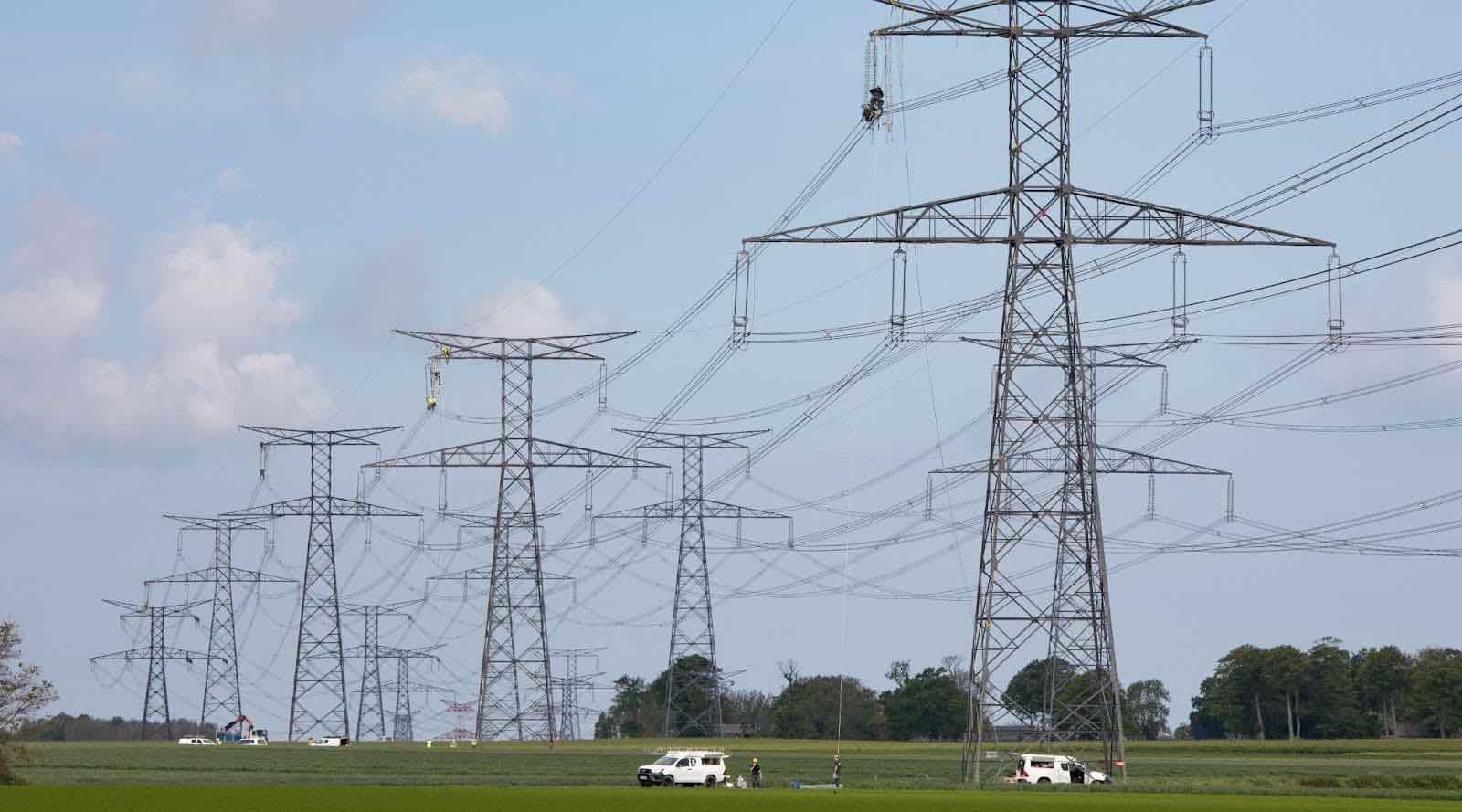
When a power line is no longer available, the electricity supposed Transit by this line will take another path. This may create an overload on another line. Each line has a maximum transport capacity.
If the current exceeds this limit, overheating occurs and the line automatically disconnects from the network. This reaction can be followed by causing numerous lines to be cut due to electrical overload.
Prolonged overload can cause power lines to expand too much and cause them to deform.
We have seen in history widespread blackouts caused by an overheated line which, under theJoule effect, expands and touches a nearby tree. Upon contact with it, the line is cut off from the network and the chain reaction begins.
One of the most famous examples took place in Germany on November 4, 2006. Turning off two lines to let a ship pass has triggered a generalized blackout in Europe.
When a nuclear power plant, for example, is no longer available, the voltage drops locally.
However, when the voltage drops, it reduces the transport capacity of the lines. This creates bottlenecks and therefore overloads. These phenomena can happen very quickly.
In Europe, we have what is called a interconnected network. That is, each country is connected to its neighbors by power lines. The frequency is therefore managed at European level.
If a defect occurs in a line near the border, it is likely that some of the flows will go to border countries. A large-scale incident can therefore theoretically plunge a large part of Europe into the dark.
Obviously, this situation is only theoretical, as there are a number of ways to mitigate these risks.

Our experts imagine for each of customized solutions, concrete and effective for manage your strategy and control your budget energy over time.
In France, RTE has three types of reserves — primary, secondary, tertiary — to manage imbalances between production and consumption.
Each of these reserves has a power in MW and is triggered if the network frequency falls.
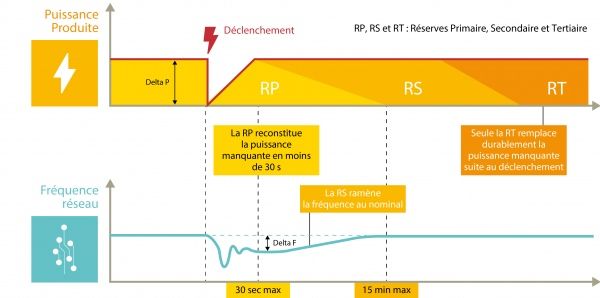
Primary (RP) and secondary (RS) reserves (called “frequency system services”) are triggered automatically to contain the drop in frequency. The first starts in under 30 seconds, while the second starts in under 15 minutes.
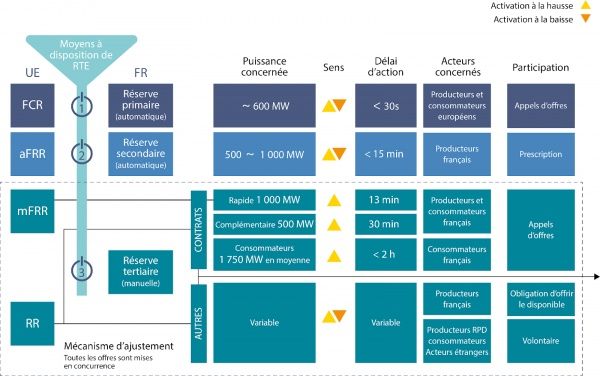
The idea is to keep the frequency from collapsing. These flexible production plants are activated by RTE, as upstream contracts have already been signed with various producers.
RTE also has another available power reserve: this is the adjustment mechanism. Some players make their production capacities available in order to balance the network. They are paid for this service.
It's the TURP who comes to bear these costs and therefore, in the end, all French consumers.
Globally, there is what is called a” network defense strategy ”. That is to say, a set of means to avoid the risks of blackouts.
For example, the N-K rule: regardless of the fortuitous event that occurs, the network must be able to function with the stopping of several power lines. It is for this reason that the lines are doubled. This is why the French network is one of the densest in Europe.
Some major consumers agree to cut their electricity consumption at the request of RTE. They are also paid for this service.
In the event of an overvoltage on the network, the manager may choose to cut off these industrial sites from their electricity. This gives him additional leeway in order to avoid a blackout. During a cold spell, the network can regain balance by cutting off power to major consumers.
In particular, this system was triggered in January 2019 and 2020 by RTE in France.
To find out more, do not hesitate to read our article: Electricity — What are the load shedding scenarios?
Today, we know that at the time of the energy transition, renewable energies will continue to grow.
This fundamental trend in the development of renewable energies will change the structure of the electrical system by accelerating the mutation of a current highly centralized system into a largely decentralized system.
By 2030, 40 to 45% of installed capacity in Europe should be connected to the BT/HTA network, compared to around 25% today, according to ENTSO-E projections.
Technically, this should cause an increase in congestion (overload) on certain lines and cause a backflow of power to the electricity transmission networks.
It is therefore important to monitor this change in production; RTE must regularly deal with the absence of MW of electrical power from renewables.
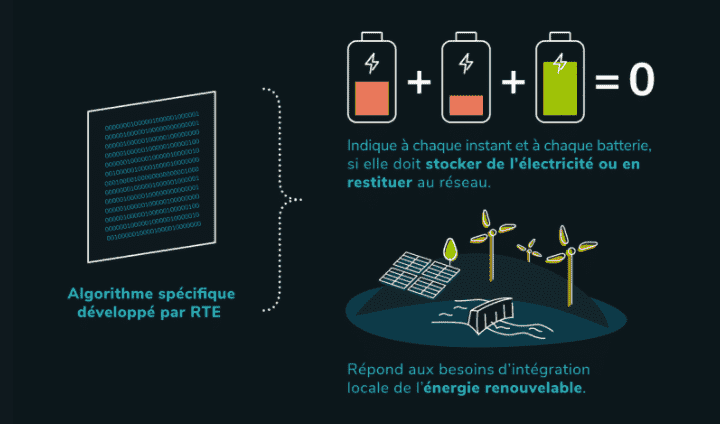
RTE recently launched its project RINGO, a series of batteries aimed at providing services to the electrical network.
As RTE says:” The objective: adapt storage/destocking times according to the electricity load on the network. ” This can be a short-term solution to integrating renewable energies into the network and avoid cuts.
At present, several European countries have experienced deadly terrorist attacks. Intelligence services are also raising the possibility of a massive attack by hackers aimed at cutting a country's power lines.
This is a risk to be assessed, as this type of incident can seriously damage the economy, but also the safety of citizens. At the time of all numerical And Smart Grids, it is important to maintain the integrity of these systems.
We can imagine a coordinated attack on an intelligent network, making it possible to seize a lot of data and do considerable damage.
French network managers are unanimous in recalling the robustness of the French network while stressing that zero risk does not exist. But France is prepared. We have 29 possible incident scenarios and the procedure in case of crisis. Electricity, in fact, is a balancing act. It is necessary to succeed in balancing production with consumption. When consumption is too great, load shedding is carried out, but it is also necessary to avoid producing too much in relation to current consumption.
To learn more about network balancing, feel free to read our article” Who is in charge of balance? ”
In a few clicks, organize an exchange with one of our experts.


weekly newsletter subscribers

4.9
