




Summarize with AI

March 6, 2026
11
Min reading

Every year, the world comes together to negotiate a coordinated response to climate change. This appointment says” Conference of the Parties ” or COP is the supreme decision-making body of the United Nations Framework Convention on Climate Change (UNFCCC).
The first COP took place in 1995 in Berlin. The 3rd, which took place in Japan, allowed the adoption of the Kyoto Protocol. The 21st, which took place in Paris in 2015, allowed the signing of the Paris Agreement.
The 26th and final edition in Glasgow, Scotland, aimed to honor the commitments made in Paris. But what is the real situation?
Through this article, SirEnergies gives you a complete retrospective of the various COPs as well as a projection on what to expect from future COPs.
The COPs were organized in order to limit global warming due to the increase, as a result of human activity, in greenhouse gas emissions (CO2, methane, etc.) into the atmosphere.
The greenhouse effect is a natural phenomenon that is essential for life on Earth. This effect is due to the gases in the atmosphere that prevent some of the sun's radiation from going back into space.
The characteristic, with these greenhouse gases, is because the main one, carbon dioxide, stays in the atmosphere for a very long time. The part of CO2 that will be absorbed the most quickly will already take about a hundred years to be absorbed.
But about a fifth of CO2 will take more than 10,000 years to leave the atmosphere. This phenomenon makes it possible to maintain a very stable temperature on Earth at around 15°C on average, instead of — 18°C in their absence, and this in the absence of human activity.
This is perfect in the absence of human activity that emits greenhouse gases, but in our industrialized societies that emit a lot of CO2, it is a Real problem.

To better understand the phenomenon, we can compare the atmosphere to a bathtub: the CO2 emitted today will join the CO2 emitted over the last 150 years. The atmosphere is filled with CO2 like a bathtub.
The difference, however, is that you don't know how to empty the atmosphere like you do with the bathtub. You must therefore turn off the tap as soon as possible - that is to say stop greenhouse gas emissions - so that the bathtub does not overflow.
Otherwise the gases accumulate in the atmosphere, the greenhouse effect increases and the temperature rises inexorably without being able to lower the fever.
Today, the bathtub is brimming, the atmosphere can no longer receive greenhouse gases and The average temperature on Earth is rising. Greenhouse gas emissions must therefore be stopped to prevent the bathtub from overflowing and limit global warming to +1.5°C if there is still time.
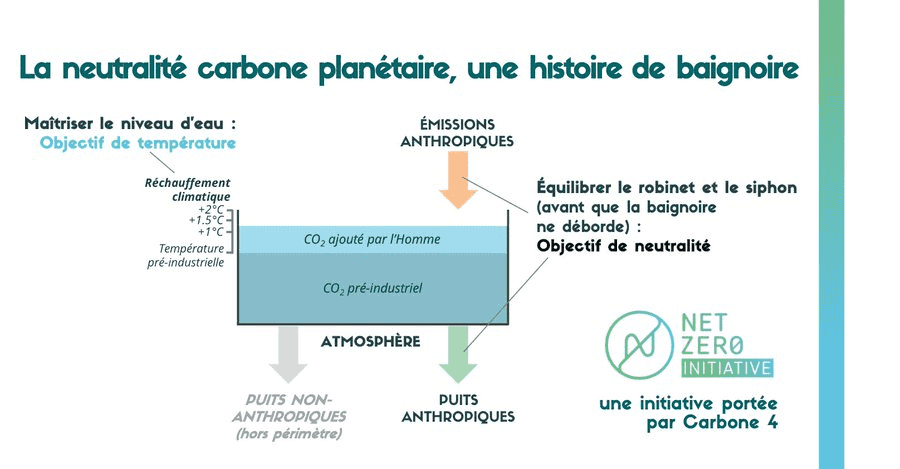
Source: Carbon4
The planet is an ecosystem with a fragile balance. It could be compared to our human body. When our temperature is 39°C instead of 37.5°C, we consult our doctor who prescribes a treatment to lower the fever, otherwise our health suffers.
Well it's exactly the same with the planet, except that there is no treatment to lower fever, because we don't know how to empty the atmosphere of its CO2. The only possible action is to stop all CO2 emissions to curb the greenhouse effect and contain the fever.
The aim of the COPs is therefore to engage the States of the world. to stop their CO2 emissions, that is to say, to put the metaphor, off the faucet in the bathtub before it overflows.
Most of the CO2 emitted by human activities comes from The combustion of fossil fuels - coal first, then petroleum and gas - in thermal power plants and in transport (plane, truck, car).
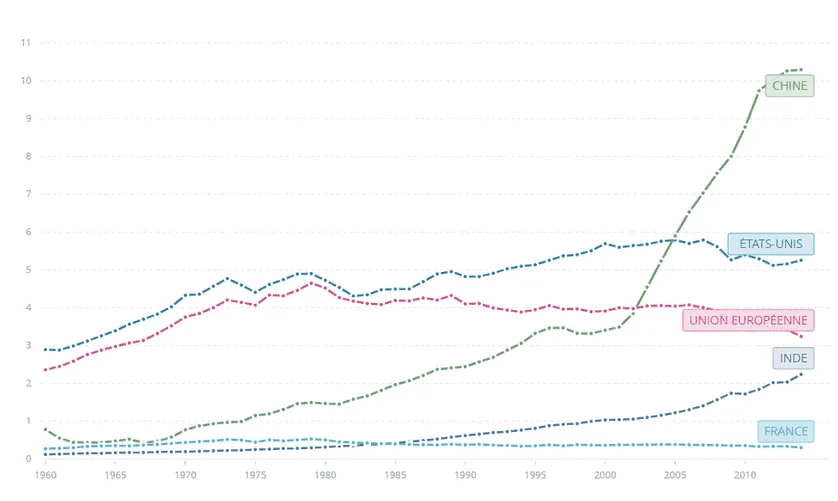
CO2 emissions since 1960 - Source: France Culture
See also a Infographic on coal-fired power plants that have doubled in capacity since the year 2000 by Carbon Brief.
Attention, the climate clock is ticking, every day CO2 emissions are dumped into the atmosphere, filling the bathtub a little more, and any day of inaction, or rather that looks like the day before, accentuates global warming the next day.
It was in 1992 during the third Rio Earth Summit that 196 nations decide to meet each year, under the aegis of the UN, in a “Conference of Parties” or “COP”, to take measures in favor of environmental protection and sustainable development.
It was in 1994 that the UNFCCC was created to stabilize greenhouse gas emissions and protect the Earth from the threat of climate change. Today 200 countries are members of the UNFCCC.
The first COP was held in Berlin in 1995. It does not lead to concrete measures, but the 120 governments present recognize the seriousness of the situation and the need to reduce greenhouse gas emissions resulting from human activities.
The third Kyoto COP in 1997 was historic because it finally made it possible to achieve numerical objectives for reducing greenhouse gas emissions. The signatory countries have committed themselves to reducing their emissions into the atmosphere by at least 5.2% by 2012 compared to 1990, when the first report from the IPCC (Intergovernmental Panel on Climate Change).
During the COP21, countries sign theParis Agreement which urges signatory countries to limit global warming to a level well below 2 degrees compared to the pre-industrial era.
At the request of the most vulnerable countries, the need for continued action to limit the temperature rise to 1.5 degrees was added. This agreement is built on the basis of a bilateral agreement signed a year earlier between Washington and Beijing under the presidency of Barack Obama.
The last one, the COP26, which took place in Glasgow from 1 to 12 November 2021, had the agenda of engaging participants in achieving more ambitious goals to reduce greenhouse gas emissions by 2030 and to discuss measures to adapt to the unavoidable consequences of climate change.
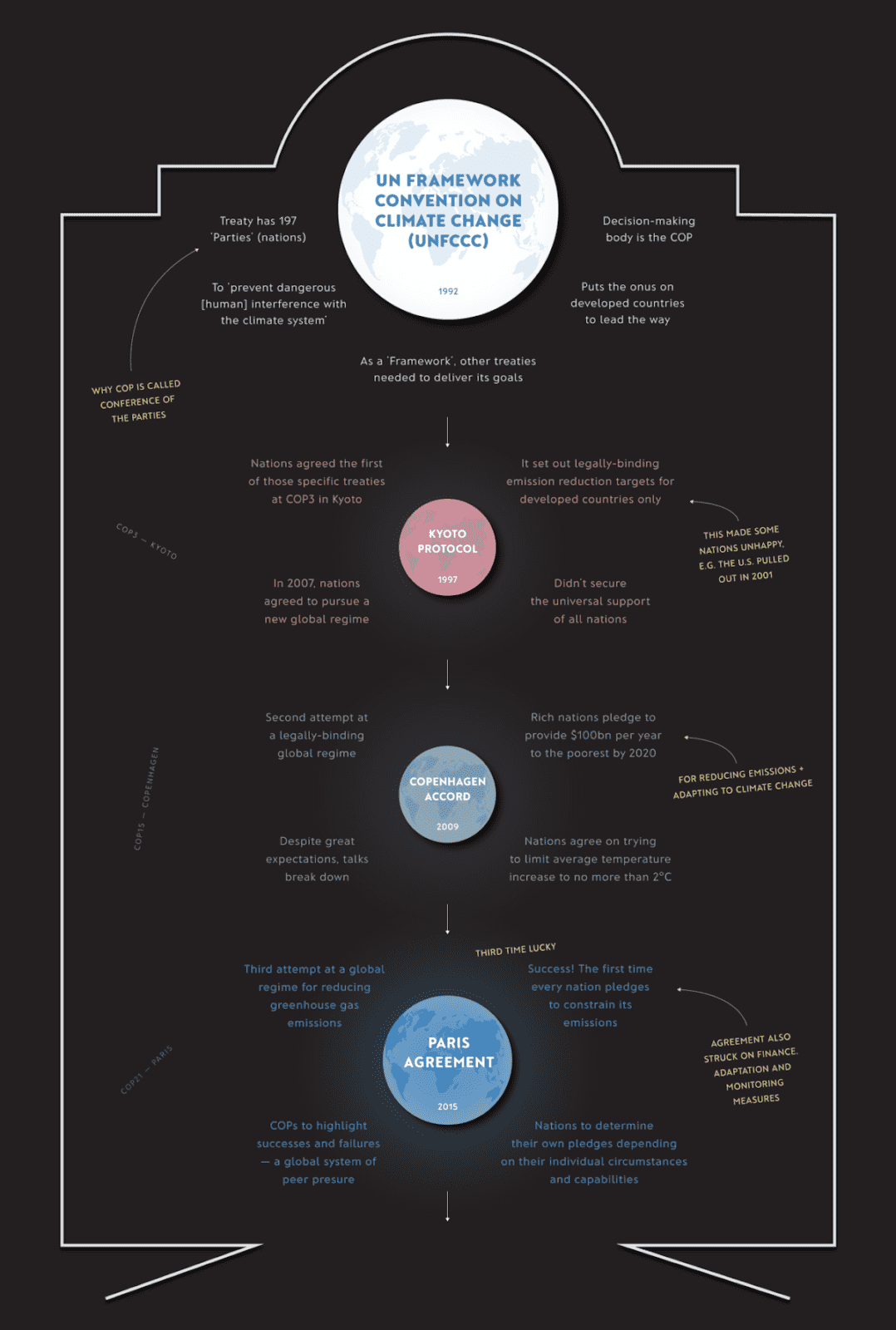
History of COPs - Source: Energy&Climate
For climate historian Amy Dahan, while COPs have not prevented greenhouse gas emissions from continuing to increase, and if they are sometimes more like “a bubble cut off from reality”, COPs serve to “mobilize civil society and raise public awareness”.
The COP mechanism has the virtue of putting each state and government under the gaze of all the others, but also under the gaze of civil society and public opinion, and whoever does not hold their own is blamed by all the others.
This is why the COPs bring together all types of actors for 2 weeks: scientists, researchers, associations, companies, unions, NGOs, etc. who can be identified by their badge.
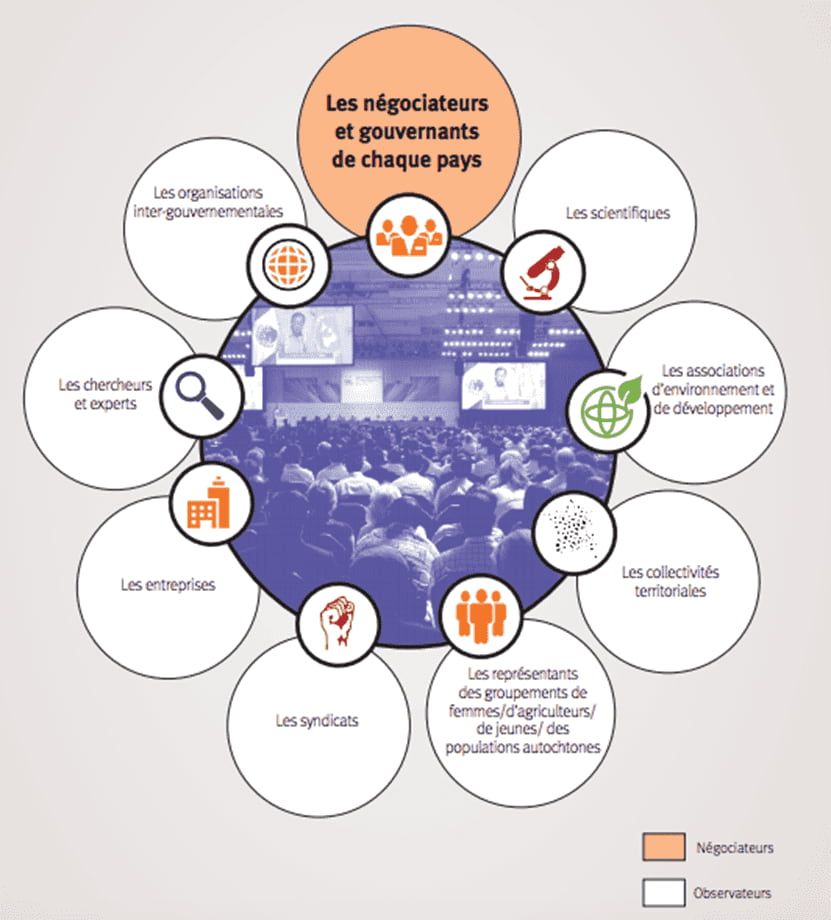
Source: Macop21
It is important to understand how the COP works, how it integrates actors who are never heard, such as small island states, associations and civil society participants, including students.
This strength ofcollective self-regulation What are COPs is based on the concern for the public image, the opinion of civil society, and the lobbying of NGOs. NGOs were present in Glasgow and they were the ones who did the work of pressure and control on the states.
Indeed, today, there is no mechanism to ensure that countries have met their commitments. The COP mechanism is always based on a declarative regime, only NGOs investigate and call states to order. The role of NGOs is therefore very important.
“Can I just say to all the delegates that I apologize for the way this process went, and I am deeply sorry. I understand your profound disappointment, but I think that as you noted it is also vital that we protect this agreement.”
It was with tears in his eyes and deeply saddened that Alok Sharma, the British president of the 26th World Climate Conference, presented the agreement reached before ratifying it with a hammer blow. This Glasgow Pact was adopted by the 200 signatory countries although unanimously considered disappointing.
The challenge of this COP, 26th in name, was toHonoring the promise of the 2015 Paris Agreement which gave each State an appointment 5 years later so that it could increase its commitments.
During this COP, 150 countries raised their ambitions, however, despite this, the trajectory followed led us to +2.7°C at the end of the century, which is considerable.
The promise of the Paris Agreement was only very partially held in Glasgow:
In the end, with many difficulties, an agreement was signed by the 200 participants:
In summary, this agreement is very disappointing. It will (probably) not be able to contain global warming to 1.5°C. It does not respond to requests for help from poor countries. It was not a COP for nothing but it is very far from being the big night.
Today, what is very positive is that all countries take for granted the fact that COPs are Major appointments, events in which everyone must participate: very different states take scientific data seriously and discuss redistribution mechanisms and joint projects with civil societies. In itself, this is already a very big step forward.
A COP is now a major diplomatic event. The joint statements of the Chinese and the Americans show that COP26 made it possible to overcome major antagonisms in order to respond to a deeply common problem.
Because if there is one subject on which global governance is needed, it is the climate, because no one is innocent and everyone will be a victim, so it is really a global subject by definition.
However, to meet the goal of global warming below 1.5°C, it is necessary as a preliminary step reduce greenhouse gas emissions by 45% compared to the 2010 level, which this COP26 reaffirmed in its objectives. However, we are currently on a trajectory, not of reduction but of increase of around 15% by 2030.
Between 2015 and 2019 in France, we did less than half of the greenhouse gas emissions reduction trajectory that we needed to do: we are at 3.5 and we should be at 9.
This COP is the end of a cycle, representatives are discussing, countries are making promises, but now is the time for action. The COP mechanism cannot go much further if states do not deliver concrete results. Otherwise, the stated ambitions will deviate from reality to the point where the process will end up being discredited.
Before a COP is held, States send their declaration of efforts. It is therefore important to understand that the model is still very largely declarative. And everyone knows that results are not won during COPs, they are won locally in each country, region and territory.
In COPs the results are measured, commitments are made, and a framework is given. Then everything happens locally, in each of the participating countries.
At their level, everyone must therefore roll up their sleeves and fight against their greenhouse gas emissions. Everywhere you have to engage in discussions and avoid imposing norms or coercive measures that could cause social convulsions on fragile populations, let us remember the yellow vests. Any social conflicts would only lead to wasting time on the decarbonization trajectory of our societies.
So it's a very fine balance to find, a path on a crest line between two chasms: the chasm of inaction and climate peril, and the chasm of social convulsion and collective failure.
Each government must address its entrepreneurs, its population, and its manufacturers by saying to them that's it, it is now necessary to make concerted, negotiated and discussed efforts so that all solutions can be found to respect the commitments made to the whole world. It is this work that must be done today everywhere and especially at home in France in the face of the climate emergency.
Do not hesitate to consult our article that answers the question: Is renewable energy still the best option?
Resulting from a desire of the French government, the Tertiary Eco Efficiency System (DEET) also called Tertiary decree, requires a gradual reduction in energy consumption for French tertiary buildings greater than 1,000 m².
This regulation aims to save 60% of final energy in these buildings by 2050.
We support you in the compliance tertiary buildings in order to comply with the obligations of the tertiary decree.
Click below for more information:
In a few clicks, organize an exchange with one of our experts.


weekly newsletter subscribers

4.9

.png)

Yes. The supplier guarantees an offer 100% renewable via the official Guarantees of Origin (GO) mechanism.
For the most demanding companies, the offer GREENVOLT+ ensures very low carbon intensity electricity, sourced exclusively from independent French producers (hydraulic, wind, solar).
To calculate Scope 2 emissions, use the following formula:
Energy quantity (kWh) × Emission factor (kg CO₂ e/kWh).
Use databases like ADEME for precision.
It allows you to prove your commitment to the energy transition and to meet regulatory requirements.
Les coopératives de taille ETI ou grande entreprise peuvent être soumises à l'audit énergétique réglementaire (norme NF EN 16247). Sirenergies n'a ni la compétence ni l'accréditation pour réaliser cet audit : nous vous orientons vers un bureau d'études partenaire accrédité, et vous accompagnons en amont sur vos achats et en aval sur le pilotage.
La réussite d'un projet collectif énergie repose sur trois piliers fondamentaux :
Le calendrier 2026 impose deux échéances majeures :
Pour simplifier ces démarches, vous pouvez centraliser vos données de consommation avec la plateforme Pilott de Sirenergies, garantissant ainsi la conformité de vos rapports réglementaires.