





Summarize with AI

February 19, 2026
4
Min reading

The ARENH 2025 window closed this Friday, November 29, 2024.
For you, consumers and customers, this device dedicated to electricity suppliers may seem remote and obscure and may not concern you.
Think again. The ARENH law of suppliers has a direct impact on your energy bill.
In recent years, traffic jam has contributed to the rise in electricity rates. You are concerned as soon as you have taken out an electricity contract with ARENH indexed prices.
But what is clipping? What is its impact on invoices? Can businesses take action now to limit the impact on their energy costs?
Here is all the information on ARENH to anticipate and secure your electricity budget.
The ARENH system was set up in 2011 by The NOME law on the New Organization of the Electricity Market, following the work of the Champsaur Commission.
This device aims to promote fair competition between the historical electricity supplier, EDF, and alternative suppliers.
The objective? Ensuring affordable electricity prices for all consumers, as part of The opening of energy markets to the competition in France.
ARENH signifies Regulated Access to Historic Nuclear Electricity. Thanks to ARENH, each alternative supplier can cover part of the electricity consumption needs of its customers by buying a share of Nuclear power generation. This access to more competitive electricity promotes the control of the prices of electricity offers.
The volumes of nuclear electricity sold at advantageous prices by EDF to alternative suppliers are capped by law. This cap was put in place to preserve the financial capacities of the main French electricity producer and supplier.
For many years, The ARENH ceiling is set at 100 TWh, with an exceptional increase to 120 TWh in 2022. This ceiling corresponds to around a third of France's current nuclear production.
ARENH's 100 TWh is divided between all alternative suppliers who have filed an ARENH application with the Energy Regulatory Commission (CRE). However, since 2018, the total volume of ARENH requested by all suppliers has exceeded the ARENH ceiling.
The clipping mechanism was put in place to regulate requests and Guarantee access to historic nuclear electricity for all, within the framework of healthy competition.
The capping is based on the following principle: allocating a share of ARENH, even partial, to all suppliers, rather than giving 100% of their demand to some and 0% to others.
The capped ARENH portion corresponds to the calculation of Difference between the overall volume of ARENH requested by alternative suppliers and the annual ARENH limit available.
Evolution of ARENH orders (in TWh) since 2018:
For example, for the year 2024, the total quantity of ARENH requested was 130.41 TWh for a maximum volume of 100 TWh. The CRE therefore carried out a shearing of 30.41 TWh, i.e. a shearing rate of 23.32%.
In concrete terms, this means that the alternative suppliers have all seen their ARENH demand met by 76.68%.
This Friday, November 29, 2024, as part of the historic ARENH 2025 regulated access to nuclear electricity mechanism, the CRE (Commission de Régulation de l'Énergie) has just announced the allocation rate.
It amounts to 74.12% with a controlled volume of 134.93 TWh, i.e. a peak of 25.88% (versus 23.32% in 2024).
The CRE recalls that the quantity of electricity allocated to suppliers has been set at a price of €42/MWh and is still capped at 100 TWh for the year 2025.
All consumers who have subscribed to ARENH indexed price contracts are entitled to a share of electricity from nuclear sources at a more competitive rate. But The locking mechanism reduces everyone's ARENH right, with repercussions on electricity bills.
Indeed, alternative suppliers must buy the limited portion of electricity on the energy market. However, prices on the wholesale market are volatile and much higher than those for nuclear electricity. The ARENH is now fixed at €42/MWh. These higher supply prices are passed on by suppliers in their electricity offers, with an upward revision of contract rates.
At SirEnergies, our innovative tool allows you to easily access, in a few clicks, Historical market prices.
Simplify your energy management today!
Regardless of the supplier, a high ARENH cap rate therefore results in a Inevitable increase in bills electricity for consumers, businesses, communities and individuals.
As a business, you don't have no control of the ARENH locking mechanism applied by CRE. But you can take action to limit its impact on your electricity bills.
In the short term, to secure your energy budget, you can subscribe to a new electricity offer before the ARENH 2025 counter. Until December 31, 2024, you can still benefit from the known and advantageous pricing conditions of ARENH 2024.
If you anticipate significant ARENH losses, you can also ask your energy supplier tobuy your capped electricity share in advance on the market, without waiting for the end of the year when prices are in the habit of soaring.
However, this requires expert knowledge to estimate the ARENH limit and identify the most financially favorable period for the supply of electricity on the wholesale market.
In the longer term, the best way to lower your electricity bill is to reduce your consumption at the source. Investing in energy sobriety, energy efficiency and renewable energies, it is the winning trio to control your energy expenses and improve your carbon footprint.
The end of ARENH is announced for December 31, 2025. The State and EDF signed a first agreement in November 2023, outlining the outlines of the new price control system from 1 November 2023.Er January 2026. However, voices are being raised to call for new negotiations in 2025.
EDF is banking on the signing of long-term contracts of at least 5 years. This period should allow businesses to secure their energy supply, by benefiting from a better visibility on prices.
With more stable prices, long-term contracts must protect companies from market vagaries and optimize energy purchases.
The bill provides for a Nuclear universal payment financed by a nuclear contribution. These would be levied on sales of electricity produced by the national nuclear park, above a reference price.
EDF and the State have set the nuclear energy reference price around €70/MWh. The bill provides for a 50% levy of EDF's additional income when the price increases between €78 and €110/MWh. This rate rises to 90% above €110/MWh.
To avoid an increase in electricity prices, the revenue collected will be directly redistributed to consumers individuals and professionals, regardless of their supplier. However, the terms of this payment remain to be specified.
The regulated electricity sales tariff is now available to companies with less than 10 employees, whose turnover does not exceed 2 million euros and whose subscribed power is less than 36 kVA.
The law of 11 April 2024 removed this last threshold. From the 1Er February 2025, all companies meeting the workforce and turnover conditions will be able to subscribe to a TRV contract regardless of the power subscribed.
Until the end of ARENH, suppliers will communicate to their customers in January 2025 the new electricity rate applicable to their contract for the year. These will have to take into account the share of ARENH allocated and the share of electricity purchased at the end of 2024 on the wholesale market.
SirEnergies recommends that you check your first invoices carefully to ensure that your supplier did not make a mistake in calculating any additional costs associated with the ARENH cap.
Our experts are at your side to optimize your energy purchases and anticipate the end of ARENH today.
The Sirenergies firm provides you with an innovative tool allowing you to Easily calculate your ARENH fees
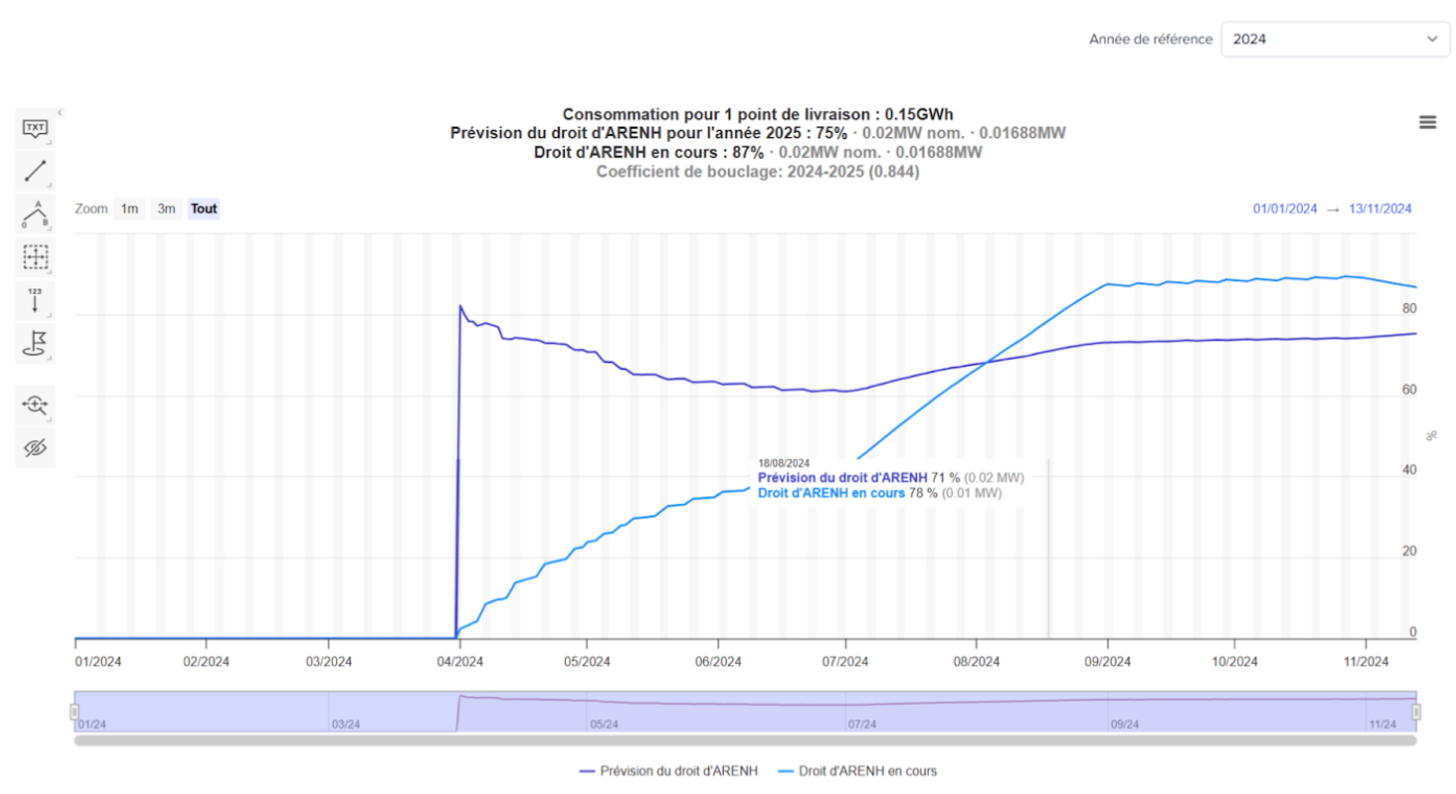
Source: Sirenergies tool
Take the first step towards controlling your energy budget now! 🚀
In a few clicks, organize an exchange with one of our experts.

weekly newsletter subscribers

4.9

.png)

Sourcing consists in identifying and analysing the offers of several electricity and gas suppliers. This approach makes it possible to obtain contracts adapted to the consumption profile and budgetary constraints of the company.
Même le bâtiment le plus moderne et le mieux isolé perd son efficacité si ses usages sont inadaptés. La technologie et les normes ne suffisent pas : la transition énergétique est avant tout une transformation humaine.
Derrière chaque kilowattheure consommé se cache une habitude.
Un collaborateur sensibilisé comprend qu'ouvrir une fenêtre alors que le chauffage est allumé ou laisser un ordinateur en veille consomme de l'énergie inutilement. En replaçant l'humain au centre de la stratégie de gestion de l'énergie, l'entreprise s'assure que ses équipements performants sont utilisés de manière optimale, garantissant ainsi une rentabilité durable et un impact environnemental réduit.
Les profits include a direct reduction in bills, strengthened budgetary forecasting and better control of consumption. Businesses gain visibility and efficiency thanks to adapted tools.
Le processus repose sur l'utilisation de la force de l'eau (énergie cinétique) issue des courants, des chutes d'eau ou des dénivelés. Le fonctionnement suit trois étapes clés :
Le kVA mesure la capacité maximale que votre compteur peut supporter à un instant T, tandis que le kWh mesure la quantité d'énergie consommée sur une durée.
C'est le levier le plus rapide pour obtenir des résultats visibles. L'éclairage représente environ 40 % de la consommation d'électricité d'une commune.
Passer au LED avec pilotage intelligent permet de réduire la facture de 50 à 80 %, avec un retour sur investissement (ROI) rapide, souvent estimé à 2 ou 3 ans.
One invoice consists of several elements: consumption, supplier share, taxes and contributions. The analysis of each line makes it possible to identify possible errors and to check the consistency with the signed contract.
Un appel d’offres permet de mettre en concurrence plusieurs fournisseurs d’électricité et de gaz afin d’obtenir des conditions contractuelles optimisées. C’est une démarche transparente qui permet de choisir l’offre la plus adaptée aux besoins budgétaires et techniques de l’organisation.
Communities are subject to taxes such as TICFE or TICGN. Sirenergies analyzes invoices, identifies exemption possibilities and fixes possible errors to reduce the tax burden.
Le calendrier 2026 impose deux échéances majeures :
Pour simplifier ces démarches, vous pouvez centraliser vos données de consommation avec la plateforme Pilott de Sirenergies, garantissant ainsi la conformité de vos rapports réglementaires.
The subscribed power must be calculated according to the consumption profile and uses (heating, industrial processes, tertiary equipment). One fine analysis makes it possible to ensure the adequacy between real need and contract.
This makes it possible to choose the right time to contract, secure your budgets and anticipate increases.
All businesses, from SMEs to large organizations, can benefit from this service. Les local authorities also find it a lever to better control their budgets.
Changing suppliers can allow you to benefit from more competitive prices, adapted services or better contractual conditions. Thanks to sourcing, change is happening without interruption of supply.
L'ARENH est remplacé par le VNU (Versement Nucléaire Universel), un mécanisme de redistribution des revenus excédentaires d'EDF en cas de prix très élevés, et par les CAPN, des contrats long terme pour les gros industriels.
En analysant votre courbe de charge pour identifier la puissance réelle appelée, puis en demandant un ajustement à votre fournisseur ou via un expert en énergie.
En 2026, les principaux leviers sont : la renégociation de votre contrat de fourniture au bon moment, l'optimisation de votre tarif d'acheminement (TURPE), la vérification de votre éligibilité aux taux réduits de taxes (Accise), et la réduction de votre consommation (efficacité énergétique, autoconsommation).
Plusieurs leviers existent pour préserver la fiscalité locale :
Farms are subject to taxes such as TICFE or TICGN. Sirenergies verifies their application, identifies cases of exemption and accompanies the procedures to reduce the tax burden.
Industrial companies consume large volumes of energy for their production processes. They have to deal with the volatility of prizes, multi-site management and specific taxes. Controlling costs is essential to remain competitive.
Among the taxes include TICFE, TICGN, CTA, CJA and TURPE. They represent a significant part of the bill and vary according to consumption profiles. Understanding them well is essential to optimize costs.
In 2025, the supplier had a NPS (Net Promoter Score) of +16 and a note of 4,17/5.
Satisfaction is based on a “zero solicitation” model and 100% in-house customer service in Toulon, guaranteeing proximity and responsiveness that cannot be found with major historical suppliers.
Parce que la puissance souscrite en kVA détermine le prix de l'abonnement et que tout dépassement peut entraîner des surcoûts importants.
Exceeding capacity leads to financial penalties and can impact the size of the contract. Adjust the correctly subscribed power makes it possible to avoid these additional costs.
Some businesses may obtain a partial or total exemption from the TICFE or the TICGN, depending on their activity and energy intensity. The support of an expert makes it possible to identify the eligibility criteria and to put together the file.
Oui, elle est considérée comme une énergie renouvelable à faibles émissions de gaz à effet de serre.
De plus, l'eau ne subit aucune transformation chimique durant le cycle de production et réintègre son milieu naturel en aval.
Cependant, la construction de barrages nécessite des mesures pour protéger les écosystèmes (débit minimum, passes à poissons).
Yes. The supplier guarantees an offer 100% renewable via the official Guarantees of Origin (GO) mechanism.
For the most demanding companies, the offer GREENVOLT+ ensures very low carbon intensity electricity, sourced exclusively from independent French producers (hydraulic, wind, solar).
Le transport (RTE) correspond aux "autoroutes" de l’électricité. Il s’agit de transporter de très grandes quantités d'énergie sur de longues distances, depuis les centrales de production (nucléaires, barrages, parcs éoliens offshore) vers les régions de consommation.
La distribution (Enedis) s'apparente aux "routes départementales" et aux rues. Elle récupère l'électricité à la sortie du réseau de transport pour la livrer directement chez le client final, en abaissant la tension pour qu'elle soit utilisable par vos appareils.
Le dispositif ARENH a laissé place au VNU (Versement Nucléaire Universel).
Ce changement structurel expose davantage les entreprises aux prix de gros, rendant la gestion des risques plus complexe qu'auparavant.
Il devient alors indispensable de définir une stratégie d'achat d'électricité avec Sirenergies pour lisser l'impact de la volatilité des marchés sur votre budget.
The €/MWh is a price unit used in wholesale markets, while kWh is the unit visible on your bills.
Tertiary companies are concerned by taxes such as TICFE or TICGN. Sirenergies checks the accuracy of invoices, identifies possible exemptions, and helps correct errors to sustainably reduce costs.
La réussite d'un projet collectif énergie repose sur trois piliers fondamentaux :
C'est l'indicateur d'efficacité d'un appareil électrique ; il représente le ratio entre la puissance active (utile) et la puissance apparente (totale).
The industry is concerned by TICFE, TICGN and other contributions that may represent an important part of invoices. Sirenergies identifies cases of exemption and accompanies the procedures to benefit from them.
The range E @sy is available in four pricing structures to adapt to each risk profile:
Tertiary companies must manage their energy costs while guaranteeing the comfort of users (offices, shops, services). Consumption is often linked to heating, air conditioning and lighting, which requires precise monitoring to avoid budgetary excesses.
Idéalement entre 6 et 12 mois avant l'échéance, de préférence au printemps ou au début de l'été lorsque la demande est plus faible.
These are signals sent by RTE during periods of tension on the electrical network. The Sirenergies tool informs you in real time to anticipate your uses.
Pas nécessairement sur votre facture finale. Si les prix de gros (le prix de l'énergie brute) ont baissé, les coûts d'acheminement (TURPE) et certaines taxes augmentent, compensant souvent la baisse de la part énergie.
Farms must deal with high seasonal needs (greenhouse heating, irrigation, storage) and high volatility of prizes. Controlling these costs is essential to maintain profitability and secure the business.
Ce record de 92,3 TWh s'explique par la conjonction de trois facteurs :
L'abondance de production française tire les prix du marché de gros vers le bas.
En vertu du mécanisme de l'Ordre de Mérite (Merit Order), les centrales les moins coûteuses (nucléaire, renouvelables) couvrent la demande plus souvent, évinçant les centrales à gaz ou charbon plus onéreuses.
Cela multiplie les épisodes de prix bas, voire négatifs, sur le marché spot.
Sourcing offers better visibility on the market and promotes the selection of competitive contracts. It helps to reduce the risks associated with price volatility and to optimize the energy budget.
En 2025, la France a atteint un solde exportateur net de 92,3 TWh, battant le précédent record de 2024 (89 TWh).