




Summarize with AI

March 4, 2026
6
Min reading
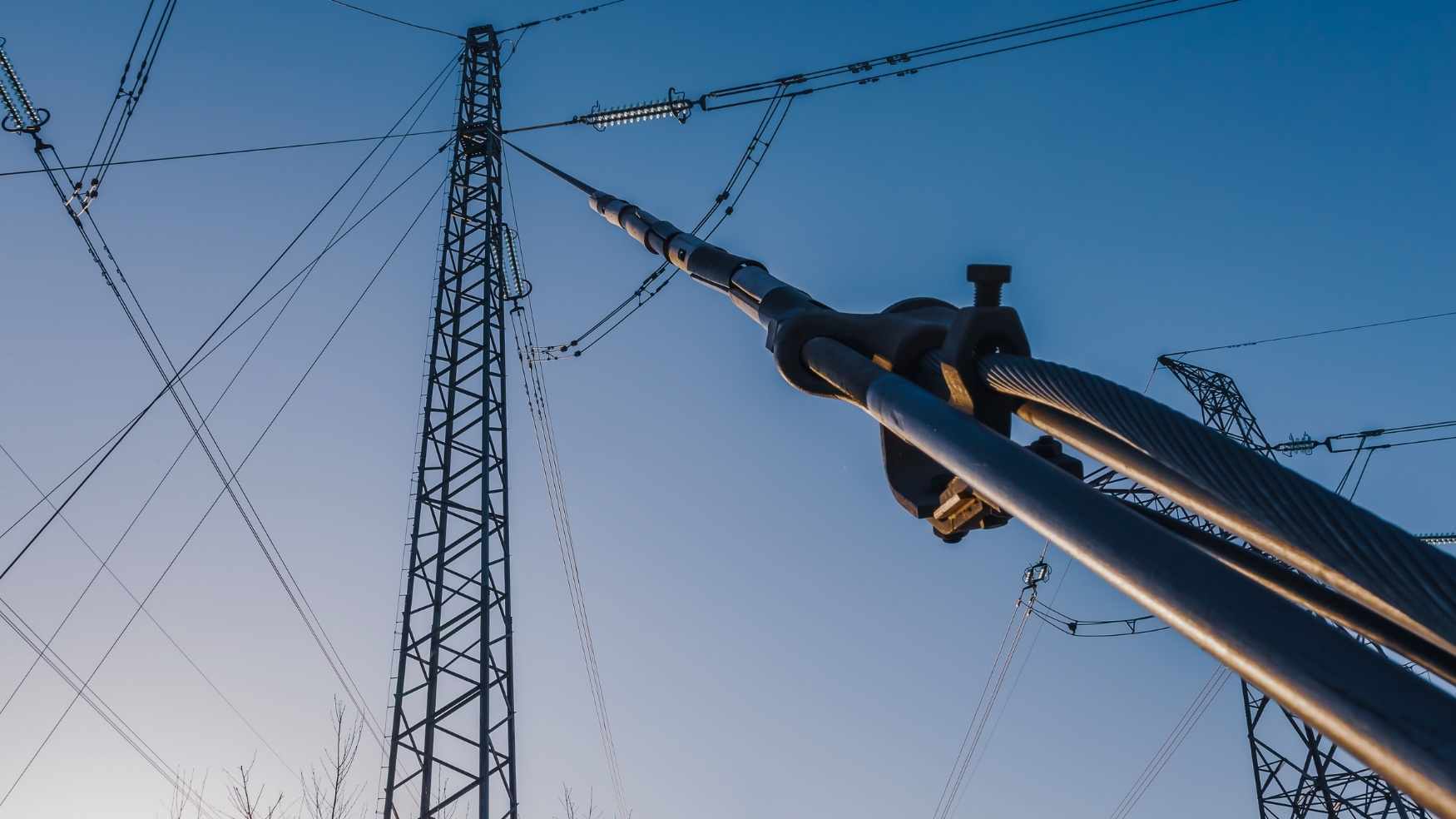
On February 6, 2025, the Energy Regulation Commission published the outlines of the future TURPE 7, the tariff for the use of public electricity networks. The new provisions will come into force on 1Er August 2025 for a period of 4 years, except for anticipated tariff movements as of 1Er February 2025. These “draft decisions” have yet to be sent to the Social and Economic Committee (ESC) for an opinion.
Faced with the major challenges of energy transition and climate change, what are the main orientations of TURPE 7 for the period 2025-2028?
Sirenergies deciphers the news.
The TURPE 7 proposals are the result of a Equilibrist number driven by The CRE, in consultation with all electricity players in France. The challenge? Maintain electricity costs that are accessible to consumers while meeting investment challenges.
The TURPE (tariff for the use of electricity networks) is the rate paid by the consumer professional and individual on his electricity bill for the use of public networks transport and distribution.
The TURPE Finances maintenance Networks and investments necessary to guarantee the security of supplies. Received by electricity suppliers, TURPE's revenues are entirely paid to network operators, RTE on the transport side, and Enedis and the Local Distribution Companies (ELD) on the distribution side.
The TURPE 7 is amended every 4 years on the proposal of the CRE.
The TURPE 7 is part of a turbulent context with contradictory challenges.
The CRE must deal with, on the one hand, vulnerable consumers by inflation, and on the other hand, a aging electricity network, shaken by climate change. The acceleration ofelectrification of uses industrial and domestic and theRise renewable energies are added to this complex equation.
But the observation is relentless. Faced with the necessary energy transition, electrical network managers must increase their investments to modernise infrastructures, improve their resilience capacity and strengthen their flexibility.
The TURPE 7 aims to support this ambition, while protecting electricity prices and the consumer.
The TURPE 7 draft decisions are the result of a long consultation conducted since the end of 2023. Public consultations, thematic workshops and round tables followed one another to gather the views of all stakeholders. On the agenda, discussions on the pricing structure, the flexibility of the electrical network, connections, the quality of service of managers or even investment trajectories.
The TURPE 7 creates a break in continuity. While the rate structure is little changed, new features are announced, including a rate increase, the relocation of off-peak hours and new rate options. These provisions will come into force for a period of 4 years starting on 1Er August 2025. An exception: the price change has already been anticipated in 1Er February to take advantage of the fall in wholesale electricity prices on the markets.
To meet growing investment needs, the TURPE 7 rate is increased by 7.7% From the 1Er February 2025.
The objective: finance the increase in investments supported by managers of public electricity networks. Thus, RTE announces 6.2 billion euros in investment in 2028 against 2.1 billion euros in 2023. Enedis aims for 5 to 7 billion euros over the same period.
These investments meet the challenges of energy transition. In particular, they must make it possible to:
The pricing structure refers to how network costs are allocated to different categories of users. Elle maintains the fairness of the network by passing on to everyone the costs that they generate according to their consumption characteristics.
Overall, TURPE 7 confirms the pricing structure of TURPE 6. However, some major changes have been announced.
For the consumer, the Displacement of off-peak hours in the afternoon is the main revolution of the TURPE 7. This change aims to encourage electricity consumption at times when photovoltaic production is the cheapest and most abundant.

Source: New placement of off-peak hours — Appendix Press release TURPE 7 — CRE
The main principles proposed are as follows:
The shift to off-peak hours will come into effect progressively starting in autumn 2025 and until the end of 2027, in order to allow the gradual modification of the meters. Consumers will be notified by their electricity supplier at least one month in advance.
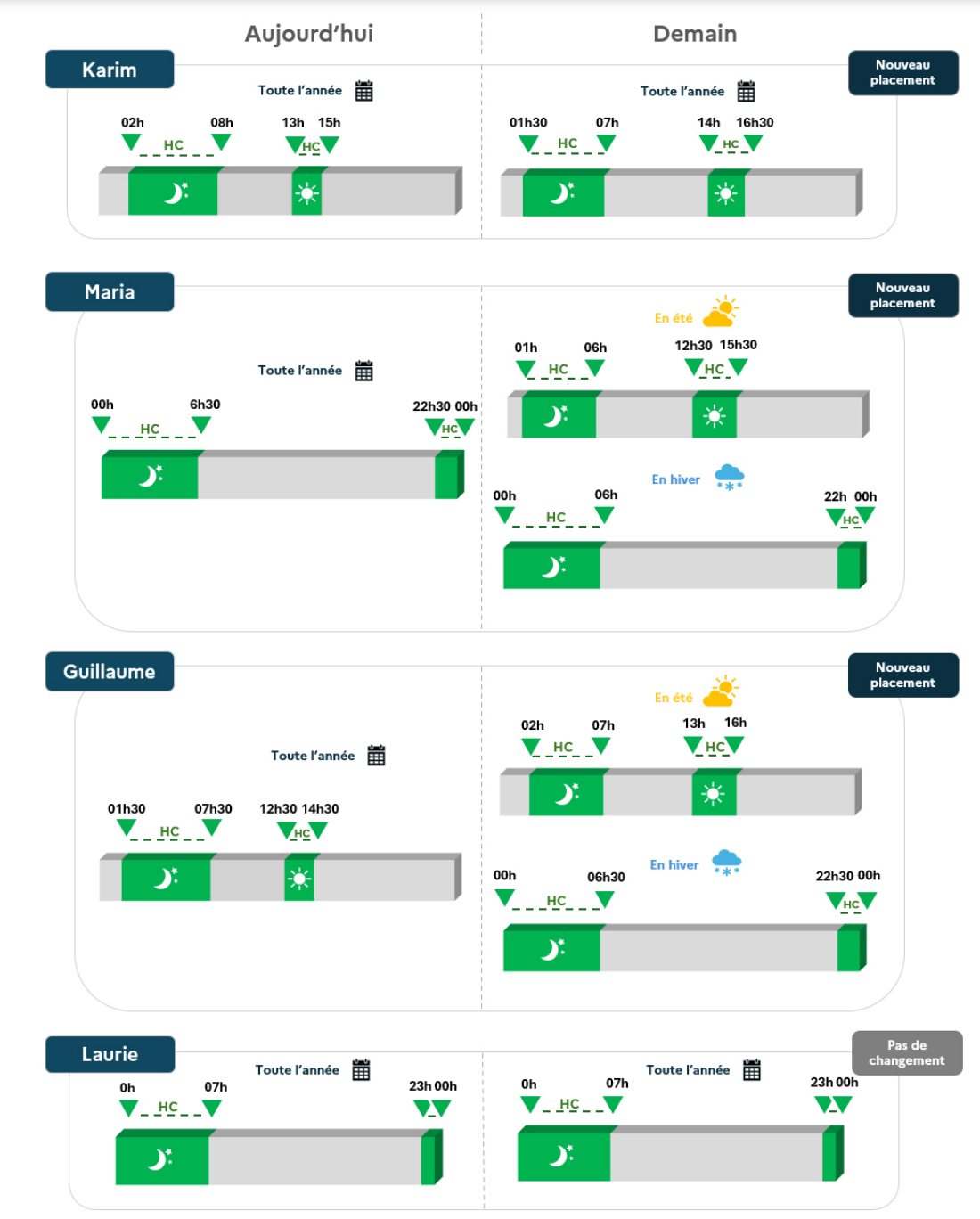
Source: Examples of off-peak hours (HC) placement — Appendix TURPE 7 press release — CRE
TURPE 7 foresees additional financial costs for consumers who have made the choice not to equip themselves with a Linky meter.
2.1 million users are affected.
Starting on 1Er August 2025, they will have to pay 6.48 euros every two months to cover backup costs. An additional 4.14 euros will be billed every two months to consumers who do not provide their electricity index or do not respond to requests for backup appointments.
The TURPE 7 adds a racking/injection pricing option. The objective: to promoteusing battery storage capacities to add flexibility to the grid and balance electricity supply and demand.
The principle is simple. During local consumption peaks, the aim is to encourage consumers equipped with batteries to inject some of the stored electricity into the grid to help cover demand. Conversely, they will be encouraged not to inject — or even remove electricity from the grid — when the electricity supply is at its highest.
TURPE 7 reinforces regulatory incentives and mechanisms, by setting three priorities for network operators:
To conclude
The TURPE 7 meets the challenges of adapting electricity networks to climate and energy challenges. The challenge: maintaining a fair balance between network efficiency and costs for the consumer.
Faced with the increase in TURPE, Sirenergies helps companies and communities to analyze their energy profile. Optimizing the cost of TURPE is possible by playing on consumption characteristics (subscribed power, connection voltage, power overruns, tariff version, etc.).
Impacted by the rise in TURPE? Find out how to reduce your energy costs now.
In a few clicks, organize an exchange with one of our experts.


weekly newsletter subscribers

4.9

.png)

Ce seuil est jugé élevé par rapport aux prévisions actuelles du marché. Si le prix de l'électricité reste en dessous de 78 €/MWh, les entreprises ne bénéficieront d'aucune redistribution. Cela signifie que la protection promise par la réforme pourrait être inexistante dans un marché baissier, d'où l'importance de stratégies de sourcing agiles et d'outils de monitoring comme Pilott.
L'impact dépendra des prix de marché. Le mécanisme prévoit une redistribution si les prix dépassent 78 €/MWh. Cependant, si les cours restent bas (actuellement autour de 60 €/MWh), le dispositif ne s'activera pas. La facture sera alors indexée à 100% sur les prix de marché, rendant le choix du fournisseur et du moment d'achat critiques.
Chaque modèle d'IA répond à un besoin spécifique du cycle d'achat :
L'expertise humaine reste néanmoins indispensable.
Car les marchés dépendent de facteurs exogènes imprévisibles (géopolitique, météo soudaine, politique) que les modèles basés sur l'historique ne peuvent pas anticiper, tout comme on ne prédit pas le Loto.
La Vente de Nucléaire Universelle (VNU) est le nouveau mécanisme de régulation des prix de l'électricité en France. Contrairement à l'ARENH, il ne s'agit plus d'un volume fixe à prix réduit, mais d'une redistribution financière des revenus excédentaires d'EDF aux consommateurs, basée sur les prix de marché et les coûts de production du nucléaire historique.
La fin de l'ARENH (Accès Régulé à l'Électricité Nucléaire Historique) marque l'arrêt de la fourniture d'électricité à prix fixe garanti (42 €/MWh).
Dès le 1er janvier 2026, les entreprises sont exposées aux prix de marché, mais deux nouveaux mécanismes de régulation prennent le relais, bien que leur logique soit différente :
Conseil stratégique : Ne comptez pas sur le VNU pour réduire votre facture en 2026 si les marchés restent stables. Auditez vos contrats dès maintenant pour intégrer une part de prix fixe ou explorer des "Power Purchase Agreements" (PPA) pour sécuriser vos coûts sur le long terme.
Instauré en 2017, ce dispositif répond à un enjeu de sécurité nationale.
L'électricité ne se stockant pas à grande échelle, le réseau doit être capable de répondre instantanément à la demande, même lors des pics de froid hivernaux. Le mécanisme incite financièrement les producteurs à maintenir leurs centrales disponibles et les entreprises à réduire leur consommation (effacement) lors de ces périodes critiques.
Absolument. La réforme des heures creuses vise à absorber la surproduction solaire en milieu de journée. Les créneaux d'heures creuses se déplacent progressivement vers la plage 11h00 – 17h00, notamment en été. C'est une opportunité majeure pour les sites industriels ou tertiaires capables de flexibilité.
Conseil stratégique :
The central objective of PPE 3 is to engage France towards carbon neutrality by 2050 by breaking the country's historical dependence on fossil fuels.
Today, approximately 60% of final energy consumption in France still relies on imported oil and natural gas. PPE 3 aims to radically reverse this trend by setting an ambitious target: to reach 60% of carbon-free energies in final consumption by 2030.
To achieve this, PPE 3 pursues three major sub-objectives:
Non. L'IA traite la donnée (data processing), mais l'analyste apporte la compréhension du contexte (market sentiment) et la prise de décision stratégique.
La Multiannual Energy Programming (PPE) is the strategic management tool for France's energy policy. Established by the 2015 law on energy transition for green growth (LTECV), it serves as a compass for the State, communities and businesses.
Concretely, the PPE sets the priorities for action of the public authorities for the management of all forms of energy on the national territory. It covers a period of ten years, divided into two periods of five years, and must be revised periodically to adapt to technological and economic developments.
It deals with major topics such as:
It is crucial not to confuse it with National Low Carbon Strategy (SNBC). While SNBC sets carbon budgets (the ceilings for greenhouse gas emissions by sector), the PPE determines the technical and energy resources to achieve them.
The range E @sy is available in four pricing structures to adapt to each risk profile:
In 2025, the supplier had a NPS (Net Promoter Score) of +16 and a note of 4,17/5.
Satisfaction is based on a “zero solicitation” model and 100% in-house customer service in Toulon, guaranteeing proximity and responsiveness that cannot be found with major historical suppliers.
Le prix Forward est fixé à l'avance (sécurité budgétaire), tandis que le prix Spot varie heure par heure selon le marché (opportunité mais risque élevé).