





Summarize with AI

February 13, 2026
5
Min reading
We see the Sun every day and we benefit from the free energy it gives off every second that passes. However, we realize quite quickly that we do not know much about him.
Fortunately, researchers have spent a lot of time studying this unlimited source of heat and energy. Thanks to them, for example, we know where the energy released by the sun comes from.
SirEnergies explains to you where this energy from the Sun that is so dear to us comes from.
The Sun is a medium sized star, a sphere of gas whose Hydrogen is the main component. As you might have guessed, the temperature is very high on the Sun. Indeed, it would be 15 million degrees!
The Sun is the closest star to Earth, located 149.6 million kilometers from our planet. It is thus a huge nuclear reactor in which hydrogen nuclei fuse.
This phenomenon will produce a continuous chain reaction which will, in turn, produce helium nuclei and a slight loss of mass. It is the latter that will be converted into energy. It comes in the form of light and particles called neutrinos.
The Sun is therefore a sphere that is always active. It is its thermonuclear reaction which gives off the light and the solar wind that our planet benefits from.
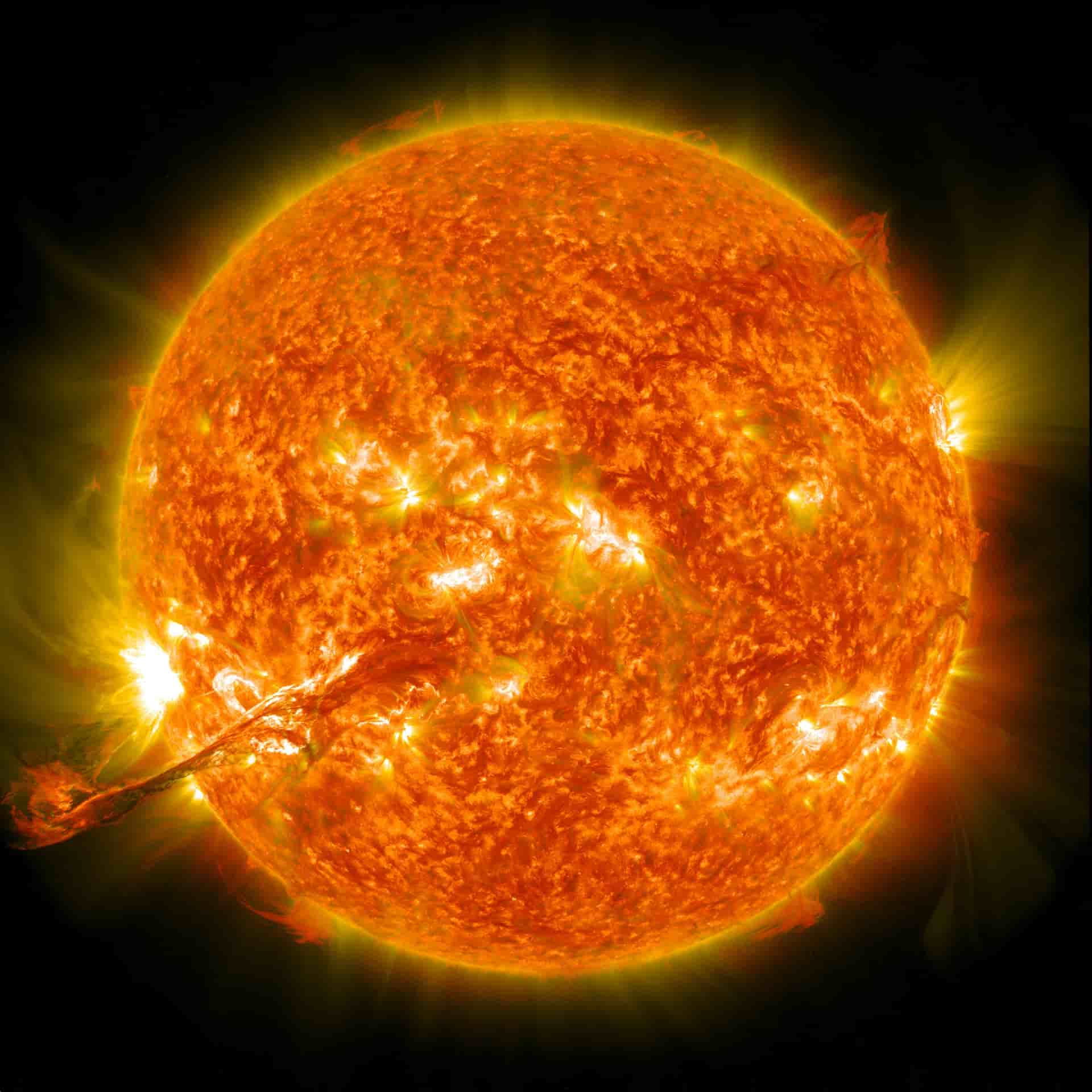
The Sun is composed mainly Of hydrogen, an atomic element whose nucleus is reduced to one proton. When the cloud of stellar matter (hydrogen) that forms the Sun contracts under the effect of the pull of gravity, it will heat up, creating nuclear reactions. It is from this phenomenon that the sun's energy comes from.
The nuclear reaction, which is the source of solar energy, results from the fusion of two protons, wearing out Hydrogen as fuel. This will create what is called A deuterium nucleus.
This is a phenomenon that releases about 2 million electron volts. For this reaction to take place, however, protons or hydrogen nuclei must come into contact. However, this is only possible at very high temperatures, in excess of one million degrees (just that!).
Solar energy comes from a phenomenon similar to radioactivity. In fact, the deuterium nucleus is composed of a proton and a neutron. You should know that the transformation of a proton into a neutron is only possible with the forces Nuclear that come from beta radioactivity, also called weak forces.
Without this radioactivity, this fusion reaction would be impossible, because the protons repel each other. Fortunately, each of the two protons can be transformed into a neutron.
During its transformation, the neutron will emit a particle called a W boson. In general, this particle is immediately reabsorbed, which means that the neutron will become a proton again.
However (and luckily for us), sometimes the W boson still finds time to disintegrate into a positron and a neutrino, which simply means that the neutron will no longer become a proton again. It can thus fuse with the other proton, which will give life to a deuterium nucleus.
The neutron and proton fusion reaction, called paramount, releases energy and heat, but not only that. Indeed, it also generates neutrons, which are essential for the formation of the various atoms that surround us. For example, deuterium neutrons are responsible for the formation of helium nuclei, carbon nuclei, and oxygen nuclei.
The spark that is at the origin of this phenomenon that is the Sun, that is to say The fusion of hydrogen, is very rare and difficult to make. Indeed, rare are collisions between protons that end in fusion.
Since that spark, the Sun has been living at a slow pace, so it consumes its proton reserve very slowly. This explains the fact that it has shone for so long and will continue to shine for billions of years.
Every second, the Sun transforms 4 million tons of its mass into radiative energy. The latter still has to cross the various layers of the Sun (they are a total of 700,000 kilometers) before reaching its surface. The light released at the center of the Sun takes at least 100,000 years before reaching the Sun's surface.
When light hits the surface of the Sun, things change much more quickly! In fact, the Sun rays only take 8 minutes and 20 seconds to get to Earth.
Solar energy, used by humans, is drawn directly from the sun's radiation. Researchers have developed techniques that make it possible to use and recover solar energy to transform it into electricity or energy.
It was in 1916 that energy was produced for the first time with A solar cell. Robert Andrews Millikan did this feat, but the energy obtained was insufficient.
Solar energy was only truly exploited during the 1970s. It was at this time that the photovoltaic panels were used for the first time in homes.
Today, solar radiation is a renewable energy source used by individuals, manufacturers, businesses and communities.

According to researchers, the Sun has been shining for 4.5 billion years now and (good news!) it should shine again for 4 to 6 billion years. What could this extinction come from? The sun will no longer be able to shine when it has run out of hydrogen.
The Sun will simply collapse without the pressure of the radiation it emits, because it is the radiation it emits that counteracts the effect of the forces of gravity. However, neutrinos pass through the Sun much faster than light (in two seconds). So the sun still has a bright future ahead of it.
To go further, do not hesitate to read our article to know What makes solar energy green ?
Recognizing the climate emergency, SirEnergies offers professionals and businesses the opportunity to limit the ecological impact in terms of energy.
We have made the choice to work with key players in solar photovoltaic to offer you support solutions dedicated to your photovoltaic self-consumption projects.
Click below for more information:
In a few clicks, organize an exchange with one of our experts.


weekly newsletter subscribers

4.9

.png)

It allows you to prove your commitment to the energy transition and to meet regulatory requirements.
Le calendrier 2026 impose deux échéances majeures :
Pour simplifier ces démarches, vous pouvez centraliser vos données de consommation avec la plateforme Pilott de Sirenergies, garantissant ainsi la conformité de vos rapports réglementaires.
Les coopératives de taille ETI ou grande entreprise peuvent être soumises à l'audit énergétique réglementaire (norme NF EN 16247). Sirenergies n'a ni la compétence ni l'accréditation pour réaliser cet audit : nous vous orientons vers un bureau d'études partenaire accrédité, et vous accompagnons en amont sur vos achats et en aval sur le pilotage.
Yes. The supplier guarantees an offer 100% renewable via the official Guarantees of Origin (GO) mechanism.
For the most demanding companies, the offer GREENVOLT+ ensures very low carbon intensity electricity, sourced exclusively from independent French producers (hydraulic, wind, solar).
To calculate Scope 2 emissions, use the following formula:
Energy quantity (kWh) × Emission factor (kg CO₂ e/kWh).
Use databases like ADEME for precision.
La réussite d'un projet collectif énergie repose sur trois piliers fondamentaux :

Contrairement à un feu terrestre, le soleil ne brûle pas d'oxygène. C’est une réaction nucléaire et non chimique. Il possède une réserve massive d'hydrogène lui permettant de briller pendant environ 10 milliards d'années avant d'épuiser son carburant principal.
Le soleil est composé majoritairement d'hydrogène (environ 74 %) et d'hélium (24 %). Le reste est constitué d'éléments plus lourds comme l'oxygène, le carbone et le fer. Cette composition gazeuse et plasmatique est maintenue par sa propre force de gravité.
L'énergie solaire provient de la fusion nucléaire : au cœur de l'étoile, la pression et la température transforment l'hydrogène en hélium, libérant une quantité phénoménale de photons. Cette puissance est l'origine directe des offres énergies renouvelables exploitées sur Terre.
La photosphère, ou surface visible du soleil, affiche une température d'environ 5 500°C. Comprendre ces flux thermiques est essentiel pour le secteur industriel qui cherche à décarboner ses procédés via la chaleur solaire
Le soleil se situe à environ 150 millions de kilomètres de nous. Cette distance permet de capter un rayonnement suffisant pour alimenter le secteur tertiaire en électricité photovoltaïque de manière rentable.
Les scientifiques estiment que le soleil est à la moitié de sa vie. Il continuera de briller pendant 5 milliards d'années, une stabilité qui rassure les investissements de long terme dans le secteur agriculture pour l'agrivoltaïsme.
Le rayonnement solaire évapore l'eau des océans, créant les nuages et la pluie. Pour les collectivités locales et acheteurs publics, la gestion de cette ressource naturelle est indissociable d'une politique énergétique cohérente.
L'énergie voyage sous forme d'ondes électromagnétiques (photons) à travers le vide spatial. Les ETI et grandes entreprises intègrent désormais cette source dans leur mix pour réduire leur dépendance aux énergies fossiles.
Non, l'épuisement de son hydrogène sera un processus très lent s'étalant sur des millions d'années. Pour une PME-PMI, l'énergie solaire reste la source la plus pérenne pour stabiliser ses coûts opérationnels.
Il s'agit de jets de matière ionisée projetés à grande vitesse. Ces phénomènes soulignent l'importance de l'analyse des prix de marché car les tempêtes géomagnétiques peuvent parfois impacter les réseaux électriques mondiaux.
Contrairement aux énergies carbonées, son exploitation ne génère pas de gaz à effet de serre. Une étude de cas sur l'autoconsommation démontre souvent un retour sur investissement rapide pour les professionnels.
Le thermique produit de la chaleur, tandis que le photovoltaïque génère de l'électricité. Pour choisir la technologie adaptée, il est conseillé de solliciter un appel d'offres énergie afin de comparer les meilleures solutions du marché.