




Summarize with AI

March 6, 2026
7
Min reading
We mentioned in a previous article the nature and changes that Smart-Grids (smart grids) can bring. We are going to see today How will the Smart-Grid be at the crossroads of all the evolutions in the world of energy. We will try to describe to you what will be the uses and the means of production that will develop in the near future.
For once, this is a prospective article that aims to imagine the energy world of tomorrow. Indeed, we are at the dawn of a transition that will change our consumption habits. It will therefore be essential to adapt and explore possible scenarios in advance.
Today, there are a lot of proven technologies out there. There are some that are already massively used in the world and continue to grow, such as photovoltaic panels or wind power. Others are still at the experimental stage but promise us great things in terms of energy. We will therefore present technologies from the most mature to the most experimental.
So we are going to discuss various technologies like biogas, Nuclear fusion or even the Blockchain and try to imagine their future uses and the interdependence between these technologies.
How we produce electricity has a major impact on how we consume it. Indeed, for example, an abundance of electricity at a low price can lead to overconsumption or bad habits. Conversely, expensive energy can push various businesses and institutions to move towards more energy efficiency. The energy transition pushes us to make room for renewables to reduce our greenhouse gas emissions.
The intermittency of these production methods raises questions and pushes us to look for ever more effective ways of flexibility. However, it is a bottom-line in our society to which solutions will have to be found.
It is therefore necessary to look at the probable scenarios of production methods in order to imagine our future uses.
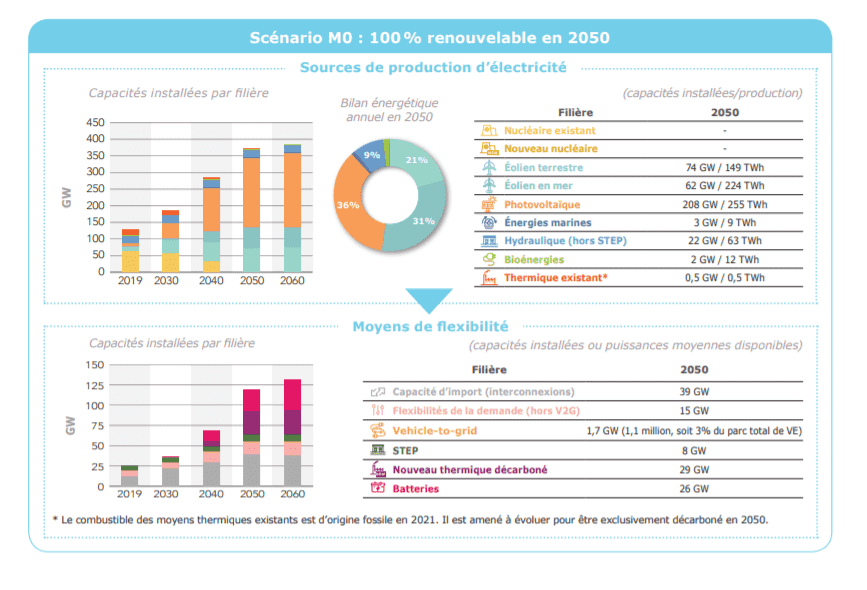
Source: RTE
If we look at the M0 scenario 100% renewable published by RTE, so we see projections at more than 373 TWh for Wind energy (including 224 TWh for offshore wind turbines) and 255 TWh for solar.
It is true that this scenario remains unlikely and difficult to implement, but it is obvious that we must take these technologies into account in our future consumer uses.
This technology is widely known and democratized. The reduction of construction and equipment costs contributed significantly to its development. Photovoltaic panels built in Asia (mainly in China) have flooded global markets.
The sun has experienced a very significant increase in development, greater each year than other production sectors. In fact, it increased 58% in one year in terms of production capacity.
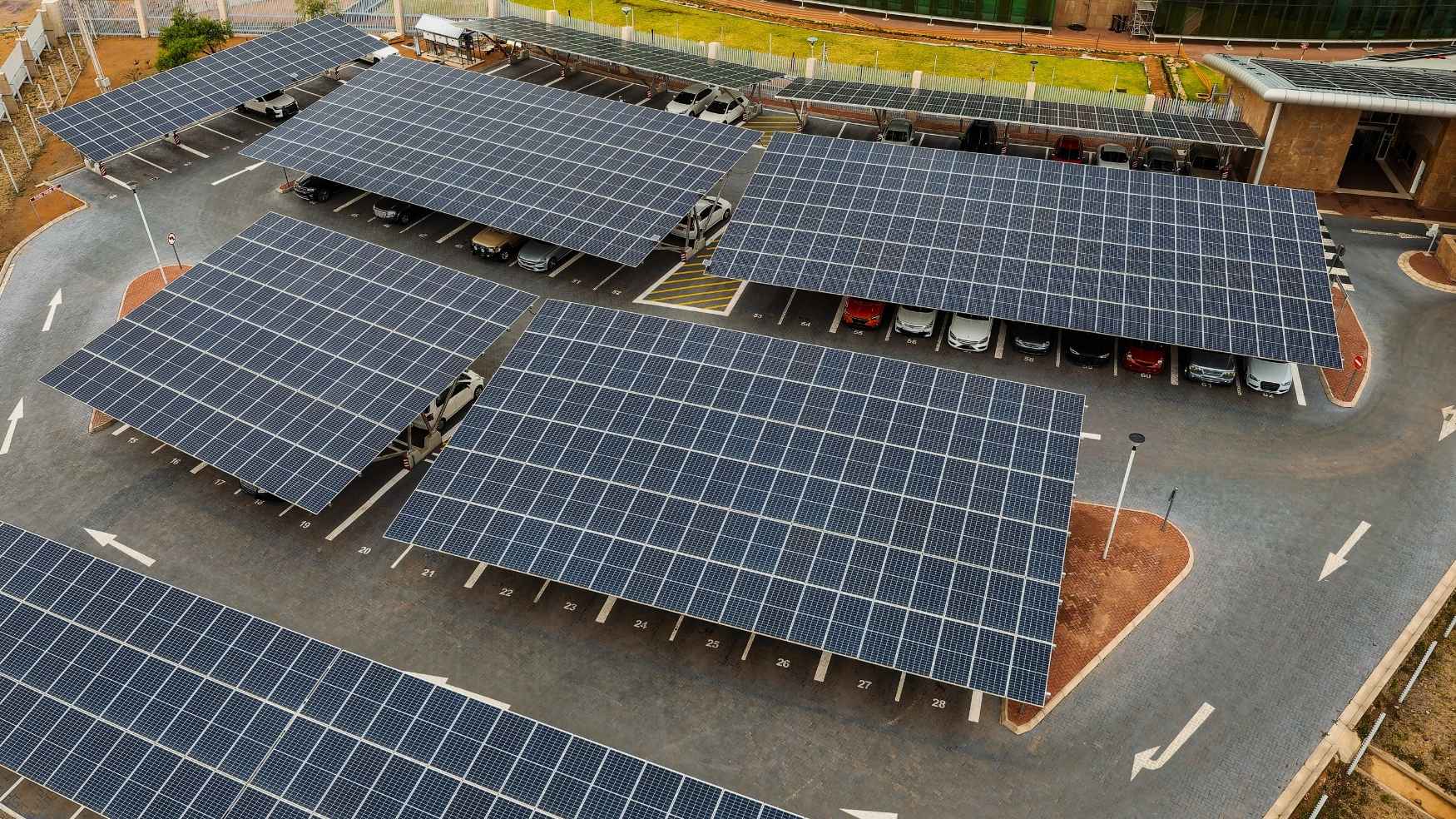
The marginal production cost (the production cost for an additional kWh) is almost zero. Finally, the success of this energy is in part due to its advantages in urban areas. The numerous roofs and buildings allow the installation of panels and their maintenance can be shared. As we will see, self-consumption will be able to develop at a sufficient level thanks to this technology.
France has the fourth largest European onshore wind farm in Europe. It is a mature technology that has many advantages.
There are more than 8,000 wind turbines installed in the country for a total installed capacity of nearly 18 GW. Unfortunately, they also have detractors because wind turbines can cause noise and visual disturbances.
It was then that offshore wind turbines come into play. This is a way to take advantage of significant sea winds and then to relocate the problems mentioned above. The first French park off the coast of Saint-Nazaire will start operating in 2022. The objective is to reach a rate of 1 GW of additional installed production per year.
To go further, do not hesitate to consult our article on Wind energy.
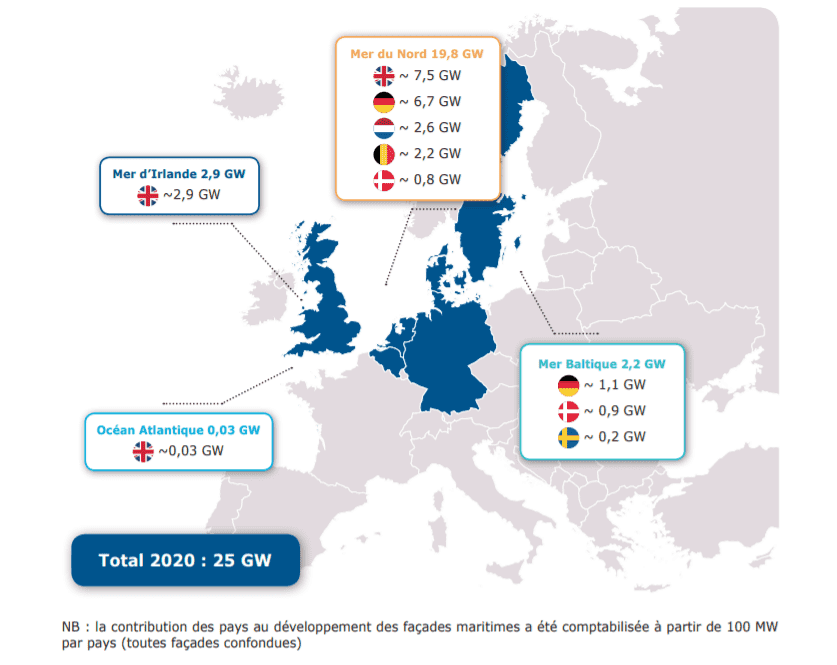
Overview of offshore wind generation capacity by European country — Source: RTE
The concept of Vehicle-to-Grid consists in considering the owner of an electric vehicle no longer as a simple consumer but as a System actor.
The idea is to use all the batteries connected to the distribution network simultaneously so that they can work in both directions. That is to say on the one hand store energy for the future use of the vehicle, but also to inject energy into the network if the need arises. In particular, they can be used to manage consumption peaks.
One can imagine that with a constant increase in electric vehicles, batteries connected to the grid could represent colossal power. This power could be used in the following cases:
We can see that today, in Australia, a battery system provides services to the networks. However, it should not be forgotten that a certain number of technologies are needed to make this project viable. You need to be able to detect when renewable energy is produced in excess, for example.
The electrical network was built centrally. To overcome the limits of our system, we must begin the transition to a more decentralized system. It is self-consumption who can enable this transition.
The fact that the customer is able to produce their energy and share it is a game changer. This revolution allows the consumer to become producer and thus to participate in the security of supply. It reduces the dependence of customers on the network and on the system in general. It also allows you to create synergies between customers.
Self-consumption is therefore one of the keystones of this new system.

Source: Cityroom
These topics are often put on the back burner when trying to think about the energy world of tomorrow. However, they could help fight global warming while giving life to Smart-City.
Indeed, this concept of “smart” city can only make sense if the waste issue is taken into account. The world's population is constantly increasing and this issue is becoming paramount. However, there are several solutions:
It is this last solution that is of particular interest to us. The methanization process in fact makes it possible to Transforming household waste into gas. The latter is obtained by fermenting waste which releases gas. Since the source of energy is renewable (because it is waste), it is called that biogas.
It is a non-polluting and future-proof energy. However, there is a downside: today, this energy system is more efficient in rural areas. Let's hope that in the future, technological progress can allow us to democratize it in urban areas and among individuals.
We can therefore try to imagine our energy future based on these elements. As explained, our uses depend in part on our production methods.
Self-consumption and the production of biogas and hydrogen will change in the coming decade. We can imagine that the proportion of French households equipped with photovoltaic panels will explode. These three means of production will greatly contribute to the reduction of our CO emissions.2.
Hydrogen is an interesting track. However, today, there are still many obstacles to overcome in order to democratize its use.
It is a safe bet that the nuclear technologies will also make progress towards a smaller reactor model (The SMRs). Many governments (France, Belgium, USA...) have announced massive investments in this mode of production.
It is certain that renewable energies will continue to make significant progress. However, nuclear power is historic in France: it is very likely that these two means of production will coexist for decades in France, with the aim of sustainable development.
We can (dare) imagine that in the world of tomorrow, all consumers at a local level will be interacting thanks to Smart-Grids. They will thus be able to exchange energy in real time and also monitor their consumption/production thanks to computer technologies ever more powerful. Smart meters are also important in this device.
There is currently an example that implements these concepts. The initiative Transactive Grid allows its users to produce and consume energy at a local level. The system is supported by an Ethereum blockchain that guarantees the security and traceability of all transactions. Do not hesitate to read our article on Blockchain to find out more.
We will also see more and more bus lines powered by biofuel. It is not certain to see it develop Biomass in urban areas rapidly; however, in rural areas, it remains an option for the future.
Finally, these concepts (most of which are already in use) combine digital technologies and energy. At the city level, waste management can be improved in order to make it efficient (underground galleries, connected trash cans) and energy producing.
La hydrogen production may also have a role to play; however, a real dense industrial fabric is needed in order to develop this activity. Offshore wind, the nuclear And the solar will continue to develop to provide ever more low-carbon electricity. It can be said, the concept of Smart-Grid is synonymous with Third Industrial Revolution.
In a few clicks, organize an exchange with one of our experts.


weekly newsletter subscribers

4.9

.png)

It allows you to prove your commitment to the energy transition and to meet regulatory requirements.
Le calendrier 2026 impose deux échéances majeures :
Pour simplifier ces démarches, vous pouvez centraliser vos données de consommation avec la plateforme Pilott de Sirenergies, garantissant ainsi la conformité de vos rapports réglementaires.
Yes. The supplier guarantees an offer 100% renewable via the official Guarantees of Origin (GO) mechanism.
For the most demanding companies, the offer GREENVOLT+ ensures very low carbon intensity electricity, sourced exclusively from independent French producers (hydraulic, wind, solar).
To calculate Scope 2 emissions, use the following formula:
Energy quantity (kWh) × Emission factor (kg CO₂ e/kWh).
Use databases like ADEME for precision.
Les coopératives de taille ETI ou grande entreprise peuvent être soumises à l'audit énergétique réglementaire (norme NF EN 16247). Sirenergies n'a ni la compétence ni l'accréditation pour réaliser cet audit : nous vous orientons vers un bureau d'études partenaire accrédité, et vous accompagnons en amont sur vos achats et en aval sur le pilotage.
La réussite d'un projet collectif énergie repose sur trois piliers fondamentaux :