




Summarize with AI

March 6, 2026
9
Min reading
In 2015, 196 countries signed the Paris Agreement, pledging to reach carbon neutrality by 2050. Achieving this objective requires economic actors to significantly reduce their CO2 emissions.
But when this is not possible or difficult to achieve, such as for air transport, an alternative is to finance virtuous carbon projects. It's called carbon offsetting.
What is it about? How is it organized? Why and when to use it? SirEnergies answers these questions.
To limit the production of CO2, and therefore reduce our carbon footprint, many solutions exist, such as soft and rational transport (walking, cycling, cycling, scooter, scooter, skateboarding, etc.), local and seasonal food, green energy contracts, recycling, energy management actions, etc. Despite all these efforts, carbon emissions still exist. incompressible.
Carbon emissions can be offset voluntarily through the financial support of energy-efficient projects. greenhouse gases. As these gases impact climate change regardless of where they are emitted, it is accepted that carbon offset projects can be carried out anywhere in the world.
That's what we call The principle of geographical neutrality of carbon offsetting : what is emitted in the North can be offset in the South.
Thus, compensation projects are most often carried out in developing countries where populations are the most affected by global warming: distribution of improved stoves, use of biogas digesters, preservation of forests, recovery of household waste, etc. These projects bring socio-economic benefits to local populations, which remain the most vulnerable and the first to be affected by the consequences of climate change.
These compensation projects can also be implemented in industrialized countries such as France and are subject to validation by the State.
The CO2 emissions thus avoided, compared to a reference scenario, are then converted into carbon credits that are purchased voluntarily by businesses, individuals or local authorities who want offset their carbon footprint.

Source: TotalEnergies
Carbon offsetting therefore consists of finance environmental projects which will contribute directly to the reduction of greenhouse gas emissions.
We talk about compensation, because the objective is, through these projects, to achieve carbon neutrality. That is to say, the quantity of CO2 emitted by an activity must theoretically be equal to the quantity of CO2 avoided thanks to the financing of a project.
So by making a financial contribution to an effective climate protection project on a global or local scale, unavoidable CO2 emissions can be offset. However, carbon offsetting is not enough to preserve our climate, it comes in complement of actions to reduce our own CO2 emissions at the source and is a tool at the service of ecological transition And of the international solidarity.
Today, two carbon compensation systems have been implemented:
The first is the Kyoto protocol by which states and large companies have committed themselves to reducing their greenhouse gas (GHG) emissions.
In concrete terms, by signing this agreement, these actors have made a commitment to finance environmental projects who are going to offset their carbon footprint in foreign countries.
In return, these financial actors, states or companies, receive carbon credits that are” Rights to pollute ” certified by the UN: 1 carbon credit authorizing the emission of 1 ton of CO2 equivalent. Under this system, states and large companies are legally obliged to offset their carbon emissions.
The second system is that of the voluntary compensation market which, as its name suggests, is aimed at all other actors (individuals, SMEs/SMIs, local authorities) who are not constrained, but who want to voluntarily offset their GHG emissions.
The main difference between these two systems is that the first is a constrained system dependent on a regulatory authority, while voluntary compensation is not and the guarantees offered by the companies offering these services are extremely variable.
In fact, individuals, communities and small businesses that do not have obligations related to carbon offsetting are at an advantage over large groups who are legally obliged to do so.
Typically, companies in the airline sector use carbon offsetting. Take for example, the Air France-KLM group:
This proactive strategy allowed Air France-KLM to reduce 20% its emissions per passenger and per kilometer between 2005 and 2019; however, the group wants to go further and reach 50% reduction by 2030.
This is why, in order to achieve this objective, Air France-KLM committed to a proactive carbon offset program in 2020. Thus, by collaborating with NGOs and social enterprises, the group finances reforestation projects And projects ofrenewables.
Other very large companies such as GAFAM support carbon offset projects. Thus, Facebook and Google followed the same strategy as Microsoft or Apple by seeking to achieve carbon neutrality by limiting their emissions and then compensating for those that could not be carbon neutral.
Carbon offsetting faces various limitations and criticisms:
Economic actors are now increasingly engaging in actions to offset their greenhouse gas emissions, whether they are obliged to do so or not. As a sign of this trend, the voluntary carbon compensation market is growing.
Companies that are committed to a rigorous and innovative CSR policy must conduct concrete actions to reduce their own emissions, and involve all their employees, service providers, subcontractors and suppliers in their efforts to reduce emissions.
But to achieve carbon neutrality, this is often not enough. Some emissions are unavoidable, so it is possible for these companies to turn to The voluntary carbon offset market.
Be careful, however, that in order to communicate effectively on their CSR policy and not be accused of greenwashing, companies should not rely solely on carbon offsetting.
Various solutions are available to economic actors wishing to offset their carbon emissions by supporting virtuous projects through their investments:

To be recognized and effective in terms of compensation, these projects must meet 4 conditions:
In order to guarantee economic actors that they can invest in projects that meet all these criteria, several labels have been created. The most recognized are that of WWF, the Voluntary Gold Standard, created in 2006, and that of Verra, entitled “Verified Carbon Standard”.
As the publication of a carbon balance has now become mandatory for certain economic actors, the State has made several resources available to help in this process explained by CEDAW: How to establish a company's carbon footprint?
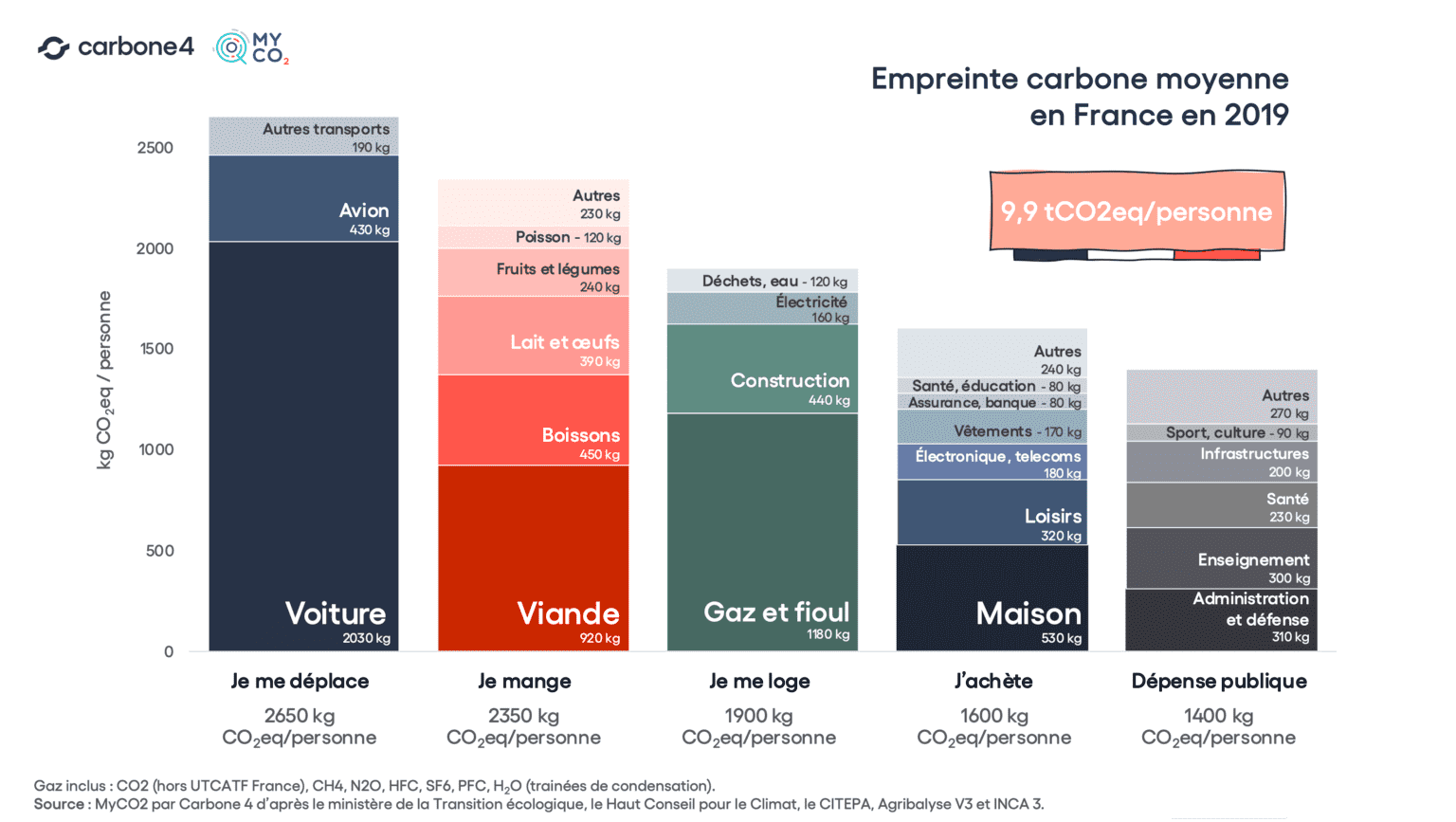
Source: MyCO2 by Carbone 4
The first action to take to engage in a carbon offset process is first to be able to estimate its emissions. For this, numerous calculators have been developed and can be used freely on the Internet.
These include:
The calculators mentioned above also make it possible to estimate the tree planting required to absorb the CO2 impact and thus calculate the price of carbon compensation.
For an economic player in the industrial sector such as a company, the reduction of GHGs (greenhouse gases) is dominated by 3 major challenges or “Scope” framed by international standards and methods:
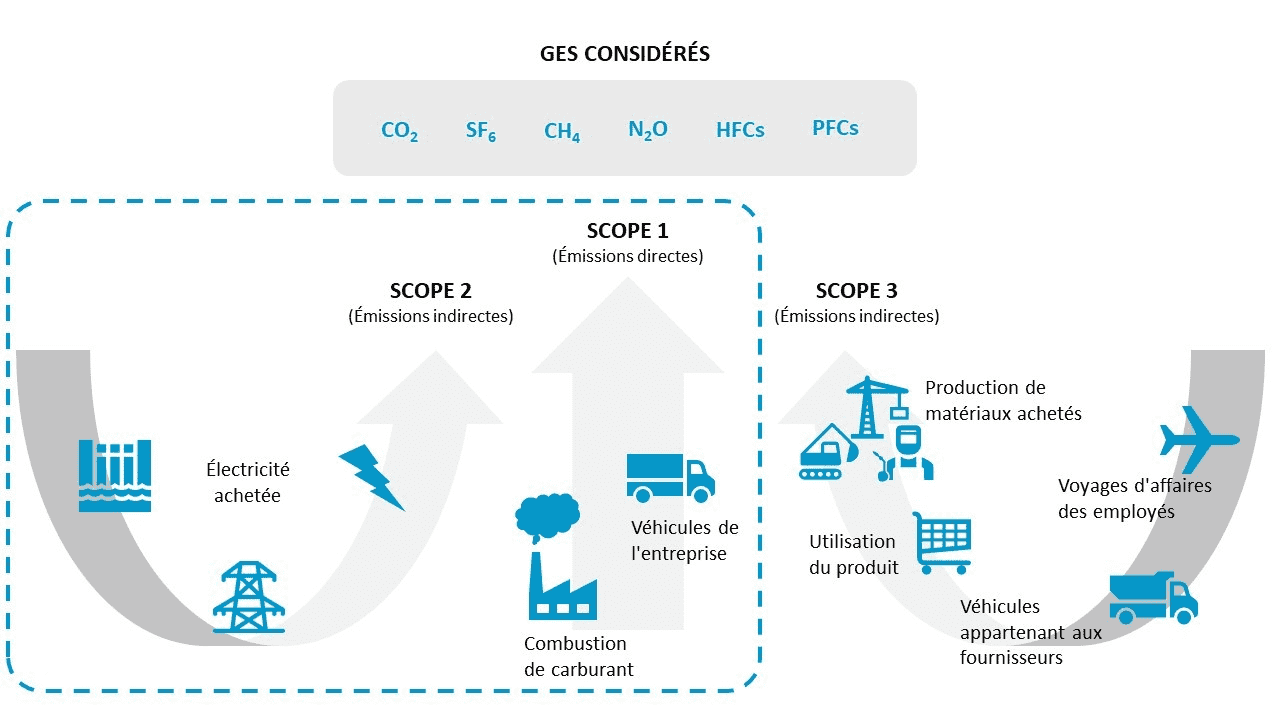
Reducing emissions means that they can be quantified. The first action for a company is therefore to Do a carbon assessment by evaluating the emissions that its activity generates. As described above, there are some online tools that allow this to be done. Another option is to turn to a specialized design office.
Once you know your balance sheet and have taken all the actions identified to reduce your emissions according to scopes 1, 2 and 3, a company can decide to offset its remaining and “incompressible” emissions by financing virtuous projects and recognized as such.
Such an approach often involves development aid in developing countries. Thus, carbon offsetting makes it possible to participate in a climate solidarity with respect to countries in the South, often among the first to be affected by the effects of climate change.
Offsetting your greenhouse gas emissions makes it possible to finance virtuous projects in terms of CO2 emissions. Among all these projects, tree planting Hold the top of the poster. The forest is certainly one of the most efficient.” carbon sink ”, which is why actors involved in the fight against global warming actively participate in the preservation of the forest.
However, it should be borne in mind that what a French person emits every day is equivalent, in CO2 emissions, to what a tree is capable of capturing in a year. This is why carbon offsetting should only be used as a last resort, when it is really not possible to avoid CO2 emissions.
In fact, offsetting a Paris-New York by planting a forest consists in emitting CO2 emissions today for a few hours and betting that a forest will compensate for them at the end of its 20, 30 or 40 years of life.
This raises two questions:
In other words, carbon offset projects must be heavily supervised and used only as a last resort when no other solution makes it possible to reduce or eliminate CO2 emissions from human activity.
Thanks to the mechanism of Energy Saving Certificates (CEE), you can finance your energy efficiency work.
SirEnergies supports you in this process!
Click below for more information:
In a few clicks, organize an exchange with one of our experts.


weekly newsletter subscribers

4.9

.png)

To calculate Scope 2 emissions, use the following formula:
Energy quantity (kWh) × Emission factor (kg CO₂ e/kWh).
Use databases like ADEME for precision.
Yes. The supplier guarantees an offer 100% renewable via the official Guarantees of Origin (GO) mechanism.
For the most demanding companies, the offer GREENVOLT+ ensures very low carbon intensity electricity, sourced exclusively from independent French producers (hydraulic, wind, solar).
La réussite d'un projet collectif énergie repose sur trois piliers fondamentaux :
It allows you to prove your commitment to the energy transition and to meet regulatory requirements.
Les coopératives de taille ETI ou grande entreprise peuvent être soumises à l'audit énergétique réglementaire (norme NF EN 16247). Sirenergies n'a ni la compétence ni l'accréditation pour réaliser cet audit : nous vous orientons vers un bureau d'études partenaire accrédité, et vous accompagnons en amont sur vos achats et en aval sur le pilotage.
Le calendrier 2026 impose deux échéances majeures :
Pour simplifier ces démarches, vous pouvez centraliser vos données de consommation avec la plateforme Pilott de Sirenergies, garantissant ainsi la conformité de vos rapports réglementaires.