






Summarize with AI

March 6, 2026
6
Min reading

Electricity prices are rising all over Europe. The levels reached are historically high and France is not spared. We can then legitimately ask ourselves about the evolution of these prices in the long term.
This is a complex issue, as the factors are numerous and difficult to predict. First of all, we can cite gas and CO2 prices, or even temperature or demand. Currently, debates are also raging with regard to regulatory aspects.
It is therefore necessary to analyze a large number of parameters in order to draw perspectives. That is what we are going to try to do in this article.
Second, it is a hot topic, according to recent government announcements. Indeed, Jean Castex, the French Prime Minister, announced a 4% increase in regulated electricity sales tariffs (TRV). The situation is the same elsewhere in Europe, such as in Italy or Ireland.
To start, you have to remember the interconnection of European electrical systems. Europe is like a giant copper plate, allowing electrons to be transported across Europe.
Even if, in France, there are many nuclear power plants with low production costs, we are subject to variations in the prices of wholesale electricity markets. It is an interconnected market. For example, on the long-term markets, some French indices are built including German price forecasts. Les short-term markets (Intraday and Day Ahead) fluctuate according to what is happening elsewhere in Europe.
Beyond this interconnection of markets, there are structural factors that lead us to believe in a sustainable rise in electricity prices. The Merit Order operates in such a way that the market price reflects the cost of producing the last power plant called.
Thus, the costs of each of the producers are covered. However, there are still numerous state-of-the-art power plants in operation in Europe. These are coal-fired or gas-fired power plants, allowing To balance the network.
Network operators still rely on these often expensive power plants. Scheduled closures continue to be postponed (for example the Cordemais power plant in France). This contributes to maintaining electricity prices at high levels in the event of nuclear or renewable non-availability.
The IMF's growth projections continue to rise and expect a recovery of 6% for 2021 and 4.4% for 2022. Post-health crisis recovery is important. And, on the other hand, the level of demand affects the price.
The stronger the demand, the more the prices of gas, coal and therefore electricity increase. It is true that the health crisis can evolve unpredictably. However, as long as the situation remains stable and under control, it is certain that prices will respond to the rise.
The use of economic mechanisms such as ARENH can help reduce the effect of increases in electricity prices.
We can imagine that, if we increase the total ceiling (which is currently 100 TWh to €42/MWh), this can reduce the cost of supplying suppliers.
If countries decide to play the sovereignty card in the face of energy Europe, they can influence energy prices. It is certain that as the various elections approach, some candidates will make proposals in this direction.
However, this seems difficult to consider, because France is fully committed to the European Union.
As we have explained, what determines electricity prices are, at their core, the costs of producing electricity. We can imagine that the progression of renewables in the energy mix could make it possible to reduce average electricity production costs over the long term.
However, this is a somewhat truncated vision of reality. Indeed, the questions of intermittency and storing remain whole. As we saw recently in the projections made by RTE, even with a significant integration of renewable energies, if battery technologies do not evolve more quickly, the problem remains.
Since the post-Covid recovery, gas demand has increased sharply, in particular due to demand from Asian countries. This is one of the factors behind the recent rise in gas prices and therefore, ultimately, electricity prices.
Faced with this, the gas supply from Russia was insufficient and well below the usual exports. This situation has created numerous tensions on the energy markets in Europe.
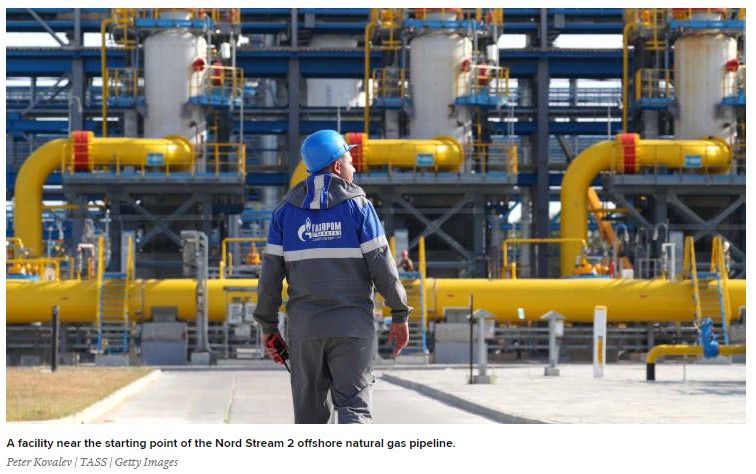
It is difficult to say whether these export cuts are voluntary on the part of Russia, but it is putting pressure on all European markets.
We can therefore hope that, if on the one hand the demand is reduced and on the other hand the supply increases, then the prices will return to their usual levels. The growth (and therefore the Asian demand) expected in 2022 is in fact less important than 2021. Analysts agree that demand and therefore prices should be impacted. It remains to be seen whether other more important factors (CO2 price, nuclear availability, etc.) will not come to the fore.
It should be remembered that these conditions are entirely cyclical, and that it is likely that a combination of several of them will be needed to take effect.
To go further, do not hesitate to read our article:”Nord Stream 2 gas pipeline: origins and impacts on the French market”
The European Union recently launched a new European climate project. It is a set of measures aimed at reducing our greenhouse gas emissions. On a certain number of them, it is a question of carbon market (CO2).
The EU intends to use this tool to increase the price of CO2 by, in particular, gradually reducing quotas. This type of regulatory news adds complexity to long-term electricity price forecasts.
It is likely that this desire to reduce our emissions will push up electricity prices on wholesale markets. This is an element to be taken into account for long-term considerations.
A disruptive technological evolution could allow for a completely different development of the energy mix. For example, it is possible to see the evolution of the sector of batteries.
Indeed, it is the main element in the development of renewable technologies. If it is possible to manage The intermittency of renewable energies thanks to batteries, it will be entirely possible to consider energy mixes with an overwhelming share of renewable energy.
This could make it possible to gradually separate ourselves from fossil fuel power plants, the most expensive power plants (those with the highest production cost). We recall here that renewable energies (wind turbines and solar power plants) have an almost zero marginal cost of production. The cost of electricity is expected to be affected downwards.
We can recall that a third of the electricity bill consists of taxes and various contributions. Rather than counting on an evolution in research that will certainly take a long time, the fiscal instrument is the fastest instrument to put in place.
A good example is the freight rate contribution (CTA). It finances the specific rights relating to old-age insurance for IEG (Electrical and Gas Industries) staff. The State could decide to reduce these specific taxes or simply to reduce the VAT applied.
To go further, do not hesitate to read our article on the” Rising electricity prices - The causes and how can we protect ourselves from them? ”
Electricity, gas and CO2 prices change every day and are important to follow for buy at the best time.
Beyond supporting you in your energy optimizations, our vision is to give you this transparency in real time. Price data allows you to make better decisions for your business.
In a few clicks, organize an exchange with one of our experts.


weekly newsletter subscribers

4.9
