





Summarize with AI

February 13, 2026
9
Min reading
Natural gas, a co-product of oil exploitation, has developed in Europe since the end of the 1950s. A fossil energy by nature, natural gas has the immense advantage of being storable unlike electricity and of emitting less greenhouse gases, CO2 in particular, than oil.
Where do we find it? Where does it come from? How is it extracted, transported and stored? These are all questions that make perfect sense in the current geopolitical context.
SirEnergies offers you below some answers that will allow you to better understand this industry linked to the oil activities of multinationals in the energy sector.
Natural gas is composed of:
Natural gas has several uses:
Coal gas is a gas produced by coal gasification or during the transformation of hard coal into coke.
Shale gas or Mother rock is a gas of natural origin which is contained, as its name suggests, in marly or argilly-type mother rocks rich in organic matter, some of which have a literal shale structure.
Compact tank gas is natural gas extracted by hydraulic fracturing of reservoir rocks. These rocks are so poorly permeable that, to ensure profitable production, they must be fractured.
Fermentation, also known as methanization, organic waste releases gas, called biogas, composed mainly of methane and carbon dioxide. This biogas is a combustible gas. of natural and renewable origin, as opposed to natural gas of fossil origin. This gas, whose origin is the decomposition of organic matter, is also called swamp gas, in reference to its formation in a natural environment.
According to the BP report, Statistical Review of World Energy 2021, published on July 8, 2021, the world's natural gas reserves at the end of 2020 amount to 188.1 trillion cubic meters. Notably, Russia, with 37.4 trillion cubic meters, or 20% of the total, has the largest of these “proven” reserves.
However, 40.3% of these global natural gas reserves are located in the Middle East, or 75.8 trillion cubic meters. Geographical area where Iran stands out with 32.1 trillion cubic meters of natural gas, which represents 17.1% of the world's reserves. Then, Qatar has 24.7 trillion cubic meters, or 13.1%. Next comes Saudi Arabia with 6 trillion cubic meters.
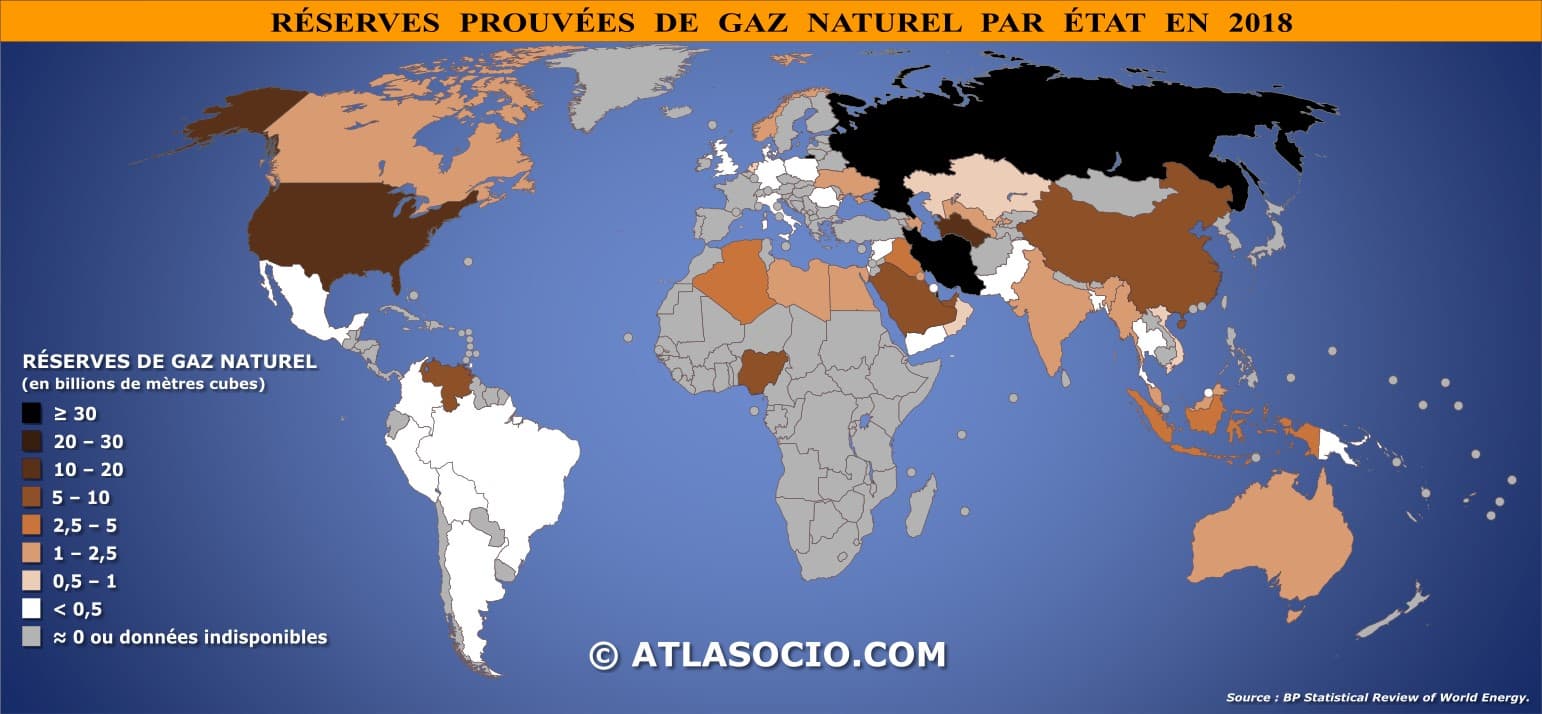
Source: The World Sociological Atlas
The ranking below shows the 10 countries with the largest natural gas reserves:
Countries
Natural gas reserves
(in thousands of billions of m3) *
Share of reserves
Global natural gas
1. russia
37.4
19.9%
2. iran
32,1
17.1%
3. qatar
24.7
13.1%
4. Turkmenistan
13.6
7.2%
5. u.s.
12.6
6.7%
6. china
8.4
4.5%
7. Venezuela
6.3
3.3%
8. Saudi Arabia
6
3.2%
9. uae
5.9
3.2%
10. nigeria
5.5
2.9%
Technically, natural gas is extracted from natural deposits. Its operation is based on three essential steps: exploration, extraction and purification.
Natural gas comes from the slow decomposition of microscopic living organisms such as plankton and algae. It is found in porous rocks in Earth's basements, but also in the ocean floors. Being naturally in gaseous form, it fills the pores and fractures of sedimentary rocks such as sandstones, carbonates, coal beds, and clay shale beds or “shales.”
Natural gas is not available everywhere. The fields are very unevenly distributed and, often, gas and oil are associated in the same geographical areas, or even in the same fields.
Gas companies use various techniques:
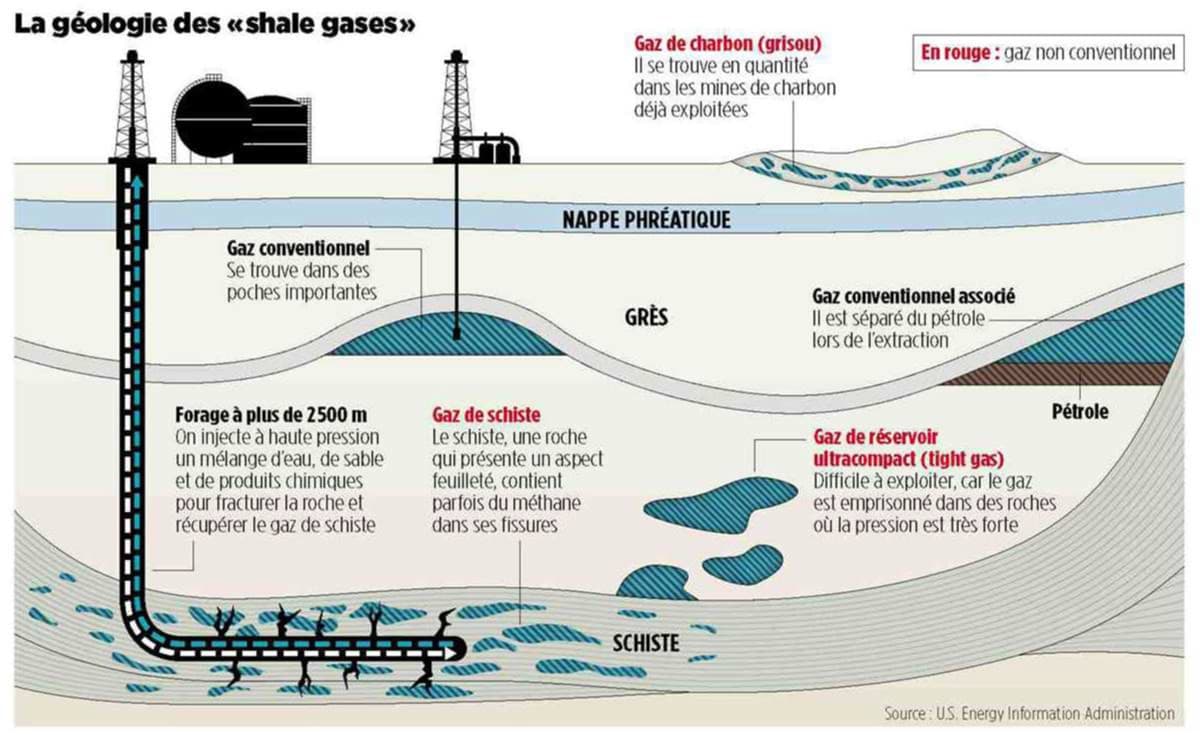
Source: Le Point August 5, 2010: “Full gas in the shales” & US EIA
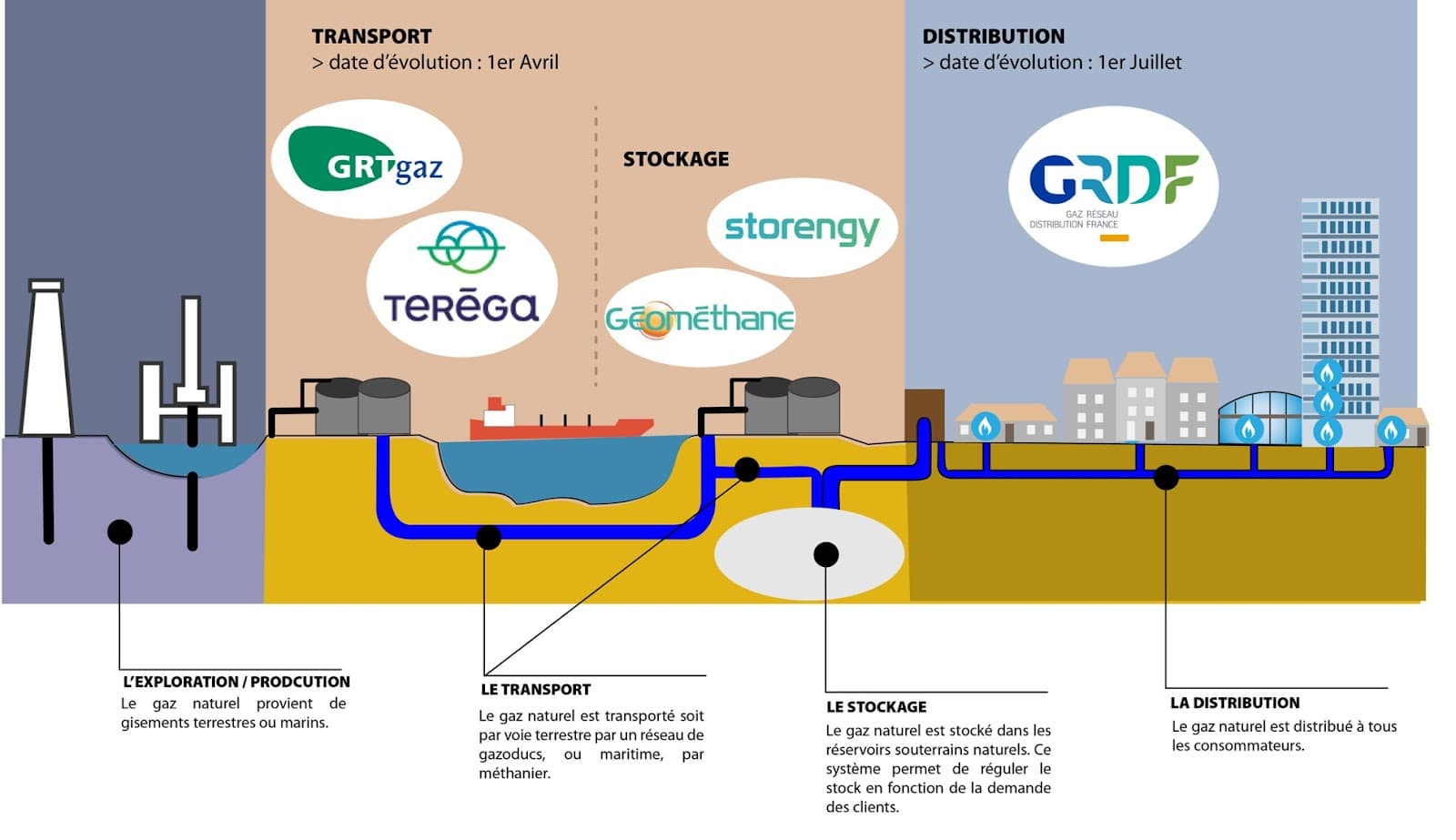
After the exploration phase, once the natural gas is located, gas companies check the viability of a deposit. They therefore proceed with several initial drilling operations in the Earth's crust to reach and delimit the gas pocket, which is generally located at a depth of more than 2 kilometers.
Once the potential of a deposit has been confirmed, impressive drilling infrastructures are installed on land or at sea, vertical to the wellbore. In practice, A drilling tower is erected to maneuver a drill head equipped with very hard diamond teeth, allowing drilling to depths of up to 6 kilometers.
Once the gas pocket is reached, the gas rises up into the borehole pipes, either under the effect of pressure or by pumping. The gas is then stored, processed and transported.
The natural gas is then transported from the drilling area to distribution networks to which end customers are connected. The means used to transport gas to the distribution network are of two types:
There are several types of natural gas storage :
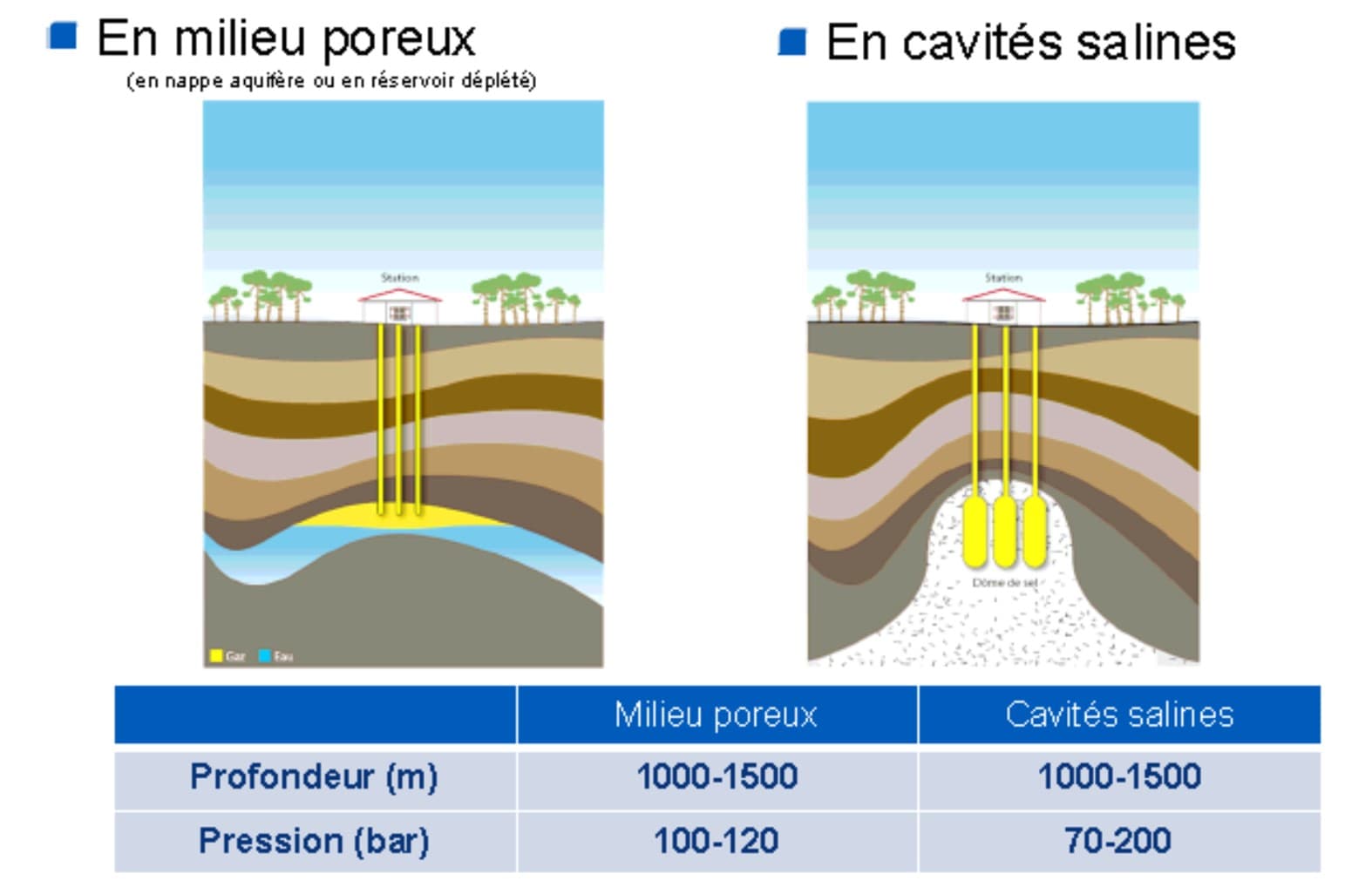
Source: Environmental Encyclopedia
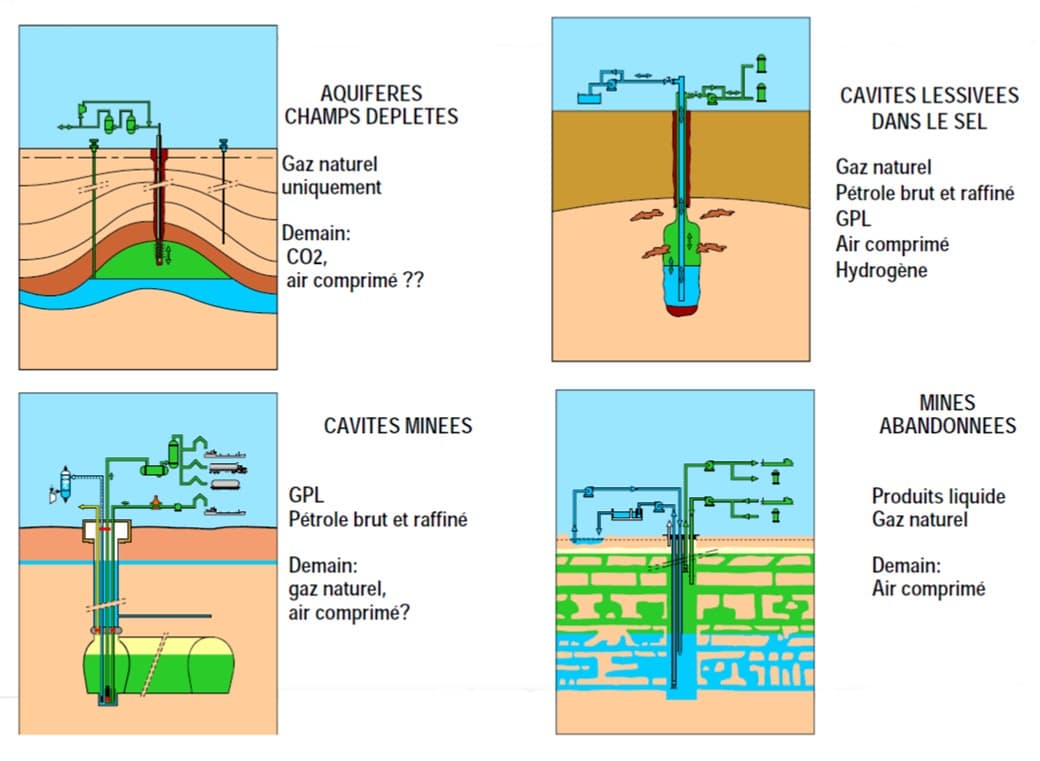
Source: Environmental Encyclopedia
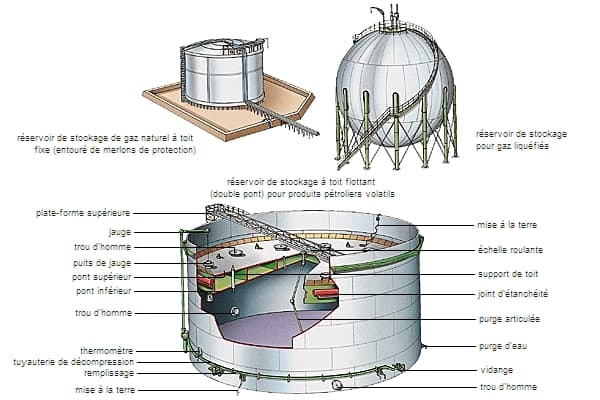
Source: Types of gas storage tanks, drawing by Patrick Taëron - Archives Larousse
There are various methods for extracting natural gas. And although the vast majority of natural gas is of fossil origin, because it is generated by the decomposition of organic matter that is several million years old, Natural gas is not renewable energy.
Indeed, just like coal and Oil, natural gas is not inexhaustible since it is consumed more quickly than it is formed in the Earth's geological layers. Its extraction, like that of other fossil fuels, causes considerable damage to the environment due to the installation of highly polluting industrial installations on extraction sites.
Natural gas only allows a 25% reduction in emissions compared to oil.
Note that there is an alternative to fossil gas: renewable natural gas resulting from methanization, i.e. the decomposition of organic matter in methanizers. This gas is considered to be green and renewable energy. It should be noted that this gas remains marginal in total consumption in France.
In France, the Lacq deposit, which once supplied up to 50% of French consumption, is still partially active and supplies only a few local businesses marginally.
Today, France imports all of its natural gas needs. This gas comes mainly from Norway. Russia thus comes in second position, followed by Algeria, Nigeria and the Netherlands.
The war that Russia is waging in Ukraine has highlighted the very strong dependence of EU economies on natural gas gas pipeline from Russia. Regardless of the measures taken in the emergency of the Ukrainian crisis, the EU must prepare for the future and protect against the risk of cuts gas imports threatening its democratic political model.
If Europe wants to give gas a future, it must now invest in port infrastructure to develop LNG (liquefied natural gas) and in new gas pipelines to diversify its onshore supplies from Russia.
PO Statistical Review foresees a significant drop in the use of natural gas in the coming decades, or even a total cessation of its use by 2050.
Currently, the Ministry of Energy Transition and ADEME push industries that consume a lot of heat, such as the food industry or the chemical industry, to acquire biomass boilers to decarbonize their sites. These subsidy programs, BCIAT and DECAR INDUS, are part of the industrial recovery plan decided by the public authorities.
Natural gas is considered by many to be a transition energy.
You are a venture and do you feel lost in the jungle of natural gas and electricity offers? Are you wondering what is the best energy contract for your business?
SirEnergies offers you an offer adapted to the specificity of your business, regardless of your size.
Click below for more information:
In a few clicks, organize an exchange with one of our experts.


weekly newsletter subscribers

4.9

.png)

L'augmentation s'explique par la revalorisation de l'Accise sur le gaz à 16,39 €/MWh et la hausse de 3,41 % du tarif de transport (ATRT 8).
S'y ajoute l'entrée en vigueur des Certificats de Production de Biogaz (CPB), un nouveau coût réglementaire pour soutenir le biométhane.
Face à ces évolutions, Sirenergies vous accompagne dans l'achat de gaz naturel pour sécuriser vos prix malgré la volatilité du marché.