




Summarize with AI

February 13, 2026
6
Min reading
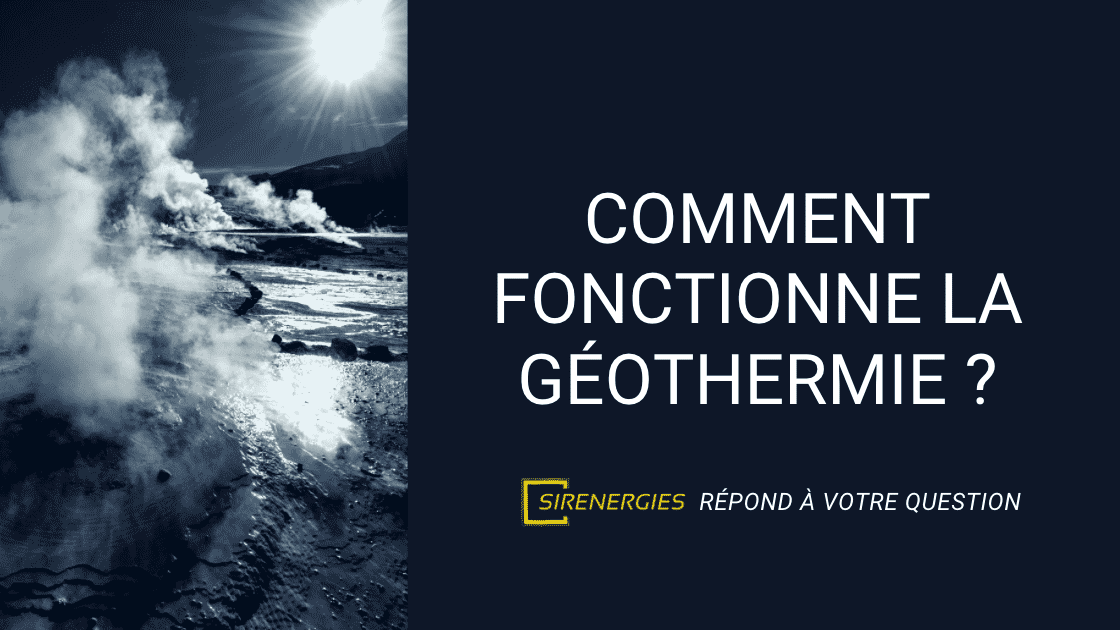
There are lots of ways to generate electricity. Geothermal energy is one of the cleanest and environmentally friendly ways.
In fact, it is a renewable energy, which uses the heat of the water contained in deep groundwater. It is therefore clean and almost inexhaustible.
At the time of Global warming, it is essential to find and operate means of production that do not emit CO2 into the atmosphere.
Geothermal energy meets all these criteria, so in this article we will see to what extent this energy can be part of the energy transition.
A geothermal power plant is based on a relatively simple basic principle.
The water contained in the depths of our planet can reach a very high temperature. In fact, the temperature of the rocks that make up the Earth's crust Increases by 1°C for every 30 m in depth. This pace gets faster the closer you get to the center of the Earth.
Volcanoes and hot springs are the most visible representations of this. It is therefore possible to dig in order to exploit the temperature of the ground as energy source.
The principle of the pump is therefore to use this heat contained in the ground in order to be able to exploit it. This is possible with the help of a fluid that will be heated in contact with more or less deep rocks and will be raised by the pump.
The fluid contained in the pipes that transport it to depth varies according to the installation. It can be water or a Glycol liquid (water + antifreeze) as we will see. There are two methods for exploiting a geothermal system: vertical and horizontal capture.

Source: dedietrich-thermique.fr
In the case of vertical catchment, we install geothermal probes upto 100 meters deep maximum. They consist of two closed U-shaped circuits in which the glycol liquid circulates.
It is essential that the soil used is sufficiently extensive and that no trees are planted on its surface. Roots can be a barrier to the effectiveness of vertical sensors.
This methodology is more expensive than horizontal capture because the heat captured is located deeper. The water contained at this depth is not subject to climatic hazards and this system is thus more efficient and stable.
This solution is often preferred by businesses, as the installation is too expensive for individuals.
Source: geothermies.fr
This is the most common method among individuals. The installation is located between 0.6 and 1.3 meters deep. Unlike vertical catchment, it is necessary to have a sufficiently large area. In particular, it must be much larger than the surface to be heated.
The installation also has polyethylene pipes who will be responsible for transporting the fluids. This will allow the interior of the home to be heated via a In-ground cable network. It is an alternative to the classic heating system for a home.

Source: geothermies.fr
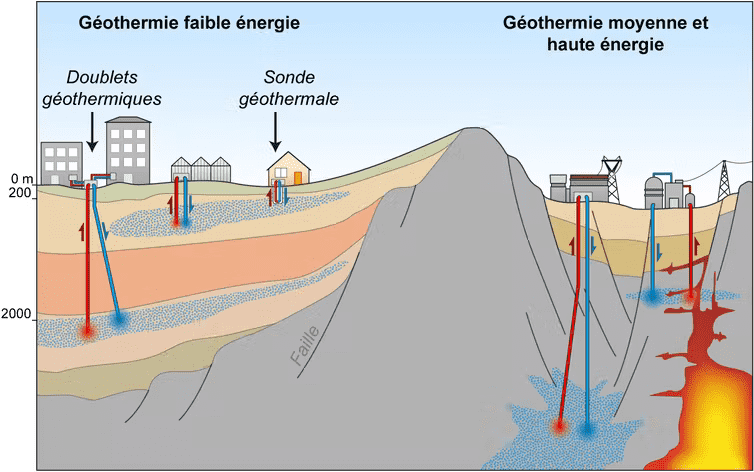
The techniques used, the performance and the uses are different depending on the depth of the installation. The heat from the water and the rocks also increases at depth.
Source: theconversation blog
It is located at an understood depth between 0 and 400 meters, at this distance the temperature is around 15 to 20 degrees. This method is mainly used for domestic uses. Generally, this system is used to heat a heat-transfer fluid or to cool it using a system of pipes as well as a heat pump.
It is the most used method because it is the least expensive and the easiest to install. It involves minimal risks, which makes it an important asset in its implementation. In fact, fluids circulate in closed loops: that is to say, the fluid transported is never in contact with the outside and always carries out the same circuit. This is a heat exchange by thermal diffusion only.
The entire circuit therefore has geothermal probes, vertical or horizontal, of a heat pump as well as a watertight pipe network.
It is possible to dig an even deeper level to find higher temperatures. Beyond the 400 meters deep The temperatures are between 50 and 120 degrees Celsius.
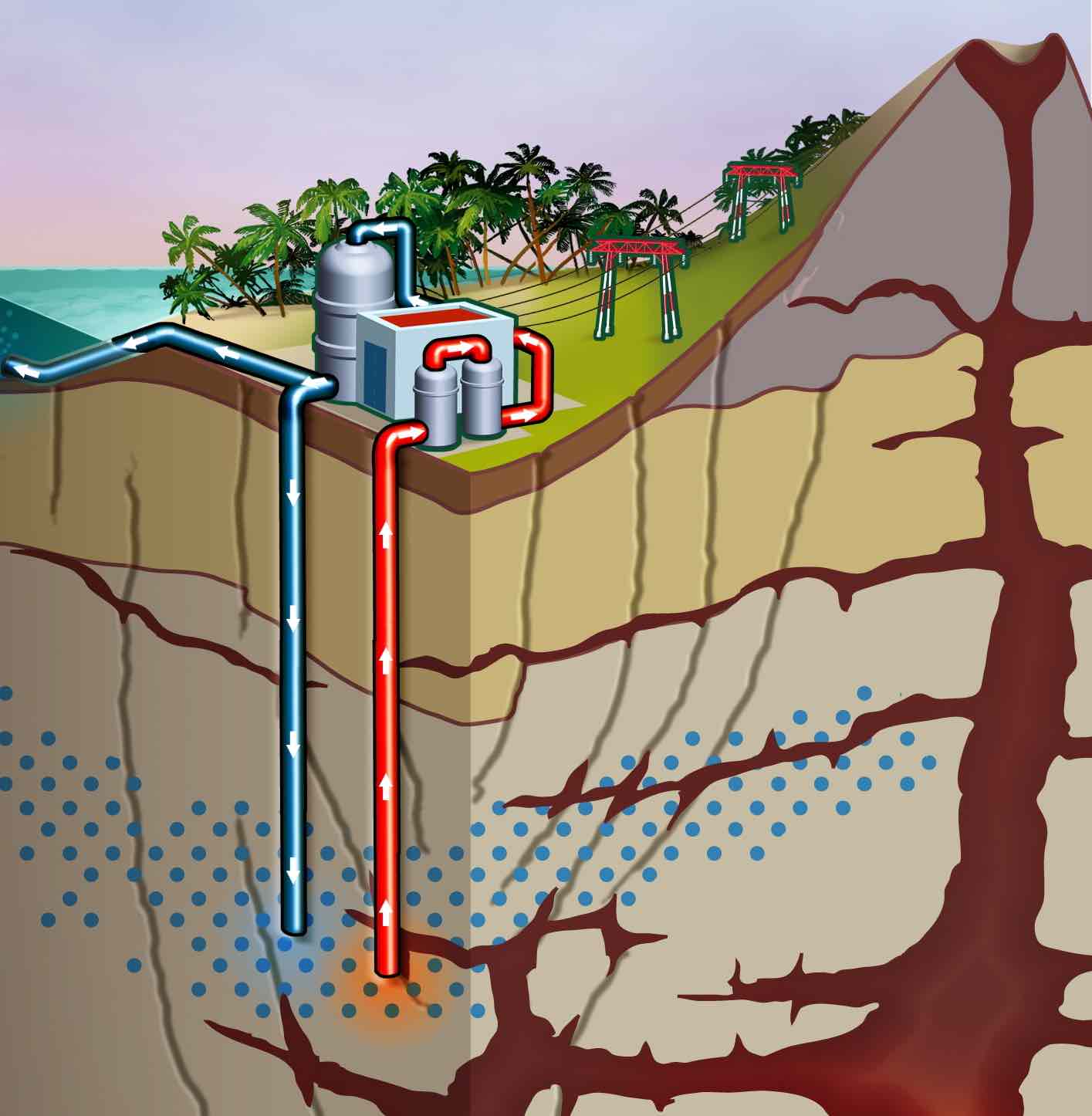
There are several extraction methods but the general idea remains the same. It involves recovering water heated to a high temperature. For example, there are places in the basement where water is naturally heated, for example the site of Bouillante in Guadeloupe.
The heat released by this hot water is then recovered using a heat exchanger ; the thermal energy of this water heats another heat-transfer liquid.

Source: TotalEnergies
This type of installation is generally used for electricity production. The costs of this type of installation are relatively high.
To do this, a water pump is installed that injects water deeply. It has two closed circuits, primary and secondary.
This method is costly and includes numerous risks ; however, its performance is important. It is a question of injecting water into the rock deeply to fracture the ground and allow the water to circulate among the hot stones before rising up. However, these methods are becoming rare because of the Earthquake risk caused by repeated fractures. In this respect, it is necessary to clearly distinguish between stimulation and hydraulic fracturing.
In fact, with stimulation, fresh water is injected in order to enlarge existing faults; the water pressure is therefore 4 to 5 times lower than hydraulic fracturing.
As we saw in the previous section, Geothermal energy does not emit greenhouse gases through its heat production process. At a time of energy transition, it is absolutely crucial to rely on technologies that allow us to produce electricity at the lowest cost for the planet. It is a renewable energy almost inexhaustible.
Its energy efficiency remains limited, but its abundant and practical nature makes geothermal energy a Future energy.
It depends little on natural resources (such as gas, wind, sun...) and can be found anywhere on the planet.
Deep hydraulic fracturing can cause earthquakes, or collapses of some basements. Deep geothermal energy requires a detailed and detailed knowledge of the subsoil in question. You need to know the depth of the cavities and their shapes in order to reduce the risk of collapse.
It is obvious that moving equipment as well as drilling are activities that emit CO2. However, compared to others fossil fuels extremely harmful to the environment (Combustion of coal or gas), geothermal energy seems to be a completely measured choice.
In conclusion, it is necessary to remember that geothermal energy has many advantages, beyond being a clean energy. We can imagine that in the years to come this technology will be adopted on a large scale, like solar panels.
The fact of being able to provide it to individuals in their homes is a major asset in energy transition. We can hope for a democratization of this type of process.
Moreover, unlike wind turbines, geothermal energy does not cause negative reactions (noise, landscape, etc.). In France, not all soils are suitable for this type of installation; however, if the public authorities take up the subject, it is likely to see this subject evolve.
To go further, discover Why is energy a major challenge for tomorrow?
In a few clicks, organize an exchange with one of our experts.


weekly newsletter subscribers

4.9

.png)

The range E @sy is available in four pricing structures to adapt to each risk profile:
Yes. The supplier guarantees an offer 100% renewable via the official Guarantees of Origin (GO) mechanism.
For the most demanding companies, the offer GREENVOLT+ ensures very low carbon intensity electricity, sourced exclusively from independent French producers (hydraulic, wind, solar).

On distingue la géothermie de surface (basse température), idéale pour le chauffage domestique via des pompes à chaleur , et la géothermie profonde (haute température), utilisée par les industries pour produire de l'électricité ou alimenter de grands réseaux de chaleur urbains. Cette expertise est au cœur de notre offre conseil pour les entreprises.
La géothermie est une énergie renouvelable, locale et constante, contrairement au solaire ou à l'éolien. Elle offre un rendement élevé, réduit les émissions de CO2 et permet de réaliser d'importantes économies sur le long terme. Pour intégrer cette énergie, découvrez notre offre sourcing achat d'énergie.
Le captage vertical utilise des sondes jusqu'à 100 mètres de profondeur, offrant une performance stable car non soumise aux aléas climatiques. Le captage horizontal, plus répandu chez les particuliers, nécessite une grande surface de terrain à faible profondeur. Nos experts analysent ces variantes dans notre offre secteur industriel.
Les installations géothermiques n'émettent quasiment pas de gaz à effet de serre en phase d'exploitation. Elles permettent de substituer les chaudières fossiles par une solution bas carbone performante. C'est un levier clé étudié par Sirenergies dans l'offre énergie ETI & grandes entreprises.
La température des roches augmente en moyenne de 1 °C tous les 30 mètres de profondeur. Pour la géothermie profonde, on peut atteindre plus de 150 °C pour produire de l'électricité. Pour optimiser vos coûts liés à ces projets, consultez notre offre optimisation facture et taxes.
Oui, la géothermie de basse énergie (entre 30 et 90 °C) est particulièrement adaptée pour alimenter des réseaux de chaleur urbains et chauffer des parcs industriels. Cette solution collective est détaillée dans notre offre énergies collectivités locales & acheteurs publics.
Les entreprises peuvent bénéficier du Fonds Chaleur de l'ADEME, qui soutient fortement l'investissement dans la géothermie. Le dispositif des CEE encourage également ces installations. Sirenergies vous accompagne dans ces démarches via son offre énergie PME/PMI
Utilisée en captage vertical, la sonde est composée de circuits fermés en U où circule un liquide caloporteur (eau glycolée). Elle capte les calories du sol pour les remonter vers la pompe à chaleur. Découvrez comment Pom’Ligne a optimisé ses flux énergétiques dans notre étude de cas dédiée.
La PAC extrait les calories captées dans le sol pour les transférer à l'intérieur du bâtiment via un condensateur. Elle permet de multiplier l'énergie consommée par un coefficient de performance (COP) élevé. Apprenez-en plus sur le pilotage de ces équipements dans notre guide sur le pilotage énergétique.
Oui, les pompes à chaleur géothermiques peuvent être réversibles. En été, elles rejettent la chaleur du bâtiment dans le sol pour rafraîchir les locaux. Ce sujet est approfondi dans notre article sur les alternatives à la climatisation classique.
L'énergie est puisée directement sous le site de consommation, évitant ainsi les pertes liées au transport et renforçant la souveraineté énergétique. C'est une réponse directe aux enjeux de sécurité énergétique en France.