




Summarize with AI

March 6, 2026
8
Min reading
On Tuesday, March 21, 2023, the National Assembly adopted at first reading the bill aimed at accelerating the construction of new nuclear reactors in France. Consideration of the text is continuing in Parliament.
This bill is in line with the energy guidelines presented by the President Emmanuel Macron on February 10, 2022. A year ago, in his speech in Belfort, the Head of State detailed the three axes of the national energy policy: The civil nuclear recovery plan, the acceleration of renewable energies and energy sobriety. The objective? Take France out of fossil fuels and achieve carbon neutrality in 2050.
To relaunch the nuclear, the government plans to build six new EPR2 and to study eight additional EPR2. A call for projects worth one billion euros should also be launched. “to make small SMR modular reactors emerge”.
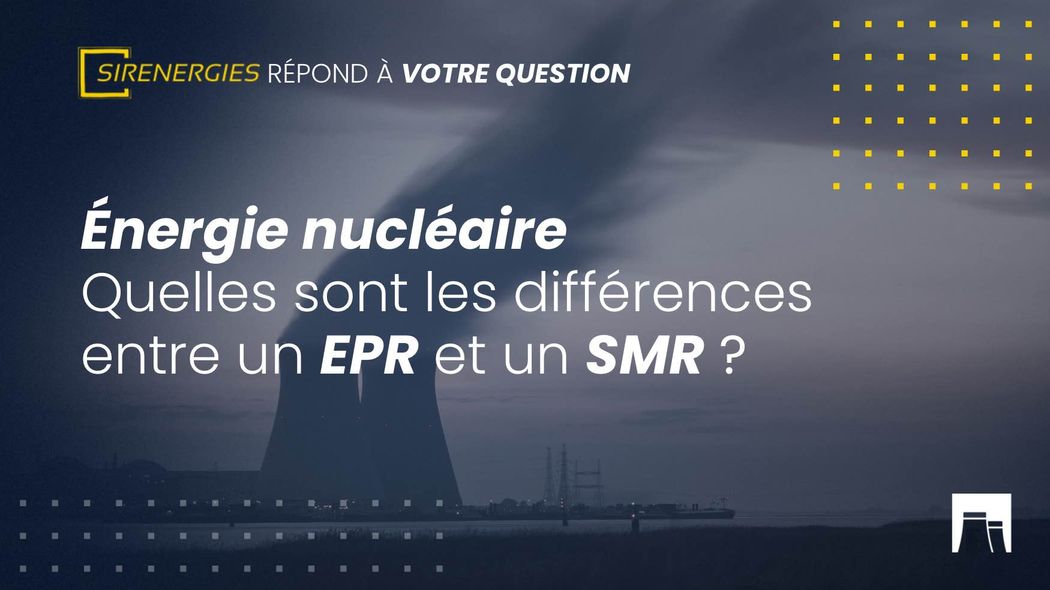
EPR, SMR, what do these acronyms mean? What are the differences and complementarities between these technologies? What are their strengths and limitations? Lighting
The acronym EPR stands for Evolutionary Pressurized Reactor. It is translated as a European pressurized reactor. EPR is often associated with negative collective representation due to construction delays in Flamanville EPR or the Taishan incident in June 2021. From a technical point of view, it is a powerful technology that offers several advances compared to current reactors.
The EPR belongs to the family of third-generation nuclear reactors. It operates on the same principle as the 56 reactors that currently make up the French nuclear fleet: Nuclear fission.
It consists in disintegrating a heavy atom, uranium, into several light nuclei, causing chain impacts between atoms. These disintegrations cause heat to be released. It is used to heat water and generate steam. Coupled with an alternator, steam activates a turbine and produces electricity.
The EPR is now available in a so-called “optimized” version, The EPR2. This reactor model was developed by EDF based on feedback from ongoing EPR construction sites. According to EDF, it is “the first reactor designed digitally”, and to use 4D simulation and 3D visualization to detect anomalies.
Today only two EPRs are active in the world in Taishan, China. In Europe, the normal commissioning of the Olkiluoto EPR in Finland is imminent, announced for spring 2023. Three other EPRs are under construction, one in France in Flamanville and two in the United Kingdom, at Hinkley Point.
The law text currently under discussion in Parliament should facilitate the construction of six EPRs in France. Of the EPR2 type, the reactors would be located, in pairs, at Penly in Seine-Maritime, Gravelines in the North and Bugey in Ain.
While the legislative draft should simplify procedures, it does not call into question the procedure for public debate and the examination of the authorization file by Nuclear Safety Authority (ASN).
In addition to EPRs, the French nuclear recovery plan provides for an investment of one billion euros in SMRs, or Small Modular Reactors. They are small modular reactors, complementary to EPRs.
The SMR is also a nuclear reactor. It produces electricity from nuclear fission.
It differs from its big brothers by its small size and lower power. The efficiency of the most powerful SMRs does not reach 20% of that of an EPR. An SMR can produce 10 to 300 megawatts.
Several technologies are currently under study and development. The majority of SMR prototypes deploy the same technologies as EPRs. In order to maintain the chain reaction, neutrons, which are the cause of collisions between atoms, are slowed down using the technique of moderation using pressurized or boiling water. But some projects are testing Overgeneration.
Still confidential because it is very expensive, supergeneration allows nuclear reactors to produce more fissile fuel than they consume. The aim is to produce both electricity and nuclear fuel to reduce waste production and uranium mining.
An SMR offers nuclear services on a small scale. For example, in Finland, SMRs are being studied to create district heating networks. They could also be used to desalinate seawater, electrify isolated sites, or replace medium-power plants that run on fossil energy.
Seventy SMR projects are listed in the world by The International Atomic Energy Agency.
United States, Canada, United Kingdom, Indonesia, Argentina, Argentina, Argentina, Argentina, Argentina, Argentina, Argentina, Argentina, Argentina, Sweden, Sweden, Sweden, South Korea, Denmark...: around the world, many countries have embarked on the SMR race, with projects of varying degrees of maturity. But only three SMRs are currently active. With a power of 35 megawatts, two are located in Russia. The third is in China and has a power of 200 megawatts.
France also launched in 2017 with the Nuward (Nuclear Forward) project led by EDF, the Atomic Energy Commission (CEA), TechnicAtome and Naval Group. By 2035, the consortium intends to offer a 340 megawatt SMR power plant composed of two independent 170 megawatt reactors.
The EPR and the SMR are nuclear reactors that produce electricity from nuclear fission. One does not replace the other. These are two models of nuclear reactors of very different size and capacity. Complementary, EPR and SMR technologies meet electricity needs, each at its own scale.
With a power of up to 1,660 megawatts, EPR technology makes it possible to meet large-scale energy needs over a larger territory.
However, due to its construction complexity and costs, EPR is not accessible to all markets. That's where SMR technology comes in. Small and flexible, SMRs meet the energy needs of local and specific markets. They make it possible to offer carbon-free electricity in territories that were previously inaccessible for nuclear, such as isolated sites, islands or small local electrical distribution networks.
SMRs are also a sustainable solution to replace medium-power plants producing electricity from fossil fuels (coal-fired power plants,...). Finally, they can be used for specific applications such as Hydrogen production or heat and electricity cogeneration.
In the evaluation report on the project to build second-generation EPR reactors published in early 2022, the cost of building three pairs of EPR2 (i.e. six reactors) is estimated at around 52 billion euros. Compared to first-generation EPRs, the cost remains under control thanks to the standardization of manufacturing and modularization.
In comparison, estimates of the cost of building an SMR are between 100 million and 1.5 billion euros depending on the size of the project and the technology used. Compact modular reactors with a simplified design, SMRs can be assembled on site, from several modules manufactured upstream in the factory.
This standardized serial construction and the industrialization of components and systems reduce construction times and costs. For the construction of the SMR Nuward, EDF announces a commissioning deadline 40 months after the first stone was laid.
EPRs and SMRs all guarantee maximum levels of safety and reliability, both in their design and in the strict maintenance and monitoring procedures.
More complex and sensitive, the safety of the EPR is ensured by sophisticated systems, mostly active, requiring a continuous power supply. This is the case, for example, with the injection system, composed of pumps and valves. In case of emergency, it allows cold water to be injected into the reactor circuit in order to maintain the temperature of the fuel at a safe level.
SMRs are less complex in design. Their safety is largely ensured by passive systems that use gravity, convection, and diffusion to keep the reactor safe in an emergency, without the need for human intervention. In the passive cooling system with natural circulation, the reactor is immersed in a water tank. In an emergency, water is automatically released into the cooling circuit and descends by gravity to the reactor core to cool it.
EPR and SMR technologies offer a promising sustainable solution To produce electricity decarbonized while reducing greenhouse gas emissions. However, the beginnings are not without difficulties. Both technologies continue to be the subject of research and development.
On the EPR side, the first construction sites are synonymous with delays, additional costs and incidents, but the first success in China sends a positive signal. With the EPR2 drawing on the experience of the EPR, the prospects are now encouraging for the successful commissioning of the first EPRs in Europe.
On the SMR side, many countries are still in the study and prototyping phase. But if SMR technology succeeds in meeting economic, security and regulatory challenges, this technological innovation will facilitate access to low-carbon and flexible energy in all markets, even small and remote ones.
Despite their advantages, EPR and SMR technologies have limitations.
The main limitation is cost. The construction, maintenance and management of EPRs generate high costs due to their size and complexity. Although SMRs are small and standardized, they are still in the early stages of development. Studies and prototypes generate significant costs that raise questions about future expansion capabilities.
Second brake on nuclear power: the question of nuclear safety And of management of radioactive nuclear waste and the problem of social acceptance. The development of nuclear power must be accompanied by the development of storage solutions long-term safe and secure to reduce the risks of radiation, environmental contamination and terrorism.
EPR and SMR are two complementary nuclear technologies that meet different energy needs. The EPR allows large-scale electricity production while the SMR makes carbon-free nuclear electricity accessible to small local markets. The combination of these two technologies offers a sustainable future solution for producing electricity while reducing greenhouse gas emissions. Their success will depend on the ability to overcome economic, technical, and social challenges.
If nuclear fission is a future solution for The energy transition, nuclear fusion would make it possible to go even further. This promising technique produces three to four times more energy but much less radioactive waste. It is in France that 35 countries are now working together as part of the international research program on nuclear fusion ITER to demonstrate the scientific and technological feasibility of large-scale energy production from nuclear fusion.
In a few clicks, organize an exchange with one of our experts.


weekly newsletter subscribers

4.9

.png)

Le dispositif ARENH a laissé place au VNU (Versement Nucléaire Universel).
Ce changement structurel expose davantage les entreprises aux prix de gros, rendant la gestion des risques plus complexe qu'auparavant.
Il devient alors indispensable de définir une stratégie d'achat d'électricité avec Sirenergies pour lisser l'impact de la volatilité des marchés sur votre budget.
These are signals sent by RTE during periods of tension on the electrical network. The Sirenergies tool informs you in real time to anticipate your uses.
Exceeding capacity leads to financial penalties and can impact the size of the contract. Adjust the correctly subscribed power makes it possible to avoid these additional costs.
The range E @sy is available in four pricing structures to adapt to each risk profile:
Yes. The supplier guarantees an offer 100% renewable via the official Guarantees of Origin (GO) mechanism.
For the most demanding companies, the offer GREENVOLT+ ensures very low carbon intensity electricity, sourced exclusively from independent French producers (hydraulic, wind, solar).
Tertiary companies are concerned by taxes such as TICFE or TICGN. Sirenergies checks the accuracy of invoices, identifies possible exemptions, and helps correct errors to sustainably reduce costs.
Oui, elle est considérée comme une énergie renouvelable à faibles émissions de gaz à effet de serre.
De plus, l'eau ne subit aucune transformation chimique durant le cycle de production et réintègre son milieu naturel en aval.
Cependant, la construction de barrages nécessite des mesures pour protéger les écosystèmes (débit minimum, passes à poissons).
Le processus repose sur l'utilisation de la force de l'eau (énergie cinétique) issue des courants, des chutes d'eau ou des dénivelés. Le fonctionnement suit trois étapes clés :
Le kVA mesure la capacité maximale que votre compteur peut supporter à un instant T, tandis que le kWh mesure la quantité d'énergie consommée sur une durée.
Un appel d’offres permet de mettre en concurrence plusieurs fournisseurs d’électricité et de gaz afin d’obtenir des conditions contractuelles optimisées. C’est une démarche transparente qui permet de choisir l’offre la plus adaptée aux besoins budgétaires et techniques de l’organisation.
Le transport (RTE) correspond aux "autoroutes" de l’électricité. Il s’agit de transporter de très grandes quantités d'énergie sur de longues distances, depuis les centrales de production (nucléaires, barrages, parcs éoliens offshore) vers les régions de consommation.
La distribution (Enedis) s'apparente aux "routes départementales" et aux rues. Elle récupère l'électricité à la sortie du réseau de transport pour la livrer directement chez le client final, en abaissant la tension pour qu'elle soit utilisable par vos appareils.
This makes it possible to choose the right time to contract, secure your budgets and anticipate increases.
Ce record de 92,3 TWh s'explique par la conjonction de trois facteurs :
L'abondance de production française tire les prix du marché de gros vers le bas.
En vertu du mécanisme de l'Ordre de Mérite (Merit Order), les centrales les moins coûteuses (nucléaire, renouvelables) couvrent la demande plus souvent, évinçant les centrales à gaz ou charbon plus onéreuses.
Cela multiplie les épisodes de prix bas, voire négatifs, sur le marché spot.
Sourcing consists in identifying and analysing the offers of several electricity and gas suppliers. This approach makes it possible to obtain contracts adapted to the consumption profile and budgetary constraints of the company.
Among the taxes include TICFE, TICGN, CTA, CJA and TURPE. They represent a significant part of the bill and vary according to consumption profiles. Understanding them well is essential to optimize costs.
Tertiary companies must manage their energy costs while guaranteeing the comfort of users (offices, shops, services). Consumption is often linked to heating, air conditioning and lighting, which requires precise monitoring to avoid budgetary excesses.
Parce que la puissance souscrite en kVA détermine le prix de l'abonnement et que tout dépassement peut entraîner des surcoûts importants.
The €/MWh is a price unit used in wholesale markets, while kWh is the unit visible on your bills.
Farms are subject to taxes such as TICFE or TICGN. Sirenergies verifies their application, identifies cases of exemption and accompanies the procedures to reduce the tax burden.
En 2025, la France a atteint un solde exportateur net de 92,3 TWh, battant le précédent record de 2024 (89 TWh).
Communities are subject to taxes such as TICFE or TICGN. Sirenergies analyzes invoices, identifies exemption possibilities and fixes possible errors to reduce the tax burden.
In 2025, the supplier had a NPS (Net Promoter Score) of +16 and a note of 4,17/5.
Satisfaction is based on a “zero solicitation” model and 100% in-house customer service in Toulon, guaranteeing proximity and responsiveness that cannot be found with major historical suppliers.
The subscribed power must be calculated according to the consumption profile and uses (heating, industrial processes, tertiary equipment). One fine analysis makes it possible to ensure the adequacy between real need and contract.
Some businesses may obtain a partial or total exemption from the TICFE or the TICGN, depending on their activity and energy intensity. The support of an expert makes it possible to identify the eligibility criteria and to put together the file.
C'est le levier le plus rapide pour obtenir des résultats visibles. L'éclairage représente environ 40 % de la consommation d'électricité d'une commune.
Passer au LED avec pilotage intelligent permet de réduire la facture de 50 à 80 %, avec un retour sur investissement (ROI) rapide, souvent estimé à 2 ou 3 ans.
One invoice consists of several elements: consumption, supplier share, taxes and contributions. The analysis of each line makes it possible to identify possible errors and to check the consistency with the signed contract.
C'est l'indicateur d'efficacité d'un appareil électrique ; il représente le ratio entre la puissance active (utile) et la puissance apparente (totale).
The industry is concerned by TICFE, TICGN and other contributions that may represent an important part of invoices. Sirenergies identifies cases of exemption and accompanies the procedures to benefit from them.