




Summarize with AI

January 28, 2026
8
Min reading

With each publication, the IPCC The hammer: the climate emergency is here. Its main manifestation? The rise in global temperature. The decade 2011-2020 was the hottest decade in 125,000 years. Greenhouse gas (GHG) emissions are the main cause of this global warming.
And, despite a deceleration in recent years, they continue to increase sharply. According to the 6th IPCC summary report published on 20 March 2023, An average of 56 GtCO2eq were issued per year over the last decade.
To achieve the goals of the Paris Agreement and limit global warming to 1.5°C, a decrease in greenhouse gas emissions from 2025 is essential for achieve carbon neutrality in 2050. The difficulty highlighted by the IPCC? The improvement in energy efficiency is currently unable to compensate for the overall increase in economic activity.
In this context, how can we reduce the concentration of CO2 in the atmosphere? For the IPCC, you have to acting on two levels. Reducing greenhouse gas emissions at the source remains a priority.
But it is now too slow. Faced with the climate emergency, scientists are calling for develop in addition the capture of CO2 in the air.
How to succeed in this technological feat? Techniques for capturing, storing and reusing CO2 already exist. What are they? What are their challenges? What opportunities do they open up?
Discover these promising future solutions to support The energy transition.
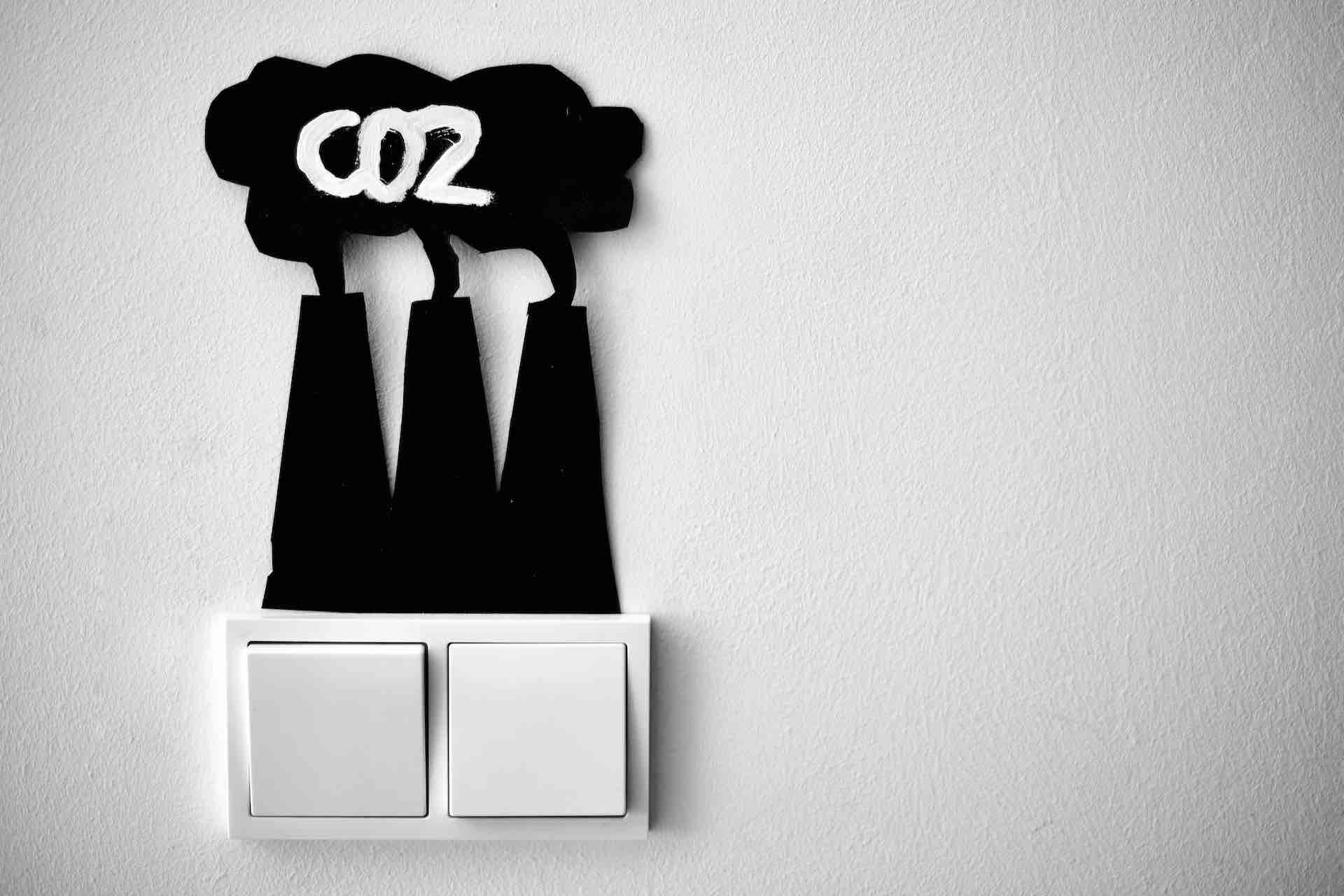
As its name suggests, the capture of CO2 in the air — also called CSS for Carbon Capture Storage —, consists in capturing carbon dioxide molecules in the air or industrial smoke. The objective? Imprison them at the source before they are released into the atmosphere.
Captured carbon dioxide may be stored under the ground, in the rock, in ancient hydrocarbon or coal deposits or in the ocean floor at great depths. CO2 can also be transformed for reuse.
Although CO2 capture has made a big comeback in the news with the release of the latest IPCC report, experiments have been carried out since the 1970s. In Europe, the Castor project, launched in 2004, was already aimed at developing technologies to capture and store CO2.
Today, around thirty installations are in operation around the world, mostly located in the United States. They make it possible to capture 40 million tons of CO2 per year. In its Net Zero Emission by 2050 scenario, the International Energy Agency (IEA) Aim for a objective of 7.6 Gt of CO2 captured each year starting in 2050 thanks to advances in capture technologies.
Today, there are several methods for capturing, storing and reusing CO2 (known as CCSU). Here are four of these technologies currently being tested and experimented with.
Photosynthesis is the chemical process by which plants use light energy to transform carbon dioxide into energy-rich organic substances. This reaction is accompanied by the production of oxygen released into the atmosphere.
Engineers had the idea of transposing this natural mechanism to industry by developing artificial photosynthesis modules. These capture CO2 in the air and, through a chemical reaction using solar energy, the transform into reusable chemicals. For example, they can produce polyethylene used in the manufacture of plastic materials, methane, nitrogen fertilizers for agriculture, or carbon monoxide for fuel production like ethanol.
This still emerging technology makes it possible to Transform a greenhouse gases polluting a resource. However, it still poses numerous challenges to research teams. Experiments are continuing to improve the robustness, autonomy, efficiency and costs of the system and to rely on abundant metals. While this method is promising, we are still a long way from an industrial process that can be deployed on a large scale...
One of the techniques for capturing CO2 consists in capturing it directly from industrial smoke where it is highly concentrated. This requires separating carbon dioxide from the other components (water vapor, oxygen, nitrogen...).

Industrial carbon sequestration - Source: Hellocarbo
Chemical absorption is the best known post-combustion capture technique. It consists in extracting CO2 from the smoke using a chemical solvent, most often amines. Recovered carbon dioxide is compressed, cooled, and liquefied to be trapped in the deep layers of the earth.
This technique for capturing and separating CO2 has been used for decades in industry, in particular for natural gas processing. Very efficient, it makes it possible to capture more than 90% of the carbon dioxide emitted. If the IPCC considers that “post-combustion by absorption is technologically ready to go on an industrial scale”, it nevertheless requires expensive installations that consume large amounts of energy.
Bioenergy with carbon capture and storage (BECCS) consists in capturing and storing carbon dioxide emitted by the production of energy from the combustion or fertilization of organic matter composing Biomass.
Let's take an example: wood fuel. In this model, trees are burned to produce energy. The CO2 emitted by combustion is captured and stored by sequestration in the ground. In this example, BECCS is recognized as a negative emissions technology (NET) because the CO2 absorbed by trees during their growth compensates for the CO2 emitted by energy production.
However, bioenergy with carbon capture and storage raises the question ofland use. According to the IPCC, deployed on a large scale, it would require the use of 25 to 40% of the world's arable land, to the detriment of food security.
Direct air capture — or Direct Air Capture (DAC) — consists in capturing CO2 from the atmosphere.
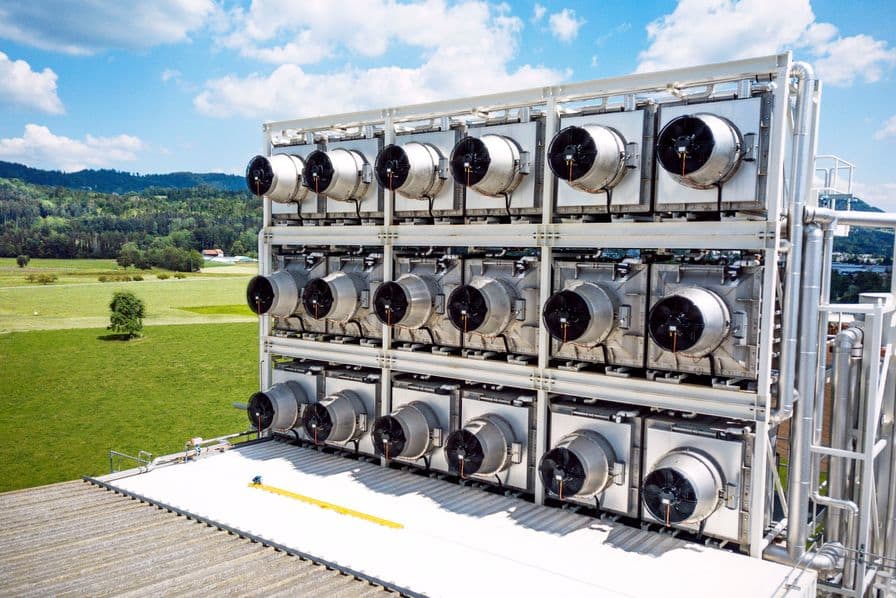
Source: L'Usine Nouvelle
There are two techniques. The liquid DAC system consists in “washing” the air using a chemical solution. This eliminates CO2. The cleaned air is released into the atmosphere. The solid DAC system use filters that absorb carbon dioxide.
In concentrated form, it is captured to be stored or reused. 18 small-scale installations around the world exploit this process for direct uses such as the manufacture of soft drinks.
However, due to the dilution of carbon dioxide in the air, direct capture remains a expensive and energy-consuming process.
While the capture of CO2 offers promising prospects, its large-scale industrialization nevertheless requires the removal of several financial, environmental and energy obstacles.
Capturing, storing and/or recovering CO2 represents investment and operating costs that are still high. The IPCC estimates that installing a CCS system on a coal or gas power plant involves a significant additional cost, due to the 13 to 44% increase in fuel required to produce the same quantity of electricity.
Today Emitting greenhouse gases is still cheaper for manufacturers to invest in a carbon dioxide capture installation. On the European trading system, the average price of the carbon emission quota (equivalent to one ton of CO2 or CO2 equivalent) was 80 euros at the end of 2022.
In comparison, the investment in carbon dioxide capture is estimated between 50 and 180 euros per ton of CO2 captured. It can go up to 1,000 euros in the case of direct air capture systems (DACCS).
Financing the capture of CO2 in the air requires questioning the role of the private sector and public authorities in reversing the trend and make investments in the energy transition more favourable than the status quo.
CO2 capture poses a fundamental question: where and how to store captured and non-recovered gas without creating damage to the environment?
The IEA answers this question in its report published in 2020. According to the international agency, land and sea storage capacity is guaranteed over the long term using ancient hydrocarbon deposits and deep saline aquifers. By themselves, these marine reservoirs represent 400 to 10,000 gigatons of storage.
In total, the storage capacity is estimated between 8,000 and 55,000 gigatons, which leaves room for the target of 7.6 gigatons to be captured each year starting in 2050.
The difficulty lies in reliable storage. The challenge ahead? Guarantee carbon sequestration over thousands of years to respect ocean and terrestrial cycles.
Given the financial and energy challenges to be met, the capture of CO2 in the air may seem like a utopia defended by some researchers and engineers. However, it doesunanimity within the IPCC or the IEA and is of interest to investors like Elon Musk and Bill Gates. Why? Because in the long run, this technology holds a lot of promise.
From an environmental point of view, the IEA estimates that by 2060, these technologies would make it possible to reduce greenhouse gas emissions by 15% From fossil fuels. This perspective makes it an indispensable asset in a global strategy to combat climate change.
The valorization of CO2 also offers attractive economic and industrial opportunities.. In the long term, carbon dioxide capture and valorization techniques will offer companies involved a real competitive advantage at the economic, technological and environmental levels, with the capacity to produce products with high added value (synthetic fuel, fertilizer, construction materials,...)
The capture of CO2 in the air, its storage and its valorization are emerging technologies, bringing hope for the planet, but also carrying industrial and financial promises.
Of course, there are still numerous challenges to overcome to bring them to maturity. Today, numerous researches and experiments are being launched all over the world.
Engineers and researchers are competing in ingenuity to advance techniques for capturing and exploiting CO2. The objective? Gain in efficiency, reliability, energy savings and competitiveness.
To mention only Europe, progress is ongoing through experimental projects. In Iceland, the CarbFix project is testing the transformation of CO2 into mineral carbonates to manufacture building materials.
In Dunkerque, the “3D” industrial pilot started in 2022. Supported by the European Union, this project consists in validating the performance of CO2 capture on industrial smoke. In the field of artificial photosynthesis, researchers are working to find more efficient catalysts and to make the modules more autonomous thanks to renewable solar energy.
The challenge: to move from the phase of building industrial pilots to large-scale industrialization.
Businesses of all sizes can participate in meeting this challenge by investing in CO2 capture technologies. Investing in these technologies means helping them to mature. It means fighting climate change in a concrete way. It means engaging in the energy transition.
Investing in CO2 capture means investing in a sustainable and responsible future.
In a few clicks, organize an exchange with one of our experts.


weekly newsletter subscribers

4.9

.png)

La réussite d'un projet collectif énergie repose sur trois piliers fondamentaux :
To calculate Scope 2 emissions, use the following formula:
Energy quantity (kWh) × Emission factor (kg CO₂ e/kWh).
Use databases like ADEME for precision.
Yes. The supplier guarantees an offer 100% renewable via the official Guarantees of Origin (GO) mechanism.
For the most demanding companies, the offer GREENVOLT+ ensures very low carbon intensity electricity, sourced exclusively from independent French producers (hydraulic, wind, solar).
It allows you to prove your commitment to the energy transition and to meet regulatory requirements.
Le calendrier 2026 impose deux échéances majeures :
Pour simplifier ces démarches, vous pouvez centraliser vos données de consommation avec la plateforme Pilott de Sirenergies, garantissant ainsi la conformité de vos rapports réglementaires.